

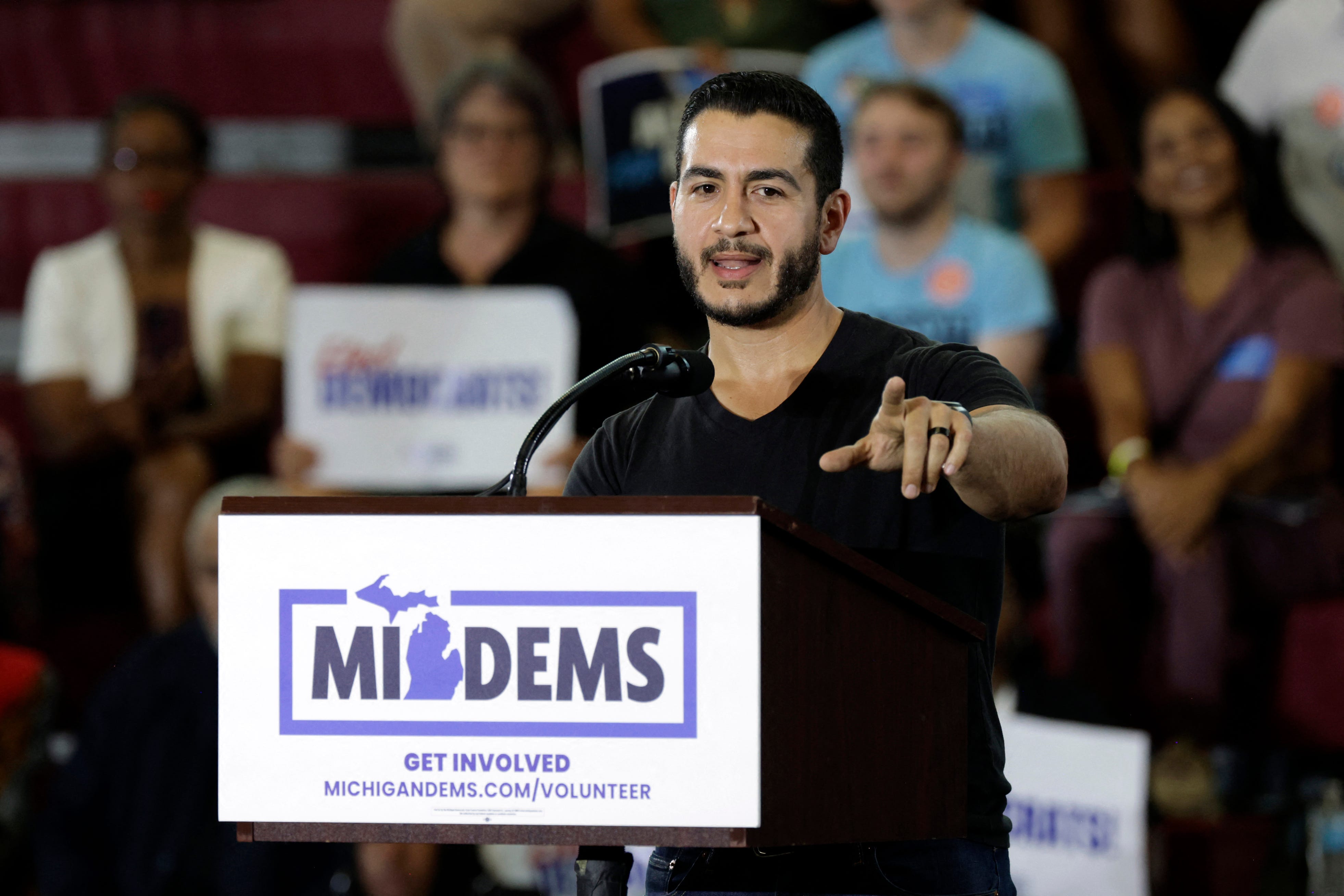
Since September of 2025, my number one anxiety about the midterm Senate map has been Michigan.
Gary Peters, the incumbent, is 67, which is like a teenager in Senator Years. He would have coasted to re-election in a favorable national political climate for Democrats. Republicans are opting to re-run Mike Rogers, who lost this seat two years ago when Donald Trump was popular and carried Michigan. Beating him when Trump has a 38 percent approval rating isn’t brain surgery.
And yet, as I wrote last fall:
The state I’m sweating is Michigan. I’d expect a generic Democrat to beat a generic Republican in a Trump midterm climate in this purple state. But the left is making a strong play to win this nomination with Abdul El-Sayed, who’s a very nice, very smart person, but I just see no reason to think that voters in this slightly red state are particularly excited about an unusually left-wing Democrat.
To make matters worse, the party establishment decided to line up behind Haley Stevens as the electable alternative. Stevens is an unremarkable mainstream House Democrat on ideology, but she has literally the worst wins-above-replacement (WAR) rating among the six House Democrats from Michigan.
I said back then that Mallory McMorrow would be the best option, but that obviously didn’t work out, and we ended up with the Stevens vs. El-Sayed showdown. It’s worth noting that while McMorrow was the best of the three candidates, there were easily a half-dozen potential nominees1 who at least on paper would have been better.
Dan Rosenheck from The Economist published a piece after the primary wrapped up concluding that El-Sayed is a very weak candidate, such that he thinks Michigan is now a coin toss despite the generic ballot’s distinct blue lean. Elliott Morris offered a counter-take that there’s no reason to believe Stevens would have done better than El-Sayed.
I think both of those takes are interesting but probably overstated by relying too heavily on polling done right at the apex of a very heated primary campaign.
Naturally, El-Sayed and Stevens slagging each other so relentlessly drove up negative sentiment toward both candidates and made them look weak. But within days of the primary wrapping up, Stevens was endorsing him, he was praising her, and the whole statewide ticket was doing a joint photo op.
It’s easy to lose sight of these things in the heat of the moment, but the reason the primary focused so heavily on Israel is that the policy differences between the left and center on 97 percent of issues are either small or unclear. The left has won a lot of notable primary victories against politicians (Diana DeGette, Dan Goldman, Adriano Espaillat) who were not clearly differentiated from their opponent on non-Israel issues. That’s a fascinating trend that will irrevocably alter the U.S.-Israel relationship, but it doesn’t change the fact that most voters (and most politicians!) don’t care very much about this and it’s easy to patch things up.
My view from 50,000 feet is that our generic expectation should be that Stevens would have slightly underperformed a generic Democrat (which is to say she would have won easily) while El-Sayed will probably deliver an electoral performance similar to what we see from Alexandria Ocasio-Cortez (which is to say he’ll win narrowly). There are a million complications and nuances, and the future isn’t set in stone. But the Michigan primary essentially pitted a generic Democrat with slightly subpar communications skills against a charismatic Democrat with a leftist political identity, so that’s my baseline expectation.
And if El-Sayed maintains that political profile, my recommendation would be to vote for him but to save your donation money for more-aligned, more strategic candidates. Still, when I spoke with El-Sayed (admittedly, years ago), he was certainly better-informed about health policy than your average elected official. And if you’re going to have a left-wing political persona, health care and Israel are probably the two best issues to be identified with.
So I think if he’s smart and focused and disciplined and pragmatic, he can win over moderate voters and not only win the race but win soundly — the way you’d have expected a Peters or a Jocelyn Benson to win. And I think the smart play for people with moderate commitments is to neither freak out nor bend the knee but try to get to yes.
The promise of normie Muslim politics
I had a Bangladeshi-American friend in college who I thought of as one of the more politically conservative people I knew. He was religiously observant and very much sympathized with his small-business-owner parents’ perspective that red tape and government overregulation were big problems. He was friendly to immigrants, but this was the George W. Bush era so that didn’t mark him out. But he also had a kind of “pull yourself up by the bootstraps” worldview that you often see in second-generation immigrants.
So I was a little surprised to learn he had pretty far-left opinions about Israel.
But that was naive of me. Of course, religiously observant Muslim small-business owners have a lot of right-of-center political attitudes while also holding views that align with the American left on specific questions about Israel and racial profiling of Muslims. This is the reason the Black church has become a central pillar of the moderate wing of the Democratic Party.
And if you look at Zohran Mamdani’s tenure, I think a lot of his best moments are grounded in that kind of politics. He wants to remove regulatory burdens on food cart operators and has come around to taking crime seriously.
Of course, he’s operating in New York City, which is a much more left-wing jurisdiction than Michigan. But I think that just means El-Sayed would do well to lean harder into that kind of politics. What does the typical immigrant small-business owner think about shoplifting, for example? The question of whether we should take punishing property crimes seriously is exactly the kind of thing that doesn’t come up in Democratic primaries but that meaningfully contributes to swing voters’ concerns about Democrats. Most women who wear a headscarf (and most of their husbands) almost certainly have views on transgender issues that are closer to those of the median voter than to the views you often hear from Democratic politicians.
I think tennis star Coco Gauff just modeled a humane and common sense way to discuss the sports issue. And I think someone with El-Sayed’s profile and identity is ideally situated to sell the left on the idea that a broad populist political coalition can’t just slap away people with traditionalist views about gender — especially views that are shared by 60 percent of the public.
By the same token, second-generation immigrants like El-Sayed are perfectly situated to channel the normie moderate take that openness to immigration is good for the United States and that it should be orderly and lawful.
The Biden-era border chaos was a genuine failure, and the loss of control was a disservice to millions of lawful immigrants. We need to roll back the insanity and excess of the Trump era without re-opening the doors to unselective onrushes of asylum claims.
Perhaps El-Sayed doesn’t believe any of this stuff and would never say it in a million years. But these are all moderate views that don’t contradict what he outlined on the campaign trail and that seem authentic to his basic biography and identity.
Michigan First, not Palestine First
Then there’s Israel. I’ll note here that he had two different campaign messages on the topic, one good and one bad.
The good message was when he told Axios he was the most America First candidate in the race, because “when you keep our money here rather than sending it to some other country’s war machine, that’s America First.” He told Kaitlan Collins that he’s against unconditional military aid to Israel but would also apply that exact same standard to Egypt or Saudi Arabia or the United Arab Emirates “and that’s not because of a focus on what’s happening anywhere. [It’s because of] a focus on what’s happening here.” He noted that there are very poor neighborhoods in Michigan and they deserve the money more than those foreign countries.
This is a good message that’s correct on the merits. While I appreciate that pro-Israel groups have helped moderate Democrats win primaries, the standard pro-Israel view that the United States should donate billions of dollars’ worth of military equipment to Israel per year does not make sense.
The problem I have with El-Sayed on Israel is that this position he outlined to Axios is not actually what his position on the issue is. What he says on his website is that he wants an “immediate arms embargo on Israel” and to restore American funding of the United Nations Relief and Works Agency for Palestine Refugees in the Near East (UNRWA).
His ambiguity on this is not unique. The pro-Palestine advocacy movement as a whole makes a lot of hay out of opposition to American financial support for Israel, which they rightly identify as a political winner. But the movement is not a movement of budget hawks who want to reduce wasteful spending; it’s a movement that wants to do whatever it takes to achieve its vision of Palestinian liberation.
I don’t expect El-Sayed to change his convictions about this.
But he should recognize that he won the argument against AIPAC-backed Stevens with the message that he was going to focus on solving Michigan’s problems. He’s going to face another cavalcade of AIPAC money, this time with an electorate that’s less sympathetic to Palestinians’ situation than the one he faced in the primary.
He’s going to need to push back on that money with the argument that AIPAC is pernicious and advocates for bad policies. His best argument will, once again, be the America First / solve problems at home message. Anything he can do to purge his official communications of any commitment to do anything other than prevent American tax dollars from flowing to a foreign government will help him. And because the policy he pretends to have happens to be a lot smarter and more convincing than the policy on his website, I kind of think that if he repeats it enough, he’ll talk himself into it.
El-Sayed is running to solve Michigan’s problems, not Palestine’s. That’s a viable basis for a détente between Jewish and Muslim Democrats that will let us focus on our shared interest in pluralism at home.
A permission structure on health care
The single most important thing that El-Sayed can do to win moderate support is to leverage his credibility with the left into ending the destructive Medicare for All wars that have paralyzed the Democratic Party for the past 15 years.
For a long time now, the vast majority of Democrats have agreed that the party should move in the direction of expanded public provision of health insurance. And they have also agreed that it is extremely unlikely that the country is going to have a rapid big-bang transition to a Canadian-style single-payer health system, as El-Sayed himself said to Jonathan Cohn.


And yet in every concrete case, leftists have absolutely savaged non-leftists who put incremental ideas on the table, including even transformative ones like Pete Buttigieg’s Medicare for All Who Want It. They also (and El-Sayed has been complicit in this) insist on labeling all disagreement with the extremely specific details of the Medicare for All Act as motivated by corruption, even though the law describes a future American health-care system that would be totally unlike the systems that actually exist in Canada or any European country. This has made it extremely difficult for Democrats to come together around specific pieces of legislation that frontliners want to support.
That framing also elides the main issue here, which is that the political process has limited bandwidth for competing priorities.
There was a broad consensus on the left in 2021 that climate had to be the top priority for new spending, which naturally limited the resources available to health care. This kind of prioritization conversation is important, and I am happy to pledge my allegiance to anyone whose enthusiasm for Medicare for All means enthusiasm for health care as a progressive priority ahead in line of climate spending. That opens the door to moderate-friendly ideas like “advance clean energy with permitting reform even though that’s not greens’ first choice” and “acknowledge that there probably won’t be sweeping ICE legislation, so the 2029 immigration agenda needs to focus on strategic redeployment.”
The point is, if El-Sayed can create a permission structure for characterizing “Medicare for All” as an aspirational statement of values rather than a specific piece of legislation, he will be doing a tremendous favor to all kinds of center-left Democrats in a way that will make moderates want him to win.
Alternatively, if he continues the double game where he personally can be incremental about this but anyone else who acts that way is a pawn of the billionaire class, he’ll make people angry.
Make people want you to win
There was a kind of ebullience in moderate circles when Graham Platner’s campaign imploded, even though the result was replacing him with Troy Jackson, who has all the same policy views. The difference is that there was clearly a plan by national factional actors to leverage Platner winning, if it happened, into a campaign against other Democrats. Platner could not or would not see that, having won his primary, his interests would be best served by unifying Maine Democrats behind him rather than acting as a factional tool.
El-Sayed’s eagerness to participate in post-primary unity gestures is a positive sign in this regard.
A primary is a primary, and it’s totally fair to fight hard in one. But the best case for him is to create a situation in which moderate Democrats aren’t privately half-hoping that Dems win in Iowa and Texas while losing Michigan, just to teach the left a lesson. Moderate Democrats shouldn’t want that outcome and I’d like everyone to get to yes here.
The biggest way to accomplish that is to be nice. Campaign with Gretchen Whitmer and Elissa Slotkin instead of Hasan Piker. Articulate a moderate view or two on something outside the pillars of the campaign. Say the words “big tent” at some point. Acknowledge, privately but clearly, that a candidate who wants financial support from the D.S.C.C. and the Senate Majority PAC is going to need to participate in normal fundraising — that you can’t spend all your time antagonizing Democratic donors and then expect their money.
Most people who work in politics are, in practice, extremely partisan. If you don’t deliberately antagonize them, it’s relatively easy to consolidate support within the party. These primaries are also fought out on relatively narrow grounds. The questions related to Israel and health care are genuinely not the issues where moderating has the most electoral value. As a factional hero, El-Sayed has a lot of running room to move to the center on other topics while minimizing backlash. He should seize the opportunity and make himself a broadly admired and well-liked figure in the party.
That’s Peters himself, Governor Gretchen Whitmer (who’s leaving politics), Attorney General Dana Nessel (also leaving politics), Secretary of State Jocelyn Benson (running for governor), Lieutenant Governor Garlin Gilchrist (running for secretary of state), and WAR superstar Kristen McDonald Rivet (staying in the House).
El Sayed sympathizing with someone who drove his car into a synagogue with children inside is a Michigan issue, not a “Palestine” issue.
Matt writes: "the reason the primary focused so heavily on Israel is that the policy differences between the left and center on 97 percent of issues are either small or unclear."
Respectfully, I disagree. And I'm not sure Matt even believes that statement. Most of the rest of the essay reads like Matt is trying to convince El-Sayed and the DSA to say different things than they believe.
Trump is doing significant damage, but he is going to be gone in 2 years and most of what he is doing can be fixed relatively easily. However, El-Sayed and the DSA will do significant damage by design (IMO) as I do not believe they share my view of the American government and our interests at home and abroad.
I do not want to turn over the Democratic Party to them and I think Matt is making a mistake by trying to sane-wash their positions.