


The people have been clamoring for updated Slow Boring donation recommendations, and today we’re delivering. This was a little slow to come together because we were waiting for a certain number of primaries to resolve themselves and because multiple rounds of redistricting drama have kept reshaping the map.
The key thing to keep in mind as you think about this election is the post-Callais, post-Virginia gerrymandering situation. House Democrats are facing a formidable set of skewed maps in the 2026 cycle, but they also have the national political winds at their back and will very likely win a majority.
The real risk is that the maps will make this House majority extremely fragile in 2028 and 2030. To fight that, Democrats need to do a few things:
They need to perform well in critical state-level elections to prevent the maps from getting even worse in 2028 and ideally to implement countermeasures in a few states.
They also need smart candidates in frontline races — not just candidates who can coast to victory when the political climate is favorable, but discerning winners who make smart decisions and can win tough races under difficult circumstances.
Finally, when Democrats put together their inevitable political-reform package (if they hold Congress in 2029), they need to make smart decisions about what to prioritize and not just re-run the fiasco of 2021.
The last part is beyond the scope of this particular exercise, but our donation recommendations are aimed at helping with the first two.
Of course, we also care about the United States Senate. Those races are ranked a little lower in our specific donation priorities because small-dollar contributions are more useful the further down the ballot you go. I would like Sherrod Brown and James Talarico to win their Senate races, but they should have plenty of money. We’ve got two Senate recommendations and are mostly trying to emphasize races that may fall between the cracks.
You can see the donation page for the candidates here.
Update on November’s slate
We made a set of recommendations last November, trying to get involved in primaries earlier and wield more strategic influence. This was a riskier, higher leverage play that involved backing some candidates — like Jasmeet Bains in CA-22 and Geoff Duncan in the Georgia gubernatorial primary — who ended up losing their primaries.
Others from our list, notably Bobby Pulido, Ben McAdams, and Anita Earls, won. Seth Moulton is still running in the Massachusetts Senate race and I would still recommend voting for him, but he has not embraced a campaign message that would make him worthy of inclusion on this list.
Some of our November recommendations — such as Rebecca Cooke and Kris Mayes — are now in more financially secure situations and/or the shifting maps have made their races easy wins. Others continue to be underfunded relative to their race’s competitiveness and strategic value and have been rolled into the new slate. So with the exception of Moulton, don’t take non-inclusion of previously recommended candidates as negative judgements. In many cases, early support from this community was crucial in putting them in position to win; we’re just trying to be rigorous about setting priorities in terms of who really needs help at the margin.
Ongoing investments
Bobby Pulido (U.S. House, TX-15)
Leading the list of ongoing investments is Pulido. An award-winning Tejano musician with a moderate message well-suited to his district, he stands a realistic chance of beating Monica De La Cruz in a seat that went for Trump by nearly 20 points.
I’ve met Pulido a couple of times and like him a lot. I think he not only has a shot at winning but at being the kind of winner who really makes a difference. His career in music gives him name recognition in South Texas, and even though he’s not a well-known personality in the Anglo community, he has real charisma and stage presence that come across immediately. Common Sense Democrats have a decent number of champions in the House, but we don’t have a star. Pulido could be that star if he wins.
Anita Earls (North Carolina Supreme Court)
Two years ago, Slow Boring readers put more than $50,000 behind Allison Riggs, who held her North Carolina Supreme Court seat by fewer than 1,000 votes. That was a key step in a multicycle effort to flip control of the state’s Supreme Court. North Carolina has a set of smart moderate Democrats led by former Governor (and soon to be Senator) Roy Cooper, Governor Josh Stein, and Attorney General Jeff Jackson. But the state legislature features lopsided Republican majorities thanks to viciously gerrymandered maps, and G.O.P. lawmakers use those majorities to gerrymander the congressional maps.
Earls is one of only two Democrats on the seven-member court. If Democrats can flip the court over time, they can break these gerrymanders and allow Cooper / Stein / Jackson-style politics — and basic democracy — to flourish.
Josh Turek (U.S. Senate, Iowa)
Turek is a two-time Paralympic gold medalist who flipped and held the reddest state legislative seat represented by any Iowa Democrat, winning it by just six votes in 2022. We recommended support for him back in November ahead of his June primary, in which he defeated State Senator Zach Wahls. As a recruiting method, “find candidates who overperform down-ballot and nominate them for higher office” continues to be underrated compared to outlandish gambits because it involves acknowledging realities that the national progressive infrastructure doesn’t always love, like the fact that moderates do better. The race against Wahls generated some ill will, but Turek was the right choice, and polls show a tight race with Republican Ashley Hinson. Turek winning would be great on its own terms, but it would also point toward a broadly smarter approach to politics.
United States Senate
Mary Peltola (Alaska)
Mary Peltola is a longtime Slow Boring favorite. She’s Chuck Schumer’s best recruit of the cycle and has a strong brand as a Democrat willing to buck the party’s national consensus on energy issues. But as much as I appreciate Schumer’s wisdom in recruiting Peltola, what would be more helpful than any amount of money would be for Schumer to publicly affirm that Democrats will leave questions about managing Alaska’s natural resources in the hands of Alaskans rather than repeating the Biden administration experience of deferring to out-of-state environmentalists. For now, though, said environmentalists are the largest single donor bloc in the Democratic Party, and candidates who challenge their ideas to win tough races need our help.
Good House recruits
Bill Hill (Alaska at-large)
I’ve fallen a bit out of love with the gambit of running independents in places where the national Democratic Party brand is toxic. But Alaska’s unique electoral system makes this the place where that strategy actually makes sense. Hill is a Bristol Bay commercial fisherman and former school superintendent who in his launch cited former Representative Don Young as an inspiration. He’s outraised the Anchorage Democrat in the race and has a good profile for winning statewide. This is a case where it’s important to think about 2028 when making moves in 2026. It is possible that the leading Democrat in the field, Matt Schultz, could win this race narrowly in a favorable climate. But Hill would not only have better odds of winning in November — he’d also have dramatically better odds of actually holding the seat in 2028.
Hill and Schultz will both almost certainly advance to the second round in Alaska’s top-four system, but ranking Hill above Schultz in the ranked-choice showdown is critical.
Johnny Garcia (TX-35)
I love this guy. He’s a Bexar County sheriff’s deputy and self-described “old-school” Democrat who’s taking on a challenging race that Greg Casar vacated post-gerrymander in favor of running in a super-blue Austin seat. I would love for Garcia to win not just because I like him and want him to win the seat, but also because of the message that contrast would deliver. It would be especially cool to see Garcia and Pulido join Henry Cuellar and Vicente Gonzalez to form a bloc of moderate Texas Latinos who could reset the whole narrative around what’s happening with this critical demographic.
This race is also notable because Republicans put a ton of money into the primary to try to boost an antisemitic conspiracy theorist as the true progressive in the race because they were hoping her nomination would embarrass Democrats nationally. Progressives did the right thing and rallied to support the moderate Garcia over the G.O.P. plant. But they’re not genuinely enthusiastic about Garcia and this is a stretch race, so he needs our support to actually win the general election.
Don Davis (NC-01)
Davis is often mentioned in Slow Boring articles as an example of an electoral over-performer, even though he didn’t previously have a pivotal frontline seat. But North Carolina Republicans took advantage of the gutting of the Voting Rights Act to redraw him into an R+12 district. I think they were hoping Davis would retire, and he deserves credit for fighting instead. He’s always been a solid politician, and I think he understands what it takes to win a tough race — for example, he signed on to the Promise to America to build his brand as a moderate Democrat.
Manny Rutinel (CO-08)
Rutinel won a competitive Democratic primary to face off against Republican incumbent Gabe Evans in a tough race. He’s got a pretty progressive record in the Colorado legislature but has been smart about trying to elevate into a swing district, embracing an all-of-the-above energy message, opposing a fracking ban, calling for a targeted form of student debt forgiveness, and recalibrating his health care message toward a public option. I just like him a lot on the merits — he’s been a leader on A.I. safety and YIMBYism, and it’s good to have champions on those issues in Congress.
Lindsay James (IA-2)
Democrats have a good shot not only at the aforementioned Senate race in Iowa but also at the governor’s mansion and three of the four House seats. Rob Sand, the Dem gubernatorial nominee, has very solid fundraising, as do two of the Democrats’ three House candidates. James is the exception with just $434,000 in cash on hand. Slow Boring donors have a chance to be real difference-makers in this race.
Bale Dalton (FL-7)
A Navy captain and former NASA chief of staff running with the support of the Blue Dog PAC, Dalton is exactly the kind of nominee you want in this tough race. But he’s facing a contested primary featuring, among other people, former Congressman Alan Grayson, a progressive firebrand who can self-fund. If Democrats are going to have a shot at winning the general, Dalton needs money, and he especially needs it from people who will specifically say they like him because he’s the moderate in the field so that he knows to stick to his guns.
Two governors in key states
Keisha Lance Bottoms (Georgia)
Bottoms was not the strategic choice for Georgia primary voters to make. But to her credit, she not only won in a landslide but did so on a perfectly reasonable platform emphasizing Medicaid expansion and preschool access. Georgia has a conservative governance history and an entrenched G.O.P. majority in the state legislature, so there’s no substantive reason for moderates to worry about Bottoms. And beyond the specific stakes for health insurance for low-income Georgians, the national implications of this race are large. If Republicans win, they’ll likely re-gerrymander the state and eliminate Democratic House seats. They may also become complicit in future Trump election-stealing schemes. And if you’re intrigued by the possibility of Jon Ossoff on a national ticket, Democrats need to win this race, or his elevation would entail losing a Senate seat.
Pivotal state legislative seats
The final three recommendations are underfunded candidates in competitive state legislative races, all in chambers that The States Project has identified as pivotal to redistricting:
Eileen Hartnett Albillar, the Bucks County clerk of courts, is challenging Republican State Senator Frank Farry in Pennsylvania’s Sixth Senate District.
Sara Agerton, a Mechanicsburg Borough Council member, is making her third run at Pennsylvania House District 88 after coming closer than any Democrat in over a decade.
John Kroll, a Marathon County supervisor, is challenging Republican State Representative Pat Snyder in Wisconsin’s Assembly District 85.
Democratic trifectas in both Pennsylvania and Wisconsin would likely be able to draw new maps that could net Democrats at least two congressional seats, somewhat narrowing the G.O.P. skew of the House map. There are other opportunities around the country to try to bring things closer to parity, but they involve winning ballot initiatives (New York) or dealing with uncooperative state courts (Virginia, Colorado) or overcoming recalcitrant Democratic incumbents (Maryland) or competing in places that don’t really offer high-leverage opportunities for political contributions (Minnesota).
I really don’t care for the tit-for-tat gerrymandering game and think a national solution should be an urgent priority for future federal legislation. But the only way out is through, and we can’t allow MAGA to maintain incredibly skewed maps through unilateral disarmament.
How to support these candidates
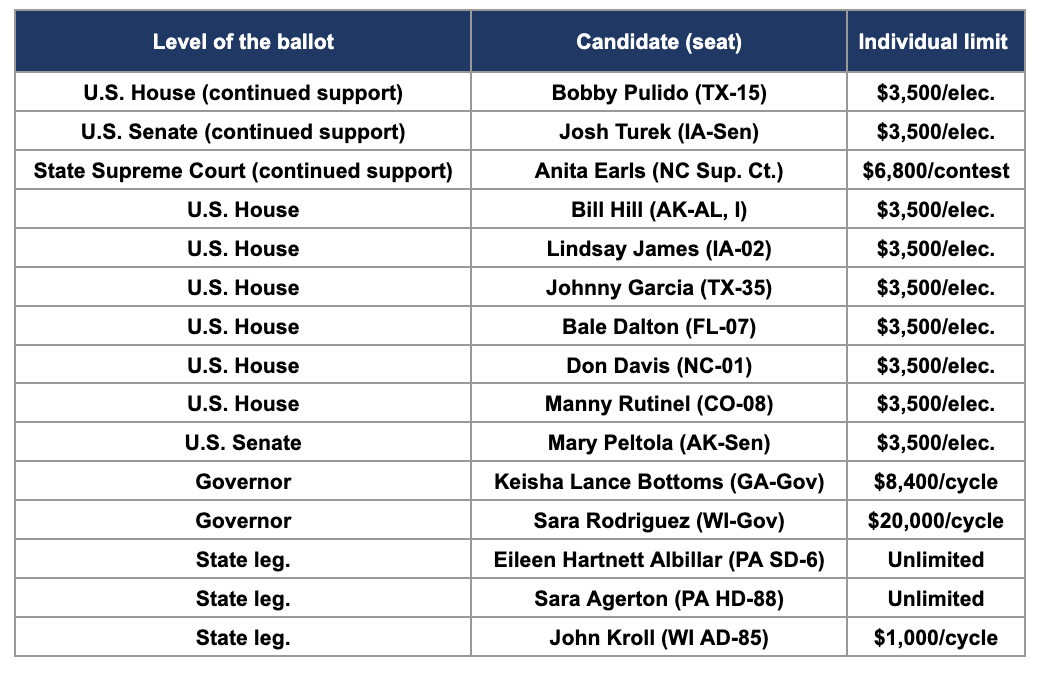
Once again, here is the page to donate, with options to pick individual races or split evenly across the slate. Here are the individual limits for each of the races we’re recommending:
Done! Donated to frontline southern House Dems and Anita Earls. Let's bore those hard boards!
> Bill Hill (Alaska at-large)
Bill Hill? Author of the well received Bill Hilly Elegy??