

We don’t know exactly what the future holds, but if the current polling is even approximately accurate, then Democrats are going to have a very good election night.
That’s good for America and for the world, but it also raises the risk of an undue level of complacency.
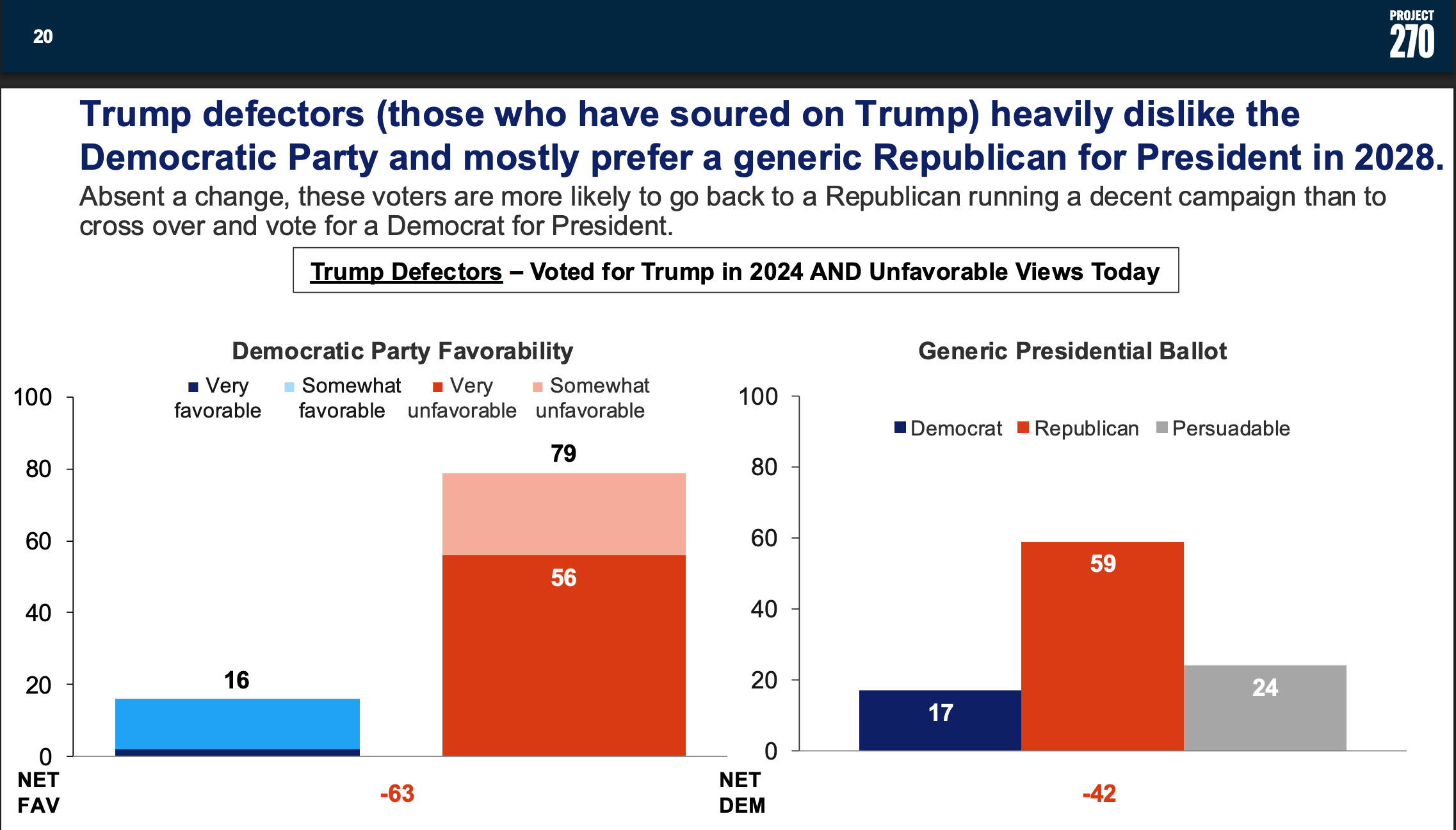
Trump starting a war with Iran that spiked the price of energy was a wild unforced error, but you can’t count on electoral gifts of that scale falling into your lap every cycle. And it’s worth taking seriously a recent Project 270 finding that of 2024 Trump voters who currently have an unfavorable view of the president, a large majority say they still plan to vote Republican in 2028.
This is just to say I think we should take the risk of complacency seriously.
Complacency, I think, is what killed Donald Trump and the MAGA movement’s moment of opportunity. Anger about inflation and border chaos pushed a lot of voters to Trump in 2024 — including lots of younger people and nonwhite people who were once seen as unwinnable by Republicans. But the GOP pocketed those voters, didn’t actually do anything on inflation, and pissed a lot of people off with a very ideological agenda.
Now voters are shifting back by default to the other political party, and I’m worried it’ll lead progressive elites to blow off the idea that there was ever any need to rethink anything.
On the other hand, I read doomer stuff like this from Ruy Teixeira about how Democrats are “deluded” and have fixed nothing, and I think he’s being both analytically wrong and counterproductive in terms of fighting complacency:
Many Democrats are giddy about the likely thumping of Trump and the GOP. The 2024 debacle is fast fading from memory. Between the adoption of the “affordability” campaign trope, a ratcheting up of populist rhetoric, and a carefully curated dose of “heterodoxy” in key races, they are convinced they have found the winning formula to take down the unpopular Trump and his party. The necessary reforms and repositioning have taken place; a “wave” election awaits. Problem solved!
I beg to differ. Here are three reasons they’re deluding themselves.
I think it’s important to understand this in terms of Teixeira’s longer-running dispute with Adam Jentleson and his colleagues at the Searchlight Institute about heterodoxy as a path forward for Democrats. I like both Adam and Ruy, and I think that relative to the bulk of Democrats they are both on the same side, and it’s unfortunate that this has become a narcissism of small differences scenario where they’re feuding rather than cooperating.
I’m half inclined to say that we’re really just watching a dispute over whether the glass is half full or half empty. But really, Teixeira is closer to insisting that the glass is completely empty, even though he acknowledges that James Talarico, Josh Turek, and Mary Peltola have all engaged in a lot of Teixeira-recommended moves to the center.
He dismisses this as inconsequential because Talarico’s current positioning is not entirely congruent with his record. But I think that’s precisely why it’s important to say the glass is half full.
If moderates concede in advance that Democratic gestures toward heterodoxy are trivial or unimportant, then the party as a whole will end up in the delusional failure mode.
The truth is that Democrats have made meaningful gestures, and those gestures have had a real impact on voters. Gestures, though, are necessarily limited in their impact because voters are cynical about politics and politicians. What Democrats need to do is try hard to win, and then if they do win, follow up on their wins by governing in line with the best versions of themselves. There will be a lot of institutional pressure on them to not do that, but the way to fight that pressure is to remember the gestures they made and their importance.
BAAJA in the balance
I would say the best evidence of both real change and also its limits comes from something that Teixeira doesn’t talk about at all: the Bipartisan American Affordability and Jobs Act.
BAAJA, the permitting reform bill, is long and complicated. If you want to learn more about the details, I would recommend reading briefings from Third Way and Searchlight and listening to what Daniel Palken from Arnold Ventures told The Argument’s Milan Singh. Or you could read Baillee Brown from the Inclusive Abundance Initiative or the Niskanen Center writeup or this collection of links from the Abundance & Growth team at Coefficient Giving.
But if you’re at all familiar with those institutions, it’s immediately obvious that the people hailing this legislation are from the “abundance” faction of the Democratic Party.
That’s great. What’s especially great about BAAJA, though, is that while it’s enthusiastically embraced by Josh Harder and the Build America Caucus, it’s not limited to a niche sect of elected Democrats. It was negotiated by Martin Heinrich and Sheldon Whitehouse, two of the senate’s longtime climate champions. Three years ago, Teixeira wrote his three point plan to fix the Democrats and point two was “Democrats must promote an abundance agenda.”
Well, guess what? Leading Democrats are, in fact, promoting an abundance agenda.
But here’s why I think the glass is only half full on energy. From what I understand based on talking to various people who are in the relevant meetings, most of the discussion inside the caucus is purely about climate politics. Everyone is trying to manage their stakeholders, and a great deal of emphasis is on an effort to get the major green groups to stay neutral on this legislation.
In a full glass universe, Chuck Schumer and Brian Schatz would just say to the greens, “Look, I get that this is a mixed bag from your viewpoint, but when you consider the obvious affordability and national security benefits, it’s a total no-brainer and we’re going to do it no matter what you say.” What we have instead is a glass half empty , where they want to take an abundance approach to energy but they also want to be maximally agreeable about it. The climate people still seem to have the upper hand in intra-party debates and the only reason an abundance approach has a shot is that it genuinely makes more sense as climate policy.
But the most important thing is the policy choices, and there’s been a tremendous evolution in the direction of reality-based energy policy, both in terms of the views that Democrats’ frontline recruits have articulated but also in terms of what mainline Democrats seem prepared to do with BAAJA. This is a big deal and worth celebrating.
The cultural mainstream
Teixeira’s point one, “Democrats Must Move to the Center on Cultural Issues,” is more of a mixed bag than abundance.
But in his new piece, Teixeira refuses to give (or take!) any credit at all. He for example doesn’t mention crime at all, except to quote a piece by Dustin Guastella that says reducing crime is the only non-economic issue that ranks as a high priority for working class voters. This is a good point! And it’s worth observing that not moderate Democrats, not mainstream Democrats, but progressive hero Zohran Mamdani has executed a gigantic turnabout on law and order issues as part of his political success. Nithya Raman, running for mayor of Los Angeles on a similar left-YIMBY political platform has been trying to execute a similar pivot, but has been less deft about pulling it off.
In less-lefty precincts of the party, we have Sherrod Brown winning a police union endorsement and actual cop Johnny Garcia as a prized recruit in Texas. There are thirteen senate Democrats cosponsoring a bill to crack down on organized retail theft. It’s been years since anyone who matters in politics was going with the line that policing isn’t an important part of controlling crime.
As someone who took a lot of shit from a lot of people for standing up for common sense on this issue when it was unfashionable, I 100 percent understand the impulse to feel a little churlish about this. Exactly zero people have apologized to me for the shit they gave me. When leftists write articles claiming I’ve been “wrong about everything,” they don’t even put in a to-be-sure graf that’s like “well he was at least right about the politics of defunding the police, as shown by the fact that even Mamdani now agrees with him.” I am annoyed by this! But it’s insane to deny that there’s been a huge shift. We won the argument!
Teixeira notes that Talarico’s moderation on the sex-segregated sports has been a little bit half-hearted. That’s true! But half-hearted moderation is more than anyone was doing in the 2022 or 2024 cycles. And others — Turek, Rob Sand, Amy Acton — have gone further.
What’s even more significant is governance. Abigail Spanberger has managed to serve for a year as governor of Virginia while kind of quietly allowing the Youngkin-era approach to this to stay in place. It’s unclear where Democrats are going to land on these issues — I feel like most in the party are not actually aware that they “shot first” by trying to issue mandatory trans inclusion rules and that “let individual leagues decide” is actually a major moderation.
But the relevant point is that it’s a topic of debate; the era of delusion is over. Now we’re just going to have to see where things actually land.
Known unknowns
My biggest question for the future is about immigration. Here it seems to me that two things have happened simultaneously:
It is universally acknowledged that the Biden border situation was fucked up and unacceptable. By the end of Biden’s term, Democrats were all excited for him to issue executive orders clamping down.
Democrats have been radicalized against ICE as an institution.
One certainly can make these two points cohere, but there are genuine tensions. I think what most Democrats want, subjectively, is for the border to become an impermeable force field such that it’s literally impossible for anyone to cross without proper authorization. Then with force field in place, we can go really easy on everyone who’s already inside the country — deport them if they’re convicted of crimes, but if they seem like basically sympathetic people, let them stay. I understand the appeal of this force field approach to immigration, and it very much aligns with my moral intuitions.
The problem is that you literally cannot do this. There is no force field.
This is one of a number of issues — along with basic economic management — where the political question facing Democrats is not really one of finding the right message but one of regaining some measure of credibility with the public.
The only way to accomplish that is to actually win an election and then do a good job. It’s clearly possible to back off Trump’s assault on high-skill legal immigration without losing control of the border. It also should be possible to back away from draconian interior enforcement without losing control of the border. But will the next administration actually pull that off? Voters, reasonably, have some doubts, and the only way to dispel those doubts is going to be to actually do it.
A debate not a delusion
There’s a lot I agree with Teixeira about. The risk of complacency in the wake of a good election result is real.
A contrary risk is that the polls are slightly overstating Democratic strength, the real generic ballot is D+6 instead of D+9, Talarico and Turek end up losing narrowly rather than winning narrowly, and leftists say “see they moderated and it didn’t work, but El-Sayed won.” The left ecosystem is frequently dishonest in their presentation of election results, and I worry about this a lot.
I also worry about the genuine collapse of patriotic sentiments among rank-and-file Democrats, which is hard to deal with because you can’t really just decide tactically to love your country.
Teixeira is also right that a big chunk of the party is genuinely deluded into thinking that if you promise everyone more populist economic policy, they’ll just turn off their brains and stop caring that you want to ban plastic straws and let tons of refugees into the country.
Last but not least, I agree that “heterodoxy” as a solution is a bit overrated. It’s good to recruit good candidates to run in the pivotal senate races. But it would be a lot better for the caucus as a whole to accept that American politics is now quasi-parliamentary and it’s the job of every single Democratic Party senator to say and do things that are helpful to winning Alaska, Iowa, Texas, Kansas, Florida, and North Carolina. But heterodoxy is still a big improvement over rigid orthodoxy!
I would say we have a party that is not deluded but debating its future. That’s normal. It would be bad to get complacent about a good midterm result when the party’s overall national image remains in the toilet.
On the other hand, I don’t think it’s realistic to change the overall national image without having a presidential nominee. You need to set a realistic bar. We are seeing in the campaigns which issue-positions make you look better than a generic Democrat and which make you look worse. The task of advocates for common sense shouldn’t be to blindly cheer, but it also can’t be to just doom and complain. Lots of good things are out there happening, and we need to build on them.
Its interesting that progressives are so invested in believing that culture war issues are entirely pushed by the right, and that they were innocently standing there, and never "shot first". By its nature, progressivism is the one challenging the status quo, and pushing for change. Sometimes thats the right thing to do. There are plenty of injustices in the world that need to be challenged. But the need to believe the pushback is coming from out of the blue, and not in response to something they actively did, is bizarre to me.
If Democrats win both houses of Congress, Trump and Democratic frontliners will keep them from passing anything too stupid. The bigger risk is the presidential primary.
My hope is that Ossoff wins a crushing victory in Georgia, one that makes it clear he would also carry North Carolina. That is a compelling electoral case, one progressives will have a hard time obfuscating. Newsom and Harris have never won a race of their own outside California, and AOC represents a freakishly progressive district in Queens. The presidential nominee is the face of the party to low-information voters. A Jewish moderate who wins Fayette County and holds Republicans under 20 point margins in Cherokee and Forsyth would be an electoral juggernaut.
On the Republican side, Kemp would be an excellent nominee. If the federal government were run as efficiently and pragmatically as Georgia, it could be morning in America