

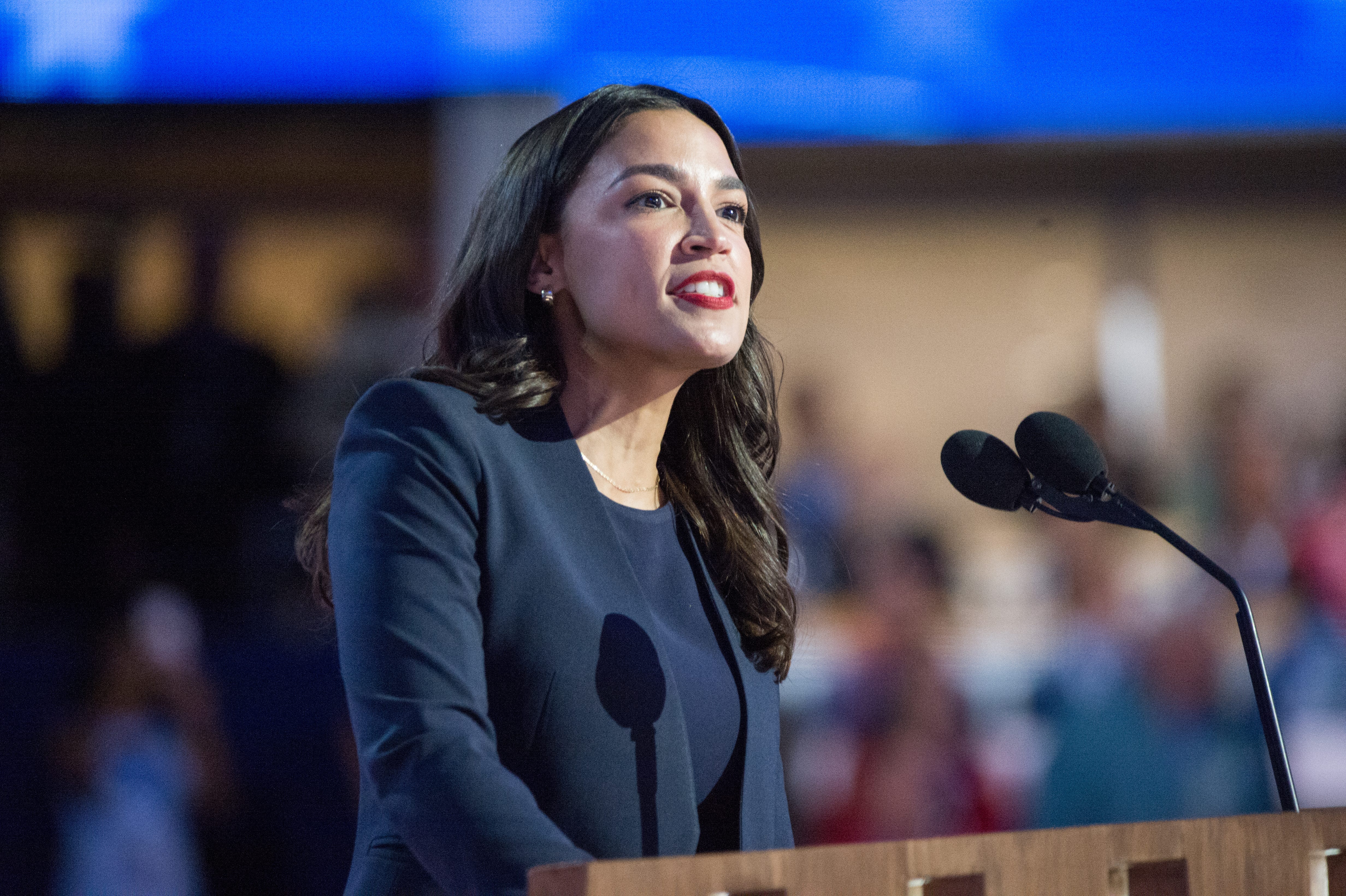
I went to Third Way’s conference in Charleston last week and thought it was a mostly great event. Bigger than last year’s iteration, it reflected the growing determination among moderate Democrats to roll up their sleeves, get organized, and do the work of building factional power.
But the headline for Holly Otterbein’s writeup of the conference for Axios captured a side of this organizing that I don’t like: “Centrist Dems Launch ‘28 Mission: Stop A.O.C.”
I do not think that Alexandria Ocasio-Cortez should be the Democratic Party’s nominee in 2028. She represents a safe blue seat, maintains a political profile as a left-wing factional actor, and is an electoral under-performer. And there’s just nothing about that resume that makes a compelling case for 2028.
At the same time, “Stop A.O.C.” is absolutely not my mission for the 2028 primary.
After all, right now the front-runner for the 2028 nomination is Gavin Newsom. If you think that A.O.C. is the problem facing the Democratic Party and that stopping her is the most important mission in politics, then all you really need to do is line up behind the front-runner and help him win, just the way that Hillary Clinton and Joe Biden won the nominations in 2016 and 2020.
But is Newsom the answer to Democrats’ political problems? I don’t think so. I think he is emblematic of their problems. Notably his career has run on a parallel track to Kamala Harris’s, and he has responded to many of the same political pressures she did to rise to the top of the California Democratic Party. I know a lot of people think that as a white man who enjoys mixing it up on podcasts, he’s totally different from Harris. But not only are their records similar, he is a certified electoral under-performer across his statewide races.
There are things that I like about Newsom and could say on his behalf. But fundamentally it’s people like him — the establishment, mainstream wing of the party — who are the problem. I don’t think A.O.C. is the solution, but if you define her as the problem, then Newsom and the status quo establishment suggest themselves as the solution, which is wrong.
The party needs to change, which means you can’t just rally around the establishment.
Centrist Democrats keep expressing doublethink about this because they know the problem is that Democrats have gotten too left-wing, and they know on some level that the actions of left-wing factionalists are to blame for this. But the dissonance sets in because it’s not like left-wing factionalists have taken over. Bernie lost. Biden passed the torch seamlessly to Kamala Harris while avoiding a primary that would have given the left a chance for a breakthrough.
The problem is that these mainstream figures embraced ideas that are too left-wing and also — here’s something that I maybe don’t talk about enough — largely stopped putting forward affirmative reformist ideas of their own.
It’s true in a sense that the actions of left-wing factionalists are responsible for this shift. But the mechanism is that sensible, pragmatic politicians decided that the sensible, pragmatic thing to do was shift left to avoid losing power to the left.
And if moderates and pragmatists want to break that cycle, we need to drop the obsession with boxing the left out and start just trying to articulate our ideas.
Lock up criminals, not razor blades
I’d never been to Charleston before, but it’s a beautiful historic city with a walkable downtown featuring the kind of traditional urbanism that’s relatively rare in the South.
One place I walked while enjoying the walkable urbanism was a Walgreens, where I needed to buy some razor blades. I was mildly surprised to see that in the Charleston Walgreens, you could just grab razor blades off the shelf without needing to ask a staff member to open a locked cabinet.
There was some stuff locked up in the Charleston Walgreens, notably electric razors and some other high-value items.
But there were dramatically fewer anti-shoplifting mitigations than I see in my local drug stores in D.C. Because, presumably, Charleston has done a better job of deterring shoplifters.
Over in California, meanwhile, a 2014 ballot initiative reclassified a number of felonies as misdemeanors in an effort to reduce penalties and incarceration. This seems to have mostly worked out fine, but one consequence of reducing the penalty for shoplifting was to encourage the formation of organized retail-theft crews.
Voters, sensibly, did not like this and in 2024 a new ballot initiative, Proposition 36, passed and made repeat shoplifting a felony offense. So if you get arrested one time trying to pocket something at the store, you’re still not going to be hit with a life-altering felony charge. Going easy on first-time non-violent offenders seems to be best practice according to the evidence. But if you’re caught repeatedly — because, say, you are actually making a living in a shoplifting crew — you’re going to do meaningful time.
These are commonsense, evidence-based ideas that also happen to reflect the policy status quo in South Carolina. The initiative passed with about 70 percent of the vote in 2024. A basically happy story!
But look at what the state’s politicians were doing. Seemingly in response to concern that an increase in felony convictions would lead to an increase in deportations, the initiative was opposed by many of the state’s elected officials, including U.S. Senator Alex Padilla and the aforementioned Newsom. Newsom was also on the losing side of a ballot initiative landslide in 2020 when California progressives tried and failed to bring back race-conscious admissions in the University of California. So what the California system ended up doing instead was phasing out the use of SAT and ACT scores in admissions.
I don’t know how salient any of this will be in a 2028 campaign. But I do know a lot of centrist Democrats, and I know that these issues — public safety, education, identity politics, and especially the interaction of identity politics with public safety and education — are where they feel the party tends to go astray on the merits. Which is exactly why Newsom — not A.O.C., Newsom — found himself on the wrong side of the California electorate on these topics.
Don’t just bandwagon — stand and fight
That’s not to say I want to obsessively slag on Newsom. If you understand the political landscape in California, the reality is that he’s often been on the side of the angels in battles with the legislature when the stakes are high. He’s made a second-term conversion to housing abundance and done some things that I believe will have major positive long-term impacts. He’s made some efforts to reposition himself toward the center on cultural issues.
I’m just saying that if you define the main problem of Democratic Party politics as “We need to stop A.O.C.,” then the easiest way to achieve that is for moderate Democrats to bandwagon behind Newsom, who is currently leading.
And with moderates already in his back pocket, the best strategy for Newsom is to box A.O.C. out by pandering to the left. This has a strong chance of working, just as it worked for Hillary Clinton when she hit Bernie Sanders from the left on guns, immigration, and identity issues while abandoning Barack Obama’s record on education reform, free trade, and energy. It worked for Joe Biden to stick with Clinton’s positions on those issues rather than revert to the Obama-Biden administration’s policies while disavowing his own crime bill from the 1990s and apologizing for the administration’s approach to immigration enforcement.
But what is the point, from a centrist Dem perspective, of continually boxing out the left in this way?
Now, obviously, on some level, moderates and pragmatists and popularists need to be meta-pragmatic and not push 2028 contenders to be so moderate that they stand no chance of winning the primary.
But if we think the Biden administration was excessively deferential to the groups and that California and other deep-blue states are profoundly in need of reform, then we can’t be so terrified of A.O.C. that we forget to say those things. And I think, in fact, we need to take heart from Zohran Mamdani’s abundance turn and embrace of commonsense elements on crime and policing, because the left can be made responsive to our concerns if we are firm and pragmatic about them.
The next president needs a real program to improve the quality and cost-effectiveness of American public services. To promote clean growth by unleashing abundant electricity. To set clear priorities for 2029.
It’s more important to have a good plan for preventing a recurrence of Biden-era border chaos than to debate which slogan best characterizes our preferred changes to ICE. I think the people most likely to do that in a compelling way are purple-state politicians like Josh Shapiro and Ruben Gallego, but Newsom could do it and so could A.O.C. The primary could also go completely off the rails the way the 2020 primary did, with the hard-left setting the agenda for all debates and then winning on the issues. But if you go into 2028 in terror of that outcome, I think it becomes a self-fulfilling prophecy.
There’s also something about seeing a young hopeful (almost naive) politician having his genuine convictions disciplined under the responsibility of governing (Obama/Mamdani) that makes people more sympathetic to policy shifts than seeing party hacks (Hilary/Biden/Harris/Newsom) try to flip flop to gain power.
Great post, Matt. AOC is not the solution but at least she aims to put forth a vision (perhaps incomplete) for the future of the country. I see Newsom as a Hillary 2016, wanting the presidency so bad he'll bend and twist in every manner to look as appealing to every Democratic faction but lacking any actual ideals.
I'm quite certain that Beshear will run in '28 but folks seem to be sleeping on him right now. I see him having quite possibly the largest net of appeal across most 2028 hopefuls and being a successful two term governor in KY is no slouch. He also has a Talarico earnestness that I think could play very well among conservatives in red states. He's about as moderate as one could want without being too overtly ideological (by default given where he lives) and articulates his policy wins in clear ways. I would say this is what makes the horse race so fun but the stakes are too chillingly high over the next couple years.