

The Searchlight Institute recently released some polling on corruption that shows incredibly high levels of public support for a range of anti-corruption measures that go way beyond the discussion of congressional stock trading.
Voters love the idea of removing elected officials who are suffering mental decline (87 percent support, though it’s hard for me to see how implementation would work), requiring drug tests for elected officials (81 percent support and it’s easy to implement), tracking and reporting elected officials’ work hours (75 percent support, but I think it’s a terrible idea on the merits), and instituting an annual town-hall requirement for members of Congress (73 percent support and why not?).
But I think the single most important finding in the poll is that when they asked whether various actions count as corruption it was clear that respondents weren’t just talking about taking bribes or accepting favors from corporations with business before the government. According to the poll, “over three-quarters of voters (78 percent) consider a politician corrupt when they vote the way that elites in their social group want, instead of what most people want.”
I know a lot of Democrats who are frustrated that the party doesn’t have a larger edge on the corruption issue, and they’re mostly angry at either the media for not spotlighting Trump’s corruption more or else at other Democrats for not messaging better on Trump’s corruption. Better messaging is always better! But this hazy sense that taking unpopular positions is a form of “corruption” is, if not particularly logical, a powerful explanation of the dynamics.
Brian: People often blame Me Too and dating apps for this generation’s dating woes. But I wonder if the problem runs deeper than that. I wonder if technology in general has made us all more comfortable on our own by giving us the ability to endlessly consume content related to our interests, such that we become more attached to our own interests, more peculiar, and in turn less inclined to forge bonds with people in real life. Thoughts?
To offer an optimistic framing, “stay home alone tonight” is much more appealing in 2025 than it was in 1985. You can stream or scroll to your heart’s content. You can download a public domain literary classic for free. You can get food delivered from a wide range of restaurants. You can send jokes to your favorite group chats. Spending an evening at home alone is still not the most exciting or glamorous thing one could be doing with one’s time, but it is a lot better than it used to be.
So it’s perhaps not so surprising that people are doing this more and going out on dates less, going to parties less, hanging out with friends less, etc. Unfortunately, this may be the end of humanity.
lwdlyndale: I’ve noticed a number of left-of-center folks (you, Josh Barro etc.) getting worried about Newsom winning the nomination and then losing the general election due various California policy stances (Medicaid for unauthorized immigrants etc.) and a lack of experience running in competitive general elections. What should people who are worried about Newsom start doing to try to prevent this? Other than furiously posting more and subscribing to Slow Boring of course.
I do think that “posting more” is probably the optimal solution here.
I would discourage you, though, from making overconfident assertions that Newsom “can’t” or “won’t” win a general election, because you can easily find yourself navigating side quests that are hard to win.
I would just calmly and clearly assert, over and over again, that it is more desirable to nominate someone with a demonstrated track record of winning difficult elections. That could be Andy Beshear or Elissa Slotkin or Ruben Gallego or Raphael Warnock or whoever else in that vein. But we shouldn’t run another California Democrat whose political specialty is managing internal Democratic Party coalitions in ways that create electoral vulnerabilities.
The main thing that we have to do is deprogram people out of the identity politics loop that a lot of mainstream American liberalism is stuck in. Democrats keep ping-ponging between “it’s racist and sexist to doubt Jasmine Crockett’s electability” and “obviously Kamala Harris was crippled by racism and sexism in the electorate.”
If you believe the latter, then sure, nominating a white man who has a very similar resume to Harris makes sense. But you shouldn’t believe it! There are women with a demonstrated track record of winning swing voters. There are African-Americans and Hispanics with a demonstrated track record of winning swing voters. Rising to the top of the heap in the very crowded world of California Democratic Party politics is genuinely hard and requires real skill. Winning over swing voters in tough races is also hard and also requires real skill. But they are not the same skills and are even to some extent anti-correlated. If we want to beat Trump we should hire someone who has the relevant skills.
I would also encourage other candidates to learn from Newsom, though.
If you’re someone with a more moderate profile and looking to run, you will face a ton of pressure from various interest groups to shore up your left flank in the primary. Newsom’s success at positioning himself as the early front-runner is a reminder that almost nobody in the base actually cares about that.
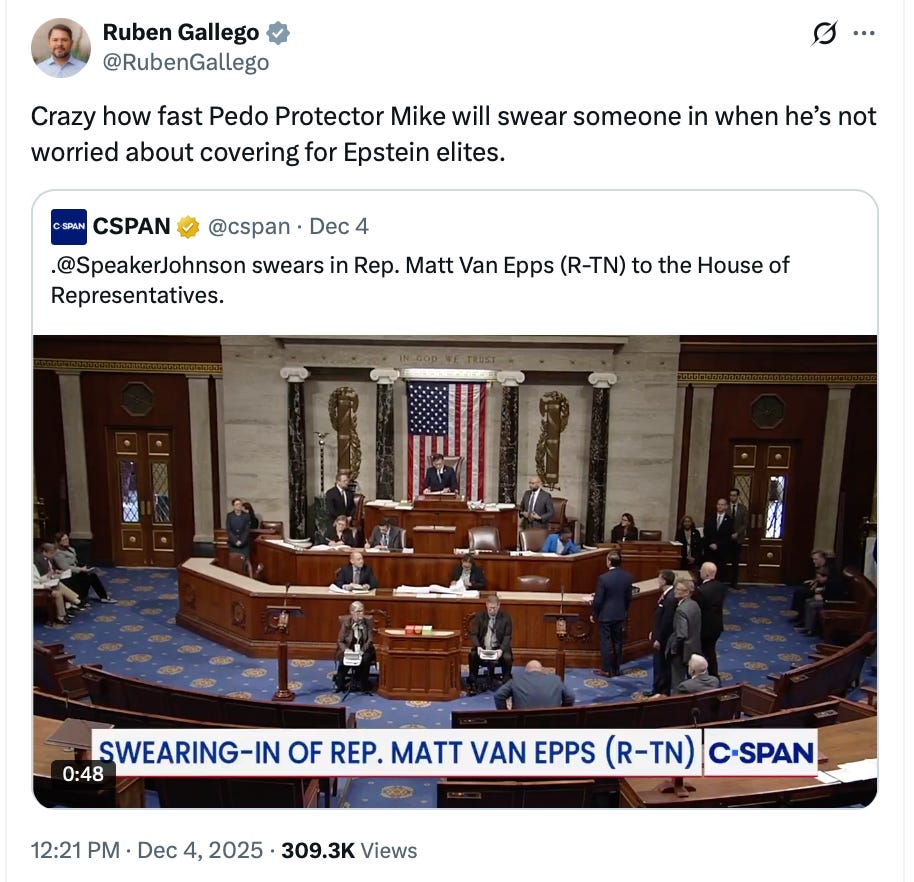
There is a bloc of real leftists who want a real leftist nominee. The rest of the party really wants to kick MAGA’s ass. They wrongly believe that Newsom is a strong electability option because he is doing a lot of genuinely funny ass-kicking tweets. If you’re serious about beating him in a primary, ignore all the interest groups and their policy demands and focus on the ass-kicking. I think Gallego is probably doing the best job of rolling out moderate policy positions while also calling his opponents nasty names, which is the correct way to thread the needle.
So we’ll see what happens. But just try to talk people through the basic logic here. I like the tweets and the hair, too, and Newsom broadly seems to me to be trying to make smart moves. But he’s had a long career in politics that has consisted of trying to outmaneuver other Democrats in very blue areas, and we should instead try to hire someone with relevant job experience beating Republicans.
Joshua Gillerman: As a former long time resident of Washington DC, I always thought that it was silly that the district’s recreation centers had such limited hours, including some being completely closed on Sundays. These centers could offer a safe place for play and activity, particularly for kids where their unstructured alternative could be less enriching/positive. It also seems like the additional investment from the district to run increased hours, and even programming, would be minimal as the centers themselves are already built and in decent shape; you just need to keep them staffed and I have to imagine there are plenty of DPR staff who would be happy for the additional hours. The major infrastructure investment has been made, so the barriers to implementing this policy feel minimal. You don’t even need to get that creative with programming, although you certainly could. It really is just that being able to play some ball/exercise/hang out in a space with with a modicum of adult supervision would much a safer, healthier alternative for some kids who would otherwise may have challenges filling unstructured time outside of school hours. Is this as obvious a miss for the district as it seems? Any actual research to support this?
I do not have any actual research to share, but this drives me crazy.
To the best of my knowledge all of the Department of Parks and Recreation’s rec centers are closed on Sunday and some of them are closed on Saturdays as well. I pay closer attention to the indoor pools, which used to be mostly open on Sundays but then for a while were almost all closed on Sundays and are now about half-open.
My understanding is that all of this is due to staffing shortfalls. But it seems to me that when it comes to recreational facilities, being open on the weekend ought to be the priority. I also think the city government as a whole is not a particularly “lean and mean” entity, and if we need fewer personnel in some other areas to put ourselves in a position to actually use the recreational infrastructure we already paid for, that would be a great idea. This brings me back to what I said last week about the mayoral race, namely that I’ve been on the Bowser administration’s side in almost every policy dispute they’ve had with the opposition bloc on the Council, but I don’t think they’ve done an incredibly good job at the basic management aspects of the role.
I’m very worried that we’re going to end up with a worse mayor. But it’s not hard to imagine someone who would be a change for the better — mostly in terms of delivering and administering services more effectively, rather than taking a dramatically different approach to issues.
Sam: I was visiting the Vatican Museum this weekend and it was the most crowded museum I’d ever visited. So much so that it definitely took away from the experience. I turned to my wife and said, “You know they really should charge higher prices for tickets so that it isn’t so crowded here all the time.” She disagreed by saying that then it would be harder for lower income people to come and visit. I suppose the Vatican is different than other museums, it’s a place for pilgrimage which might make charging higher prices less acceptable than doing so at the Borghese Gallery. Despite that, I wanted to hear your thoughts on this general sentiment that my wife expressed, which I’m sure would be a common response. I know you’ve said similar things about restaurants and other ticketed places and events in the past.
It does seem true that, in general, lower-income people benefit from having a cheaper lower-quality experience, whereas making it nicer but more expensive would primarily benefit the rich. I do think that what’s often missing from “think of the poor!” takes is that the extra money itself is useful. What I was saying about Taylor Swift’s concert prices is that if she doesn’t want to be greedy by charging market-clearing prices for access to her shows, she could give away a large portion of the proceeds to causes that she thinks are important.
We give 10 percent of our subscription revenue to the GiveWell Top Charities Fund. In the latest update I got on that from them, they’re making grants that they believe are saving lives for between $3,500 to $4,000 per life plus ancillary benefits in terms of non-fatal illnesses averted. It’s not just that Swift could be allocating her tickets more efficiently; she could be saving a ton of lives.
The Catholic Church of course has its own centuries-old sense of mission in the world. If they think that maximizing the sheer quantity of people who are able to see the Sistine Chapel is the best way to serve God or save souls, it doesn’t seem like I’d be able to talk them out of this. That said, I think they actually sell very expensive V.I.P. tours of at least some of the Vatican facilities outside of normal business hours. This kind of price discrimination strategy is, I think, what an economist would recommend: You sell the same basic thing at multiple price points, to maximize revenue while minimizing the number of people who are actually priced out.
In general, though, people have a lot of odd intuitions around pricing. I remember one year I went to the American Economic Association annual conference and the lines for coffee were extremely long. I kept joking to various economists who I was next to in line that you’d think a convention of economists would know how to handle this problem, and I usually got a laugh.
13ajgfsd723u2: Matt - any thoughts on the recent D66 victory in the Netherlands and how Rob Jetten has navigated the coalition building process so far? Any parallels to draw or lessons that Democrats can learn from his campaign?
The political systems are so different that it’s hard to really learn anything.
But what happened is that the Netherlands had a right-wing cabinet where the leading party was Geert Wilders’s PVV. Like in any multi-party system, he had to trim his sails somewhat to get a coalition agreement signed. But he ended up pulling the plug on the coalition over some demand or other and triggered a new election. PVV lost 11 seats in the race and ended up tied with D66, a center-left party that gained 17 seats. Nonetheless, right-of-center parties have a clear majority in Parliament.
D66 got slightly more votes than PVV. And relative to other left parties, D66 is positioned on the moderate end of the spectrum while PVV is positioned on the extreme end of the right. So D66 was chosen to lead government formation talks. That seems like it will amount to them making a deal with two center-right parties (CDA and VVD) and potentially get those two to agree to add a second center-left party (which is itself a merger of the old Dutch Social Democratic Party with a Green Party) to make a pure centrist coalition. Either way, even though Wilders lost and D66 won you are definitely not going to get a left-of-center majority coalition that pushes through an agenda of sweeping change.
Americans should think about this, not because there are any concrete lessons learned, but just as kind of a thought experiment. If it were possible to assemble such a thing, would you want a centrist grand coalition to ice out Trump? Would it make sense for the leader of D66 to say “Well, the right-wing parties got a majority, so Wilders should take another stab at forming a coalition?” You can’t straightforwardly map these situations onto each other, but I do think it’s food for thought.
Mark Gilbert: What should we think of the SPEED Act? My local birding group (formerly Audubon Society) asks me to oppose it, saying it undermines NEPA.
SPEED definitely “undermines NEPA” and I expect almost all green groups will oppose anything that undermines NEPA. NEPA is the National Environmental Policy Act, the big federal law that requires extensive environmental review before major projects can move forward. SPEED is a permitting-reform bill that would streamline that process.
But green groups are wrong to oppose it. Technologically agnostic permitting reform that facilitates renewables siting, transmission lines, and pipeline projects taken together is good for the country.
The nuance around SPEED is that, as it currently stands, reasonable Senate Democrats don’t want to wholeheartedly embrace it because they are trying to get stronger language in that would prevent the president from just kind of randomly killing renewables projects the way Trump has been doing. This makes sense on the merits and it makes sense tactically, and I don’t begrudge them their effort to drive a hard bargain. At the same time, you have a bunch of people who are never going to get to yes on anything that is bipartisan or politically realistic or economically feasible. It’s hard to tell just by reading tweets or press releases who is in which camp.
My broad wish is that Democrats would attack this with more urgency.
Joe Manchin was promised White House support for a permitting deal in the 117th Congress and didn’t really get it. Then we had another deal in the 118th Congress that didn’t get over the finish line. It’s now true that what’s on the table in the 119th is less favorable than what Democrats could have secured when they controlled the Senate and the White House, but them’s the breaks. It’s true you could hold out for an even better deal in some future Congress. But if you do a deal now, that doesn’t actually prevent a future Congress from passing new laws, so I don’t find “keep waiting and hoping” to be all that compelling.
Greg Packnett: How many deaths could reasonably be attributed to Brian Thompson? A lot of whackadoodles try to justify his murder on the basis of “all the people he’s killed”, and even people who don’t think he should have been murdered tend to concede that he sucks, but is that accurate? Not that many people die because they can’t afford to pay for treatment, and those who do tend to be uninsured. Is there a way to estimate how many United Health Care policy holders had claims unfairly denied or were otherwise unjustly denied coverage and died as a result during the period he was CEO?
I don’t think this argument makes any sense. There is definitely evidence that people die due to a lack of health insurance coverage. A classic pre-Affordable Care Act study estimated this at around 26,000 excess deaths per year. Critics of that study raise a bunch of methodological points about the demographic characteristics of the uninsured population that should lead you to believe that’s an upper bound estimate rather than the real number. Of course since then we passed the A.C.A. and the uninsured rate got much lower.
What’s more, post-A.C.A., the uninsured tend to fall into three buckets:
illegal immigrants
healthy people free-riding on the guaranteed issue rules
or people in states that have refused to expand Medicaid.
The first is an immigration policy problem, number (2) is a real flaw in the system and it’s the reason that a strong individual mandate was originally part of the proposal but it’s obviously not something that anyone is dying from, and (3) is very bad.
The A.C.A. also culminates a roughly 20-year practice of tightening regulations on the entire insurance market — both individual and job-based — in ways that were largely designed to address concerns about denials of coverage.
One big change is much stricter rules about rescissions. It used to be that if you became a customer who was a net money loser to your insurance company, they would go back through your old paperwork and try to catch you in an error or undisclosed condition that they could use as a pretext to drop your coverage. That went away. Insurance companies also have to rebate funds to customers if their medical loss ratio is too low, which reduces the incentive to minimize payments. There are processes in place to address various case-by-case denials of care as well. The general upshot is that it’s not 1995 anymore: the private sector moved at one point to control health insurance costs largely by making coverage stingier, there was very negative public reaction, and as a result the financial value of insurance coverage is much higher today. The odds of a person dying because an insurance company wouldn’t cover a treatment are very low.
That of course doesn’t mean it never happens. It’s a big country, there are a lot of sick people, there are a lot of experimental or speculative treatments that might work.
On the other hand, whether you’re talking about a regulated private system or a public-sector system, there are tradeoffs between never saying “no” to anything and controlling overall costs. A policy change that saved some lives while dramatically raising insurance prices might cost lives through a higher uninsurance rate.
I think there is something to the intuition that it would be better for these rationing decisions to be made by public officials than by insurance company executives. But the executives really are dealing with a heavily regulated industry and operating in a world where it’s not like the health care providers lack lobbying power or political clout. Hospitals, doctors, pharmaceutical companies, and medical device makers all push hard for more and more coverage and less attention to cost effectiveness. The image of the insurance company as an all-powerful villain is really outdated and wrong, over and above the more general wrongness of murdering people.
Interested in housing news? Earlier in the week Halina Bennet, Slow Boring’s writing fellow, covered what’s next for buyers, builders, and cities. You can read that piece here.
Man, that last question represents a scary outlook on life. Not a long journey from that (wholly incorrect) line of thinking to one that justifies or commits violence. I worry that Matt's response is about 6 grade levels of thinking higher than the questioner can understand.
I have seen people claim that Brian Thompson “killed millions of people” and it never occurs to them as to how this can be true in a country with 3 million total deaths a year.
These people are just lazy epistemological nihilists who want to revel in violence and evil.