

I love the Knicks, but back in the aughts when the team was in terrible shape, I was a serious Lakers-hater, which meant I became an admirer of the Tim Duncan Spurs and rooted for them in their 2003 / 2005 / 2007 championship runs. And then imagine my surprise when I met Kate, a legitimate Texan and Spurs fan. So it was awkward for the household dynamic when this season put the teams on a collision course.
And I have to say, the post-defeat narratives around the Spurs remind me of a lot of bad political-narrative crafting where irrelevant considerations and arbitrary framings have generated a totally unwarranted cloud of negativity around the team’s performance. If the Spurs had lost in seven to the Thunder, everyone would have said this was a team that achieved more than anyone was expecting this year. But then they achieved even more than that by making it to the Finals, only to fall short after some dumb mental errors and obvious fatigue issues impacting Wembanyama, and people turned very negative. But they’ve got five key guys — Wemby, Castle, Harper, Champagnie, Vassell — who are 25 or younger, plus Carter Bryant coming up and neither Keldon Johnson nor De’Aaron Fox is old. In other words, this is a team you’d expect to get meaningfully better next year just due to aging. It’s a team that stands a better chance than anyone else in the league of winning multiple championships in a short timespan.
Vas: In honor of the Knicks, whats the best NY song?
I feel a little weird about this one because I am from New York and haven’t lived there since going off to college and I think the essence of New York as a city is that it’s a place that people move to.
Whether you’re talking about Frank Sinatra’s “New York, New York” or Taylor Swift’s “Welcome to New York,” you have so many classic songs that are essentially about New York as a destination. If I can make it there, I’ll make it anywhere. Billy Joel’s “New York State of Mind” is about going to New York, and Jay-Z and Nas both have New York songs that directly reference Joel.
These are all good songs, but they’re not really songs that express my emotional relationship to New York City.
For that, I think you have to look to “What New York Used to Be” by The Kills, which is something more obscure.
You guys know that I am a YIMBY and a believer in abundance and change and economic liberalism. But I think we nonetheless all have a nostalgic side to ourselves, especially about our hometowns. And to me the most striking and resonant thing about New York is that what I think of as my hometown — Greenwich Village in the 1980s and 1990s — really doesn’t exist anymore. You can go there, obviously. And thanks to Jane Jacobs a huge share of the physical structures have been preserved despite the economic incentive to re-develop them. But the area around N.Y.U. doesn’t have any of the feel of a college town anymore. Nothing about it seems particularly bohemian. The neighborhood will always have a kind of iconic role in gay history, but that doesn’t have the same social meaning that it used to. Once upon a time on MacDougal Street there were a bunch of Italian cafes that served espresso drinks. Most of them are gone now, but, more to the point, the idea of “cafes serving espresso drinks” being a distinctive attribute of a neighborhood is incredibly outdated, just like “people can be openly gay here” no longer calls out anything special.
It’s not to say that things were better in the past (though they were at least cheaper), but they were different and that different New York is where I’m from.
Another one that I like and that speaks to me is Le Tigre’s “My My MetroCard.” Ad-Rock used to live in the penthouse floor of the apartment I grew up in, and Kathleen Hanna moved in some time after I left home. This song really captures, among other things, how cool and modern and fresh the MetroCard seemed at the time it was introduced and also the endless possibilities presented by the New York subway’s globally unusual flat-fare structure.
More than that, though, I think it perfectly encapsulates a certain virtue-signaling progressive hypocrisy that I was also participating in around the turn of the millennium. The whole vibe of the song is about the exuberance of 1990s New York, back when residents were enjoying the fruits of the huge crime drop but being in the city still felt edgy and affordable. But still we progressives were singing, “Fuck Giuliani! He’s such a fucking jerk!” He in fact was a huge fucking jerk and did a bunch of wildly unnecessary stuff that his successors moved away from — what they didn’t move away from, though, was the core embrace of data and proactive policing that brought crime down and opened up the city. That’s my cranky middle aged guy take. But I still love the song and at the time it came out I loved the sentiment without a hint of irony.
evan bear: Bernie Sanders isn’t a full-fledged “worse is better” type of leftist, but I think it’s fair to say that he was pretty ambivalent about the risk of electing Trump in 2016, and that there were significant elements of his base that saw positives in Trump defeating Clinton. Have the events of the last 10 years been a success for him/them? Leftists have more influence in the discourse than ever before, NYC went from Bloomberg to Mamdani, there is at least a possibility that we’ll elect a socialist president in 2028, and many of the people and things that have been hurt the most under Trump — the career civil service, the military and national security establishment, international trade, American soft power — are not things that they ever had any love for. Would any of this have been possible if Trump never becomes president?
The thing is, the left-faction has been winning when Democrats lose (Clinton’s defeat discredited moderation, Harris’s defeat set the stage for the collapse of pro-Israel Democrats) but it was also winning when Democrats won: Biden appointed a ton of left-factionalists to key public-policy roles, governed as much more progressive than most people expected, and basically let left-factionalists get their way on all domestic issues.
Now maybe if Hillary had won that halts this process. But I reported a lot on the Clinton transition, and it was already set to put in a place a much more progressive staff than the Obama team. This is just what happens when you’re out-organizing and out-debating your factional rivals — things tend to break your way.
My question about all this, though, would be to ask beyond personalities what has actually been achieved here.
Mamdani’s presence in office seems to make left-wing people very happy. Just as Trump in his first term delivered emotional satisfaction to conservatives because him sitting in the White House owned the libs, Mamdani in Gracie Mansion seems to confirm to the city’s younger, better-educated, and more left-wing residents that it is really “their city” instead of one that’s governed by a coalition of rich Wall Street guys, the Black church, and cranky outer-rim quasi-suburbanites. But he’s not actually doing much policy change. At the federal level, Biden was more left-wing on economics when it came to vibes but, even before Trump’s Big Beautiful Bill, taxes were lower than they’d been at the end of the Obama administration. The big antitrust push left zero legacy in terms of policy. A bunch of blue states are backing off their climate goals because they never actually implemented policies to facilitate clean energy abundance. It turns out we didn’t actually have an alternative to police and incarceration.
So I think the left is struggling. Many of their ideas are bad. And replacing liberal Democrats with even-further-left Democrats in safe blue states is an extremely weak lever for changing public policy. John Bel Edwards delivered publicly funded health insurance to hundreds of thousands of poor people, because beating right-wing Republicans with moderate Democrats is a powerful strategy and because Medicaid is a basically good program.
KH: Considering how this sexting scandal has impacted the poll and how Platner team has handled it, I increasingly feel like he should step down. And the subsequent question here is, “how to convince Platner and his base that dropping out is the best way going forward”
I thought about this bc public shaming him seems to have resulted in those ardent supporters double down the conviction “establishment is out to get them” (like Freddie DeBoer and Ken Klippenstein) while I have a trust issue over their faction to have high enough of self awareness and conscientiousness to come to a conclusion on their own.
And i feel like the experience of pressuring Biden to drop out may have led us to believe “we can just publicly shame anyone to drop out and this is the only way” while dealing with low conscientious person like Platner is very different from handling with Biden who def has chip on his shoulder but at the end of the day has enough conscientiousness to make a tough decision to drop out.
I think it’s less about conscientiousness than it is about the teams. Team Biden was stacked with highly partisan Democrats who, whatever their other conflicts or self-interest or dissonance, were deeply motivated by a desire to defeat Donald Trump.
The Platner project is a highly factional enterprise that isn’t going to be bothered by “establishment” Democrats criticizing him. If he wins in the face of establishment opposition, that’s great for their cause. If he loses in the face of establishment whining and criticism, that’s also great for their cause because then they can say the establishment has revealed themselves to be hypocrites about the imperative to win.
The only way for Platner to get off the ticket would be for pro-Platner factionalists to decide they’d rather not have him. There’s a guy, Troy Jackson, who was running as the Bernie candidate for governor and seems to have fallen short. He’s very left-wing but as far as we know has never fibbed about any tattoos or gotten caught stepping out on his wife. If Sanders and Ro Khanna and whoever else wanted to swap out Platner for Jackson, maybe they could make that happen. But they don’t. And it really doesn’t matter what someone like me says because the relevant people don’t care what I think.
Brian: After listening to a recent episode of Derek Thompson’s podcast, I came away feeling that, at this point, the discourse has become so fully attuned to the loneliness crisis and all of its causes, but has no real solution for it. Am I right to think there’s no real solution on offer, and that the problem is likely to only continue getting worse?
This is not a fully worked out agenda, but I think the people who talk about this stuff are too reluctant to propose sort of obvious crude measures. If people are spending too much time scrolling on their phones, then policymakers should tax digital ad revenue to make “get people hooked on infinite scroll” a less lucrative business model with fewer companies trying to pursue it and fewer smart people working on it. Maybe they should also tax streaming video. I think there’s a real argument that linear television was better for society because it generated more monoculture moments and more water-cooler conversations.
I’m not totally convinced that this is right. But I’m open to it. If there’s really a “loneliness crisis,” there should be serious steps taken to discourage people from spending so much time scrolling alone and then they’ll go do other stuff.
City of Trees: Nate Silver recently tweeted “‘Vote blue (or red) no matter who’ is a bad heuristic; it’s good to have some standards, otherwise you tend to be the sucker in the bet over the long run. Oppose candidates from the left, right, center, from a nonpartisan angle, or whatever; make up your own mind. The deterrent of not supporting candidates you intrinsically dislike is a noble impulse and a good check against parties shoving shitty candidates down your throat.”
What’s your take? What kind of standards do you think devoted Democrats or Republicans should hold in this regard? Are there any general situations in which you would withhold a vote from a shitty Democratic candidate?
To quibble, I think Nate is kind of mixing up two ideas.
Is “raw partisanship matters more than individual candidate attributes” a bad heuristic?
Is it bad for America that “raw partisanship matters more than individual candidate attributes” is actually a pretty good heuristic?
My answer to (2) is much more clearly yes than my answer to (1). Back in the day, both parties approached congressional elections more in the spirit of “every state and every district has a median voter.” So if you go back to the 107th Congress in 2003, the first one that I covered professionally, you’ll see that Ralph Hall and Charles Stenholm from Texas have voting records that are somewhat more conservative than a handful of New England Republicans.
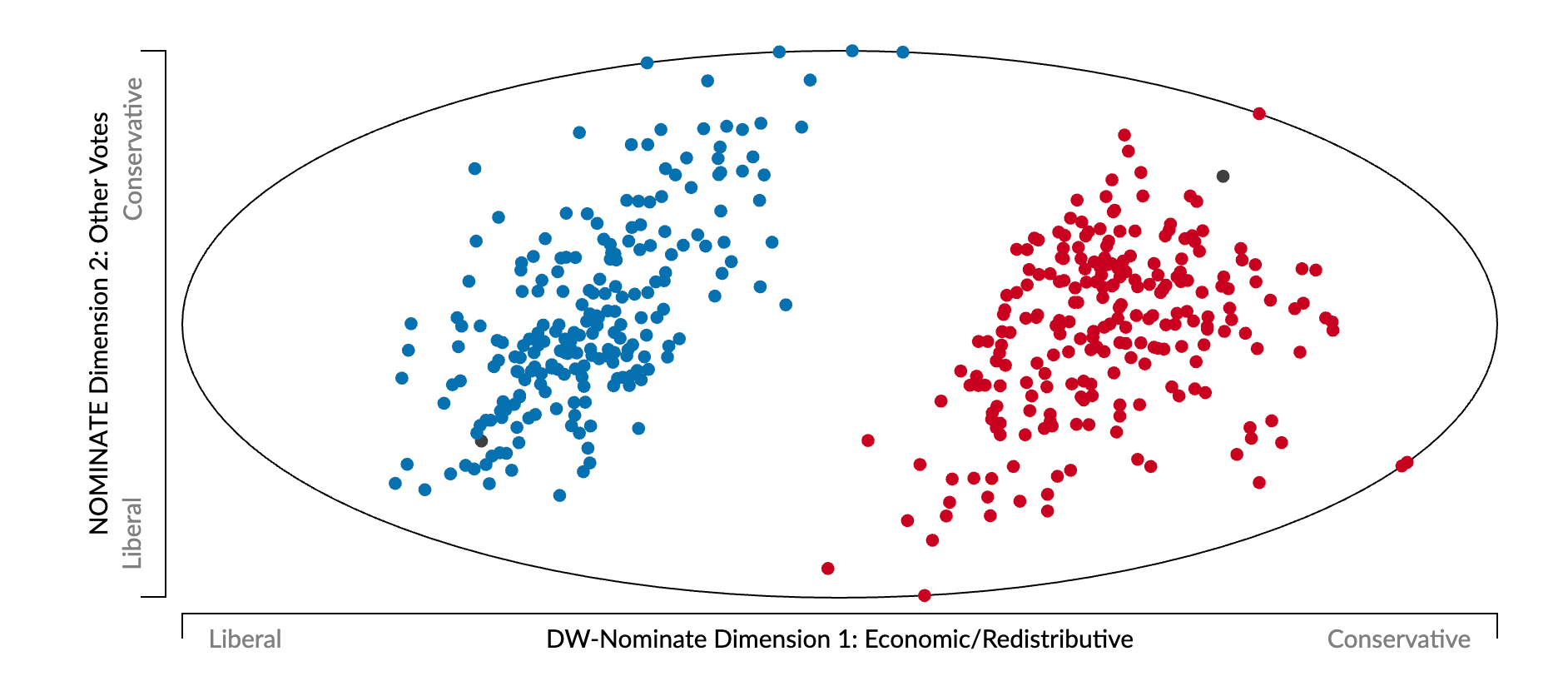
If you go further back in time, that was even more common. Even when the parties became perfectly sorted after the 2004 election, you still had plenty of crossover on specific issues. In the 2007–08 Congress, the most moderate Democrat was to the left in the aggregate of the most moderate Republican. But you did have pro-life Democrats from districts where abortion was very unpopular and pro-choice Republicans from districts where abortion rights were very popular. Same on guns. In 2009, a bunch of coal country Democrats voted against the Waxman-Markey climate bill and a handful of Republicans voted for it.
The evaporation of that style of politics and the emergence of a world where I can’t think of any noteworthy issues on which Susan Collins is to the left of any Democrats is bad for the country. It would be a fine way for politics to operate in a proportional representation system, but America’s system of geographically based voting requires more attention to local conditions than that. One benefit of a less-polarized politics is that it would let more people behave the way Silver is suggesting, which would have some benefits. I am constantly arguing that polarization is an elite-driven choice and not something that just happened. But it is a reality, and I think it’s reasonable for people to use heuristics that acknowledge reality.
Where the heuristic breaks down is local politics and many state races.
I would happily vote for a Republican over an ethically troubled Democrat for the D.C. Council, for example. For starters, there’s just no chance that the policymaking of the Council goes off the rails in a right-wing direction. Ideally, a G.O.P. officeholder in D.C. would operate as a smart, pragmatic moderate who plays a constructive role and gets re-elected. But if he didn’t do that, he’d just get crushed in a landslide next time by a Democrat who doesn’t have any ethical problems. I think most voters are too reluctant to punish bad behavior by co-partisans in these kind of cases where majority control isn’t at stake and where the cross-party elected official is very likely to serve only one term. If you live in the Texas Panhandle and your state senator is enmeshed in scandal, there’s no reason not to vote for a Democratic opponent, even if you think the opponent is way too left-wing. One extra progressive serving one term in the state legislature isn’t going to wildly alter state policy. But making sure all incumbent officeholders stay on their toes and avoid scandal is good.
Now of course this is a two-way street. I have substantive sympathy for some of what Spencer Pratt was saying about Los Angeles, but Pratt was giving the electorate in a very blue city nothing to work with. If you look at the G.O.P. mayors of the 1990s, Richard Riordan and Rudy Giuliani were legitimately to the left of most Democrats on gay rights issues and immigration. Their vision of “tough on crime” included gun control. They gave Democratic voters concrete reasons to trust that they wouldn’t simply govern as national Republicans. In a world where Trump is stealing elections, partisan Democrats are going to want some very explicit assurances that a guy who’s asking for their vote for any kind of executive office isn’t going to be complicit in that.
Juan C: What is your take on Dean Baker’s post on abundance and patents and copyright?
Baker has been playing a version of this game throughout my entire career. It used to be primarily about free trade. People would say that free trade is good for normal, boring economics reasons and that protection is bad because it produces deadweight loss. Then Baker would pop in to say “If you really cared about deadweight loss, you’d be talking about pharmaceutical patents.” Over the course of this, he absolutely persuaded me that it would be smart to switch to a system of financing pharmaceutical innovation that relies more on prizes and less on patents.
But he didn’t convince me that free trade is bad. And despite his take that it’s somehow hypocritical to be bothered by the deadweight loss of protectionism rather than the deadweight loss of pharmaceutical patents, the obvious difference is that pharmaceutical patents have important upside in terms of spurring innovation. They are plausibly not the best way to spur innovation. But a reform that was just “no more pharmaceutical patents” would make most people worse off over the long run while a reform that was just “no more tariffs” would make most people better off. That’s a big difference!
Now I think a fair critique of free traders circa 2004 was that the marginal gains from further dismantling trade barriers via initiatives like CAFTA-DR or the Trans-Pacific Partnership were actually very low and it was a little odd to be so hung up on this. But the regulatory issues that the abundance movement is targeting are a really big deal. Housing, transportation, and energy are the most important sectors of the economy. The regulatory constraints in these areas generate both static efficiency losses and dynamic losses via reduced innovation. That’s really bad!
If someone writes a smart piece about better ways to finance pharmaceutical innovation, I’m not going to dunk on them and say, “You should really be talking about zoning.” It’s fine to care a lot about pharmaceuticals instead. But I would ask people who care about that to actually work on that issue, rather than complaining about people working on housing and transportation and energy.
I’d be curious what Baker thinks about proposals for clinical trial abundance — an effort to think about how to boost the pace of biomedical innovation without throwing more and more money at patent-holders.
Thomas: Was there a path for the Ottoman Empire to survive? What does the Middle East look like if they had held on after WWI?
This is a fun one. As you know, I am relatively bullish on the idea that the Habsburg Empire could have survived indefinitely if the Central Powers had not been defeated in World War I. Can we say the same about the Ottomans? Say Gavrilo Princip doesn’t shoot Archduke Franz Ferdinand and the war doesn’t break out. What happens to the Ottomans?
My understanding is that the basic Ottoman polity was a shakier entity than the Habsburg one. This is in part because it was under pressure from a rising current of Turkish nationalism along with centrifugal forces. On a more banal level, it was also very poor. Part of my point about the Habsburgs is that the residents of the eastern parts of the empire derived real economic benefits from being integrated with the richer, German-speaking western parts. This is not really true in the Ottoman case. There were no booming industrial cities in Anatolia for non-Turkish subjects of the empire to move to and secure upward mobility.
On the other hand, the “Arab Revolt” against Ottoman rule depicted in Lawrence of Arabia was by most accounts a pretty narrow enterprise heavily dependent on British funding.
In retrospect, of course, it got mythologized by Arab nationalists as a broad movement that was betrayed by the Sykes-Picot Agreement. In reality, there were just clearly not that many people actually involved in the Arab Revolt, especially outside of the Hejaz region. The rebels not only needed British money to stay in the field, but ultimately their military victory was heavily dependent on British and French participation in key battles. Bruce Masters argues that until the outbreak of the war, most Sunni Arab religious elites and wealthy urban merchants in Arab cities happily supported Ottoman rule. There were plenty of tensions within Ottoman society — Shiites and non-Muslims were subject to discrimination, there were economic issues, there were localized revolts against particular governors — but there was no big Arab movement against the system. That’s in part because local political power in Arab areas was typically wielded by prominent Arab families.
The problem is, this whole system was arguably breaking down as the Ottoman state attempted to modernize. There was very little mass literacy in 1914, but the Ottomans were rapidly expanding their education system and starting to create a modern literate bureaucracy. This really posed the question of whether governing elites were going to need to Turkify. This tension of course also existed in the Habsburg Empire. But if you think about contemporary Slovakia or Hungary, it’s just the nature of the situation that these linguistic communities are so small that any halfway elite Slovak needs to master a foreign language. Today that’s English. But if history had shaken out such that it was German instead, that’s not so different. Arabic, by contrast, is a major world language and has a special prestige association with the Islamic religion. So that’s a much tougher linguistic needle to thread as you start talking about mass education and mass media.
And the fundamentals of the World War I situation would still be in place. The world’s largest Arabic-speaking community is in Egypt, which was already outside the boundaries of the empire. The oil in the Persian Gulf would become increasingly important over time. So whether we’re talking about Britain using Egypt as an entry point to undermine Ottoman rule and obtain control over the Gulf (as happened historically during World War I) or an independent Egypt with Arab nationalist ideology (as happened historically in the 1960s), I think the idea of a polyglot empire is going to come under a lot of pressure.
Looking for more Slow Boring content? Halina has a great take on Freddy, the German soccer fan road tripping across the southern United States for the World Cup.
I used to have a Hungarian colleague, with a Bulgarian wife, working in the Czech office of an American company.
"What language do you speak at home?" I asked them.
"English, of course!" they replied.
I think the rise of Bernie, DSA, and a bigger appeal of the prominent left/socialist leaning faction (I'm still not sure most of them are full on socialist in the European sense) is downstream of the Great Recession. None of this regains prominence I dont think without a lot of facts on the ground circa 2008-2014 or so. Doesn't mean they're right about everything or anything policy wise but I think it was a defining historical moment on Millenial politics that will continue to have an imprint.