

I wanted to flag something that is almost the opposite of the dynamic I noted earlier this week in oil markets: If you look at the prediction websites, gamblers have become pretty bullish on Democrats’ odds of winning the Senate since the war with Iran broke out. This is not matched by movement in the generic ballot polling, which has been minimal. The easiest way to make sense of that is to posit that gamblers believe the economic reverberations of the war haven’t really hit American households yet, and that when they do hit, we’ll see a larger backlash against Republicans than the one that has already manifested.
That seems like a plausible theory of the case to me, but it’s the reverse of the implicit theory of the futures market, which is that Trump will back down before oil prices soar precisely in order to avoid this blowback.
Who’s right? I don’t know. The politics gamblers sort of feel more correct to me, but the oil futures market is a lot larger and more professionalized, so I’m inclined to give it more credence. It’s hard to write good columns that express ambivalence, so I’m just noting it here because I don’t really know what to make of it.
Now for this week’s Mailbag. Slow Boring sends out a mailbox to paid subscribers every Sunday where they can submit their questions, so if you’ve got a question for us, upgrade your subscription below.
Lost Future: Retro question- if you were dictator of the US and you could make gun laws whatever you want, what would you do? The rules are, your laws can’t be repealed later and you don’t have to worry about them being popular. But, you do have to worry about black markets, largescale defiance, unintended consequences, etc. What (if anything) would you pick? Banning handguns? More restrictions on semi-automatic rifles? Or less? Everyone likes to just blindly repeat the phrase ‘background checks’ here, but it’s not clear to me that the average mass shooter would be unable to pass a background check. Nor do I believe that largescale psychological testing of every gun purchaser is realistic
For political feasibility reasons, the gun policy debate in the United States tends to be myopically focused on trying to prevent ultra-rare massacres by regulating the purchase of powerful, scary-looking weapons.
I share the common liberal intuition that it would be fine if nobody owned this kind of firearm. Nothing terrible would befall the country if we could make it so that the only long guns people owned were single-shot bolt-action rifles designed for hobbyist hunting and target shooting. It’s just not true that owning highly lethal long guns is likely to help defend your family against crime and/or tyrannical government.
On the other hand, it’s just also not the case that these kinds of weapons are killing large numbers of people.
Firearms deaths in the United States are mostly suicides, and gun homicides are overwhelmingly committed with small, cheap, easily concealed handguns, not big, expensive “assault weapons.”
So one thing I would say is that there would be public health benefits to just broadly discouraging gun ownership via things like taxes. Fewer guns floating around would mean fewer suicides and fewer accidental gun injuries. Over the longer term, it would also mean fewer handguns diverted from the licit markets to the illicit ones where the crime is taking place.
Beyond that, if you could credibly commit to America’s legal gun owners that you were not going to take their guns away, there’s a lot that you could do to regulate handguns to make them less potent tools in the hands of criminals. There should be a national firearms registry with liability attaching to the owner-of-record if a gun is used in the commission of a crime. New handguns should come with chips embedded that can be tracked by police, and there should be financial incentives to swap out existing guns for new chipped guns. That way if you lose your gun or it’s stolen and you report it promptly as required by law, it can be easily tracked and recovered. If a shooting takes place, we can easily verify which firearms were in the vicinity. A person out on parole with an ankle monitor who started carrying a gun would be immediately caught.
Of course, you would still have the huge existing stock of illicit guns floating around, so in the short-term the impact on gun crime would be minimal.
But right now, urban police forces do a fair amount of activity dedicated to “getting guns off the street.” Yet even though D.C. cops seize thousands of illegal guns every year, this has relatively low efficacy because criminals just get new guns. If new guns were made much less useful for crime, then seizures of the old guns would actually make a difference.
The goal here would be to create a situation where a non-felon who wants to own a handgun for self-protection is generally free to do so, but where diverting such weapons into the illicit market is much less likely.
This does not work as well for the “mass shooting” concern about semi-automatic rifles because those spree killings are normally not committed by habitual criminals. I think this is an overrated policy problem, but to the extent that you want to tackle it you really do need to just crudely restrict people’s ability to get the guns that they want.
That’s why my actual political stance is that Democrats should probably just drop the assault weapon conversation. It sounds like lower-hanging political fruit than going after handguns used in crimes, but in the real world it inherently brings you into conflict with law-abiding gun enthusiasts.
Lomlla: What do you think of San Francisco’s new child care subsidies that have eligibility for those making up to $310,000 a year (family of four)? Do you think this dis-incentives work, especially because many new parents directly trade-odd mom’s salary and day care pricing? How does this rush of money affect child care providers? How does this affect housing prices in the city proper versus the surrounding suburbs? I believe San Francisco is the first to institute such large subsides for high income earners.
I think it makes sense, in principle, to have subsidies for parents of young kids operate on a totally universal basis (the way K-12 public schools do) without means-testing. Obviously in the real world, budget constraints and tradeoffs matter. But I don’t have a problem with that approach.
Fundamentally, though, I think that if you’re looking at a city like San Francisco or New York or Boston and wanting to make it more family-friendly, spending a bunch of money on child care subsidies is not where I would start. The most important thing, by far, is to make it easier to add market rate housing, especially in the places where the land values are highest. After that, it’s improving the management of your existing K-12 schools and maintaining public order on the streets.
Stoldney: How does the Great Khan of the Midwest, JB Pritzker, fit the profile of the kind of politician you are looking for in 2028? Could he fit the mold of Jon Ossof you wrote about this week?
Pritzker to me is just very much in the Gavin Newsom mold of a guy whose political experience is running a large blue state that most Americans don’t regard as a model of good governance. I get why a lot of highly partisan Democrats really enjoy Pritzker, but the whole point is to appeal to people who are not highly partisan Democrats.
To be a solid candidate, he would need some kind of “Illinois Miracle” story to point to, where people and companies were moving to Chicago as a low-cost alternative to the overpriced coastal metropolises and Illinois public schools were leaping up the NAEP charts. But he doesn’t have a record as a visionary successful reformer or as a bipartisan “get things done” kind of guy.
DWD: Do you think the situation in the Middle East would any different if Ariel Sharon didn’t suffer his stroke?
It’s certainly possible. But Sharon was 77 when he fell into a coma in 2006 and Ehud Olmert, his successor as party leader, won the Knesset election that was held later that year, so it’s not obvious to me that Sharon holding on a little longer would radically change things.
The big point I would make about Israeli politics is that if you look at the two times when Israeli prime ministers made generous offers to the Palestinians — Ehud Barak at the Taba summit and Olmert at Annapolis — they were not just lame ducks, but lame-duck prime ministers whose governing coalitions depended on the participation of religious parties — notably Shas — that did not support their proposals.
If you go all the way back to the 1992 election that brought Yitzhak Rabin to power, you had a majority in the Knesset of Labor and parties to the left of Labor. But that included the Arab parties, and Labor at that time promised to negotiate on the basis of a Jewish majority for peace, which would have meant including Shas, which again did not support the kind of concessions that were later put on the table at Taba and Annapolis.
Which is just to say that separate from the dysfunctional behavior on the Palestinian side, I don’t think it was ever the case that there was adequate political support in Israel for a peace deal.
This is a very unfashionable view of mine, but I genuinely think the religious motivations in play are an important part of the Israel-Palestine conflict. Hamas is obviously an avowedly Islamist movement, as is Hezbollah, as is the regime in Iran. Shas always opposed the division of Jerusalem in principle for religious reasons over and above any security issues in play. And since the 1990s, we’ve only seen the rise of further-right religious parties in the Knesset. Some questions are amenable to win-win positive-sum dealmaking, but questions about to whom God has allocated which land are not like that, and this makes the conflict unusually intractable.
Sean O: Would a President Al Gore have maintained the No-Fly Zones over Iraq?
Yes, I think a Gore administration basically just maintains the somewhat unsatisfactory status quo in Iraq while also fighting a fairly unsatisfactory war in Afghanistan. You probably end up with a significantly larger Ralph Nader vote in 2004 than you had in 2000, plus Republicans nominating John McCain on a moderate platform. I think this means Gore loses his re-election bid badly.
Grand Moff Tarkhun: How sincere are you about being “blackpilled”? Most of your content still seems pretty optimistic but when you talk to Brian it seems like you’re in a totally different mood.
Do you just like… forget who your coalitional allies are while you’re alone at your desk writing articles, then get bummed out by reality when you talk to progressives?
I’m not blackpilled about anything, but I do think that things have changed between 2018 and 2026 in a way that is not very productive.
Eight years ago, my read was that the genuine views of rank-and-file Democrats were quite pragmatic and focused on anti-Trump and anti-MAGA by any means necessary. There was a very effective, but overwhelmingly elite-driven, push by progressive-issue activists to essentially hijack that resistance energy and turn it toward greater ideological rigorism across the board.
Today, though, I think that things are different. Angie Craig in Minnesota seems to be really suffering for her moderate voting record (she’s way down in the polls and primary voters seem mad that she backed the Laken Riley Act) rather than benefiting from her rating as an overperforming superstar. Jared Golden was hounded out of Congress. Tom Suozzi was forced into an apology over his ICE funding vote. Gavin Newsom is the frontrunner.
It’s not like pragmatism has completely vanished from the face of the earth, but rank-and-file Democrats have gotten a lot more sincerely progressive and a lot less tolerant of letting elected officials cook. Party leaders are weaker than ever. The strategy of “hope Trump fucks up the economy badly enough that we can get away with blowing off public opinion on cultural issues” looks like it just might work, but I still don’t think it’s a good strategy. I do, however, think it’s a strategy that the Democratic faithful mostly wants.
Abby: On the scale from “current level” to “$9 a gallon”, what do you think is the correct level of gas tax?
Back in 2006, Greg Mankiw calculated that the correct Pigouvian gasoline tax would be about $1 per gallon, which would be $1.65 today. That’s a lot higher than the current per-gallon federal gasoline tax of 18.4 cents, but it’s way lower than $9.
What’s interesting is that back 20 years ago, the behavioral impact of higher gas taxes was expected to be mostly people opting for lighter, more fuel-efficient cars (like the kind of cars Europeans drive) rather than big American trucks and S.U.V.s. At our current state of technology, it’s much more likely that you’d get wholesale switching to electric cars. That in turn means that high gas taxes are probably much worse at generating revenue than they would have been 20 years ago.
David Muccigrosso: Matt (and all other Slow Borers) — Do you have any recipes that force your partner to vacate the kitchen due to biohazards or offending odors/risks of any other kind? Asking cuz I made my verde chicken chili today, and had to give Boo a biohazard warning while I sauteed the chilis. But fortunately, unlike previous apartments, this one is well set up to disperse the offending capsaicin cloud!
I like to make some pasta-with-anchovy dishes that I don’t attempt when Kate is around because she is quite averse to the pungent scent of tinned fish.
Matt S: If people searching for answers by watching manosphere YouTube influencers instead decided to sit down and get their answers from philosophy books, what would you recommend them to read? What do you think would speak to them?
I think you’re supposed to name Marcus Aurelius or some other stoic, but that’s actually not the kind of philosophy that I studied and I don’t know anything about it. I appreciated Sam Harris’s recent “manosphere” take especially because he’s a decidedly anti-woke figure. This is a very brief clip, but the key point he makes is that contrary to a traditional situation where someone might present themselves as a good person but then be revealed to be actually bad, figures like Sneako and Andrew Tate are transparently selfish and immoral in a way that almost puts their ideas beyond debate.
But I don’t really think the answers here are to be found in philosophy.
We just used to have more advice and entertainment content targeting young men that was decidedly “non-P.C.” (think Maxim or “The Man Show”) without going full-tilt “this content is created by the most crass and immoral people in the universe.”
Unset: Following up from Friday’s thread, can anyone recommend a good history of the Austro-Hungarian Empire? I want to learn more about it.
I read Robert A. Kann’s 1980 book, “A History of the Habsburg Empire,” when I was in high school. It appears to still be in print today, suggesting that it’s still considered a somewhat standard English-language treatment of the subject, albeit somewhat outdated.
Martyn Rady’s much newer 2022 book, “The Habsburgs: The Rise and Fall of a World Power,” is more modern. I have not read Pieter Judson’s “The Habsburg Empire: A New History,” but from what I can tell it has the most Yglesias-forward take on this, explicitly pushing back against the notion that a multi-national polity was “doomed” or outdated rather than destroyed in a regrettable war.
Sidebar: I am not the kind of person who is obsessed with “enshittification” and complaining about big tech companies. But if you fire up Amazon.com and search for books about the Habsburgs, what they currently show you is a bunch of paid advertising for A.I. slop books.
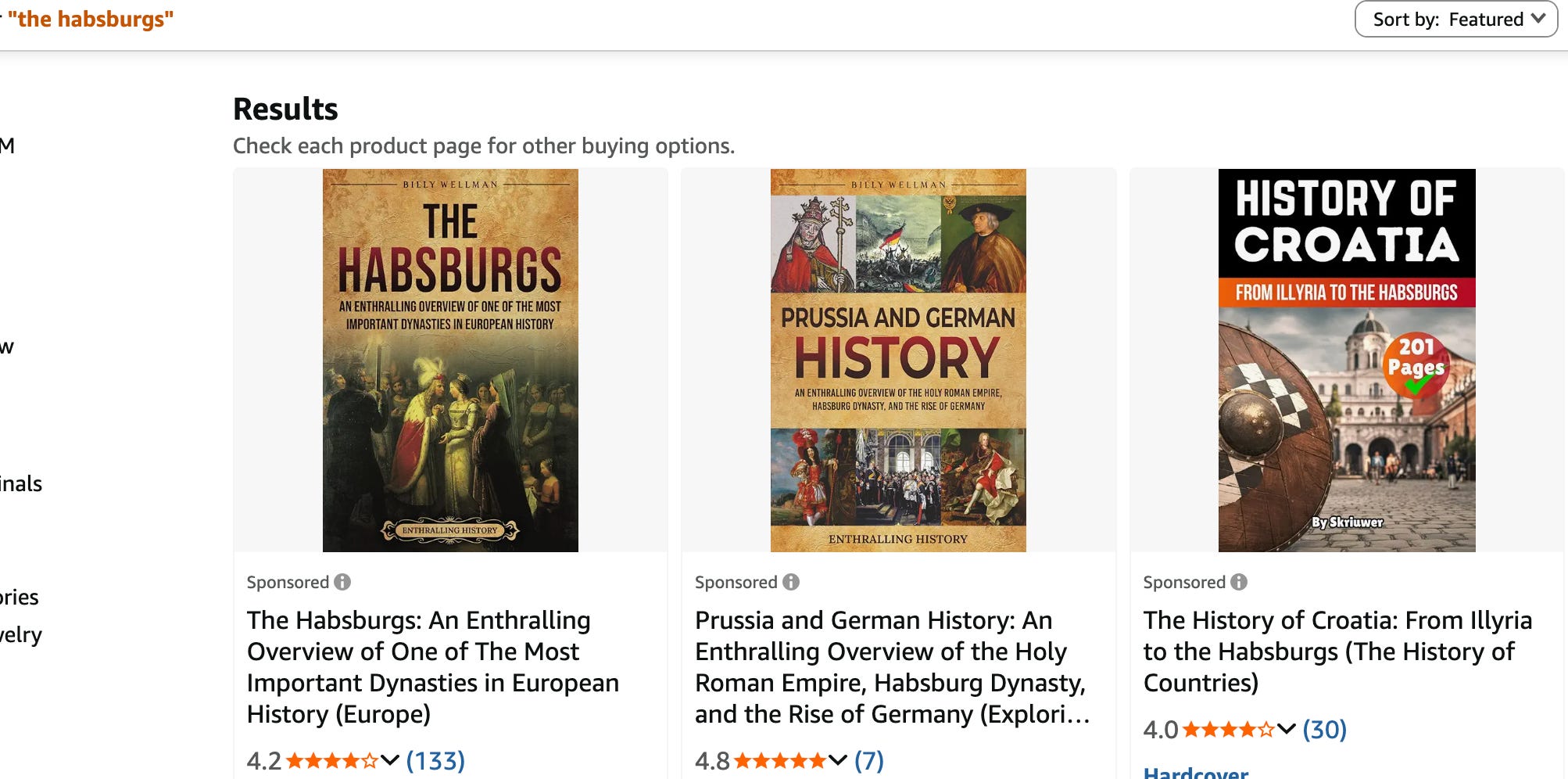
That first one is credited to Billy Wellman, who has published an improbably large number of books on the history of basically every country, seemingly backed by heavy investment in S.E.O. and paid promotion on Amazon.
This is just a tremendous disservice to human culture relative to an equilibrium in which a person who searches for history books is directed toward the standard works on the subject.
Matt writes: "Yet even though D.C. cops seize thousands of illegal guns every year, this has relatively low efficacy because criminals just get new guns."
The solution is to seize the *criminals* in addition to the guns. A guaranteed 5 years in prison if caught with an illegal firearm would go a long way to a better situation than we have today.
An important point on gas taxes is simply that they should be a percentage, like any other sales tax. Not cents per gallon. The tax gets eaten up by inflation.