As someone who is interested in monoculture events in general and the movie business in particular, I suppose I should have something to say about “Spider-Man: Brand New Day,” which is a huge hit and stands a decent chance of becoming the top-grossing film of all time in nominal terms.
I saw it and I thought it was … okay. The third-best of the Tom Holland Spider-Man movies? The third-best film Zendaya has appeared in so far in 2026? Which is just to say I sort of don’t get it. I don’t know anyone who is super enthusiastic about this movie but also nobody is outraged by it. For a big hit movie to also be sort of mid and unremarkable is I guess the kind of thing I used to expect from America’s old movie culture, when a much larger fraction of the population was in the habit of “going to the movies” pretty regularly. Because “Spider-Man” strikes me as a fantastic “going to the movies” kind of movie. Everyone basically knows who Spider-Man is and the movie will make perfect sense even if you are not up to speed on the latest M.C.U. lore. It has that kind of well-rounded quality where there’s a romantic plot and plenty of action but no hyper-violence and the Punisher is funny rather than alarming so anyone could enjoy it.
But isn’t this sort of “Hey, let’s go to the movies!” vibe exactly what’s gone away in post-pandemic America, with its endless streaming and short-form options? Not that I’m complaining, mind you. I love going to the movies. But that’s why I’m still the guy showing up for stuff like “Crime 101” and “Tuner” — random cool genre movies that would have done at least okay in the 1990s but kind of drop without a trace these days. Not that I’m complaining; I’m glad people are enjoying “Spider-Man.” But I think it’s a little weird.
Siddhartha Roychowdhury: I’m seeing an attempt by the media/Democratic politicians to redefine the Woke 1 era by compressing it from Covid/Floyd in 2020 to 2024. I’m pretty sure that DEI in hiring, dumbing down of curriculum, trans stuff, etc. goes back to around 2014/2015 at least. Are you and others noticing this as well? Should that concern those who don’t want a Woke 2 when Democrats are back in power?
The whole “Woke 1” discourse is a good joke, but it obviously lacks a certain kind of precision.
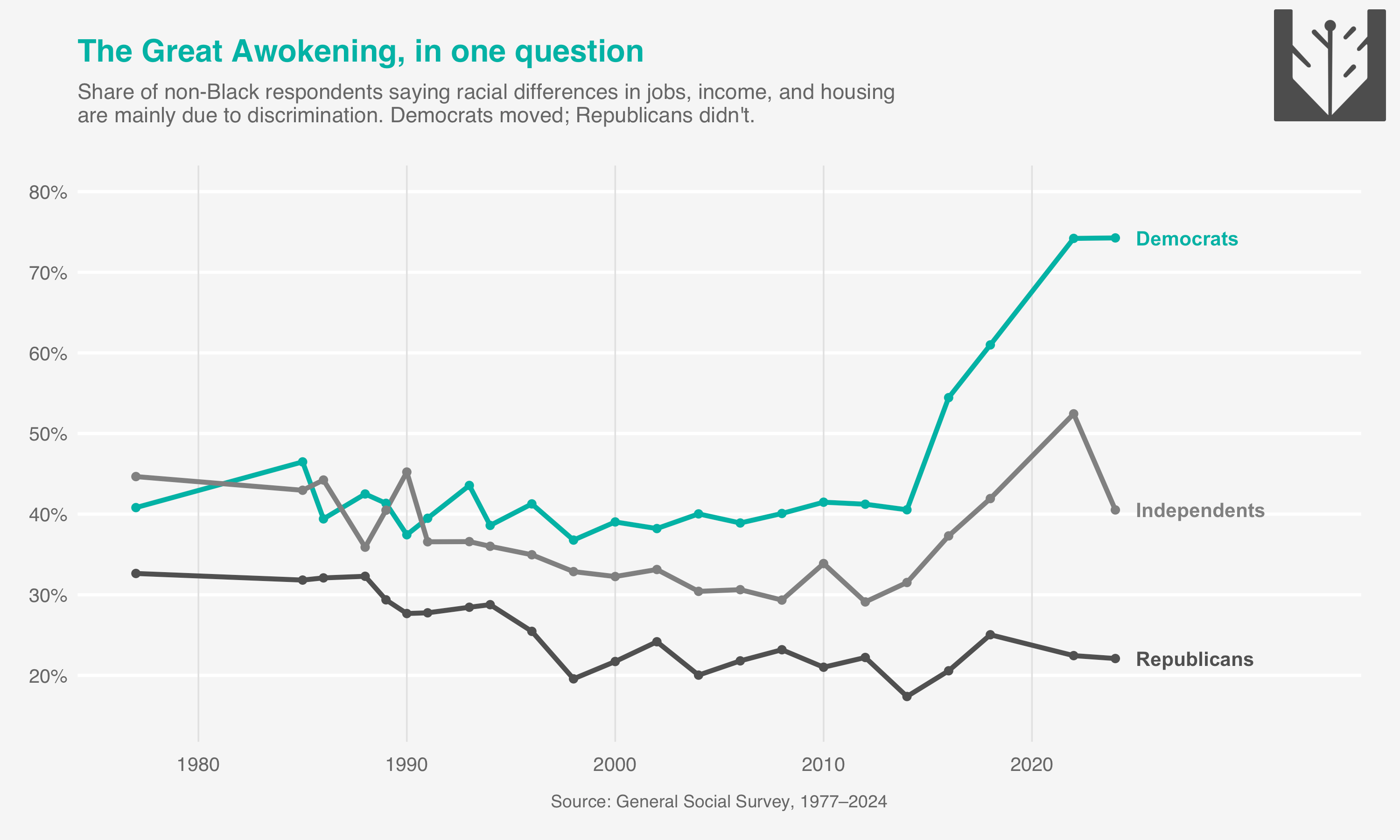
I wrote a big feature for Vox about what I called the Great Awokening back in March of 2019, which obviously was before Covid and before George Floyd. So while the social phenomenon I was talking about clearly reached its apogee 12 or 24 months after I published the piece, the underlying shifts were visible before that. There are a bunch of different ways to characterize what these shifts were, but I think if you want a single clear data point to focus on, I would look at the share of the non-Black population that says “yes” to the question “On the average Black people have worse jobs, income, and housing than white people. Do you think these differences are mainly due to discrimination?”
While 2014 feels like a long time ago now, when I wrote my Great Awokening piece in 2019, it was only five years in the past. And you can see that as recently as 2014, a majority of non-Black Democrats said “no” to this question. The numbers then surged among non-Black Democrats and non-Black independents in the 2016, 2018, and 2022 surveys while Republicans had small increases in 2016 and 2018.
Lots of stuff happened as a downstream consequence of this, and some of that stuff was good and other stuff was bad. You can sort of try to cabin off whatever you think the worst excesses were and call that Woke 1 and then say that whatever you thought was good doesn’t count as woke or is what’s going to be brought back during Woke 2.
If you want to understand how I was thinking about it in 2019, my views were heavily influenced by my understanding of William Julius Wilson’s work. In this view, the big hope for progress in America was that we could secure political support for a race-neutral program of uplift for what he called The Truly Disadvantaged. Late in life, Martin Luther King Jr. had some socialist economic policy ideas that I don’t think worked, empirically, but shared this moral vision of a program that “would benefit all the poor, including the two-thirds of them who are white.” King specifically described his ideas as “not a ‘civil rights’ program, in the sense that the term is currently used.”
The blockage here, though, was that I recall very clearly back in Barack Obama’s first term that Rush Limbaugh would specifically describe the Affordable Care Act as “a civil rights bill” and “reparations” because delivering health care to low-income families does disproportionately benefit African Americans. That’s a classic mode of American politics, right-wingers using divisive racial rhetoric to undermine white support for the social safety net. My optimistic read of the Great Awokening was that declining anti-Black sentiment in the white population was going to undermine this style of right-wing politics: that rather than viewing anything that helped African Americans as inherently suspect, white Americans were going to be increasingly open to seeing their fellow citizens as fellow citizens regardless of skin color and wanting to help people in reasonable ways.
Now that we are in the post-woke era, I also think it is important to recall that overt advocacy for racial discrimination as a law enforcement strategy used to be pretty mainstream in American life. People would say that, well, if it’s statistically accurate that Black men are committing crimes at a higher rate than white ones, it is correct and appropriate for law enforcement to target people on that basis. This is, I think, a very demeaning, dehumanizing, and socially corrosive way to manage public spaces. And a clear implication of the Great Awokening was that we should move away from it.
To an extent, I think those good things have in fact happened and that’s good. But during “Woke 1” we also got a ton of turbocharged, totally thoughtless disparate-impact analysis. The most infamous example was the argument that if African Americans are disproportionately represented among the population of people who get arrested, that shows that the practice of arresting people is racist and so we shouldn’t have police. This style of thinking had, obviously, disastrous consequences for people who lived in crime-prone neighborhoods and delivered a disproportionate negative impact on precisely the Black communities it was intended to help. But the bad inference about crime and law enforcement was not the only example of this kind of sloppy thinking. And, unfortunately, I think a structural increase in sloppy thinking due to viral content distribution is very much still with us even though this specific mode of thought has become unfashionable.
Incidentally, for the young people out there who don’t even remember what pre-Awokening Democrats sounded like, here’s Obama at a Black church in 2008 talking about how fathers are “missing from too many lives and too many homes,” scolding parents about how they need to not “just sit in the house watching SportsCenter” and “don’t get carried away with that eighth-grade graduation; you’re supposed to graduate from eighth grade.” As Julie Bosman wrote at the time, this kind of thing made frequent appearances in Obama’s rhetoric:
The address was not Obama’s first foray into the issue. On the campaign trail, Obama has frequently returned to the topic of parenting and personal responsibility, particularly for low-income black families. Speaking in Texas in February, Obama told a mostly black audience to take responsibility for the education and nutrition of their children, and he lectured them for feeding children “cold Popeyes,” a reference to a chain of fried-chicken restaurants, for breakfast.
“I know how hard it is to get kids to eat properly,” Obama said at the time. “But I also know that if folks are letting our children drink eight sodas a day, which some parents do, or, you know, eat a bag of potato chips for lunch — buy a little desk or put that child at the kitchen table. ‘Watch them do their homework.’”
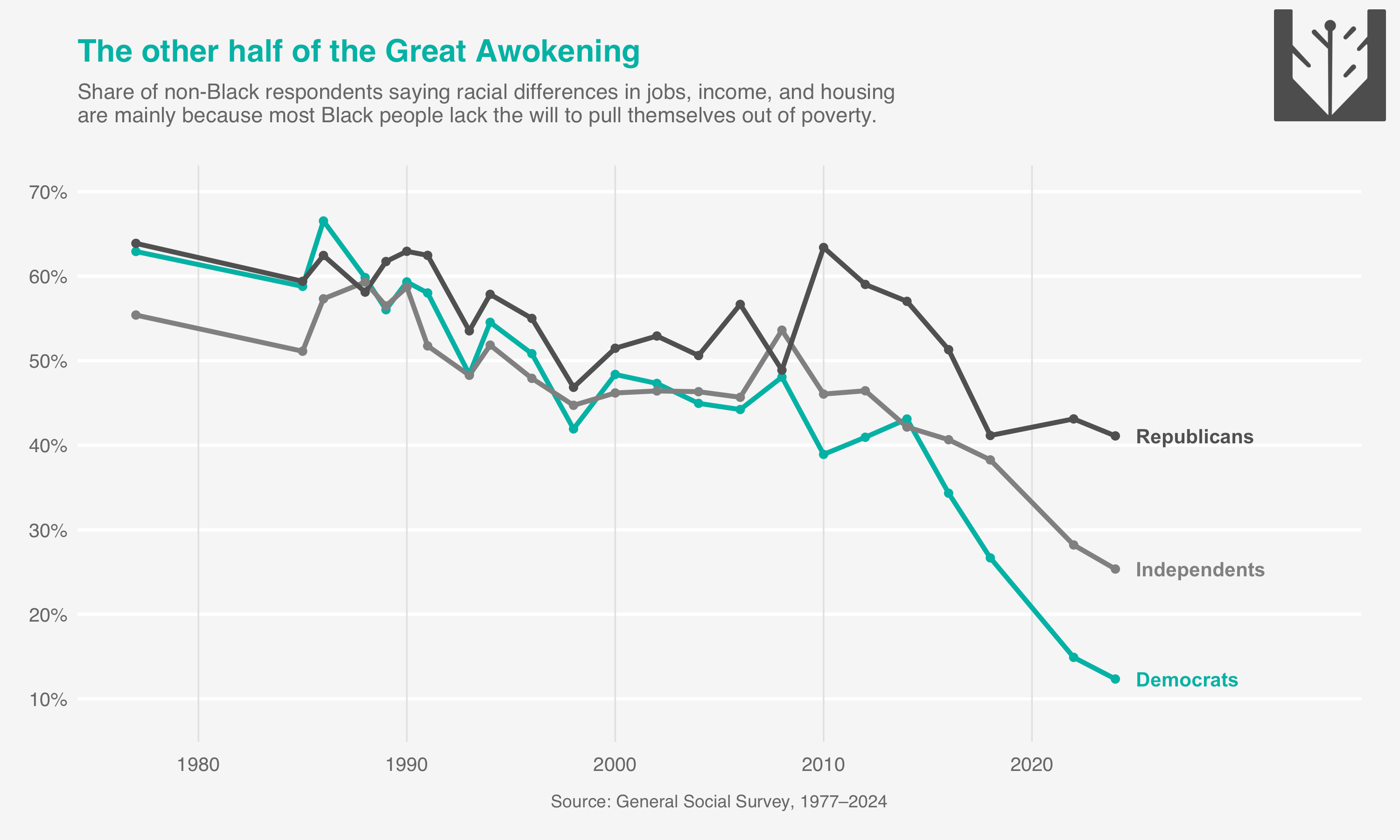
This was a frequent bone of contention between Obama and more progressive African American intellectuals. Ta-Nehisi Coates really didn’t like it and Nia-Malika Henderson wrote an insightful piece about Obama shifting away from it in his second term as the Awokening was gathering steam. The change, obviously, isn’t that now Democrats think cold Popeyes and potato chips are healthy. But it used to be that a majority of non-Black Americans favored willpower-based explanations for disparate racial outcomes and support for that collapsed, especially among Democrats, starting after 2012.