

As we get closer to Election Day, it feels a bit like entering the event horizon of a black hole, at least from an analytical point of view.
Back in June of 2025, I think I was able to offer important and useful observations about the upcoming midterms. My key theme was that given the intensification of Donald Trump’s assaults on the pillars of the American republic, a 2018-style rebuke in which he actually gained Senate seats would not be sufficient to give us even momentary relief from the crisis.
The stakes were elevated by the fact that while it’s easy to look at the 2026 Senate map and simply proclaim it unfavorable for Democrats, the 2028 and 2030 maps aren’t any better. Given the American political alignment that emerged in the 2016 / 2020 / 2024 cycles, there simply are no favorable maps — even Joe Biden’s very strong popular vote performance in 2020 only carried 25 states.
There is no way to rescue the country without Democrats becoming meaningfully competitive in multiple states that Trump won three times in a row.
I argued that summer that to achieve that, Democrats would need both to be smart about candidate recruitment (which they basically have) and to reposition the national party’s image (which they really haven’t). I did not specifically discuss the possibility that Trump would fall into the surprisingly common G.O.P. trap of initiating an economically destructive war in the Middle East, though I did tell everyone in November of 2024 that Trump’s team seemed like people who would start a war with Iran.
From the standpoint of today, though, all I can really do is look at the polls, and all anyone really wants to know is whether the polls are correct.
And I just don’t know.
What I do know is that they’re annoyingly close. Marist’s latest Texas poll has James Talarico up by two. If he instead loses by one, they’ll say that they were pretty close. But if the current narrow Democratic leads in Texas and Alaska and Iowa and Kansas and Maine and Michigan all turn into narrow Republican wins, that’s a wildly different outcome for the country.
So which will happen? I don’t know. Do prediction markets give us strong evidence independent of the polling? Not really — the markets just tell us that assuming the polls are approximately right works pretty well on average. There’s just no further insight to be gleaned about the thing everyone wants to know.
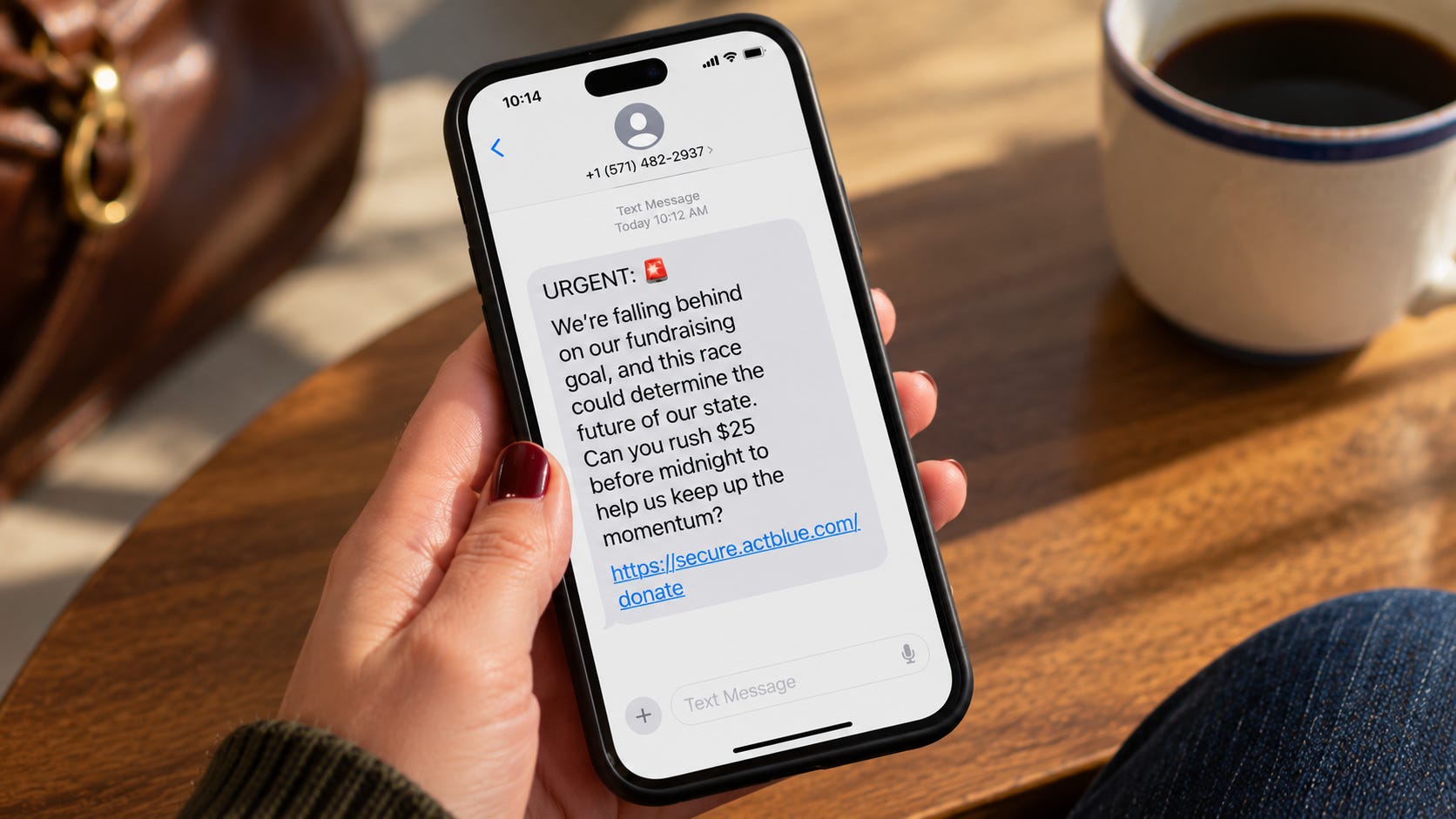
What I do know, though, is that like many of you during these final weeks, Slow Boring HQ is being inundated with last-minute requests for money, including this rather absurd request from Massachusetts Governor Maura Healey:
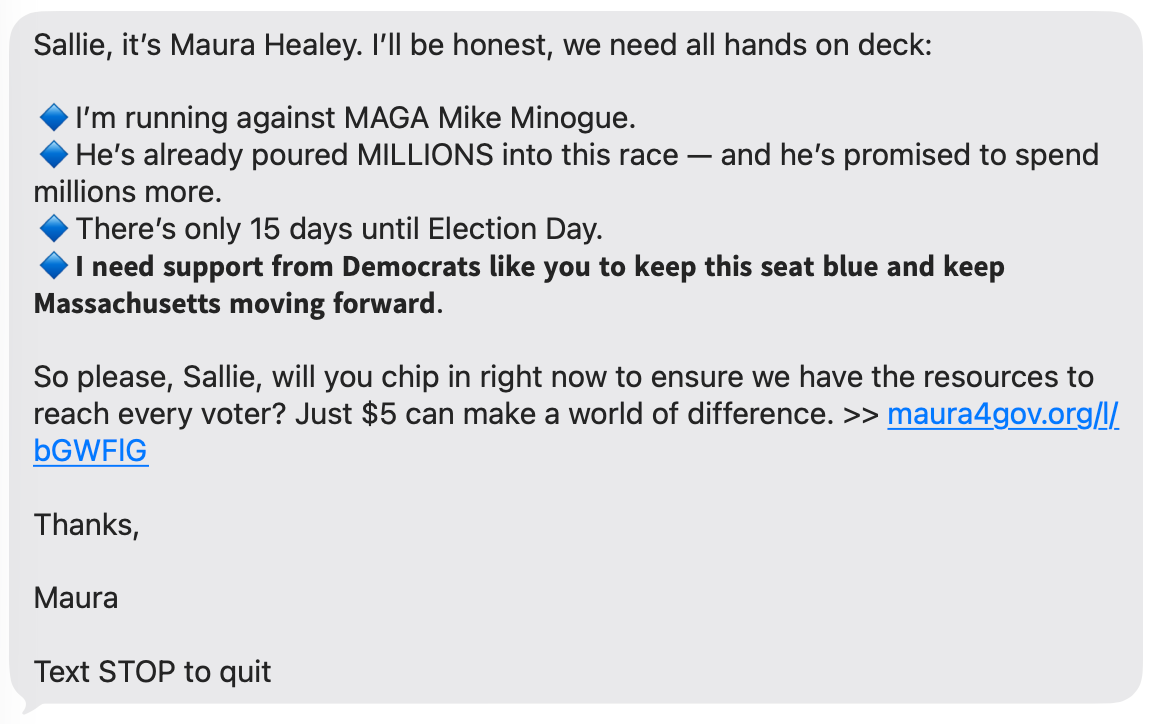
There’s a broad spectrum of sketchy fundraising behavior, from outright scams to bad ideas, and I think this is something that Democrats should think hard about, structurally, over the next several cycles.
While the strong alignment of America’s billionaire donors behind the MAGA movement is a potentially enormous problem for Democrats, the saving grace is that Democrats do a lot better in small-dollar fundraising and, for various legal reasons, a contribution of $5 to Josh Turek accomplishes more than the $5 Elon Musk spends on behalf of Ashley Hinson. But to maintain this advantage, Democrats need to avoid exploiting or misleading their own small donors. People who make these kinds of contributions are not getting kickbacks via government contracts and need confidence that fundraising appeals are being made in good faith.
Do not give $5 to Maura Healey
I want to say first that I really like Governor Healey. Kate and I both went to college in Massachusetts and have affection for the state. I met Healey once and found her smart and charming and funny, and I think it’s too bad that she’s never “in the conversation” as an example of an interesting Democrat. She’s also quietly doing abundance (or at least as close as one can in New England), not just on housing but on natural gas, and she’s talking sense on rent control.
I’m a fan. I’m a booster. If she were actually facing a meaningful electoral challenge, I’d be all-in on helping her win.
But guys. MAGA Mike Minogue is not going to become governor of Massachusetts. If you’re doing small-dollar online donations, this is not the race you should be worrying about.
Again, I like Maura Healey. I’m not here to hate. But she is someone who should be supported by good old-fashioned transactional donors. Are you a Massachusetts labor union? Be a good soldier and chip in. Do you work in government affairs for a company that has business interests in Massachusetts? Could be smart to make a donation. You’re an actual friend or acquaintance of the governor or a senior member of her team? Sure.
But there are tons of people in the United States who are — rightly — acutely frightened about the state of our country. Recall that in the winter of 2020-21, Donald Trump made a somewhat half-assed but fundamentally genuine effort to overturn the results of a legitimate presidential election. People committed crimes in pursuit of this cause! Trump is utterly unapologetic about the attempted putsch, pardoned the criminals who tried to carry it out, and has self-consciously staffed his second administration with people he believes are more personally loyal to him.
Democratic Party senators routinely embarrass appointees to executive and judicial branch jobs by asking them who won the 2020 election, and the appointees always dissemble about it. Trump has been doing political purges of the military officer corps and overtly abusing the prosecutorial functions of the federal government. And a large fraction of the wealthiest and most powerful figures in corporate America have chosen to bandwagon behind him.
The good news is that the public seems sick of Trump. The bad news is that the sickness really does seem to be largely contingent on things like gasoline and diesel prices, not revulsion at Trump’s hostility to democracy and the rule of law. Those of us who are revulsed by this incredibly alarming situation need to be smart with our resources, not throwing them at dumb stuff like defeating MAGA Mike in Massachusetts.
Waste, wishful thinking, scams and cons
Obviously I think this is the optimal list of people to give money to. But there’s a broad “reasonable people can disagree” range here. I want to see more candidates like Josh Turek in the future rather than more candidates like Abdul El-Sayed, so Turek is on my list and El-Sayed is not. If you have the reverse preference about future candidates, it would make sense to reverse those choices. If you’re indifferent, then both races are important and both could use money.
I’m also recommending campaigns that I think are underfunded at the margin. James Talarico is a monster fundraiser, so I didn’t put him on my list, but it’s not like giving him money is a mistake — I just feel confident that lots of other people are doing it.
Outside of the core battleground races, a lot of people have been urging some fairly undisciplined behavior.
I have no problem with Scott Colom, who’s running for Senate in Mississippi. But the idea that additional fundraising is going to help Democrats flip this Senate seat doesn’t seem remotely credible to me — this experiment was tried with Jaime Harrison in South Carolina and Amy McGrath in Kentucky in 2020. I’ve had to not recommend gubernatorial candidates I like, including Jonathan Kreiss-Tomkins in Alaska and Aaron Ford in Nevada, just because I don’t think the races have large strategic implications for people who don’t live in those states. But that’s a judgment call. If you have some connection to those states or candidates or think there’s some angle I’m missing about the larger significance of the races, then fair enough.
The gubernatorial races in Texas and Florida, by contrast, have big strategic implications in terms of redistricting and just the large size of the states, but putting money into them seems like wishful thinking to me. Still, while I don’t think any of these races are a particularly good use of money, these are things people of good faith can disagree about.
A lot of this is just misdirected enthusiasm. But there’s also the reality that people make money off of political campaigns. There are vendors and consultants who have contracts with David Jolly or Gina Hinojosa, and they benefit specifically from donations to those candidates rather than other candidates, even if other candidates would be a better use of your money. And most people — even highly trained professional political pundits like me — don’t have visibility into the web of financial relationships connecting different people and institutions.
And that’s to say nothing of outright scams, like PACs that say they’re supporting candidates but mostly just fund themselves. Take a look at Politico’s description of End Citizens United:
The group has continued to promise in fundraising appeals aimed at small-dollar donors that their money will go toward boosting Democratic candidates and fighting to overturn the Citizens United decision. But its primary PAC spent four times as much on operating expenses as it did on donations to candidates and independent expenditures during the 2024 cycle, according to a Politico analysis of data from the F.E.C. As of the end of March, it has spent more on fundraising costs than at this point in any previous cycle.
I think Adam Bonica’s pieces about “spam PACs” paint with way too broad a brush in collapsing the distinction between actual scams and just the basic architecture of online fundraising. But beyond the fact that some of these PACs are genuine scams, the broader point I would make is that I can’t think of any good reason why it would be better for a small-dollar online donor to funnel their political giving through a PAC.
It’s not that all PACs are scams, but if you want to raise small-dollar donations for a finite universe of candidates, you just don’t need a PAC to do that. The Slow Boring slate (which I really do recommend you give to — yes, late money is still helpful!) is just a page with donation buttons for the candidates. All the money goes to the candidates we’re supporting; there’s no legal or financial entity between you and the candidates. There are plenty of valid reasons that people launch and give money to PACs, but these reasons involve large donors and lobbying machinations.
If you have modest sums of money to give and just want to help good candidates win, then give directly to those candidates.
I don’t know exactly what the party can do to crack down on bad PACs or fundraising solicitations from candidates like Healey who are way outside the “reasonable people can disagree” standard for optimal donations. But they’d better start thinking harder about it. Keeping the small-donor engine running is vital to keeping Democrats in the game electorally, and that means giving donors some assurances that their money is being well spent.
I report as spam and block the nearly a dozen a day fundraising texts I get. I think the DNC should launch a subscription service where at a certain level you don't get any texts at all! (Sarcasm)
Also your Mehdi Hasan interview is an incredible scissor of the American left wing. I found him to be a smug prick who was hilariously wrong about many things (Gaza and Iraq are not the top two, Iraq maybe top ten, Gaza objectively barely top 25, foreign policy events of the last 25 years) and he showed absolutely zero grace in both that you have openly acknowledged your stance on the Iraq war and admit when you're wrong (even ceding that maybe you tweet too much about dumb stuff!) I thought Hasan was a graceless jerk. Thanks for sticking it out.
There's quite something to be said about a group that says it's devoted to curtailing campaign spending ending up doing scammy campaign spending.
But while I do agree with Matt that scams are worse than spam, the spam is still really bad, too. It risks being countereffective in turning off people permanently in the long run for only the benefit of hooking people in in the short term. I've never donated to a political campaign of any kind, and when I see this yapping maw of spammy begging, it makes me less likely to ever do so.