


The sheer scale of the 2026 blue wave — an anti-MAGA swing large enough to carry Democrats in places like Mississippi and South Carolina — poses a question of democratic theory that I think is a lot more interesting than the tired empirical debates about moderation. What should a person who won somewhere they “shouldn’t” have do with their term (or terms) in office, knowing that it’s objectively unlikely that the terrain will be as favorable in future cycles?
My perception is that most mainstream Democrats adhere to an ethic I would call Pragmatic Progmaxxing.
They understand that Ayanna Pressley tweeting about reparations is bad politics, that politicians like Josh Turek and James Talarico are going to have to stay away from 100-proof left-wing politics, and that even Abdul El-Sayed needs to do some picayune localism related to the auto industry. But their basic orientation is as intense policy demanders who are trying to maximize the amount of progressive change by pushing elected officials to be as left-wing as they can possibly get away with.
Pragmatic Progmaxxing has especially interesting implications for the people who won the real reach seats. From a Progmaxxing point of view, you accept a certain amount of moderation from Sherrod Brown and Roy Cooper so they can win re-election. But Scott Colom needed a D+13 national political climate and an amateur hour opponent to barely win, so he should just give up and vote like Ed Markey. It’s basically a free Senate seat for six years.
I want to push back against this.
I think American democracy has been in a really dangerous place for the past 10 years. That’s proximately due to Donald Trump and the MAGA movement. But the intense policy demanders have been creating an underlying structural weakness by framing thumbing your nose at your constituents as noble and trying to be a loyal servant of the people as cowardly.
I would like to see Colom and Annie Andrews and the couple dozen House Democrats who won deep red seats make a good-faith effort to represent their constituents. That doesn’t mean they answer every policy question with a poll of public opinion in Mississippi. But it does mean they have to take seriously the question of whether a particular piece of legislation aligns with what their constituents are asking for. Because it’s not “brave” or “fearless” to ignore the public will in order to curry favor with your side’s interest groups. That pattern of behavior has made voters cynical about the democratic process, eroded faith in party politics, and given us the bad phenomenon of “safe seats” where the incumbents barely even care what’s happening.
To the extent that newly elected members run big political risks, I hope they look into their own hearts about what motivated them to run for office as Democrats at a time when large swaths of the business community were deciding to bandwagon with the MAGA movement. My guess is that in most cases, the Democrats who ran in 2026 were both aware that the “save our democracy” messaging of 2024 was not persuasive and also (rightly) believed in the merits of that messaging.
If I’m right about that, I think the best way to behave consistent with that ethic is to:
Fight for democracy by being willing to take risks to hold Trump and his cronies accountable for violations of the law.
Practice democracy by acting as if you care more about the policy views and interests of the voters in your constituency than the views and interests of ideological donors and the groups.
My fear is that in practice the opposite combination is more likely. The Democratic base is in some sense very fired up about the issues in bucket (1). But in terms of concrete political power — campaign dollars and the endorsements that can win you primaries — it’s all about the greens and the labor unions and the civil rights orgs and the child care advocates and the immigration lawyers.
If you feel that you need to break with party leadership on something, the thing you’re most likely to get latitude on is Trump accountability. This is more or less “how things work” in the modern era of American political parties — they demand a lot of party loyalty on votes about policy ideas — but it’s terrible for the country.
The nobility of winning
In his classic 1974 book “Congress: The Electoral Connection,” David Mayhew says we should understand members of Congress as single-minded seekers of re-election.
In a world where that’s broadly true, it’s also true that when a member of Congress deviates from the rule, that’s usually driven by courage and prescience. All of your colleagues are looking at the Voting Rights Act through the narrow lens of re-election, but you decide that the most important thing is whether you can tell your granddaughter that you did the right thing, so you vote yes. Maybe you lose in 1966, maybe you don’t. But either way, it’s the right thing to do.
It’s important to understand, though, that a lot has changed since then. American political parties used to be basically patronage operations whose business model was winning elections so they could hand out jobs and contracts. Around the time that Mayhew wrote his book, these old patronage parties were dissolving in the face of amateur political activists who were rapidly forming professionalized issue-advocacy groups.
Those groups have now formed into quasi-stable coalitions that are aligned with and finance the political parties. The business model now is to deliver wins for intense policy demanders. And to accomplish that, you do need to win power sometimes — it’s Pragmatic Progmaxxing, not doctrinaire left-wing politics — but that’s quite different from Mayhew’s singular focus on winning.
Similarly, just being a member of Congress has become a significantly less elite job even as high-end income inequality has exploded. I wouldn’t say anyone is deliberately losing elections just for the pay raise, but it’s objectively true that going down in defeat and then becoming a media personality or a senior fellow at the Center for Pragmatic Progmaxxing is going to mean your living standards go up rather than down.
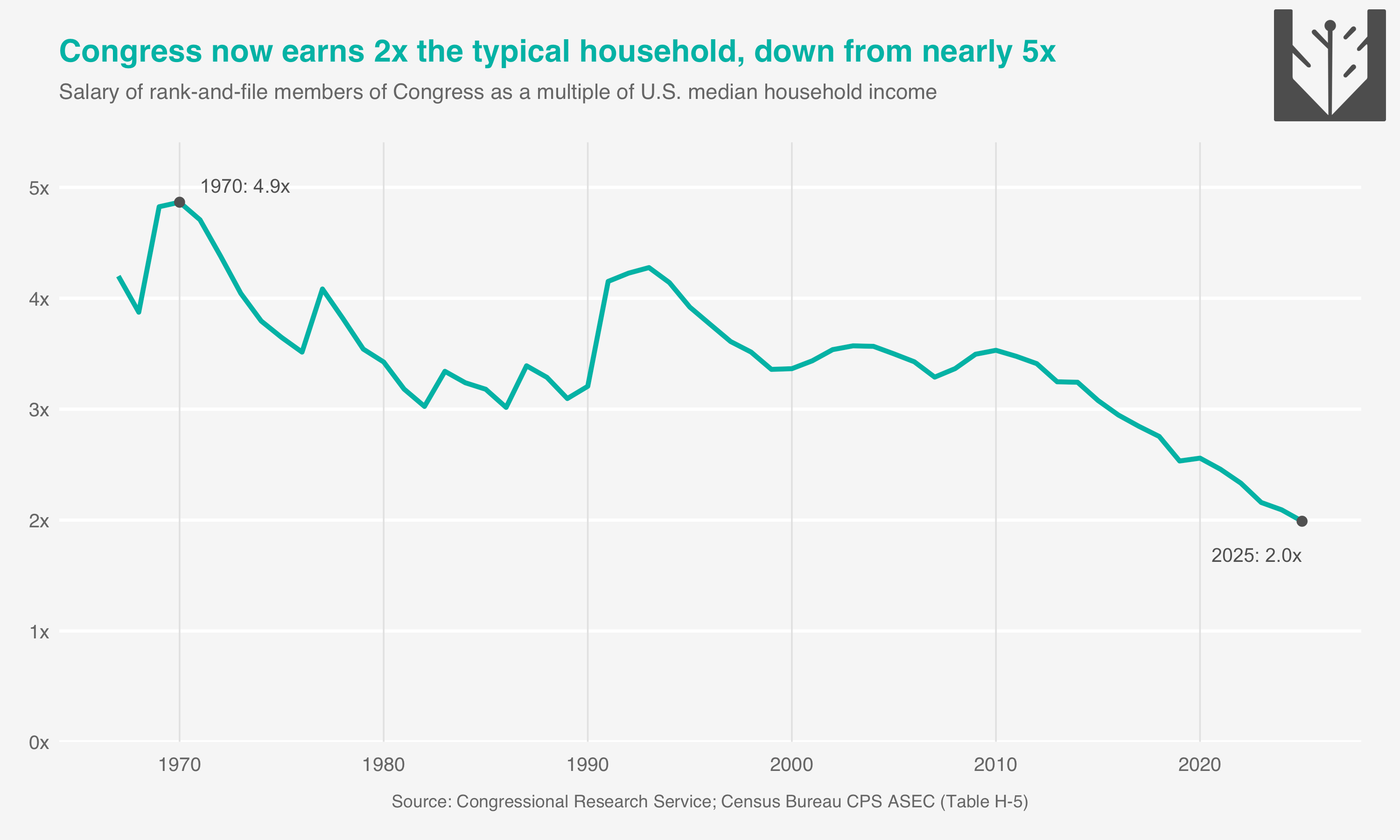
In this post-Mayhew universe, it’s of course still possible for a member to risk their re-election prospects for the sake of a transcendent moral cause.
But we don’t actually have any issues that are as titanically significant as civil rights. And I would say a much more typical case is a situation like the 2025 Congressional Review Act vote to disallow the state of California from imposing a de facto ban on internal combustion engine cars.
Electric vehicle mandates are unpopular, Republicans were unified on it, and it’s not filibusterable, so how individual Democrats voted had no relevance to the outcome. As a result, a few dozen vulnerable House Democrats broke with their party to vote with the Republicans. Notably this included three of the six House Democrats from Michigan — Shri Thanedar, Hillary Scholten, and Kristen McDonald Rivet — because the Michigan-based auto companies are laggards at E.V. manufacturing compared with Kia/Hyundai and Tesla, so they would be particularly disadvantaged by what California wanted to do here.
Notably, though, Haley Stevens did not defect. She was, at the time, prepping her Senate run and courting establishment support. And the Democratic Party establishment is, contrary to myth, actually quite left-wing and pressures elected officials to cast progressive votes even on meaningless bills.
There was a fair amount of anger from the green community that Hakeem Jeffries didn’t whip the vote harder, and pressure was brought to bear on Chuck Schumer to get his frontliners to all cast meaningless no votes against a popular resolution. Schumer succeeded in getting every single Senate Democrat except Elissa Slotkin — even the retiring Gary Peters — to do this before putting Stevens up as his electability choice in Michigan.
I think that in this case, the real courage was shown by Slotkin and Rivet and the others who deviated from the party line, standing up to out-of-state bullies in order to serve their constituents’ interests. I think it’s crass to act like Stevens and betray your constituents in an effort to climb the intra-party ladder or to act like Peters and just kind of give up on your state on the way out the door. There is no organized interest group of “Americans for Being Able to Buy a Normal Car if I Want to,” but it’s better to align with the actual views of the people you represent than to be feted at a League of Conservation Voters dinner.
Defend — and practice — democracy
Senator-elect Adam Hamilton said on television shortly after the election that he’d be disappointed if Democrats spend all their time in the new Congress investigating Trump rather than focusing on the critical cost-of-living issues that were decisive to marginal voters.
I don’t think you can save democracy from the MAGA movement without practicing democracy, so it’s perfectly correct for Hamilton to emphasize cost of living in his public presentation. That being said, while I’ve never met the guy and have no access to his private thoughts, I feel like it would be strange if a successful minister risked his career on a longshot Senate bid primarily because he was personally outraged by the price of ground beef.
My guess — and I freely admit it’s just a guess, but I think I’m right about this — is that he was concerned about the state of American democracy.
Both Mary Peltola and Sherrod Brown considered running for governor, races where it would be easier to achieve separation from the national Democratic Party brand, but Schumer talked them into running for Senate instead. When he did that, did he appeal to the idea that they’d have more influence over grocery prices as senators than as governors? That just doesn’t seem true, analytically, and it also seems kind of implausible as a motivation. I bet he appealed to them as patriots about the need for a check on Trump’s powers.
The good news is that fighting to hold Trump accountable doesn’t involve any genuine tradeoffs with fighting for policies that improve affordability.
What it does involve is a modicum of political risk for people representing districts that voted for Trump three times. I think it’s a risk that’s worth running because it’s genuinely the most important issue of the day — and, again, because it doesn’t trade off in a substantive way against making progress on affordability.
But guess what does trade off? A lot of intense policy-demander priorities. There are, of course, ways to fight for affordability that amount to just fighting Trump — reduce tariffs, end the war in Iran — but ideas like fiscal discipline, Jones Act repeal, biofuel waste, or prioritizing cheap energy over green fundamentalism require conflict with Democratic Party interest groups.
You can’t take the politics out of politics, and obviously Turek isn’t going to go against corn farmers and El-Sayed and Slotkin aren’t going to advocate for Chinese E.V.s. But I think everyone holding down a tough seat should try to be really rigorous about prioritizing the cost of living over Democratic Party interest-group slop and then also be really rigorous about protecting democracy and the rule of law.
These folks should also try to practice democracy on the cultural issues. There’s a kind of thin consensus around “focusing on” affordability, but the fact is, most of these red-state senators staked out a view or two on cultural issues that would have gotten them canceled just a year earlier.
For the most part, the groups seem to have held their fire on this stuff, hoping that vague remarks don’t necessarily commit anyone to anything specific on policy. But I think policymakers should look at representing their constituents’ authentic views on guns, or on who plays on which sports team, or on how many refugees we let into the country. There is such a thing as a fundamental question of human rights, but most of the specifics on this stuff genuinely come down to judgment calls, and voters in places like South Carolina and Mississippi deserve to have their values represented in Congress without being forced to support thuggish authoritarians or corrupt plutocrats to get that. And I think part of stabilizing the democratic system is giving voters less polarized options.
The genuinely hard part of democratic politics, I think, is that you need to navigate around ideas that people like but that would backfire if you implemented them.
I’m sure a lot of people think they love the idea of price controls to bring down the price of beef. But if you implemented them and beef vanished from supermarket shelves, they’d be mad about that.
Alternatively, sometimes there’s an idea that really would accomplish a popular goal, like variable pricing of electricity to bring down average bills, but voters hate the idea. I’m not sure there’s a simple rule about how to think of these dilemmas — figuring out how to strike the right balance is where true statesmen make their bones.
Broadly speaking, though, I don’t think politicians or their staffs or journalists who cover them should view a Mayhew-like focus on securing re-election as ignoble or cowardly. Americans liked the relatively unprincipled midcentury political parties a lot more than they like today’s polarized, highly ideological ones. Real political courage is trying to be a genuine steward of your constituents’ interests rather than acting as a proxy for intense policy demanders or the preferences and priorities of the staffer class.
I think in the 70s the nascent Groups did in fact have more of a bead on public sentiment, and were actually able to not just raise money but mobilize real political support. They're much less relevant politically now, and I bet the more electeds defy the Groups the more they'll learn that the Groups are pretty toothless now. Hopefully.