

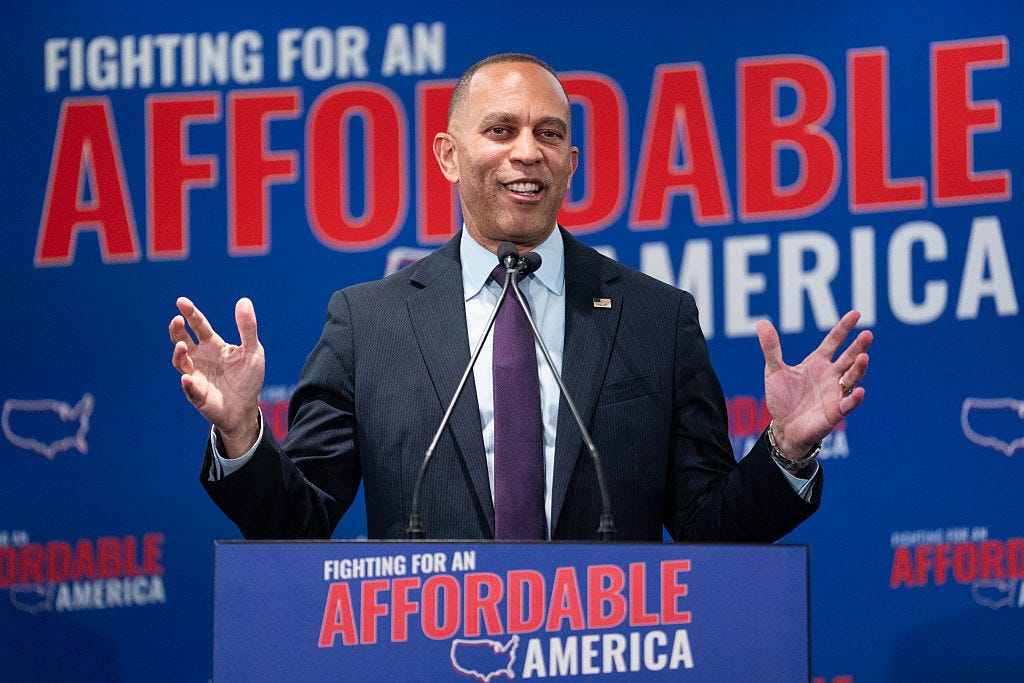
As a naturally disputatious person, I was a little bit annoyed by how good the vibes were at last week’s “What’s Next” conference from the Majority Democrats. Annoyed in particular because I suspect that many of the Democrats who believe they’ve reached consensus around ideas like Democrats need to be “laser-focused on affordability” don’t actually agree with each other.
Or, rather, that what they have agreed upon is a slogan rather than a plan.
Words are, after all, tricky things and full of different kinds of ambiguities that clever sloganeers exploit. The way that politics works is that participants in political debates talk about highly technical policy areas while simultaneously trying to communicate with normal people who are not versed in technical jargon.
Doing this effectively is a real skill. But a lot of the skill resides precisely in not being clear about exactly what you mean.
For example, back in John Fetterman’s 2022 campaign, when he was a progressive hero, he used to say that he was determined to “make more shit in America” as part of his solution to inflation. Part of what made this turn of phrase so good is that it’s ambiguous between an abundance-flavored agenda of supply-side reforms and a protectionist agenda of tariffs. If a writer turned in a piece to me that was ambiguous in that way, I’d ask them to try to be clearer about what they’re saying. But in politics, it’s good to be unclear. And while obviously Fetterman has fallen out of favor with the left, the consultants behind him also worked on the Zohran Mamdani, Graham Platner, and Abdul El-Sayed races and continue to be quite skilled and influential, not least in popularizing “affordability” as an alternative to “inflation.”
What’s good about this term, though, is precisely that it’s less clear.
In a campaign speech or ad, it’s optimal to find terms that resonate with large groups of people while being vague in their specific implications. But if you’re trying to reach consensus on a policy agenda, you need to actually work through the disagreement, not find turns of phrase that cleverly paper over it.
Multiple approaches to affordability
If we took the term “affordability” literally, I think it would mean something like what economists call “real income.” In America, for example, cars are broadly affordable — it’s more common for a family to own two cars than to own zero — even though cars are expensive. Incomes are high enough that people can afford them. And, indeed, Americans of 2026 can afford more (and better) cars than they could afford in 1986 or 1956. In India, by contrast, incomes are low, so most people can’t afford cars.
This definition has two virtues. One, I think, is that it makes a lot of sense as a question of technical economics. Would you prefer a world where you earn $250,000 and a burrito costs $20 or a world where you earn $65,000 and a burrito costs $9? Rationally, it’s clearly better to be in the former world.
The other is that in terms of progressive politics, “affordability as real income” lends itself to some obvious policy fixes.