

It’s that time of year again! Please join Slow Boring, along with all of your favorite Substackers, as we try to raise $1,000,000 to help some of the poorest people on the planet. If you’re already familiar with GiveDirectly, I hope you’ll click the button below to support their efforts in rural Rwanda. If you’re not, read on for more about what they do, why we’re such big fans, and how you can get bonus Slow Boring content by donating today.
One question that I did not answer in last week’s mailbag column had to do with the extent to which my political beliefs hang on big, deep, hard-to-answer questions.
At the time, I wasn’t really sure what to say to that. But after considering it for a few days, I think I’d say that the best approach to life is to try to orient your thinking around ideas that you have really high confidence in, rather than making high stakes bets on difficult puzzles.
One of the most fundamental facts about the world is the declining marginal utility of money. Which is to say that while almost anyone would be happy to find a $100 bill on the floor, how much actual difference it would make to your life is largely a function of how much money you already have. That $100 makes a lot more difference to people who in a whole year live on less than $1,500 than it would to an upper-middle-class American.
To return to the mailbag question, how we generate sustained long-term economic growth is an extremely important question, but it’s also a pretty hard one. By contrast, the question of whether your personal financial contribution to a very poor person in a very poor village in a very poor country would make humanity better off on net is a pretty easy one.
Veteran Slow Boring readers know where this is going: We are, once again, asking for your help on Giving Tuesday as we raise money to support GiveDirectly in their efforts to deliver unconditional cash transfers to some of the poorest regions in Rwanda.
Slow Boring veterans will also know that as this fundraiser has grown — from a brief mention in our Giving Tuesday post in 2022 to a nearly one-million-dollar effort in partnership with other Substack writers in 2024 — our readers have consistently been the most generous. In both number of donors and total money raised, you have always gone above and beyond.
But this year, we managed to talk The Bulwark into joining. That’s fantastic because they’re a good publication with a large audience, and I hope their participation will help raise a lot of money. Our goal this year is an ambitious $1,000,000, and frankly we need all the help we can get.
I am also afraid that they’re gonna beat us.
Shallow vanity is not really the point of this exercise, and yet I cannot totally avoid such things, so please don’t make me look bad! We’ve got higher minded arguments below, both on the merits of the work GiveDirectly is doing and our moral case for being a person who does things. But if you, like us, enjoy a little old fashioned competition, don’t hesitate to click the button below now to ensure that the Slow Boring community once again emerges victorious.
It’s surprisingly easy to help people
For those of you who are new or forgetful or perhaps just less motivated by inter-Substack rivalries, let me back up.
GiveDirectly is an anti-poverty organization that runs a number of programs in the U.S. and overseas, all built around providing low-cost, low-friction direct cash transfers.
The program we’re supporting today is their poverty relief program in Rwanda. As recently as 2010, a majority of the world’s deeply poor lived in Asia. Today, that’s no longer the case. The number of people living in extreme poverty has fallen dramatically — from about 2.3 billion to about 800 million — over the past 35 years, thanks largely to economic growth in China and India and nearby countries. Now, the world’s poorest populations are heavily concentrated in Africa where, unfortunately, economic growth has been slower.
The poorest countries don’t just contain a large number of poor people — in most, an extremely large fraction of their population is poor.
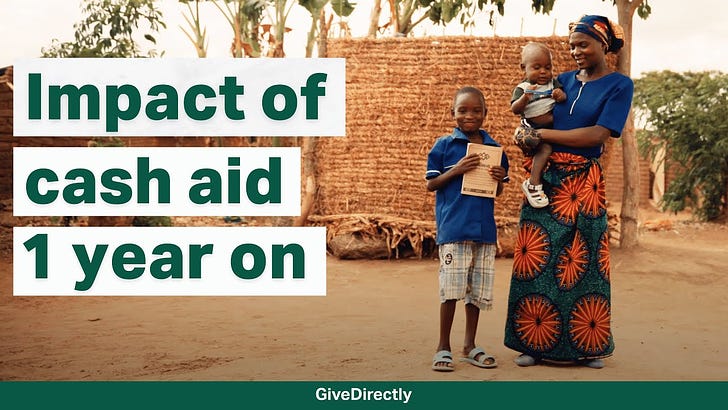
And this is partly what drives GiveDirectly’s anti-poverty strategy. The organization works in low-income countries, including Kenya, Malawi, Mozambique, Rwanda, and Uganda, to identify villages where a large majority of the population is very poor by global standards. They then enroll the entire population of the village in the program, using mobile banking to transfer approximately $1,100 to each household in town.
This transfer boosts recipients’ short-term living standards, minimizes logistical complications and perverse incentives, and, optimistically, is a kind of shot in the arm to the local economy. After all, one problem with being desperately poor and also surrounded by other desperately poor people is that even when you have useful goods or services to sell, no one can afford to buy them.

Cash transfers offer a quick and clean solution, and while they’re certainly not a panacea for the problems of African economic development, they do appear to work.
GiveDirectly has the infrastructure and capacity to deliver more than $250 million to some of the poorest people in the world this year, but they anticipate only having about $90 million to give away. There is tremendous under-used capacity here, and one of the things I really like about the cash transfer model is that even if they were getting close to that threshold, it’s relatively straightforward to bring it to larger scale.
Still not convinced? We’ve written in more detail previously about why we find their work so compelling.
To that end, we hope you’ll help us reach $1,000,000 in Giving Tuesday donations this year, which would allow GiveDirectly to reach more than 800 families across three villages in rural Rwanda.
What’s in it for you?
The best reason to give is to help people, of course, but we want to make it fun and to build enthusiasm for participation, so here’s what we’re offering:
Subscribers1 who make a one-time donation of $500 or more OR a monthly recurring donation of at least $50 will receive six bonus newsletters in 2026. This won’t be typical Slow Boring content, but lighter, more personal pieces. Last year’s donors received movie recommendations and thoughts on parenting, among other topics.
Subscribers who make a one-time donation of $2000 or more OR a monthly recurring donation of at least $200 will, in addition to the bonus content, get a guaranteed answer to a mailbag question in 2026.
Share your receipt with us by Monday, December 8 (you can forward it to kate@slowboring.com), and we’ll add you to the list. If you prefer to write a check or give via a DAF rather than the link above, you’re still welcome to send us a note letting us know that you’ve made a donation.
Solving solvable problems
As I reflect on yet another year’s labor in the discourse mines, I’ve been thinking a lot about the sort of perverse attraction to getting emotionally invested in the world’s least tractable problems.
To return to our original question, these problems are often very serious, and the suffering that they cause is quite real.
But precisely because they’re intractable, thinking about them doesn’t really call you to do anything in particular, other than express to the world that your opinions are correct. I think this is partly what drives the tremendous anxiety afoot about “misinformation” or “the decline of religion,” which are good meaty topics but also don’t actually compel you to do anything differently.
One thing that I think is so appealing about this type of worrying is that the change you’re asking for in the world is basically for a bunch of other people to stop having incorrect opinions and adopt your correct ones instead. And it’s true that many problems in the world — from climate change to the wars in Ukraine and the Holy Land — could be solved in rapid win-win ways if only everyone agreed with me. It’s even my job as a professional political columnist to do these takes, to tell everyone that they should agree with me.
What’s more challenging, though, is to recognize that, on any given day, I could be eating an office yogurt lunch rather than walking to Rice Bar for some bibimbap and giving the money I save to someone who needs it more than me.
And I do feel that I have gotten better at this over the years, but it’s still a struggle because it is, in a sense, never ending. If you live in a rich country and went to a good school and have a good job, there’s always more you could be doing for the world, and it’s more fun and self-indulgent to get mad about other people than to sacrifice. But even though getting mad feels better in the short-term than challenging yourself to actually do something, in the long run you’ll be happier if you live your life with agency and with the knowledge that you can, and do, make a difference in the world rather than just doomscroll.
This offer is, unfortunately, limited to Slow Boring subscribers. Not because we don’t want your friends and family to give too, but because we’re limited by the logistics of emailing this bonus content.
I almost never comment on the substacks, mostly because the rest of you are either substantively smarter than I am or better shit posters than I am.
But I’m breaking with my usual practice to say I donated. I’m wishing a very sincere happy second place to the bulwark.
I like The Bulwark. They play an important role in the media landscape and the fight against Trump. It's also great that they're participating.
But the "slow boring of hard boards" audience just can't lose to the "pro-democracy" audience on this one. Let's show them what we got!