

I don’t really want to spin this out into a huge take, but I do want to flag something that I noticed while scrolling through Nate Silver’s polling averages on February 25:
Donald Trump’s net approval rating was -14.1, just a tiny bit better than the -14.5 he scored at the same point in his first term.
Democrats were up 5.4 points on the generic congressional ballot, which is quite a bit worse than the eight points they were up at this point in 2018.
This might be very consequential. Looking at the states that are key to winning the Senate, Silver’s methodology estimates a generic ballot of R+5 in Iowa and Florida, R+5.3 in Texas, R+5.5 in Ohio, and R+8.3 in Alaska.
I would not take any of those figures to the bank as Senate projections — nobody thinks Democrats have a better shot in Florida than Alaska — but they’re illustrative of the fact that it would not be surprising to see Republicans sweep those races. It’s just really hard for even a totally solid candidate running a totally solid race to run five or six points ahead of the partisan fundamentals. If Democrats were doing as well as they were in 2018, you’d be asking the Dem Senate candidates to run two or three points ahead of the fundamentals. That’s a lot more doable.
So why are Democrats polling worse than they were in 2018?
It’s not because Trump is polling better. Anyone who reads Slow Boring can probably guess what I think the takeaway should be, but I don’t want to start any arguments so much as to platform the observation. Trump’s approval is basically tracking where it was eight years ago, but Democrats in Congress are doing worse.
Patrick Spence: I’m a DC voter who doesn’t want to vote for Janeese Lewis George for fairly obvious reasons, but is genuinely concerned Kenyan McDuffie is a downgrade from Bowser and his responses to the Greater Greater Washington questionnaire don’t make me feel reassured. Is there a case for voting for McDuffie over JLG? What about a case for genuine optimism about what a McDuffie mayoralty looks like?
Michael W: Do you have any thoughts about GGWash’s endorsement of Janeese Lewis George and saying that Kenyan McDuffie is weak on urbanism issues? I know from your tweets that you are pretty skeptical of George on those issues.
McDuffie is not a dynamo of charisma and his entire political persona and communication style is geared toward older working-class African Americans, so a huge share of people who I know personally are in the camp of “afraid of Lewis George and also afraid that McDuffie doesn’t have the juice.”
I think this may actually be bullish for McDuffie, because it indicates that he is making soft inroads with people who are vibes-wise more drawn to Lewis George. I also think Greater Greater Washington has had a borderline-inexplicable affection for Lewis George that dates back to when in 2024 they strongly endorsed her over an opponent who was identical on housing (while they refused to endorse Brooke Pinto in Ward 2 for no reason) and that they’ve done him dirty to an extent.
But I’m not sure. I’ve never met McDuffie, but I think I’ll have a chance to talk to him soon, so I reserve the right to change my mind in either direction.
Here’s the affirmative case I would make for him right now, though. If you read Meagan Flynn’s Washington Post article profiling the launch of his campaign, he has a completely correct diagnosis of the actual specific problem facing the city right now.
Every central city in America was dealt a negative shock by Covid and remote work. But then just when cities should be trying to recover from that shock, D.C. was hit by a secondary wave of negative economic shocks coming from DOGE and congressional Republicans.
Under the circumstances, jobs number one, two, three, four, five, six, and seven for the city government have to be doing whatever’s possible to improve the economic growth environment for the city. McDuffie is a progressive person who cares about inclusion and equality, and so am I. But he also clearly understands that there is no inclusive growth without growth, and that a city being rocked by negative shocks from forces beyond its control needs to take that seriously. His warning about the possibility of a return to the bad old days of 30 or 40 years ago — days that his base of older D.C. natives remembers personally — is prescient and correct.
Will he be an upgrade or a downgrade from Bowser? I’ll say that I have consistently been on Bowser’s side in her public policy fights with the progressive bloc on the D.C. Council. But I am not sold on her as any kind of amazing mayor.
She has struggled to get on top of really basic problems of first-order service delivery (garbage crews not picking up garbage, weak traffic enforcement, A.N.C. members struggling to get city agencies to do their jobs) and has not been very effective at actually communicating her position in the aforementioned policy fights. I have not reported extensively on D.C. government, but to the best of my understanding some of this is downstream of the fact that she has really indexed on personalistic loyalty and information control in personnel decisions when transparency and competence are what the city needs.
Would McDuffie be better? He’s in a little bit of a pickle.
I would feel better about him if he articulated those criticisms of Bowser. But he is trying to get Bowser’s endorsement, her email list, and the support of her machine, so being mean about the incumbent may backfire. I found Kamala Harris’s reluctance to criticize Joe Biden a little baffling given the totality of the circumstances, but in McDuffie’s case it’s a much tougher call. My basic take is that Bowser is basically good, there’s no reason to think McDuffie would be worse, there’s upside that he might be better, and either way the city would benefit from some fresh blood.
He’s also just clearly better than his opponent.
Back to Greater Greater Washington: Do I wish that McDuffie had been critical of historic districts? Yes. That being said, both candidates answered in the affirmative to the question “Should apartments be legal city-wide?” This change would, if enacted, be a genuinely radical overhaul of land use throughout the city. McDuffie repeatedly, across multiple questions, endorsed zoning reform to support this goal. Unfortunately, the local YIMBY community in this city has failed to cultivate a true champion on the council — there is no figure comparable to Scott Wiener or Buffy Wicks — who would lead concrete legislative fights and help organize the battle space. As a result, this is a mayor’s race where there just isn’t a sharp contrast on zoning.
The GGWash approach to this is to react by going all-in on Lewis George, largely because she endorsed congestion pricing. I love road pricing and have written in favor of it nine million times.
That being said, traffic jams are just honestly not a large problem in D.C. at the moment (the District is suffering much more from the reduction in commuter volumes). What’s more, this is something that Congress would almost certainly block since it would be a tax whose incidence falls primarily on suburbanites.
If you want to pursue this as a policy agenda, the way to accomplish that would be via the Maryland and Virginia congressional delegations. As a city government issue, it has no real consequences. It’s just that left-wing council members love the idea of higher taxes so they’ll endorse it, while more moderate members don’t so they won’t. That’s fine for generating rationalizations to endorse progressive factionalists. Also note that the story of congestion pricing in Oslo, Stockholm, London, and New York has always been that it’s unpopular until it’s actually implemented and people see that it works. So proposing it only to have Congress block it seems very counterproductive.
Meanwhile, it’s notable that nobody who actually builds housing within the District’s borders thinks that Lewis George is a good choice.
This is where we get back to the basic question of diagnosis.
After a spell of rapid housing production, permitting activity in D.C. has ground to a halt. That’s because under current market conditions nobody wants to finance new projects here. Rents have been flat in nominal terms since 2019, for a mix of good reasons like new supply and bad reasons like the aforementioned negative shock to our economy.
All of Lewis George’s legislative achievements relate to increasing regulatory burdens and spending in the city. Her call for stricter Tenant Opportunity to Purchase Act rules will make it harder to finance new projects in the city, not easier. And her entire forward-looking agenda is like this. I think it’s very telling that her “good jobs for all” plank does not appear to envision any role for people working in the private sector — there’s no construction, no restaurants or retail stores, and nobody launching a successful firm that would diversify our economy.
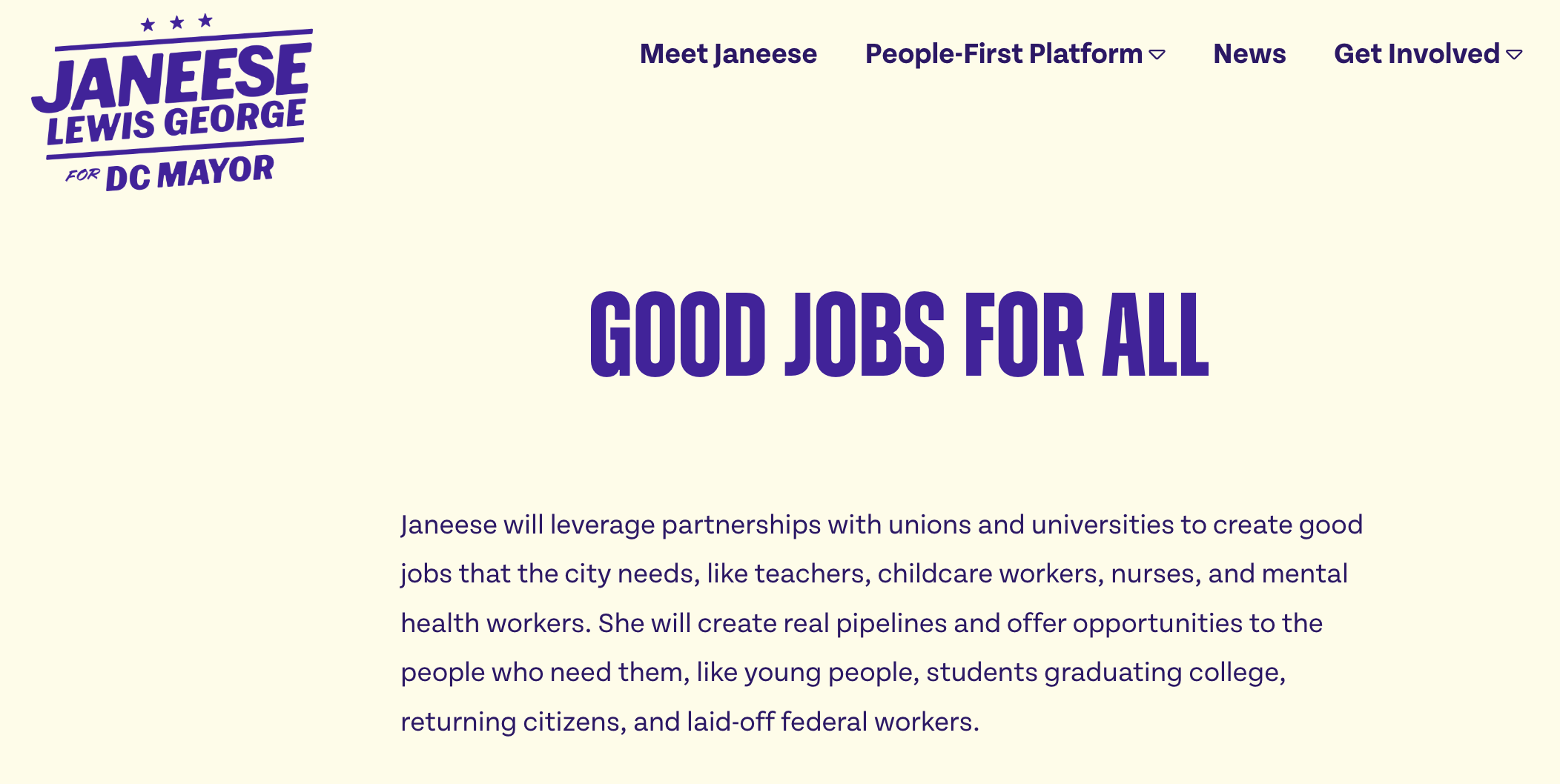
There’s also just something incredibly NGO-brained about the idea of trying to create a pipeline to specifically steer formerly incarcerated felons (that’s what “returning citizens” means) into child care jobs. Her whole campaign is positioned as if D.C. has an underlying economy that’s booming and all that’s needed is to redistribute those resources.
What McDuffie gets is that while that approach might have made sense during the 2018 mayoral campaign, the situation has actually changed. Lewis George is against Waymo because the S.E.I.U. told her to be, and she’s running with the enthusiastic support of the Washington Teachers’ Union, whose leadership was incredibly counterproductive during the Covid recovery and was last spotted campaigning to keep the schools closed longer due to snow.
D.C. needs a mayor who can see clearly the actual situation the city faces, and I think that’s McDuffie.
Eric Randall: You have written about your love for the Jack Reacher series and Michael Connelly’s books. I believe you are a completionist on both. I am someone who recently learned he enjoys the occasional Jack Reacher book, and is interested in dipping a toe into Lincoln Lawyer or Bosch. (I think something hormonal awakened in me when my son was born two years ago - must... read... dMad... fiction.) But I don’t care to start from the beginning and make my way through. Do you have advice on your personal “Greatest Hits” for those series? A way to think about how to pick between them if you only intend to read like four of these kinds of books a year?
One reason that I do tend to recommend starting from the beginning with these kinds of books rather than jumping around is that normally a long-running series will come to be a long-running series because the first few iterations were bangers. Once you have a loyal audience you can keep feeding them slop and not worry about it too much. The Reacher series, in particular, has lost a lot of juice over time in my opinion. But if you want the greatest hits, I would consider trying books one, three, six, and nine.
For Connelly, the most straightforward approach is probably to just pick up “The Lincoln Lawyer” and if you like it go on to the second book in the series. There are only eight of these books rather than the 90 million Harry Bosch stories, and Bosch is a side character in some of them, so you can see whether you like him and decide if you want to dive into the Boschverse.
Sean O: How much did you buy into the “Emerging Democratic Majority” and “Coalition of the Ascendent” rhetoric of the mid to late 2000s? And how much of the current angst among Gen X and Millennial Democrats can be traced to this majority not emerging and not ascending?
People lump these ideas together, but I think it’s worth insisting that the E.D.M. hypothesis was actually pretty different from the post-2012 demographic-transition hypothesis. I was a big fan of E.D.M. when it came out, and to some extent I think that I am the last defender of the thesis. The big thing that the book got wrong is that the authors just did not predict that both parties would shift policy views significantly to the left.
But go back and consider the stuff we were arguing about 25 years ago — gay marriage, the war in Iraq, Social Security privatization — and you’ll see Republicans just gave up on it. Trump’s positions on retirement programs and marriage in 2024 were to the left of where Barack Obama was in 2008. And even though there’s been back and forth on these issues, key parts of the social safety net like Medicaid, SNAP, the Earned Income Tax Credit, and the Child Tax Credit have all gotten more generous since the George W. Bush years.
Contemporary Republicans have a lot of bad qualities that Bush-era Republicans didn’t really have. They are more conspiratorial, they spread dangerous misinformation about Tylenol, and they are contributing to an alarming collapse in childhood vaccination. Most of all, Trump is extremely corrupt personally and does things like try to overturn the results of the 2020 election. These were not topics that a reader of the “Emerging Democratic Majority” would process as partisan political issues. And even something with more policy content, such as immigration, just was not a polarized, highly partisan topic at the time the book came out.
So I think “underlying shifts in American society will make Democrats win most elections” turned out to be wrong but “underlying shifts in American society will shift American public policy in the direction of the ideas espoused by the Democratic Party” turned out to be absolutely correct.
In terms of the “Coalition of the Ascendant” rhetoric (I like to signpost it with Ron Brownstein’s February 2013 headline “With New Support Base, Obama Doesn’t Need Right-Leaning Whites Anymore”), that’s a different idea and it did not really make sense to me at the time and has aged very poorly.
The thesis of E.D.M. was that Democrats could coast without “winning back” non-college whites relative to Al Gore’s performance. The Brownstein thesis that Democrats could just completely blow off the largest demographic group in the country was a different and mathematically implausible idea. How could you look at Obama winning Iowa and Wisconsin in his 2012 re-election bid and conclude that the growing Hispanic population was all that mattered?
I think this idea not only did not make sense, but encouraged a paranoid counter-response from conservatives who started to see a “great replacement” behind every immigrant.
Steve Lauer: To flip the Senate, should Democrats be going harder for the Farmer Vote? I don’t love subsidizing inefficient land use but I do want to win the Senate and am willing to compromise. What can Democrats do better?
I think if you’re running in a farm state, you should absolutely advocate for home-state economic interests. That said, I don’t think the reason Iowa went from being a swing state to being a red state is that Democrats forgot to advocate for home-state economic interests. It’s that the party got too closely associated with left-wing cultural politics.
lwdlyndale: I think our current system of “the president can just start wars whenever they want for any reason they want” is bad. Any ideas about how to restrain future presidents? The War Powers Act was one attempt but presidents just decided to ignore it, and Congress and the courts refuse to enforce it, so seems like we need a new approach.
I don’t think this is fixable. The founders’ conceit that the president could have operational control over the military while Congress retained the power to declare war is just not workable in practice and notably never really has been. Way back in 1846, then-President James Polk wanted to go to war with Mexico, so he sent troops into the disputed region between the Nueces River and the Rio Grande. The Mexican government interpreted that as an invasion and moved to repel the American troops. Polk then reported back to Congress that Mexico had attacked American troops and we needed to declare war. This is just another reason to think that the presidential republic is a flawed idea.
Michael Adelman: Now that war with Iran appears imminent — how do you think opponents of this war can do effective politics against it? Public opinion did eventually turn on the Vietnam and Iraq Wars, but the anti-war movements against both were mostly ineffective at the outset, and in both cases drove backlash that made pro-war politics initially more popular. Trump’s total lack of a public case for war with Iran reads to me like supreme confidence that the politics are already as good as won. One key background condition is that Dems are too culturally toxic to win national majorities, so Republicans facing no serious electoral competition can be quite unconstrained in their behavior in general. And specific to this issue, Trump has little to fear from the kind of New Left stuff we often hear from anti-war protesters. How do we change these toxic dynamics and make an actually effective public appeal against a war I really think the public will come to regret?
Realistically, I think the public opinion dynamics around all these wars are driven by the volume of American military casualties much more than by domestic counter-mobilization. The reason there is backlash risk with anti-war protests is that left-wing people tend to want to frame opposition to American military adventurism in terms of protecting innocent foreigners from American imperialism.
Trump’s brand of anti-neocon politics always took the opposite view: He was protecting American soldiers and taxpayers from “globalists’” desire to go around the world helping foreigners. In Venezuela (and with earlier strikes on Iran), Trump managed to engage in mini-wars in which no Americans died. If he tries that again in Iran, it may well not work out. And if he ends up in a costly quagmire, people will hate it. But I don’t think you can stop it beforehand.
DWD: What public transit station naming style do you prefer? The DC/Boston method of naming stations after a local landmark with no duplicate station names or the NYC/Philly/Chicago style of naming station after cross street even when it leads to multiple stations with the same name?
I broadly think that cities are basically making correct choices here. The New York system works well when you can count on train lines basically following the route of a single street for a long stretch of time. This pairs naturally with the American urban-planning paradigm where we have big street grids. Boston does not have a street grid, so it has a station-naming paradigm that is more similar to what you would see in London or Paris.
D.C. is the odd man out because it does have a street grid, but the Metro lines don’t follow it, so naming stations after cross streets would get a little confusing. It’s not obvious to me what the right call was.
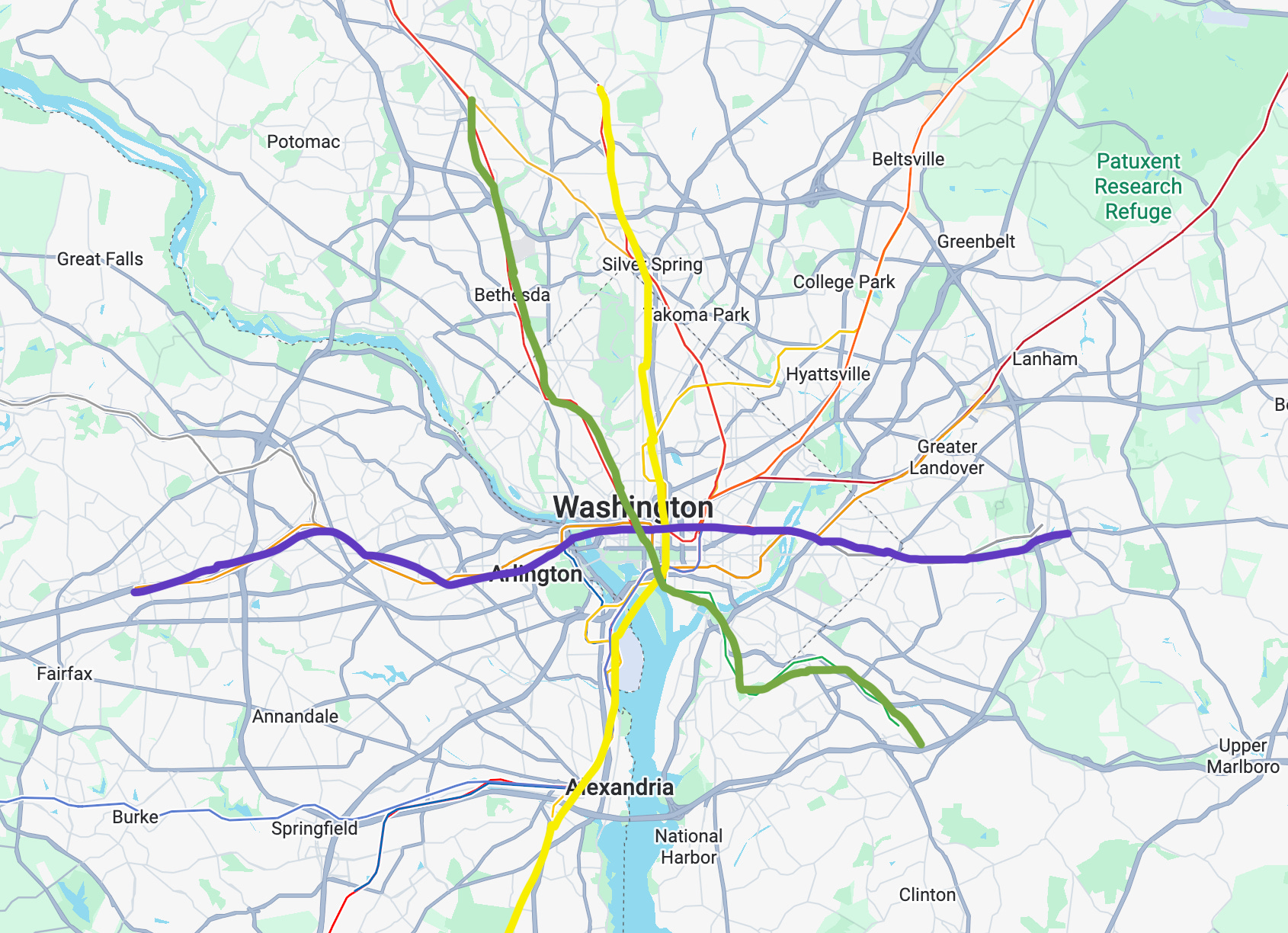
The larger issue is that I am genuinely puzzled as to what the planners of WMATA were thinking when they came up with these route designs. Metro was built in the 1970s, so should have benefited from lessons learned over nearly a century of Western mass-transit planning.
Instead they did things — like give the Red Line a U-shape and have the Blue/Yellow/Orange lines split and recombine — that violate all kinds of best practices. A lot of the tracks also replicate existing commuter-rail lines rather than upgrade those lines to S-Bahn quality. Metro should have been an efficient triangular system like this, with the resulting extra money put into electrifying MARC/V.R.E. and building infill stations.
One piece of lore that I have heard from some old-timers is that the D.C. Metro names have actually led to shifts in how people understand neighborhoods. In 1991, the U Street-Cardozo station of the Green Line was opened. Because stations in D.C. are normally named after neighborhoods rather than cross streets, this created the impression that the name of the neighborhood around the station was “U Street.” And as a result, the older neighborhood name “Cardozo” started to fall into disuse, to the point that now people use “U Street” as a metonym for the whole area.
Maltshop 84: You’ve discussed multiple times your opinion that the Habsburgs should have been more willing to make concessions to Italy during WWI. What is your perspective on Germany’s decision making process on the eve of the war? Was it rational to view Russia as a massive threat? Could they afford to not back up their one true ally in A-H? Given that France wanted a war against an isolated Germany, is there truth to the German perspective that they were forced into fighting a war of survival against enemies on all sides in which they had to be an aggressor to have a chance of winning?
Just to say this all up front, I was very persuaded by Christopher Clark’s argument in “The Sleepwalkers” that we ought to view the Central Powers’ position in the war much more sympathetically. If you accept the Habsburg Empire’s legitimacy as a state, then there’s just no way they can sit idly by while terrorists with genuine ties to the Serbian government assassinate their political leaders. Similarly, Germany’s response to the July Crisis — to refuse to allow their one major ally to be dismembered by Russia even though it meant giving France the war they wanted — makes a good amount of sense to me.
My critique of Austria’s approach to Italy is that they, like the Democrats in the Trump era, were not taking their own diagnosis seriously.
I completely understand why the Habsburgs did not feel that being victimized by Serbia and Russia and France should force them to make concessions to Italy. At the same time, the Habsburg diagnosis of the situation was that they were facing an existential threat from state-sponsored Serbian terrorism. What Italy wanted (some small territorial concessions) was not an existential threat. If the Serbian problem was as serious as the Habsburgs decided it was, then you make whatever deal you need to make with Italy to win the war. If the problem was not sufficiently serious to be worth making concessions to Italy over, then maybe it’s just not that serious and you don’t need to fight the war at all.
For Germany, though, the problem wasn’t anything they did in July of 1914; it’s the way that years earlier they managed to get on the wrong side of the British. The kaiser did not need to get into a naval arms race with the world’s premier naval power, and he did not need to seek a colonial empire in Africa. The Herero genocide that played out in contemporary Namibia in 1904 through 1908 was not only a horrifying crime — it was part of a grand strategy that made no sense. There was very little of value there and absolutely no reason to be trying to plant German settlers in the region, and the whole thing backfired strategically in spectacular fashion.
Alex: Asked this two years ago (and didn’t make it past top-3 stage), but with AI progress, it seems even more relevant... Given the progress in science and technology, do you think it is possible that a USSR-style planned economy might be more viable now than in mid-late-20th century? Most directly, sciences that deal with “how to optimize supply chains”, and such (so industrial engineering and operations research/management science) have just been properly established by mid-20s century and all have improved tremendously since. Our understanding of economics has improved as well. Plus, you want a lot of computing power to run a planned economy, and USSR obviously had very little compared to what would be available today. So, is it a given that a planned economy with modern economics, modeling tools for manufacturing, agriculture, etc, and computing power to run all these models, would still necessarily underperform?
Maybe. But I don’t think the main problems with a centrally planned economy really come down to lack of computing power.
As I discussed in the post on the history of whaling, by the 1960s the Soviet Union was killing tons of whales for basically no reason. The market for whale oil as an industrial lubricant was real at that point but limited in size. Whale oil as a base for margarine was on the way out. The Soviets kept trying to convince their citizens to eat whale meat, but they weren’t succeeding.
This wasn’t exactly the planners being confused and miscalculating the value of killing the whales; they knew that the value was low, which was why they were trying to convince people to eat the meat. It wasn’t bad math; it was a political decision. For some reason the Soviet whale fleet had clout with the relevant decision-makers, so it kept on killing until eventually the politics flipped. And I think that, rather than Hayekian calculation problems, is in practice the big difficulty with centrally planned institutions.
Matt writes, regarding Emerging Democratic Majority: "How could you look at Obama winning Iowa and Wisconsin in his 2012 re-election bid and conclude that the growing Hispanic population was all that mattered?"
For a simple reason: The proponents of this line of thinking are racialists, in that they believe skin color and ethnicity are determinative of policy and voting preferences. They misread the history of the Black voting bloc for Democrats as being related to the race of the voters rather than the discrimination tolerated or supported by Republicans during the Great Realignment.
It's why they adopted the "black and brown" and BIPOC rhetorical formulations. They thought the skin color was what was important. Their race-first way of thinking of the world created big blind spots around immigration and criminal justice, allowing a neglected set of issues for Trump to build upon.
The question about AI and the answer I think both misunderstand Hayek’s point. His point wasn’t that authorities lack the necessary computing power for central planning.
Let’s suppose you can “calculate” as much as you want given your information. You still can’t run a good economy.
A ton of the information needed to coordinate efficient economic activity is based on local or tacit knowledge that isn’t in a database anywhere. Individuals have their own preferences, they know their capabilities, they might have knowledge of some local context, etc.
How the hell do you elicit this information? Most of the time, individuals can’t even articulate these things themselves!
Misunderstanding this is, I think, what makes a lot of liberal wonk types bullish about a kind of technocratic dictatorship. Even with all the “experts” (ie, people who have read a couple articles in Vox or The Argument), you’re not going to get very far with benevolent central planning.