

I read “Moby Dick” in high school, which was a long time ago, and then again in January. Upon re-read, I was struck by the extent to which the book is literally about whaling.
That’s perhaps obvious, but my high-school English teacher — and therefore the in-class discussions of the book — focused on the metaphorical and allegorical aspects of the text, on the whale as a symbol, and on the whaling voyage itself as a kind of metaphysical exercise.
My more mature view, though, is that Herman Melville really does want us to think a fair amount about whaling, which in 1851 (when the book was published) was a really major American industry, though its inner workings were obscure to most people because it took place at sea.
Of course Captain Ahab’s quest for the white whale is not just about commercial whaling. But Ahab’s thirst for vengeance is the backdrop for a story that spends significant time on much more humdrum affairs.
On one level, Ahab is insane. He’s driven mad by his rage and is counterpoised to the rational first mate, Starbuck, who wants to focus on the actual job at hand rather than risk everyone’s lives on a quest for revenge. But the gruesome and lengthy description of how sperm whales are normally tracked and hunted and butchered makes it clear that there’s something kind of insane about Starbuck’s quest, too. You’re on a years-long ocean voyage across the entire world (because the North Atlantic whale population has already been depleted) in miserable conditions, engaged in grotesque and brutal butchery, all so that people can have nicer candles.
Part of what gives the book historic resonance is that while whaling was booming when the book was published, the American whaling industry was also on the verge of collapse.
Voyages were getting longer and longer, reaching increasingly remote locations like the Sea of Okhotsk as the prey became scarcer. The Civil War was poised to deal a further blow to American whaling — and America was, as Melville is at pains to explain, the world’s premier whaling country by far. The discovery of oil wells in North America made the manufacture of kerosene much easier, providing a convenient alternative to using dead whales for illumination.
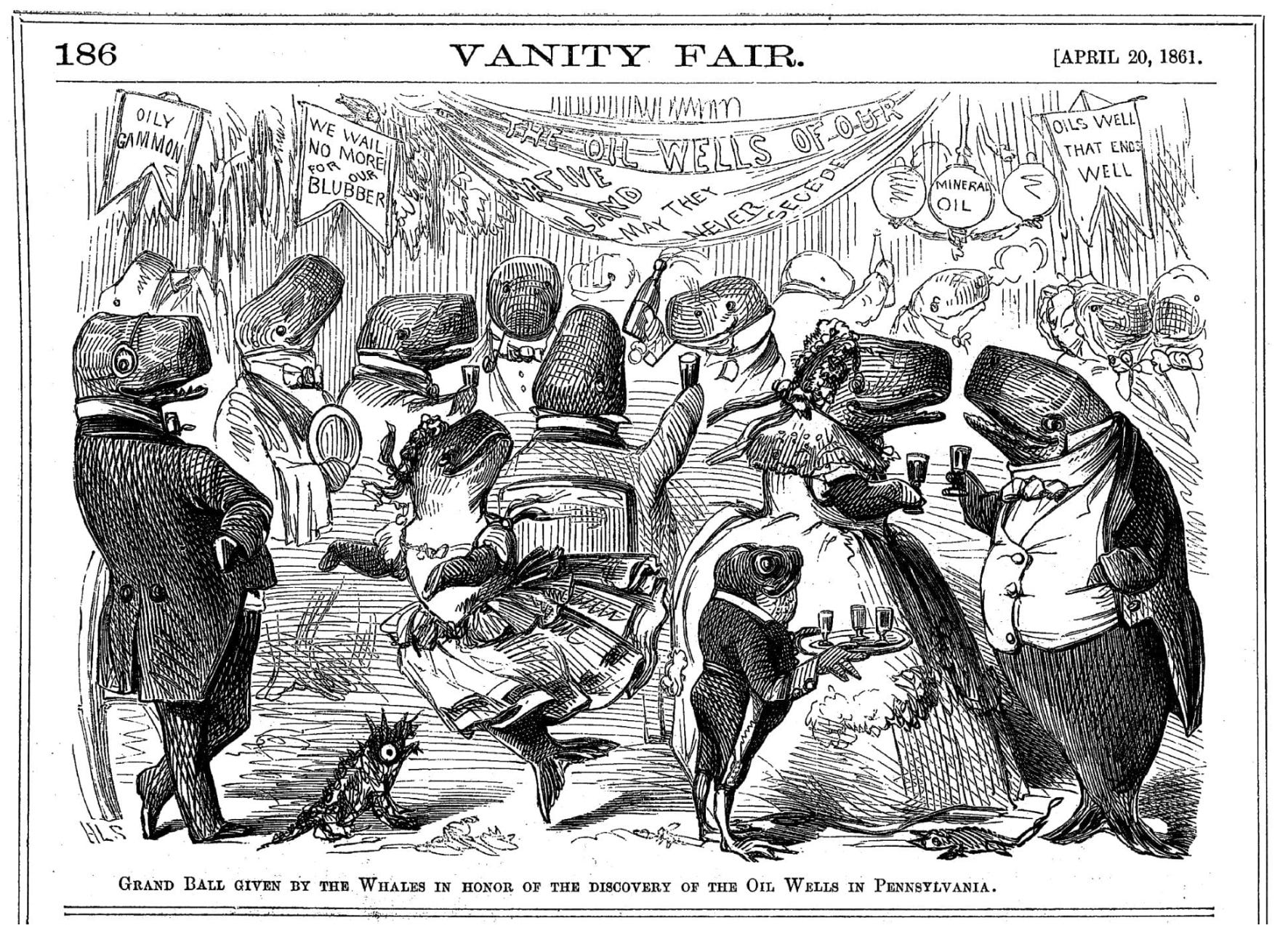
I saw this Vanity Fair cartoon years ago, and have occasionally repeated its core message that whale oil was superseded by kerosene and that’s why commercial whaling went into abeyance.
But having read more non-fiction about whaling after my “Moby Dick” re-read, I now know this is not true.