


After you read today’s post, I hope you’ll listen to the latest episode of “The Argument” podcast, where Jerusalem and I talk with economics commentator Kyla Scanlon about why young people are so pessimistic about the economy, even when the economic data looks relatively good. Paid subscribers can watch or listen ad free and read the transcript and show notes here. Free subscribers can catch the episode on YouTube here or listen wherever you get your podcasts.
Subscribe: Apple Podcasts | Spotify | YouTube | Overcast | Pocket Casts
Thanks to Skydance’s rapid acquisition of both Paramount and Warner Bros., Hollywood is dramatically more concentrated than ever, especially since Fox and Disney merged several years ago.
And yet the movie industry — which has been teetering since the pandemic thanks to competition from home streaming and the proliferation of social video content — is wrapping up its healthiest year in a long time.
So far in 2026, domestic moviegoers have spent about $8.76 billion at the box office, which is more (in nominal terms) than the totals from 2021, 2022, or 2024. Once the December haul — which will include both “Avengers: Doomsday” and “Dune: Part Three” — comes in, everyone expects this year to shatter 2023’s $8.9 billion box-office haul and be the best year since the pandemic by a decent margin.
While that box-office haul is led by big studio pictures (“Spider-Man” is a Sony/Disney collaboration and “The Odyssey” is from Universal), part of what’s striking about this year’s top 10 is how diverse it is.
We have mini-majors Lionsgate and MGM (which is only a midsized movie studio even though it’s owned by Amazon, which is a giant company overall) with the #5 and #6 movies and specialty label Focus and independent studio A24 coming in at #7 with “Obsession” and #9 with “Backrooms,” respectively. Notably, those two horror hits, while not as large in revenue terms as the biggest movies of the year, are spectacularly more profitable due to their dramatically lower production costs and lack of dependence on expensive intellectual property. “You Can See Everything,” also from A24, was a massive artistic achievement, drove incredible amounts of discourse, and made spectacular sums of money for a low-budget documentary.
This is not to say that we should have zero concerns about the regulatory process around the merger — I have big concerns that I really hope the new Congress will investigate. But the threat of a movie studio monopoly turns out to be pretty illusory. It’s just fundamentally very difficult to monopolize this industry because, thanks to the First Amendment, there are very few barriers to entry into the world of making movies, similar to the problem facing us journalists. The incumbent studios can’t stop A24 and Neon from growing their market share. They can’t stop Apple from getting into the movie business. They can’t stop Netflix from competing asymmetrically via streaming or from putting “The Further Mis-Adventures of Cliff Booth” into movie theaters and competing with them directly.
If they could block competition, of course they’d try, and in tons of industries, established companies succeed. And in most cases, if you want to fight monopoly and take on system-rigging corporations, what you need to do is dismantle barriers to entry.
The captured economy
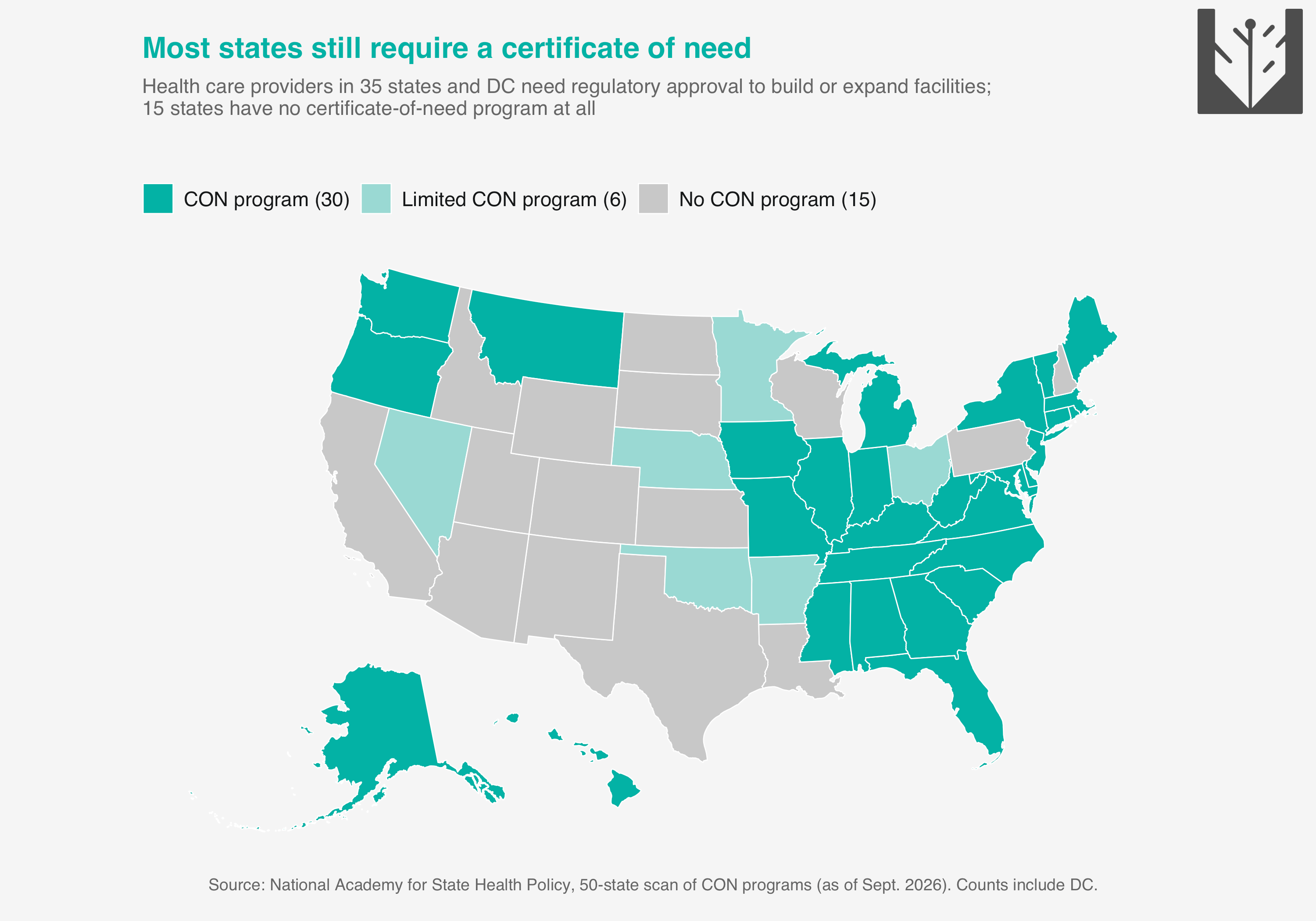
Health care costs are a big deal. A lot of people end up focusing their mental energy on insurance companies because you pay money to them directly in premiums and then they annoyingly don’t always cover what you want them to cover. Ultimately, though, the availability of health care services is downstream of the actual availability of medical facilities and personnel. And when it comes to facilities, most states have a range of certificate-of-need laws on the books that set up processes where you have to beg permission before opening a new facility.
In terms of personnel, the number of residency slots to train new doctors is capped by law in a way that creates a structural shortage of physicians.
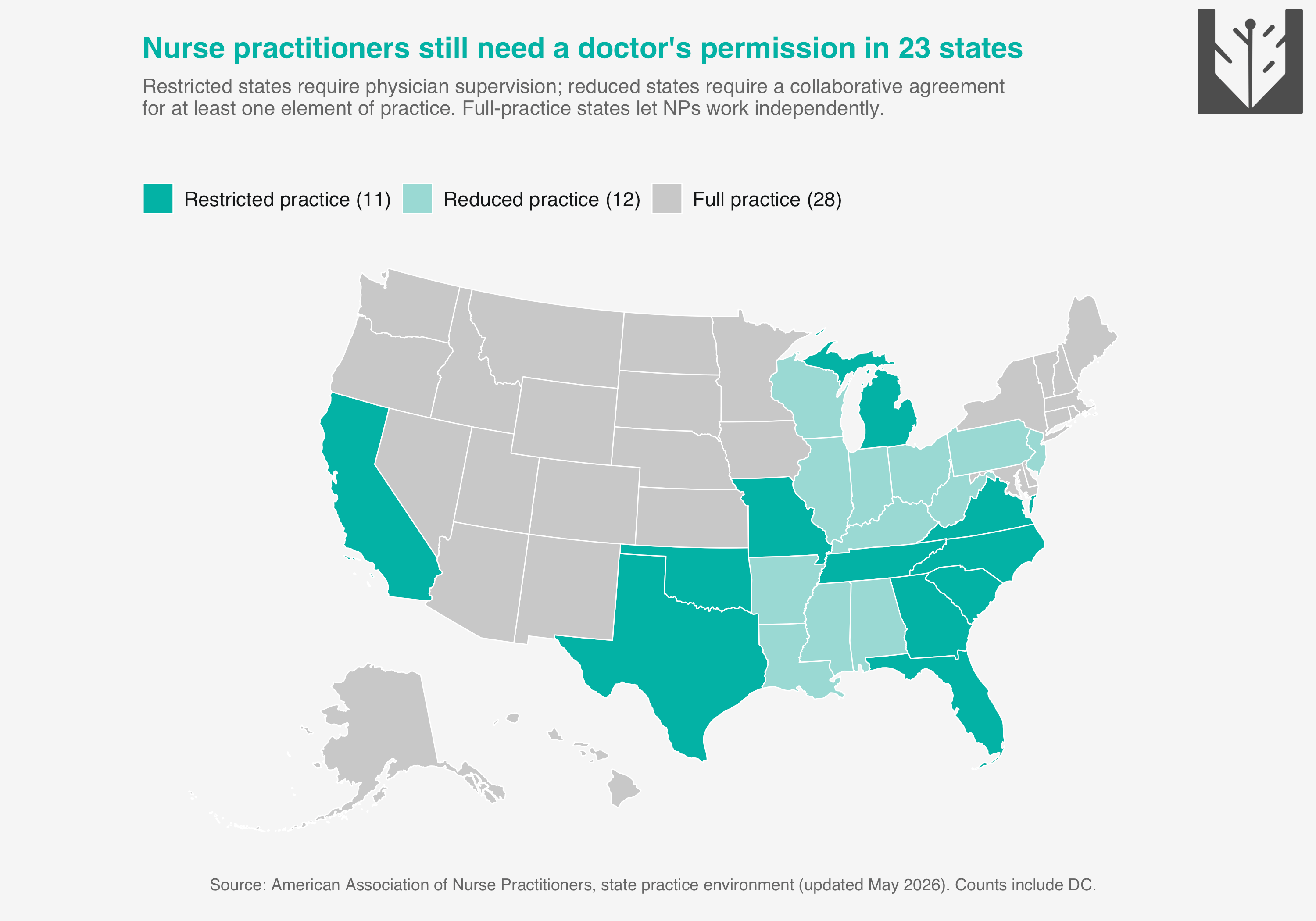
In many states, this shortage is ameliorated by nurse practitioners having full scope-of-practice rights, meaning they can evaluate patients; diagnose, order and interpret diagnostic tests; and initiate and manage treatments, including prescriptions. But in lots of states, they’re subject to rules that are much more restrictive.
The same is true of dental medicine, where hygienists are often prohibited from offering tooth-cleaning services without cutting dentists in on the deal. Tesla successfully fought state-by-state battles against monopoly rights for car dealerships, but those fights were often won in a limited way that has meant Rivian now needs to re-fight the battle to legally sell cars directly to consumers without cutting a dealership owner in as a middleman. But even if Rivian wins this battle, it’s still a relatively small thing compared to a world where old-line car companies — Ford, GM, Toyota, Volkswagen, Kia — could just sell directly to consumers.
In the housing space, not only do land use regulations often serve as a quantity limit on the supply of housing, but a preference for discretionary processes also serves as a barrier to entry.
After all, on some level you might ask yourself what a “real estate developer” is anyway. A construction company builds buildings. An architect designs them. A developer in some sense encompasses those trades but adds in a layer of detailed competency in navigating local permitting processes. A guy who rose up through the ranks in the construction industry might know perfectly well how to build an apartment building. But he can’t really go out on his own and start a business, because he doesn’t know how to get a zoning variance or navigate a Planned Unit Development process.
The point, though, is that these kinds of barriers to entry aren’t unique to health care or housing or auto sales. They’re pretty typical of the American economy.
How the system gets rigged
Something you’ll note about this is that car dealerships aside, most efforts to rig the system against competition are mixed up with plausibly useful regulatory ideas.
It is very easy to understand why there would be occupational licensing of medical doctors and other health care providers. The existence of safety concerns surrounding this makes a lot of sense! My considered opinion is that land use regulations are an all-around bad idea, but I understand why people in good faith believe they’re beneficial.
By the same token, I think it’s pretty obvious that if not for the First Amendment, we in the United States would have had a major push starting way back in the blog era to license journalists in order to keep a lid on misinformation. This would have been incredibly misguided, but it is true that journalists behaving unethically and people publishing things that are false or misleading are real problems in our society. I think that due to Americans’ cultural respect for free speech, an unusually wide range of people understand that a journalist licensing regime intended to improve the quality of information would in practice be used to (at best) stymie competition and (at worst) suppress inconvenient or undesired information.
But while speech is in some respects special, the exact basic dynamic exists in other areas.
Back in October, I mentioned in the New York Times that “new American commercial jet pilots generally must have 1,500 hours of training flight time before they can qualify to co-pilot a plane — over five times as much time as required by perfectly safe European airlines.”
For my trouble, I got some leftists accusing me of wanting to see more people die in plane crashes. The point, though, is that while there are clearly good reasons to regulate aviation safety, doing so also creates opportunities for system-rigging.
When Colgan Air Flight 3407 crashed in February of 2009, the American aviation industry was already in rough financial shape because of the recession — demand for air travel was plummeting, and nobody was very interested in hiring new pilots. Lobbyists pushed Congress to enact this dramatic increase in training requirements not because this would have prevented the crash — the pilots of that plane would have qualified under the new stricter standard — but because they saw an opportunity in the crash to do something pretextual. Congress went along with it because in the economic climate of 2009, a pilot shortage didn’t seem worth worrying about.
Today, though, we have a profitable airline industry, albeit one that’s achieved profitability by adopting some consumer-unfriendly practices. What we’d like to see is profitable airlines seeking further profits by expanding service, either by offering new direct flights between city pairs that don’t currently enjoy service (a win for consumers) or by competing on routes that are already served (a different win for consumers).
Major airlines are in fact doing this, but it’s a slow process. If it were faster to get pilots trained up and hired, we’d have more intensive competition and a better economy.
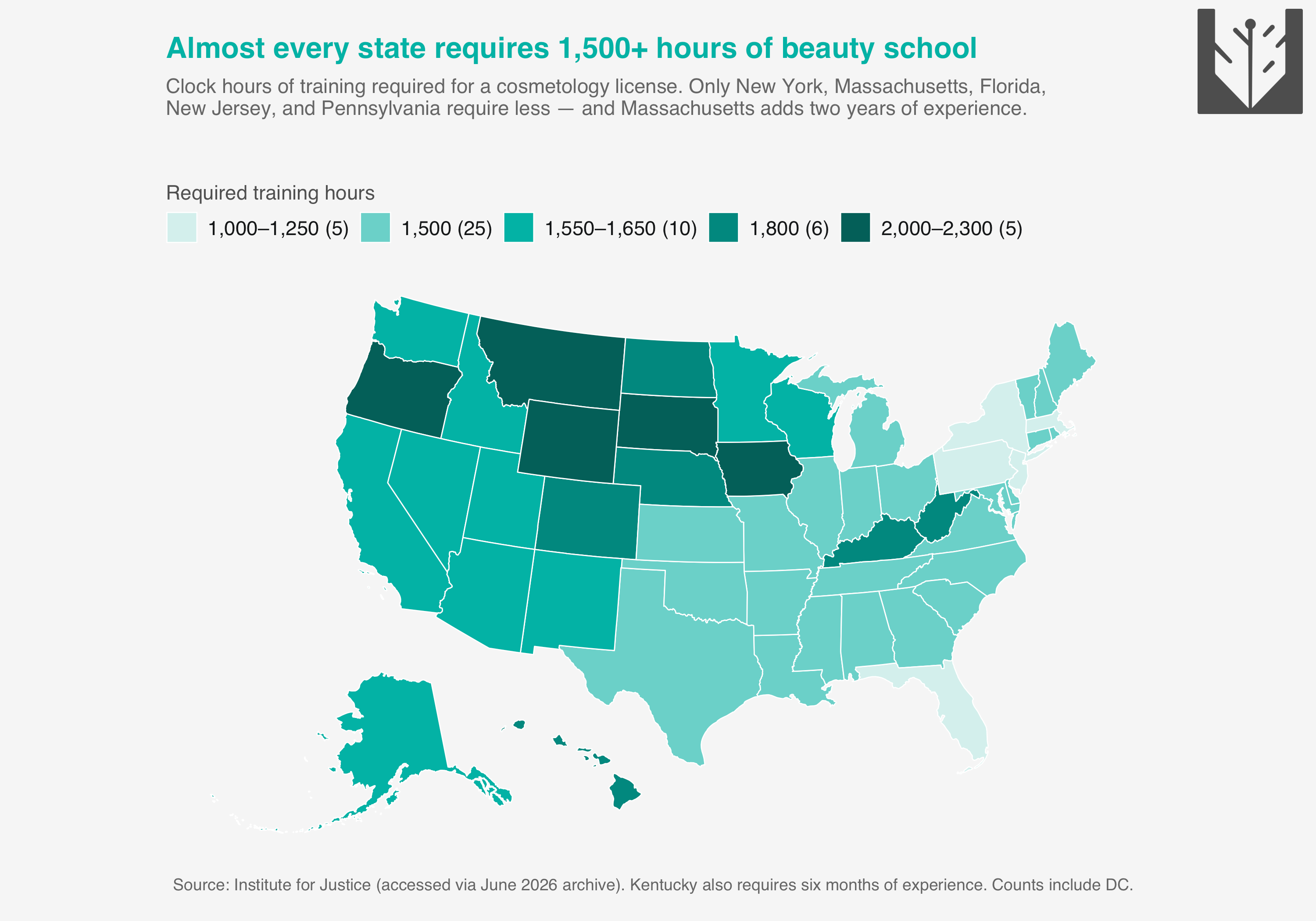
Here in Washington, the Council is using safety concerns as a pretext to prevent Waymo from competing with Uber and Lyft. And does anyone think beauty salons in Iowa and Wyoming are genuinely safer than ones in New York and New Jersey thanks to their more onerous licensing requirements? That’s silly. I don’t understand the sociology of why state legislatures in the Great Plains and Appalachia (and I guess Oregon) seem unusually susceptible to unreasonable rules on this subject, but there’s no way this is a bona fide consumer-protection rule.
What would benefit both workers and consumers more is more competition, just as cinema continues to thrive as a medium despite the best efforts of corporate M&A specialists to consolidate.
The case for populist liberalism
It’s worth understanding all of this because it is definitely true that there’s political merit to populist rhetoric about how the little guy is getting screwed by the system.
It’s also true that as a matter of habit, the kinds of people who talk about the kinds of issues I’ve raised here tend not to use populist rhetoric in our internal discussions. For starters, we’re mostly people who believe in positive-sum economic growth, so we don’t love populist framings, which tend to reflect a negative-sum worldview.
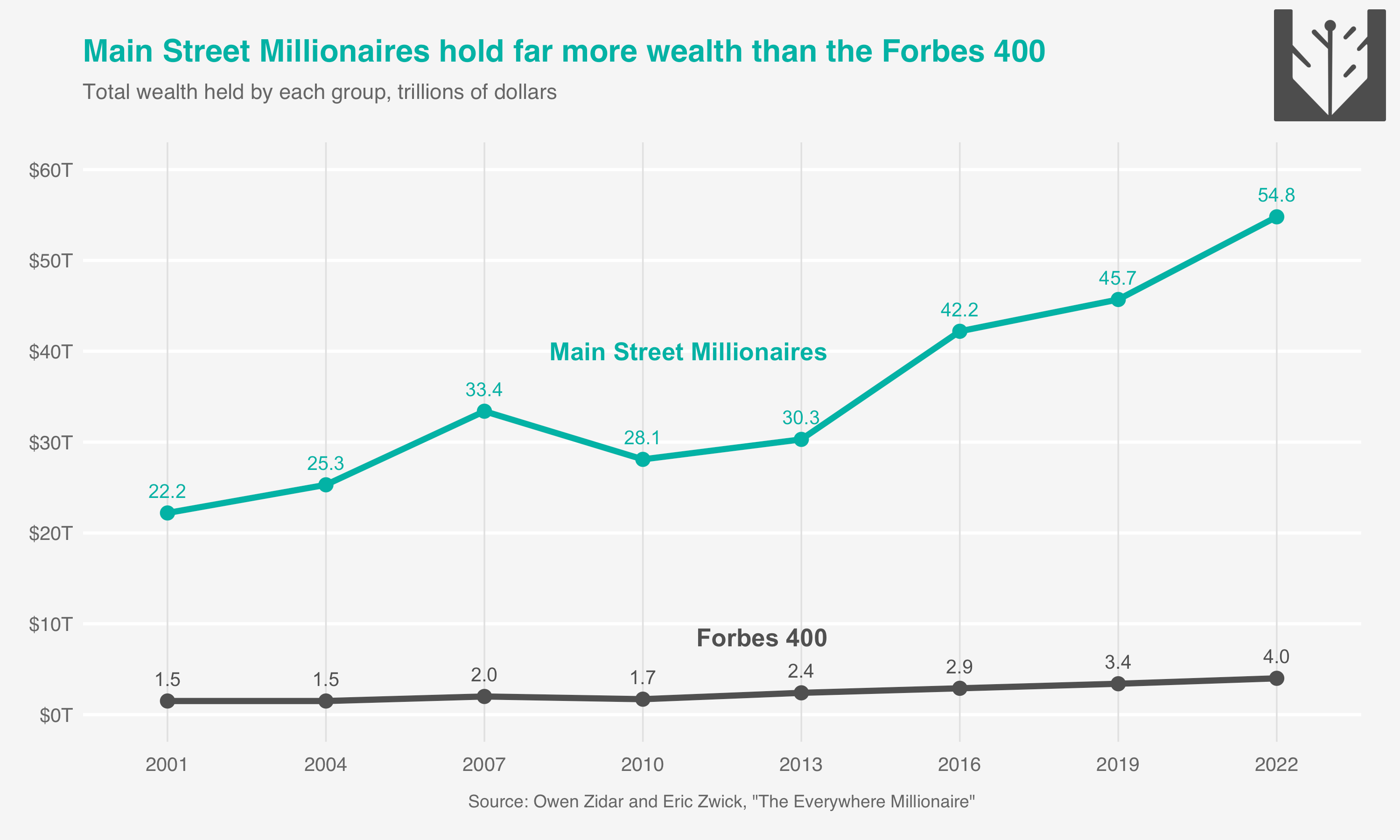
Secondarily, it’s generally true that the “villains” in stories about barriers to entry and rent-seeking, though they are richer than the average American, are not literally the very richest people in the country. That’s not because an Elon Musk or a Jeff Bezos is above lobbying for anti-competitive rules — everybody tries to work the angles available to them. But the way to become multi-billionaire rich is to found a company in a space that is open to competition and then win the competition. The people owning and operating businesses in heavily protected spaces tend to be “everywhere millionaires” rather than ultra-billionaires. But these people are very wealthy in aggregate.
Mostly, though, it’s just happenstance. People operating in spaces that I’ve seen labeled at different times as “neoliberal,” “pro-growth progressive,” “liberaltarian,” or more recently “abundance” tend to use words like “barriers to entry” rather than “monopoly” and usually say “rent-seeking” rather than “rigging the system.”
But these are the same ideas. When traditional stick-built housing interests imposed onerous regulations on manufactured housing to ward off competition, that was monopolists rigging the system for profit. When the 21st Century ROAD to Housing Act finally repealed those rules, it was a triumph for the little guy against the power of concentrated special interests.
I do not personally have very strong feelings about which rhetorical mode should be used. When I wrote “The Rent is Too Damn High” way back in 2011, I thought that co-opting left-populist rhetorical framings was a promising idea. I wanted to use the phrase “land reform” to mirror populist political demands from rural Latin America, just applied to urban and suburban areas. The YIMBY movement has prospered in the years since then and has mostly not gone in that direction, and so I think its choices have probably been correct.
I do believe, though, that both operatives and journalists who are less policy-focused have gotten confused about the actual stakes at issue and that’s the fault of those of us more on the abundance side of things for not articulating the populist window into our message. People who think they’re getting a raw deal from the system are making good points, and the obligation of policymakers is to fix real problems rather than feed people slop that doesn’t work.
The perils of slop politics
Back to where this piece started, though: The merger of Paramount and Warner posed no serious problems for competition due to the lack of barriers to entry in the movie business.
But I do have serious antitrust concerns about the way the merger went down.
My concern is that from the moment Warner went on the auction block, the Trump administration acted as if merger approvals were not a question of law but of the president’s whim. There is some reason to believe that a rival bid from Netflix was ultimately shot down by signs that the White House would look less kindly on such a combination than on one that would give a political ally control over CNN. It’s not totally clear that this is actually what went down, but there are some indications — including the fact that Trump interfered with legitimate antitrust enforcement specifically to influence CNN back in his first term.
This is just one in a long list of things that I hope the new Congress will look into because there’s smoke around it and it deserves to be seen as a major scandal if that’s what Trump did.
I’m concerned, though, that this entire angle has been lost to Democrats because they’ve embraced too much unsound neo-Brandeisian thinking. On the view that basically all mergers are bad, the question is whether it was bad to approve the Paramount bid. On the more sound view that monopolies normally require barriers to entry and that the general market for video entertainment is very competitive, the inappropriate action was threatening to block a Netflix bid.
Note, though, that either way, we’re talking about a rigged political and economic system, corrupt people in power, and the machinations of billionaires. The general populist rhetorical frame does not uniquely point toward either perspective on competition policy. The reason to prefer the correct perspective is just that it’s correct and that it will let us make good policy choices that help people and improve lives. But either way, you’re fighting monopolies and unrigging a crooked system.
This week on “The Argument” podcast, our guest is Kyla Scanlon, who explains what’s leading to Gen Z’s pessimism about the economy. Paid subscribers can watch or listen ad free or read the transcript and show notes here. Free subscribers can watch the episode on YouTube here or listen on your podcast app of choice.
The other tricky thing with the Paramount/Warner merger is market definition. Other movie studios are arguably competing in the same market. So is Netflix, even though most of its movies are released direct to streaming. Fine, you can still make an argument that the merger would increase market concentration by an unacceptable amount.
But what about YouTube? Or Instagram Reels/TikTok? If you group them into the same marker as Paramount and Warner then it looks really unconcentrated. If you don’t then it looks much more concentrated. This also gets tricky because YouTube and Instagram and TikTok make their money from ads rather than charging consumers for subscriptions, which makes it hard to calculate diversion ratios based on price increases. (I’m sure there’s a way to do it but I didn’t get that far in my coursework.)
Anyways I find this stuff very interesting personally so I think over Thanksgiving I will write up a blog post that tries to explain how to estimate demand and supply curves and simulate the effect of a merger in both plain English and econometrics.
A lot of the biggest billionaire companies do have a ton of market power and charge monopoly prices. Two big examples of this: Apple’s 30% cut of App Store fees and Meta/Google’s ad prices. Consumers don’t pay these directly so you might not notice but they are subject to antitrust litigation all around the world because they drive up costs for all the businesses that use them and ultimately do feed into consumer costs.