


On my income tax return, the largest source of income by far derives from the fact that I am the co-owner of a business whose profits “pass through” to me as an individual without being separately taxed at the corporate level.
These kinds of pass-through business entities are increasingly common in the United States, and you see them in many fields. To reach a certain scale, of course, you need to be able to take on more investors, and it would no longer work to organize as a pass-through. But for smaller firms, it’s an advantageous way to organize.
The upshot of this is that on the official balance sheet of the United States, I am an example of a person who is earning a high income primarily thanks to my status as an owner of capital. Wealth begets wealth, and the working man gets screwed.
But of course in the real world, I work at the company I own and my blogging labor is our main product.
This is an idiosyncratic industry, but it turns out to be a pretty typical Rich Guy Scenario.
That’s the message of a great new book, “The Everywhere Millionaire,” by Owen Zidar and Eric Zwick. They look at the roster of American households who have a net worth of more than $5 million — a nice round number that gets you about 4 percent of the population, or about five million households. And of those five million, roughly three million are what the authors call Main Street Millionaires: owners of privately held businesses rather than C.E.O.s or investors in giant corporations.
The average wealth of these Main Street Millionaires is $25 million per household, and because there are millions of them, they collectively hold dramatically more wealth than the billionaires of the Forbes 400. Plus, in absolute terms, way more wealth has been added here than in the Forbes 400, since the wealth of the Main Street Millionaires started so large and the cohort grows rather than being capped.
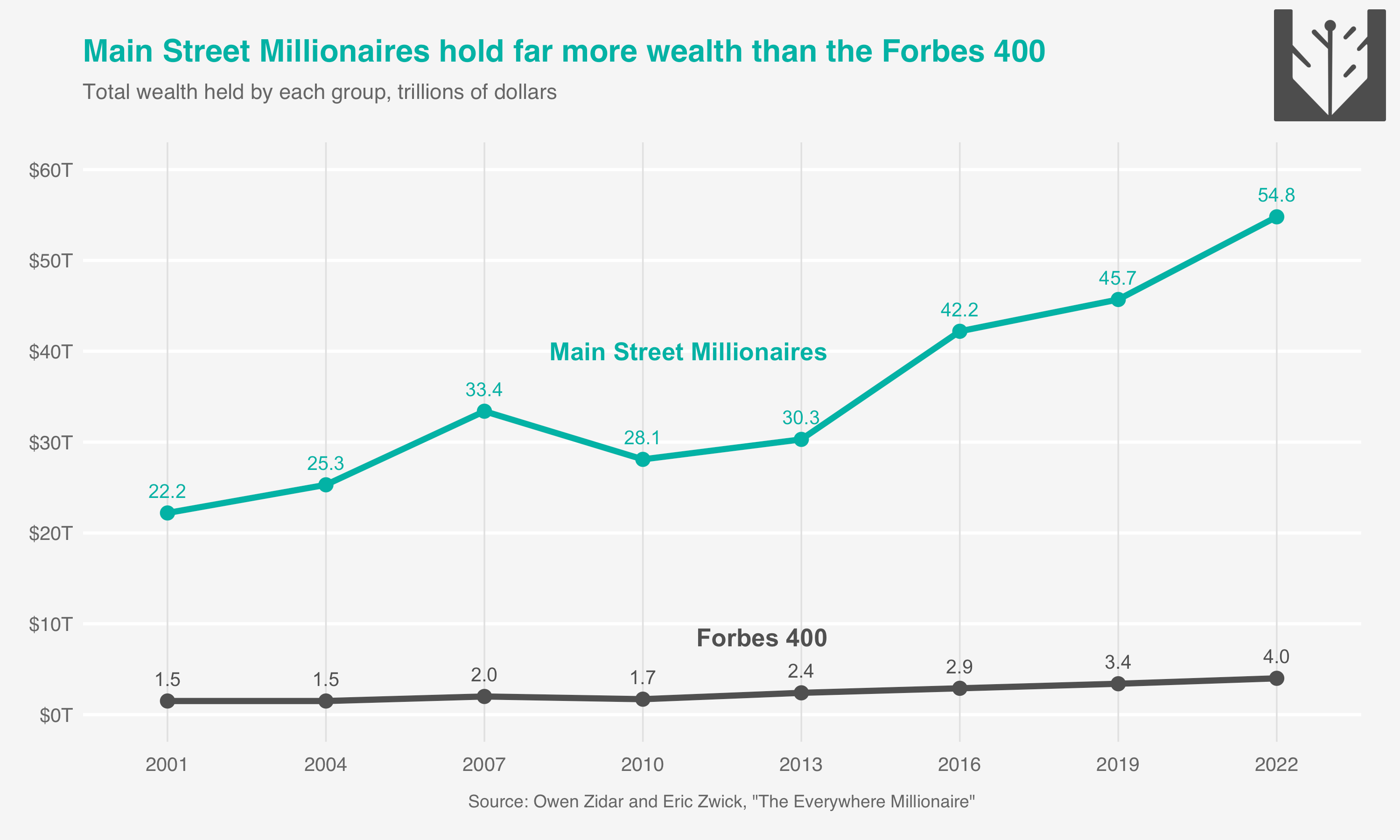
Much of the book is dedicated to telling the stories of individual Main Street Millionaires.
The publicity for the book says that these stories “suggest the American Dream is not dead and many paths to prosperity remain open today.” And that is definitely one takeaway here — it’s simply not the case that you need to get into a super-elite college and then go found a tech company or work at one of the prestigious companies from the Chetty, Deming, and Friedman study of the Ivy League to become rich. Indeed, if you’re smart and hardworking and really just want to make a lot of money, these prestige pathways may be a bad idea. A very large share of America’s Main Street Millionaires own and operate companies in banal fields; they’re HVAC contractors or beer distributors who out-hustle the competition in a defined geographic area and make a lot of money.
But what I think is more interesting about the book is the somewhat unfortunate implications for politics.
Tax problems everywhere
One issue with this proliferation of highly profitable small businesses is that they’re a tax nightmare. The way the tax code really “wants” to work is for everyone to work for a giant company. Some people earn modest wages and others are highly paid executives, and everyone is taxed on a progressive basis. Then everyone who earns money spends some of it and saves some of it. Money that you save earns a return in the form of capital gains or dividends, and that income is also taxed but at a lower rate than wage income because it’s good for long-term growth to encourage saving. The corporations themselves also pay corporate income tax, and that income is their revenue less their costs.
People owning small businesses messes things up.