

I wanted to take a minute to once again tout Alex Bores, who is running for the House in the NY-12 primary that’s happening on June 23.
Slow Boring doesn’t normally get involved in safe-seat House races, but Bores got on my radar early for two reasons. One, this is the House district that I grew up in, so I have a sentimental attachment to it. Two, Bores — in addition to having a basically solid track record in the state legislature and being an all-around smart guy — has long been interested in artificial intelligence policy and has some genuine technical chops himself. This struck a lot of people as a very niche concern when I first recommended him, but now not too many months later it’s moved closer and closer to the mainstream of politics. We’re obviously not going to elect a whole Congress of A.I. experts, but it’s a good idea to have a few in there.
I felt a little bad about this initial recommendation because one of the other candidates in the race, Micah Lasher, also seems like he’d be an above-average House member. But I really felt that there was a unique value to getting Bores in.
Evidently, some in the industry agree and Bores has been targeted by significant negative spending from an anti-regulation A.I. super PAC. This intervention has, I think, meaningfully impacted the stakes of the race. There’s a reasonable argument that the decision to target Bores — who is in a crowded field that in addition to Lasher also features Kennedy family scion Jack Schlossberg, George Conway, and several other lesser candidates — backfired and actually elevated a somewhat obscure guy to the top tier of the race. If Bores actually wins, I think that narrative will set in and it will not only mean we get a smart member of Congress but also that the industry thinks twice about dumping tons of money into stamping out anyone who even whispers about regulation. But if he loses, they’ll try to put the word out that it’s painful to even think about challenging them.
So if you live in New York, know others who do, or have some money burning a hole in your pocket that you’re eager to donate to a good cause, know that Alex Bores is worth your time.
Joseph America 2028: From the earliest days I can remember, my parents—a union electrician and a stay-at-home mom—told me I would go to college. It was NOT an option; it was a requirement. Every grade I earned from my first day of kindergarten through high school graduation was scrutinized for its impact on my potential for college acceptance. This was (mostly) in the 90s, and things were somewhat different back then. An undergraduate degree meant more then than it means now, in the paradigm of credential inflation. Nevertheless, you are a father. How do you talk to your son about his educational future? Do you have ambitions or expectations independent of his will, or will you simply let him go where the current takes him?
I would say that the message coming from Kate and me is that he is a smart kid, but that it is also important for him to work hard.
He reads books, which is great in this day and age, but his default reading choices tend toward slop and we force/encourage him to put some more challenging material into the mix. He should have an opportunity to get on an advanced math slot next year when he starts middle school and he’s working outside of class on prep to make sure he qualifies for that. He has always articulated a desire to go to college, so I don’t think we’ve particularly communicated to him that he should have that desire. Neither of his grandfathers finished college (my dad didn’t finish high school) and they’ve both had good lives and good careers — I’d never tell anyone you have to go to college if you don’t want to. But my dad has always said that in retrospect he regrets not having gone. I think you can see that the attitude he expressed here, at the time he dropped out of high school, is a little immature.
By the same token, though, the main thing that I’ve said to my son about college is that way too many people go to college and then deliberately pick easy majors or choose easy courses or don’t do the work. These are takes I’ve written before, but college students should be spending more time studying and humanities classes should be harder on average.
This is, I think, the missing dark matter in the conversation about whether too many people are going to college or whether we’ve made collegiate aspirations too universal and widespread. What’s bad, it seems to me, is that we’ve advanced the aspiration to educate more people primarily by watering down the product. In practice, if college were harder then fewer people would go. That’s a better outcome on net, but the “fewer people going” part is not per se desirable. I would love for the second-order consequence of college becoming more rigorous to be a renewed appreciation of its value. Because to me, the value really is in putting in the work. Occasionally, stuff I studied in philosophy classes is relevant. But I think the main value of philosophy is that because philosophy departments are small and it’s a kind of canonically useless subject, majoring in philosophy is (or at least was 25 years ago) an opportunity to take classes with smart professors who make you do difficult reading and hold you to high standards. That’s just a positive experience to have in life.
Our son’s main sport is swimming, and while he’s good at it, I don’t think he’s a swim prodigy who’s on track for the Olympics or to become the next Michael Phelps.
But contemporary American society tends to value rigor and hard work much more in the youth sports context than in the academic context, and I think the rigor of his swim team is a very positive life experience. The kids need to practice really hard. The clock does not lie about how good you are doing. He does a lot of training and he is showing demonstrable improvement. Learning that structured self-improvement is possible is valuable. I am fortunate to have a job that I love. But I genuinely do work really hard at it. And I think getting into a top private college or your state’s flagship public university and then finding classes you are interested in and working hard to master the material is a good way to get started in life for people who have any aptitude or interest in academic work. And I think our son does.
I don’t know exactly what I would say to a young person who’s not academically inclined other than that you shouldn’t use anti-college political propaganda from conservatives as an excuse to avoid hard work. People who don’t want to go to college should join a structured apprenticeship program for one of the skilled trades or join the military or undertake some other purposeful activity. We’re a sufficiently affluent society that the typical 19-year-old can just kind of float along aimlessly mooching off their parents without anyone starving to death. It’s good that families are not on the brink of starvation, but that kind of aimlessness is not good.
City of Trees: What’s your take on do it yourself (DIY)? What’s your proportion of tasks that you prefer to DIY versus hiring out someone to do for you? And how do you think people should best think about how to allocate their tasks between the two?
I am a big believer in the power of the division of labor!
One thing I would note about me, though, is that I am like a worst-case scenario for doing things myself. I have a highly paid job. I also mostly enjoy my work a great deal. And worst of all, unlike most people, I more-or-less really do have a marginal wage. Which is to say that I can always write more Slow Boring content or spend more time figuring out how to promote Slow Boring (or Politix) or spend more time reading relevant stuff or having conversations with relevant people. I also write sometimes for outside publications and I could easily place more articles if I spent more time pitching other places and writing the stories. There’s also a bunch of stuff that I generally don’t do — like appear on television — but that I could try to pursue if I wanted to.
In general you might, as a thought experiment, say “Well you could fix the sink yourself but your time has blah blah value so it may not be worth it.” But most people actually can’t just work two extra hours whenever they want to and make more money as a result. I sort of can. So while I like to sleep and see my family and do stuff with friends and take time to chill out, I’m really pretty averse to spending time on home repair and I would much rather just pay someone to handle it.
But lots of people:
have a $0 wage at the margin no matter how much they are paid.
may experience disutility from spending extra time working at a job they don’t enjoy or (more realistically) enjoy only within limits.
enjoy a little bit of working with tools even if it’s not something they would want to do full time.
So I’m not someone who’s going to run around saying that all the D.I.Y. enthusiasts out there are engaged in some massive fallacy. D.I.Y. just isn’t for me. I sincerely do like my work, independently of the dollars and cents of it all. In any given week, there are always extra people I would in principle have enjoyed grabbing a coffee or lunch with to learn things and gossip and shoot the shit about politics and policy. That’s just me, though — it’s not life advice.
DWD: Alternate history: What if Eisenhower rebuffed offers to run for President in 52?
Would the Republicans have nominated Taft? If so would the Democratic candidate have been able to win despite hostile fundamentals? If elected Taft would have died 6 months into his term.
The other strong Republican candidate would have been Earl Warren if nominated he would have won but not by as much as Eisenhower. Warren was more liberal than Eisenhower, would we have more action on civil rights in the 50s? Would the Democrats with their southern base have become the conservative party?
On the first ballot of the 1952 convention, Ike got 595 votes to 500 for Taft, 81 for Warren, 20 for Harold Stassen, and 10 for Douglas MacArthur. Those Stassen delegates (from his home state) were pledged to him but only if he obtained at least 10 percent of the vote, which he did not. They then almost all switched to Eisenhower and that put him over the top at 614. The upshot is that even though Taft was easily the second-place finisher, there was a clear majority for a moderate candidate.
Without Ike in there clearing the field, it would presumably have been made up of a more fragmented set of moderates. Warren would have attracted more support, but nothing close to what Eisenhower got. Stassen would have done better. Thomas Dewey, the party’s 1944 and 1948 presidential nominee, might have made another run. Taft would have had a large lead over the second-place contender, and I think probably could have worked something out to secure the nomination. But “worked something out” probably would have meant picking a V.P. who assuaged the Eastern establishment types. Let’s say that spot went to Alfred Driscoll, who in 1952 was 50 years old and in his second term as governor of New Jersey. This is not a guy who had a big national profile at the time or who was going to be a viable presidential candidate, but he’s from the east and had reformer/suburbanite/moderate vibes. The Taft/Driscoll ticket would have won (albeit not as overwhelmingly as the real-world Eisenhower/Nixon ticket did) and then Taft would have died in 1953, making Driscoll president.
Even though this means swapping out a historically world-famous general for a kind of random forgotten politician, I think you would end up with broadly similar outcomes. Driscoll’s big achievements as governor of New Jersey were that he finished the New Jersey Turnpike and started the Garden State Parkway, so his record perfectly aligns with Eisenhower-era investments in the federal highway system. He championed the state’s 1947 constitution, which was mostly focused on judicial reform and strengthening the powers of the executive branch but also included a civil rights plank — so, like Eisenhower, I think he would have been broadly but not especially forcefully in favor of civil rights.
The known-unknown, though, is that there were a lot of Cold War crises playing out in the 1950s and even a broadly similar politician could have made a bunch of specific different calls.
Lost Future: It’s 2029 and newly seated President Jon Ossoff has a 62 seat Dem majority in the Senate, along with the House. What healthcare policies are you advocating that the Dems tackle, if any? As I understand it the federal government cannot compel the non-Medicaid expanding states into granting it, so that while seems like low-hanging fruit I’m not sure what the Dems can do there. Anything else?
I’m going to not answer this question and just focus on the Medicaid expansion issue.
The next Democratic administration is going to be taking place in a context of limited fiscal space and will be dealing with the same climate of endemic social-media negativity that has bedeviled Donald Trump and Joe Biden. Under the circumstances, it’s important to understand that something you are allowed to do is to simply highlight policy choices made in Red America that you think are bad and talk about why they are bad and what the bad consequences are. Conservatives are not shy about just pointing and laughing at Blue America homelessness problems. Biden-era Democrats, to the extent that they thought about the Medicaid issue at all, were obsessed with trying to find solutions for it. But the Obama administration already solved this problem with the text of the Affordable Care Act, and then the Supreme Court threw it out. Then Andy Beshear and John Bel Edwards and Laura Kelly solved the issue again. And nothing is stopping Republican governors in Florida and Alabama from solving it. They just don’t want to.
The next administration’s message should be that:
there are a lot of problems in American life (negativity!)
one such problem is generally subpar public-health outcomes, especially in conservative states (accurate!)
and one easy way to remediate the problem would be for Red America politicians to hate poor people less and expand Medicaid.
That’s it. No policy. Just tweets and press conferences and encouraging people to write articles.
Nate Meyer: If you were appointed absolute monarch of the UK and asked to fix the economy, but were told if the people were pissed off by excessive austerity they would chop your head off, what policies (other than yimby stuff that seems necessary but not sufficient) would you pursue?
I want to be provocative and argue that “YIMBY stuff” would in fact probably be sufficient to solve the United Kingdom’s economic problems.
A striking fact about the U.K. is that (in part just because Demis Hassabis likes London) it has an A.I. industry. They also manufacture airplane components, including jet engines, in the U.K. And of course they have a major finance and insurance industry, and they successfully export a lot of pop culture products. This means the U.K. has actually done the really hard part of economic growth and is a player in multiple high-value-added global frontier industries.
They have, meanwhile, completely fallen down on the rather banal task of homebuilding. I don’t want to say that legalizing housing where it is in high demand would single-handedly solve all of the country’s problems, because to maximize the economic value of new housing you would also need to build new transportation and electricity infrastructure and the U.K. is a negative outlier on those fronts, too. If the U.K. legalized housing and expanded Heathrow Airport and re-learned how to dig subway tunnels and just did banal road bridges where needed and built nuclear power plants and got high-speed-rail construction back on track it would really be cooking.
So this is more than “just YIMBY stuff” but it’s also kinda sorta just YIMBY stuff?
Note that right now, Greater London is already a very large share of the U.K.’s population and economy. In the Yglesian YIMBYtopia, the country becomes even more London-dominant in part because there’s more housing right there but also because the London suburbs would sprawl out to encompass Oxford and Cambridge (each of which is about as far from London as Bridgeport is from N.Y.C.). So I get why this is kind of a hard sell. Beyond the specifics of British people’s weird greenbelt hangups, it’s obviously a better message to talk about spreading prosperity to all parts of the country than to just grow housing and transportation infrastructure in southeastern England. But it’s still the best idea. Not that everyone would or should move to Greater London, but the reduced demand pressure from the people who did move would raise real living standards elsewhere and help average productivity rise and let Britain’s leading-edge companies expand.
AlleyOop99: NBA media increasingly treat the rise of international MVP-level talent as a concern, while similar globalization in baseball or European soccer is seen as normal. While the league has its problems, I find this one odd. Is this just NBA media and prominent fans being more hardwired to complain and nitpick than other sports?
I’m not sure fans are necessarily complaining about this, I just personally find it to be a bit odd.
The English Premier League is a fully international labor force, with a bit more than 70 percent of its players born abroad. I’m sure there was a time in the past when the de-nationalization of the major national soccer leagues was considered a big deal, but in the contemporary context the heavy presence of foreign-born talent just signifies that the E.P.L. is the best soccer league in the world and there are not that many English people.
The N.B.A. is 75 percent U.S.-born and Team U.S.A. crushes all opposition in international competitions. The game is played internationally, but the U.S. clearly dominates the global production of basketball talent. Under the circumstances, it’s odd that the U.S. just had our eighth consecutive foreign-born M.V.P.
Victor Wembanyama seems like the most plausible candidate to contest the throne next year, and the other major contenders — Jokić, Giannis, and Dončić — would all receive serious consideration if next year they manage to enjoy more team success. So it feels like something strange is occurring where a majority of professional basketball players are American but you could plausibly argue that all five of the top five guys are foreign.
President Camacho: Jamelle Bouie wrote an Op-Ed this week arguing that the Democratic Party needs not a string of pieced together policy ideas for 2029, but rather a bold vision that seeks to remake Congressional power in the spirit of reconstruction. How critical would such a vision be to the party’s success in 2029?
I was talking to someone this week who is working on one of the several “new big ideas” projects for Democrats and I was trying to tell him that I am incredibly literal when I say that Democrats need fewer big ideas not more.
That doesn’t mean that I am against new ideas. But I think that what really matters is that for every one good new idea that you add to the agenda, you want to be deleting two or three bad ones. That’s less fun than just adding more stuff to the list. But subtraction, prioritization, and focus are really important. So, sure, we could have a bold vision to reinvigorate congressional power and curb the imperial presidency. But are we going to do that and also ban plastic straws, or can we focus on constitutional reform instead of banning plastic straws?
Eric: Going back to the 1950s (which I’m identifying as the origin of modern pop), what is the best song to come out of each decade?
If we trust the science (Rolling Stone’s 2024 revision of its 500 Greatest Songs of All Time list) then the answers are:
1950s: Chuck Berry, “Johnny B. Goode”
1960s: Aretha Franklin, “Respect”
1970s: Marvin Gaye, “What’s Going On”
1980s: Public Enemy, “Fight the Power”
1990s: Nirvana, “Smells Like Teen Spirit”
2000s: Missy Elliott, “Get Ur Freak On”
2010s: Robyn, “Dancing on My Own”
2020s: Lana Del Rey, “A&W”
I think that’s a great example of how the canon gets clarified with time. I don’t like that Lana Del Rey song at all, whereas while I don’t spend a ton of time listening to music from the ‘50s and ‘60s, those two selections are undeniable bangers. What’s more, as you get into stuff that I’m more familiar with, I want to quibble more and express more hipster opinions. I really love Robyn and Nirvana, but their favorite songs of mine are “U Should Know Better” and “Drain You.”
Interestingly, like “Drain You,” my favorite Rancid song, “Olympia, WA,” is also about being in love with Tobi Vail, who apparently left a real impression on people. So then I’m dishing hot takes like “actually the best song of the 1990s is ‘Rebel Girl’” that Vail co-wrote with her bandmates in Bikini Kill. Do I really believe that or have I just thought way too much about the early-1990s Olympia punk scene over the course of my increasingly long lifespan? Talk about the ‘50s, though, and I both have no idea what I’m talking about and am also totally convinced that “Johnny B. Goode,” which I probably know primarily from “Back to the Future,” rocks hard.
I asked Claude to produce a list and it picked “Smells Like Teen Spirit” as its ‘90s entry but then immediately threw itself under the bus by saying that hip-hop was the objectively more significant cultural force of the decade and it should have selected “Nuthin’ But a ‘G’ Thang.” I have written before about having been on the wrong side of history as a ‘90s Alt Rock Guy, and I think Claude is reflecting that dissonance. Its initial answer (like Rolling Stone’s answer) is dominated by the written corpus that reflects the disproportionate cultural clout of ‘90s Alt Rock Guys. But we clearly lost the argument!
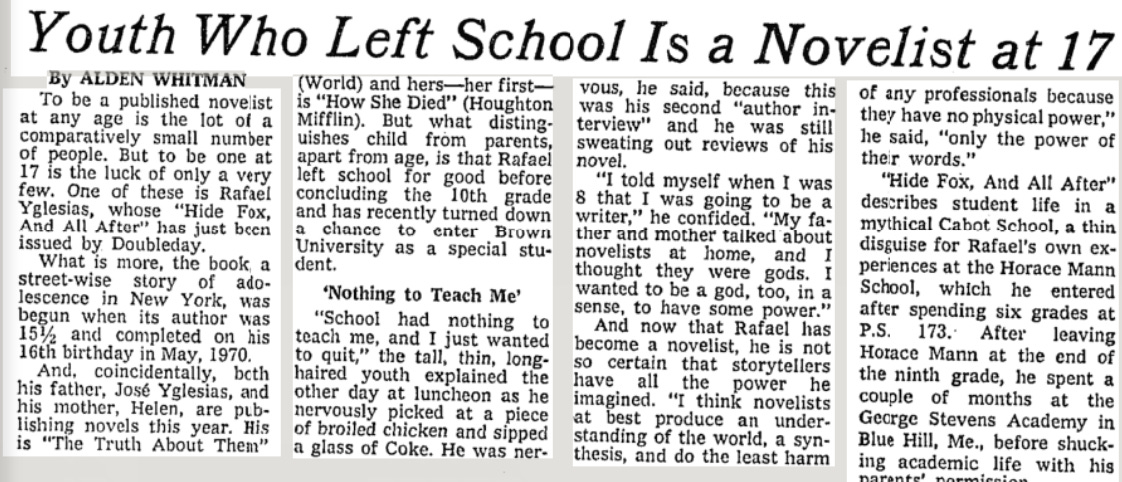
Pro tip: If you're seventeen, your first novel is coming out, and the NY Times asks to interview you, sure say yes, but answer all questions like an athlete: "I'm going to take it one novel at a time, I'm just happy to be here, I'll read the classics, learn from my mistakes, and get ready for the next one." Also go to college and find a good therapist.
Hey everyone! Wanted to flag that my new job is the Editor at The Searchlight Institute — they're a new center left think tank that I think is very much up this crowd's ally. I still plan on chatting occasionally with you all here, but to read me and the organization's work subscribe to their Substack. https://searchlightinst.substack.com/p/no-one-faction-policy-or-person-can