

After you finish today’s post, I hope you’ll listen to the latest episode of “The Argument” podcast, where Jerusalem and I continue the conversation about why politicians aren’t listening to voters’ demands for lower prices. Paid subscribers can watch or listen ad free and read the transcript and show notes here. Free subscribers can catch the episode on YouTube here or listen wherever you get your podcasts.
Subscribe: Apple Podcasts | Spotify | YouTube | Overcast | Pocket Casts
Voters, clearly, are very upset about the cost of living, and (to be boring) this was an important factor in the midterm elections. Indeed, to the extent that we can tell from surveys, not only do voters think Republicans need to focus much more on the cost of living, but they even make this critique of Democrats to some degree.
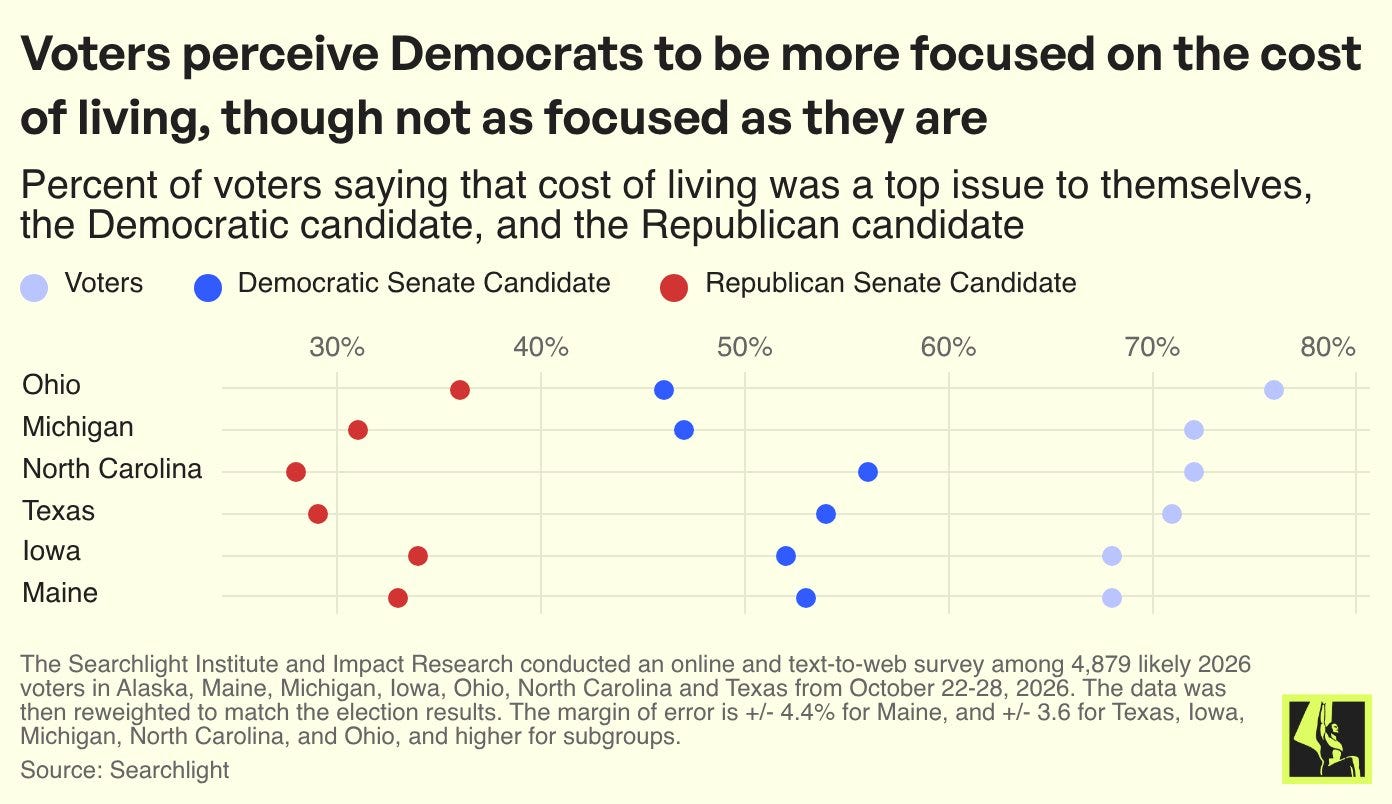
Even where you might think other factors are at play, like with Latino voters in Texas, more than 70 percent of those voters cite the cost of living as a top three issue compared with roughly 35 percent for immigration and border security.
People are upset about costs, they’ve been upset for a long time, and the re-acceleration of inflation associated with the war in Iran has been a fiasco for the Trump administration.
But having stipulated all that, now that the election is over, I’d like to observe that voter rage about the cost of living seems somewhat out of proportion to the actual circumstances.
This was the biggest midterm wave since 1974. But on top of Watergate, which was a huge factor in that election, the inflation rate in 1974 was a bit over 12 percent after 8.7 percent inflation in 1973. More recently, we had 7 percent inflation in 2021 followed by 6.5 percent inflation in 2022. As of September, it was 3.7 percent. That’s bad! It’s a legitimate basis for criticism of Donald Trump!
But it’s way better than 1974, and on its face you’d think it would generate a smaller backlash.
Of course, Iran has specifically generated a spike in gasoline prices, which are always particularly salient and particularly annoying. Still, gasoline is way more affordable today than it was not just in the 1970s but in the pretty recent past.
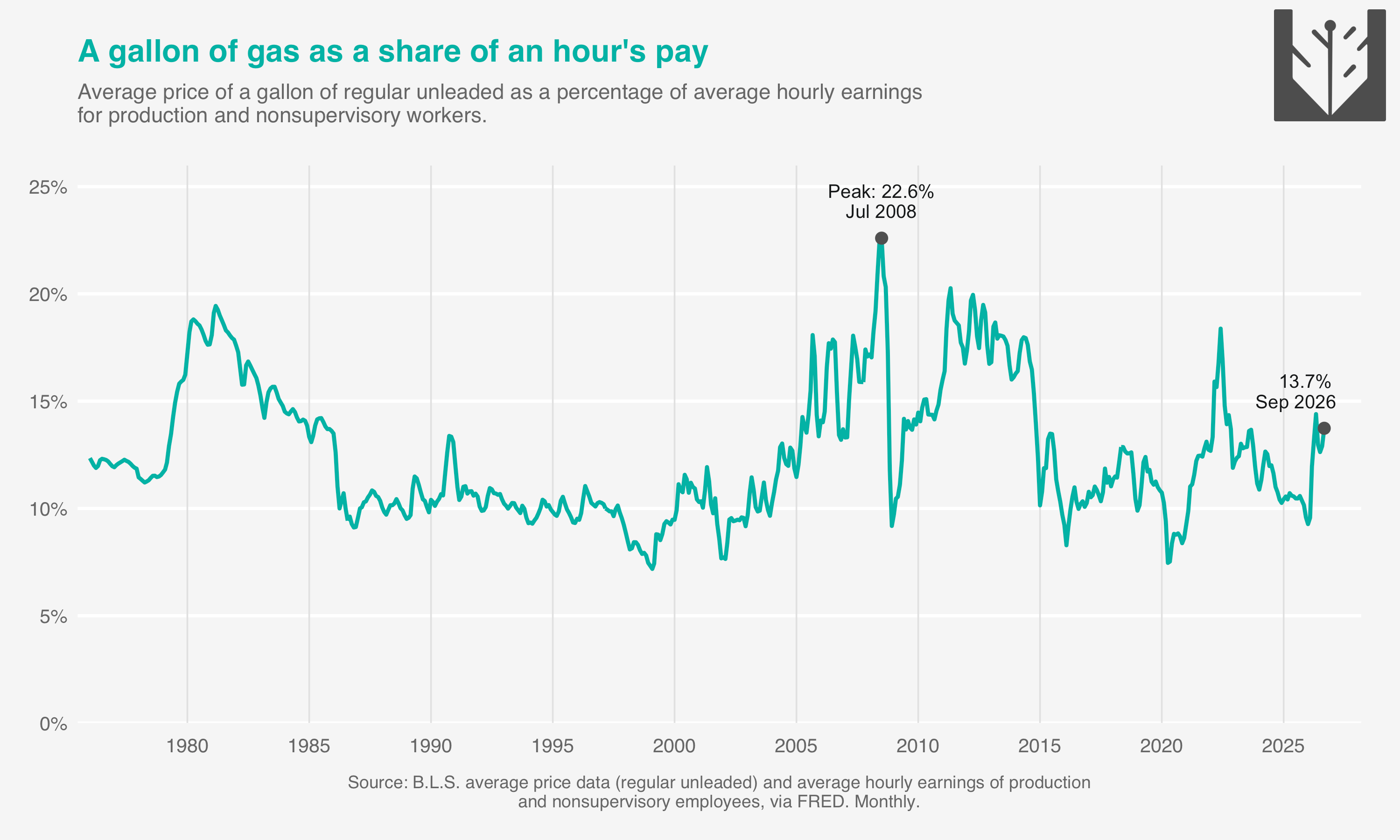
Obviously, it’s completely tone deaf politically to say this, so I encourage the White House to borrow my chart and argue with the voters that things are fine, actually.
But just between you and me … it seems pretty fine? Especially because if you pop over to Jason Furman’s giant dashboard of economic indicators, a lot of other things seem to be going well. The unemployment rate is low at 4.1 percent and has been low for a long time. G.D.P. growth is solid, and the job openings rate is slightly higher than the unemployment rate, indicating a well-balanced labor market. This is not a perfect economy, but it seems genuinely better than a lot of situations I’ve seen play out in my lifetime.
Yet people really hate it, to the extent that they feel the opposition party isn’t focused enough on complaining about how terrible everything is.
The great betrayal
This is vibes rather than data, but after some introspection, one theory I’m partial to is that people feel betrayed by their political leaders.
I, for one, find it strange and annoying that after everyone was clearly furious with inflation in 2021-22, we never got a strong pivot to “It’s time to fight inflation.”
I’m a dork, so I phrase this in technical macroeconomic terms that normal people would not use, but here’s what happened: Inflation surged, we had a period of denial that it was all transitory, and then interest rates went up to keep inflation contained. Inflation then started heading back down throughout the Biden years, but it never returned to its target level. And the Biden administration never made a big policy pivot toward deficit reduction or supply-side regulatory reform to address it. Then Trump won promising not just a return to on-target inflation but an actual fall in the price level. That second part was impossible, but Trump never delivered the return to target that was possible. Instead, he increased the budget deficit in a way that increased inflationary pressures, and then we got a negative supply shock when he started a war with Iran.
The takeaway here is not that the underlying situation is genuinely the worst on record but that the political system is stubbornly averse to addressing it.
Even now, though, if you scour the universe of Democratic Party-aligned think tanks, you don’t see anyone saying, “Now that voters are angry about the cost of living, we need a totally retooled policy agenda to reduce inflation and interest rates.”
What’s happening instead is that everyone has taken the same off-the-shelf ideas from 2019 — neo-Brandeisian antitrust policy, expanded child-care subsidies, fighting climate change — and given them an affordability rebrand.
It would be a little crazy for an ideological movement to just completely abandon its long-held substantive goals in favor of a 100 percent focus on inflation and interest rates. But right now, Republicans are doing less than zero on inflation and interest rates. And the best I can really say for Democrats’ plans is they’re mostly avoiding ideas that would make things worse.
But there has really been shockingly little rethinking of the substance of the policy agenda. The whole idea of the new antitrust thinking, for example, was that the prior generation of enforcement had been overly focused on low consumer prices. It was genuinely bad luck for Lina Khan that she took power right when public concern about low consumer prices exploded — it’s not like the Federal Trade Commission caused inflation — but it seems obvious that when everyone is mad about consumer prices, you pivot back to the “low consumer prices are really important” school of thought.
Taxing wealth or unrealized capital gains is an inflationary mechanism of financing new government spending because you’re increasing overall consumption. Carbon pricing was abandoned as a climate solution in favor of Green New Deal thinking at a time when the economy needed stimulus, but the economy doesn’t need stimulus now and nobody’s gone back. The whole progressive child-care agenda was cooked up when unemployment was high, and it doesn’t make sense in a tight labor market.
Of course, Trump is president right now, and he’s even worse on this score.
It’s not just Iran. And it’s not just that tariffs raise prices — the whole premise of the tariff agenda is that higher prices are a good idea because you’re trying to protect American manufacturers from low-cost competition. Trump is also deliberately shrinking the workforce with his immigration policy, as if there’s some pool of unemployed people who are going to fill the jobs.
Nobody seems to want to sit down and say, “Okay, what is something I believed in but that doesn’t make sense in the specific economic situation we are facing?”
A crisis of politics, not economics
On one level, it seems a little crazy to attribute this level of policy awareness to the American electorate.
But I’m trying to make sense of all the facts. If you want to ask yourself, “How bad is the economic situation, really, in historical terms?” I think the honest answer is that it’s not ideal but we’ve seen much worse, including pretty recently. But if you want to ask yourself, “To what degree have political elites altered their policy priorities to respond to the problems in the economy?” the answer is genuinely not at all.
And that’s kind of remarkable. In 2008, the Bush administration and House Democrats collaborated on a bipartisan stimulus bill. The Obama administration passed a big economic rescue plan in 2009 and then enacted a couple of stimulative deals with Republicans around tax cut extensions and unemployment insurance. During Covid, Trump and Democrats collaborated on the CARES Act.
I don’t want to overstate the extent to which politicians are loyal public servants eager to address the problems of the mass public, but they do normally try at least a little.
I remember being on a briefing call with the Biden economic team, and they were talking about their cost-of-living ideas. Their talking points were pretty uncompelling to me, and I asked a question that I hoped would be helpful, something like: Can you give me an example of something you’re doing to address costs that people wouldn’t normally expect to see from a Democratic administration? Like what’s a policy that you wouldn’t think was a good idea if the economic situation was different but that you have specifically adopted to address the cost-of-living crisis?
And they legitimately had nothing to offer. The agenda wasn’t all bad ideas, but it was stuff Democrats would be inclined to favor in any economic climate.
Then Trump comes in and, again, it’s not like his team has zero initiatives that are helpful on costs. But everything he’s done that’s constructive here is completely generic Republican deregulatory stuff. There’s nothing at all that’s like, “If inflation was 1.9 percent, we’d love to do X, but because it’s 3.7 percent, we’re doing Y instead.”
So while I think the cost-of-living crisis, qua economic crisis, is a bit overstated, it does strike me as a very real crisis for American democracy.
Political parties are supposed to try to advance their coalition’s ideological and interest-group agenda. But they are also supposed to respond to the mass public’s priorities! And for the past four or five years, they just haven’t.
On some level, I think you don’t actually need to understand the whole macroeconomic picture to see this. Everyone knows what it would look like for a president to take on his base or his political allies in order to advance a policy goal. Biden clearly stood up to the left for the sake of a pro-Israel policy that he believed in. Trump stood up to the pro-life movement to reassure residents of blue and purple states about abortion.
But neither of them did anything like that on the cost of living.
People are equally angry everywhere
One piece of evidence for this view is that economic trends impact different places differently, but everyone seems equally angry.
In Alaska and Texas, for example, a negative shock to Middle Eastern energy supplies is arguably good for the local economy since they produce a lot of oil. But Democrats are winning the Senate and gubernatorial races in both those states. That’s in part thanks to four smart candidates who ran smart campaigns, but there’s just clearly no way that Democrats are winning those races without pissed off voters.
I was looking for an example of something that, unlike gasoline, really has become unprecedentedly expensive, and what I came up with is beef.
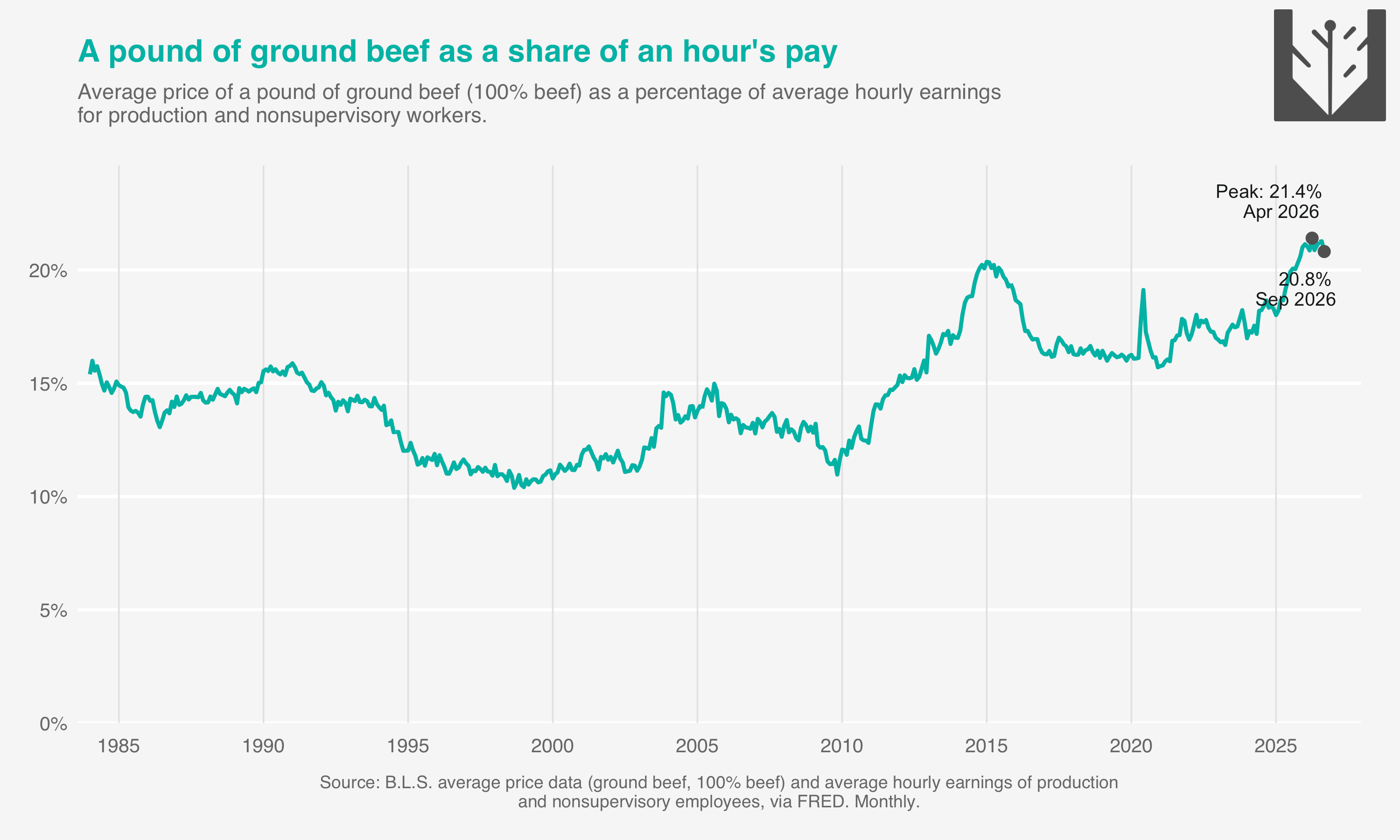
Now the thing about beef is that unlike gasoline, you don’t really need to go buy beef if you think it’s too expensive. Beef is way less affordable right now than it was in the 1980s, but chicken is cheaper. People need to eat food, but you can always pick another protein. And when Cindy Hyde-Smith made this point, it was so politically toxic that it seems to have reversed the most notorious racial-polarization dynamic in all of American history and gotten a Democrat elected in Mississippi.
I think people aren’t just angry about beef; they’re angry about the arrogance of a political class that refuses to listen when they say this is their top priority.
Political scientist Christoffer Dausgaard did some technical analysis that exploited local variation in gasoline prices to ask whether the swing against Republicans was particularly large in places where gas rose an above-average amount, and the answer is no.
In other words, the level of public anger about prices does not vary with the prices themselves.
Another way I’ve been thinking about this is that northern New England is more exposed to the Strait of Hormuz shock than the rest of the country because people there rely on oil (rather than gas or electricity) for heat and also because gas-fired power plants in New England need to partially use liquefied natural gas rather than rely on cheaper pipeline gas. There was a big swing against Republicans in northern New England, the same as everywhere else, but Republican governors got re-elected in New Hampshire and Vermont, and Susan Collins put up a strong performance (as usual) even in defeat.
I think this all supports a kind of sociotropic account of price-related rage. Rather than mechanically responding to individual variation in the cost of living, voters are aware that inflation concerns are a big deal nationally and that political leaders at the national level are not prioritizing these concerns. They are equally mad about this everywhere in the country and gave some grace to Republicans who have unusually strong brands distinct from Trump and national Republican leadership.
How sure am I that this is what’s going on? Not that sure.
I think the level of voter outrage over modest inflation is genuinely a little bit mysterious. But I don’t think it’s plausible that all the economic data is wrong or that voters are responding to something that’s totally fake. Something that is absolutely real is that we’re now on Year Five of the inflationary episode and first Democrats and now Republicans have declined to genuinely prioritize inflation reduction. And I think Democrats ought to think hard about changing that when they craft their agenda for 2029.
Before you go, we wanted to remind you that paid subscribers can watch or listen ad free to this week’s episode of “The Argument” or read the transcript and show notes here. Free subscribers can watch the episode on YouTube here or listen on your podcast app of choice.
The simplest explanation is that the inflation stat just isn’t accurate and actual inflation is a bit higher. I would’ve said this was a conspiracy theory in the past because my own spending pre-COVID was relatively constant year to year. But this year I’ve saved much less money than last year and even less money this year than in 2024 when I bought a new car and haven’t made any similarly large purchases this year. And many of my expenses are fixed (I have a COVID-era mortgage and employer-subsidized daycare)—imagine the situation facing a non-homeowner who is literally facing double or triple the monthly costs of pre-COVID!
The unemployment stat also hides a huge amount of variation by age. Young people have it pretty bad. Young college grads are back to early-2010s levels of unemployment: https://www.epi.org/blog/class-of-2026-young-college-graduates-face-a-weaker-labor-market-but-a-more-mixed-picture-than-the-headlines-suggest/. And everything is much more expensive than the early 2010s.
I would say that what has happened is that everywhere consumers go they don’t feel like they are getting a deal. This whole inflationary episode feels like a bunch of nickel and diming after every episode. I am angry my Greek yogurt brand has increased one dollar a pint. I am angry that the Brazil coffee tariff prices negotiated a long while ago are passing through. I am angry my it takes ten extra dollars to fill my Corolla.