

Join us for our D.C. happy hour tonight at 6:30! Details here for paid subscribers!

For many years now, advocates of an expanded role for the federal government in the provision of child care have been angling to “go next” in Democratic Party priorities. And we’re already seeing things like a $50 million push not just to help Democrats win races in the midterms, but specifically to get their campaigns to center child care issues.
Elizabeth Warren, a critically important thought-leader in the party, said at the Center for American Progress’s IDEAS Conference in May that “It would be political malpractice for Democrats not to be talking about child care every chance we get, going into the midterms and beyond.”
But of course, she doesn’t just want to talk about child care in the abstract. She wants to talk specifically about her Child Care for Every Community Act, which was introduced last year with Mikie Sherrill as House co-sponsor, a role that has been taken up by Alexandria Ocasio-Cortez now that Sherrill is governor of New Jersey.
The link between calling on Democrats to campaign on an issue and pushing specific policy measures relates to a very dysfunctional norm in the Democratic Party where everyone more or less agrees that the way to win a substantive argument about policy prioritization is to first win an argument about messaging. There’s a similar push underway, led by Sheldon Whitehouse, to get Democrats to talk more about climate change.
Of course, for senators like Warren and Whitehouse with safe seats in New England, there’s no downside to just talking about both.
But Democrats need to win races in Iowa and Alaska and Texas and Ohio if they’re going to do anything at all. And to do that, it helps for the national party to have accurate information about what voters care about. But if progressive issue advocates believe that the only way to secure prioritization for their topic is to deceive party elites about the voters’ priorities, they’re incentivized to engage in spreading misinformation.
I would note that you don’t actually need to conduct politics this way. In 2001 and then again in 2003 and again in 2017 and again in 2025, newly elected Republican presidents prioritized regressive tax cuts that conservatives believe are morally important. But Republicans have never made “we want to cut rich people’s taxes” the centerpiece of a national political campaign. They don’t even make it the centerpiece of their pitch for the regressive tax bills they promote. They simply keep in mind that the thing they most care about is not the same as the thing that persuadable voters most care about.
And just as persuadable voters don’t really care about climate change, they don’t seem to care very much about child care either.
I don’t want to get the people at Navigator Research in trouble, because they’re trying to be good Democrats and progressive allies. But their latest battleground polling presentation (which to be clear is full of good news for Dems) also makes it clear that the child care issue is a niche topic.
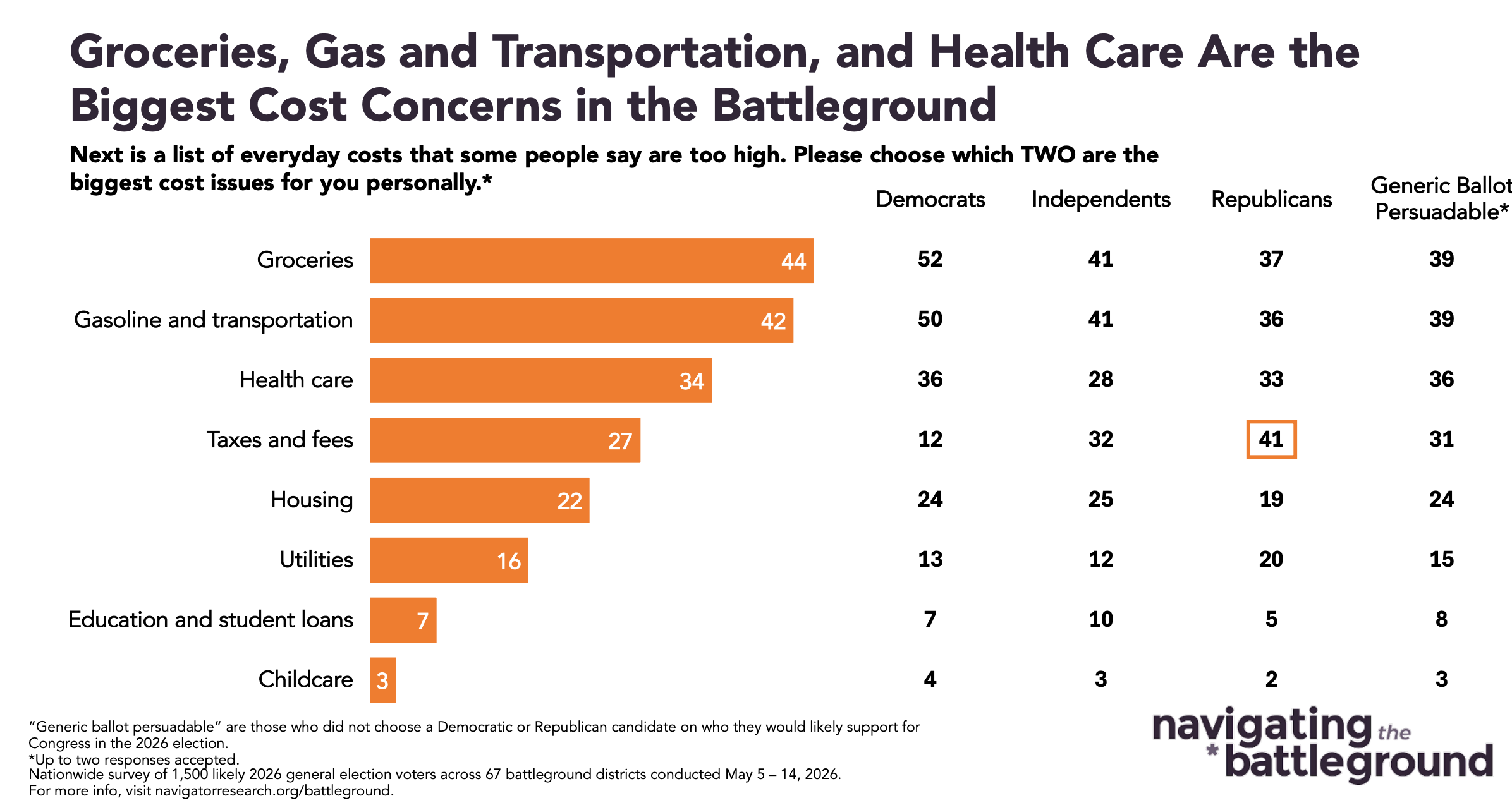
This should not be a huge surprise. Child care costs are a huge topic for dual-income couples with kids under five, especially if they live in expensive metro areas. But while people like that are very well-represented in the Democratic Party staffer class, they’re just not a very large share of the population.
Interest in subsidized day care centers is limited
One issue here is just that while the general topic of child care is highly salient to anyone whose kids are too young for public school, that’s just not that many people.