

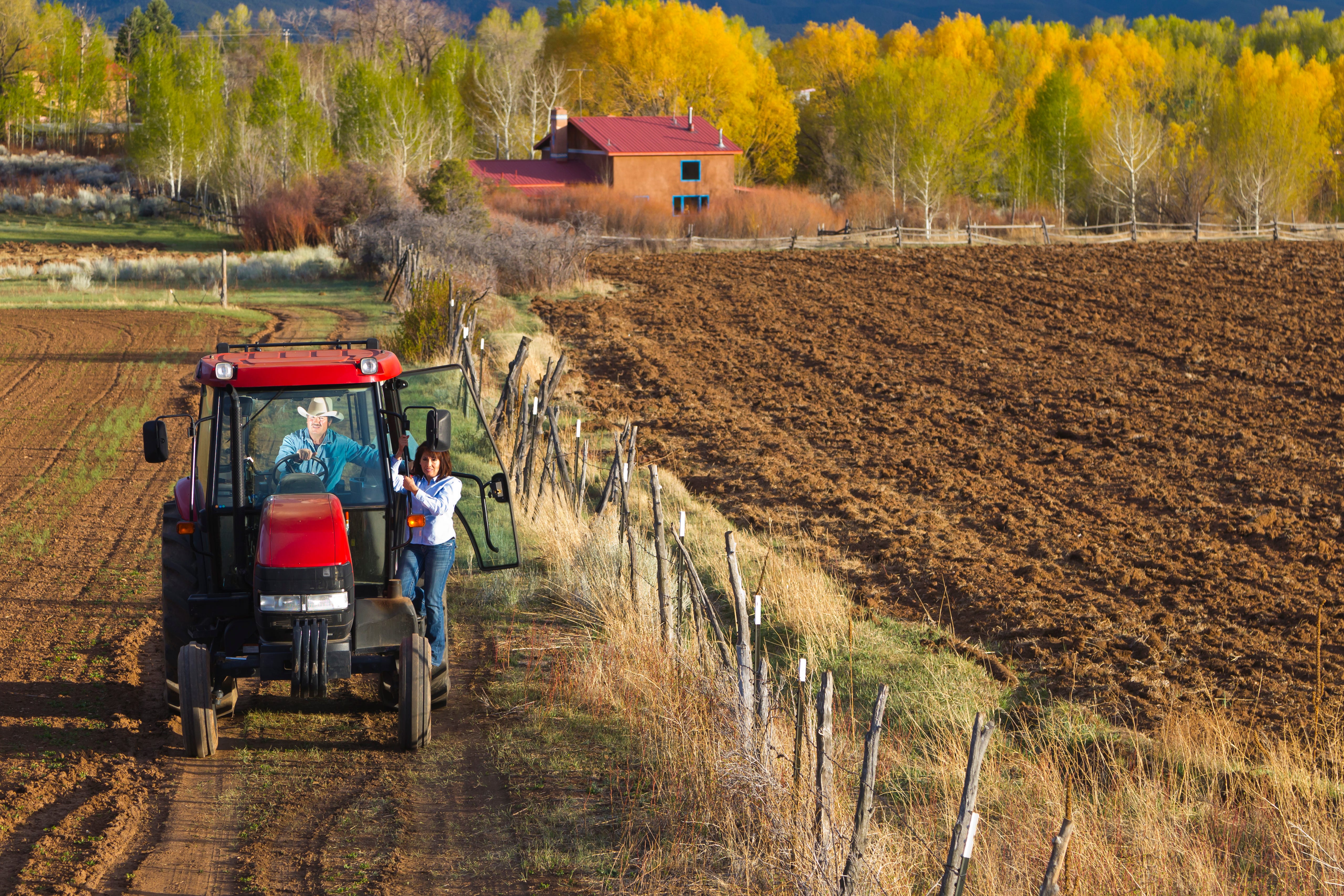
Along with my controversial view that dogs aren’t people, a subtly significant claim I believe to be accurate and consequential is that farms aren’t nature.
I think the vast majority of people, including people with a healthy appreciation for the value of economic growth, think there’s an important role for public policy in preserving nature. The exact nature of that role is, of course, controversial. You don’t see Donald Trump pushing to sell the Grand Canyon to build a golf course or California YIMBYs calling for midrise apartments in Yosemite. But outside of the most obvious examples, people have somewhat different intuitions as to what nature even is.
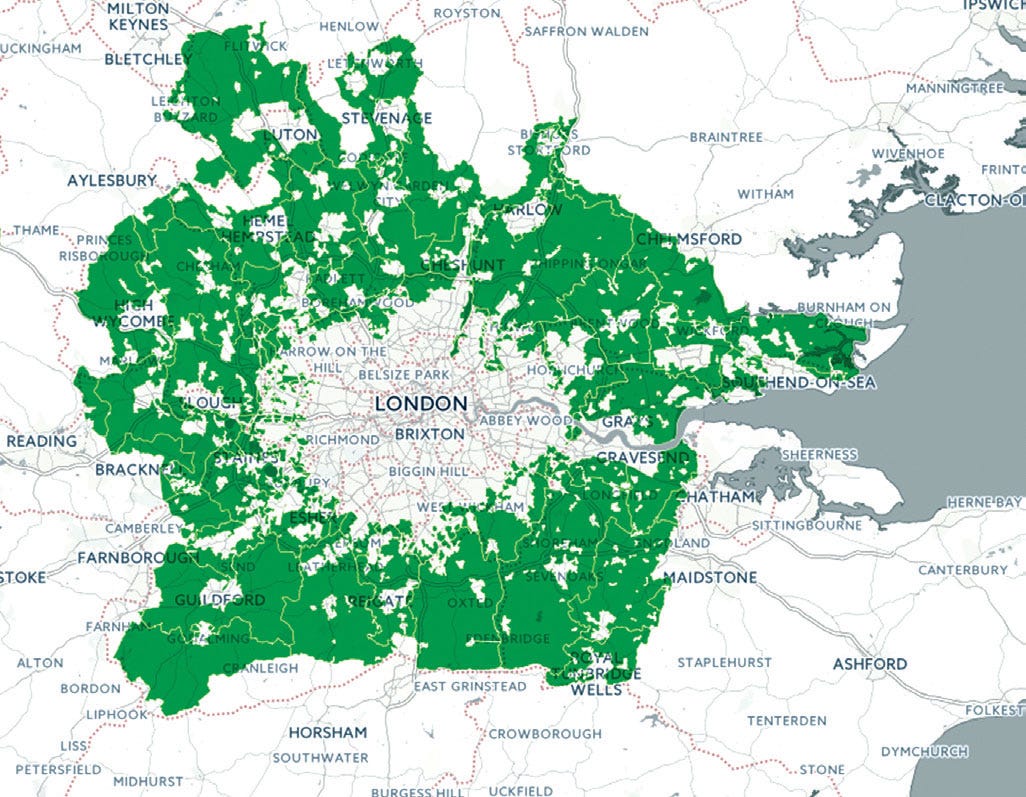
For example, London (like other British cities) is surrounded by an extensive green belt in which housing development is heavily restricted. This is obviously a costly economic policy given the country’s acute housing shortage. What I think is not clear from the map is that the “green” in the green belt is not parks or woodland but mostly farms with a smattering of golf courses and other sports facilities.
In the United States, we don’t typically have policies like that. One exception, though, is that Montgomery County in the D.C. suburbs has an extensive Agricultural Reserve where, similarly, suburban sprawl is banned.
But what you get in exchange for the development ban is not parkland or nature preserves but (mostly) small farms that absent regulation would not be an economical use of the land. Many of these appear to be hobby farms or derive the majority of their revenue from use as wedding venues or the like. Regardless, the Agricultural Reserve is, in effect, a kind of super-duper large-lot zoning, not a “conservation” policy as I would understand it.
Freddie deBoer called me out the other day for some intemperate remarks on British cultural and political attitudes toward housing, and I think he had a basically fair point. I try to advocate for pragmatic, non-expressive politics, and when it comes to the United States of America I think I do a pretty good job of it. Since I don’t actually live in Britain or cover British politics professionally, it can be fun to mouth off. But it’s bad practice. So I’ll say that I do not really understand the culture, legacy, or history of these British green belts. I will simply observe that in the United States of America, we do not normally understand farms to be part of the category of “nature” that we are trying to protect with environmental law, and this is a strength of American society. But we do have exceptions, and I’m a bit concerned that these exceptions are growing.
Forever farmland? Why?
I’m writing from Maine, a state renowned for its natural beauty.
It’s also a state that after decades of population decline has seen rapid population growth since Covid, which is creating a lot of pressure on housing prices. That’s especially true because the places where remote workers want to live — and therefore where people who want jobs doing locally facing services for remote workers want to live — are not necessarily the mill towns that lost population during the decline years. The state has passed some major YIMBY laws to address the housing crisis, but I think common sense says that the state will also want to take measures to ensure the preservation of the aforementioned natural beauty.
One way this happens in Maine is through conservation easements.
In a conservation easement, a landowner stipulates that future development will be restricted on all or part of a property. Enforcement of the conservation easement falls to one of the various land trusts that exist around the state. The restriction reduces the fair market value of the property, which generates an income tax deduction (and, if applicable, estate tax savings) while also lowering the landowner’s property-tax liability. In exchange, the status quo is preserved.
This broadly makes sense to me. The former owner of a property I can see across the water from my house placed it under a conservation easement in partnership with the Maine Coast Heritage Trust. It is nice to look at from afar and makes for a fun, easy hike to take visitors on.
But there’s no legal requirement that a conservation easement involve opening the land to the public like this. What’s more, there’s not even a legal requirement that it be a nature preserve! From a tax standpoint, what’s going on is that by forswearing development rights, you are reducing the value of the land.
Nearby, the Blue Hill Heritage Trust has a Farmland Forever program that encourages people to create conservation easements that stipulate that land cannot be used for future housing development because it’s going to be a farm.
It’s of course true that if you take a parcel of land that could potentially be valuable if subdivided into housing and say “nope, this is going to be a farm forever,” this reduces the economic value of the land. But is giving a person a tax break for doing something economically perverse with a parcel of land really a good idea? What if a plumber had agreed in 2002 to stipulate that his plumbing business would never use cell phones or email or launch a website? That would reduce the value of the business. But you wouldn’t want the tax code to encourage people to run their businesses in a dumb way.
You can even go to fundraising dinners at the local country club where upscale residents will, I guess, donate money to the cause of encouraging people to get tax breaks for restricting housing development on their land.
It seems like it’s basically just NIMBYism with a vague high-minded gloss.
Blue Hill Heritage Trust grimly warns that “as land values rise and properties are subdivided, agricultural land can quickly be converted to housing and other uses. Once these productive soils are developed, they are effectively removed from agricultural use forever.” That may or may not be true, but it’s absolutely true that once land is placed under a perpetual conservation easement barring residential development, it is (by definition) removed from residential use forever. And for what? Small-scale New England farms haven’t been a major part of the American economy since railroads were built in the late 19th century.
Which, of course, is not to say that people shouldn’t be allowed to operate farms in Maine or wherever else they want to. I like farmers’ markets and paying a premium for fresh local produce as much as the next upscale liberal.
But I also want people to have places to live and reasonable commutes. I want builders and the people who manufacture the stuff that goes into homes to have jobs. I want towns to have tax revenue so they can support schools and roads. Bearing an economic cost to preserve nature seems reasonable to me. But part of how you get there is you allow more development so your town has a larger revenue base. That lets your town acquire more choice parcels for parkland rather than just freezing random small-scale developments in amber.
The big tradeoff
Cutesy farms in cutesy coastal towns are a kind of funny edge case for both nature conservation and agriculture.
What I think is underappreciated, though, is the tradeoff around the large commercially viable farming operations that genuinely underpin the American agricultural sector and, to some extent, the entire global food system.
These farms are mostly not cutesy, and people express relatively little desire to preserve them. Indeed, they often express the desire to have less nasty “agribusiness” and more cutesy farms.
The problem with this is that, as Michael Grunwald’s great book on agriculture from last year points out, the big nasty commercially viable farms are the way they are because they are dramatically more efficient. A single cutesy farm in a cutesy town looks nice, but it’s not producing enough food to feed the town. Agriculture that is less intensive, less efficient, and more localized would require widespread deforestation. And yet even with relatively intensive modern methods, the national footprint of agriculture is much larger than all the cities and suburban subdivisions and strip malls combined. Over a third of federally owned land is used for grazing.
I’m not going to say that this is bad; obviously, it’s good to have food.
But it does underscore that biofuels subsidies are a crazy agricultural policy. Shrinking the footprint of nature in order to grow more corn in order to turn corn into a gasoline additive is ridiculous — especially if you keep in mind that farms aren’t nature.
I heard Bill McKibben tell Ezra Klein recently that America doesn’t need more energy because “we already use huge quantities of it, and we use it strangely.” This is wrong, though. If we had much more abundant energy, then vertical farming would be economically viable for at least some crops and we could get by with much less farmland — and much less pesticide — and have more room for homes and for nature.
And that’s the general point. If you’re interested in the subject of human activity encroaching on the natural realm, then agriculture is by far the main way in which this happens. If you adopt a kind of anti-urban, anti-housing politics whereby farmland is conceived of as a form of nature, you not only end up engaging in costly forms of farmland preservation, but you ultimately undermine the goal of preserving actual wild landscapes, wildlife habitats, and recreational amenities.
I just have to say, going out of your way to acknowledge Freddie de Boer, of all people, calling you out for intemperate remarks is an act of tremendous humility and intellectual honesty.
At a planning workshop last month I pushed back against exactly this. Some are trying to get farmland conservation into our plan of conservation and development and I had a list of a few bigger downtown and suburban neighborhoods that had been old farms. Which was quite easy because everything in New England was farms once! We have absurd situations where the descendants of the last farmers are desperately trying to sell off or develop the land they've inherited and it's the neighbors organizing relentlessly to force them into endless intland wetland hearings and filing lawsuits even when things finally get approved.
What's nice is at public comment you have to state name and address, so it's pretty easy to check what farm their property had been prior to development. It's totally OK that MY house was built on an old farm but HOW DARE YOU try to sell that farm to EVIL developers????