

Donald Trump has plunged the United States into a new and destructive round of the trade war with Canada.
Obviously, the U.S.-Canada relationship is a bigger deal for Canada than for the United States since we’re a much larger country with a wider set of global entanglements. But fundamentally, Canada really does matter quite a bit to the United States, probably more than any other single country. And I think Americans — especially anti-Trump Americans — are sleeping on the extent to which this is viewed in Canada as an existential moment.
The nature of Trump’s demands, which include things that have long been on the U.S. side of the bilateral-trade docket but also speak to language arrangements that are at the core of Canadian national identity as well as Canada’s basic sovereign right to conduct trade relations with other countries, is stark. And Trump contextualized those demands by snarking that he was going to turn Canada into the 51st state, a “joke” that JD Vance couldn’t help himself but repeat at the height of the crisis.
Democrats have uniformly opposed these moves, as far as I can tell, but they’ve hardly risen to meet the moment in a diplomatically or politically sophisticated manner, nor are they genuinely attentive to the dynamics on the Canadian side of the border.
Worst of all, Gavin Newsom in an interview with Canadian television committed to dealing with Canada more respectfully but not to reversing the tariffs.

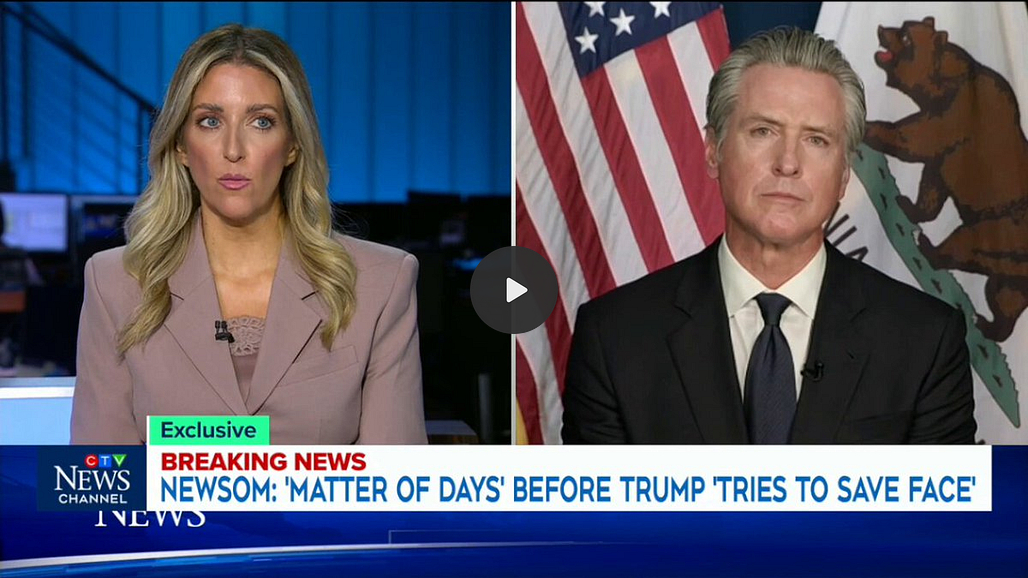
This didn’t attract a lot of attention in American circles, but obviously Canadians were paying attention. And their interpretation is that the most prominent anti-Trump figure who bothered to come on Canadian media and discuss this was basically embracing a bipartisan squeeze play to crush Canadian sovereignty.


I think the people I quoted above are overreading the level of intentionality in Newsom’s remarks and underrating the extent to which he’s just not very smart.
But I also think that Democrats should pay attention to this reaction and do everything in their power to steer away from this dynamic. Trump’s conduct has been truly destructive and shocking to the conscience, and Democrats should say that.
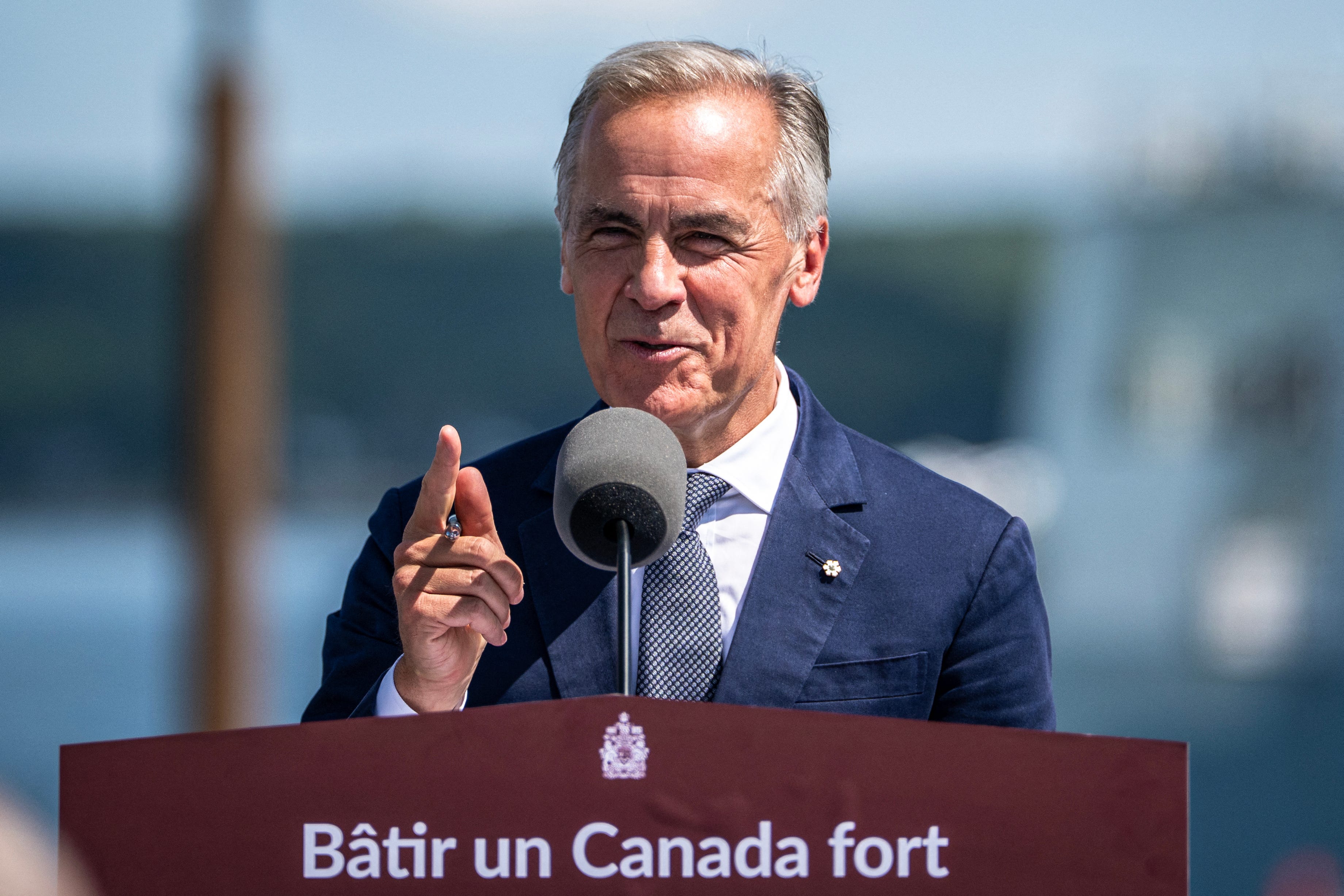
For now, Canadian Prime Minister Mark Carney is standing strong. For now, the Canadian people are behind him. And Democrats should say loud and clear that he is right to stand strong and that if they wield power in 2027, they will do whatever they can to roll back this trade war, and if they govern in 2029, they will absolutely end it.
Don’t just criticize Trump’s actions — positively repudiate them and promise to reverse them. Do it on Twitter and in the American media, but in Canadian media, too. Newsom is wrong on the politics and wrong on the merits.
The strategic logic of vowing to surrender
Trump may be deplored abroad, but Democrats should recognize that they’re not as well-liked as they may think.
One reason for that is that when Joe Biden was president, he actually didn’t roll back the vast majority of Trump’s tariffs from his previous term.
Both Bill Clinton and Barack Obama were broadly free-trade presidents, and free trade is the historic legacy of the Democratic Party from the Jefferson-Jackson era through to F.D.R. and J.F.K. But in the 1970s and 1980s, congressional Democrats became trade-skeptical, and most Democrats in Congress voted against NAFTA and many other modern trade agreements.
The Biden administration, which opted essentially for continuity, was sort of paralyzed by its labor union ties from rolling back any of the Trump One tariffs.
But while Biden deferred to labor on trade, he did not defer to them on everything — in particular the Keystone XL pipeline. Environmentalists wanted to kill this project, so Biden killed it, even though American building trades and the Canadian government wanted it. None of this is on a par with Trump’s behavior, but it was high-handed and alienating and has made Canadians worry about a good-cop, bad-cop dynamic.
But here’s the problem.
Trump’s logic is that while a trade war will be bad for 340 million Americans, it will be worse on a per capita basis for 40 million Canadians, so at the end of the day the Canadians will cave. Carney’s contrary logic is that this is an existential threat for Canada and basically pointless from an American perspective. His constituents are willing to pay a price to preserve the True North strong and free, while Trump’s constituents are being asked to take further blows on the cost of living to feed the ego of a corrupt psychotic.
Carney’s strategy, though, depends to an extent on his model of the Democrats. If Democrats will surrender in the trade war, then the best strategy for Canada is to stay strong, bear the pain north of the border, inflict pain south of the border, make Trump look bad, and help Democrats win. But if Democrats are just going to play good cop / bad cop, then it raises the question of whether Canada can really hold out forever. If no help is on the way, it might make sense to cave and deliver Trump a big win he can brag about.
The need to avoid a hollow victory
That’s bad for Democrats.
It’s also bad for America. Entrenching the idea that American presidents can make political hay out of bullying friendly countries with negative-sum trade dynamics would be a disaster for American commerce and foreign policy.
The United States simply cannot prevail in prolonged geopolitical competition with China unless citizens of other democratic societies sincerely believe that American power is preferable to the Chinese Communist Party. This is something prior American leaders took for granted, but Trump has actually made much of the world prefer Chinese leadership — part of an overall disastrous approach to China policy that is pointlessly obsessed with bilateral export balances rather than the strategic balance of power.
Any American administration would try to get some trade concessions from Canada — more access to their markets for our dairy farmers, for example — and that’s totally fine. The fact that countries are friendly doesn’t mean they have no disagreements.
And Democrats caring about alliances and international cooperation shouldn’t mean committing to being suckers or to endless free-riding. But there’s genuinely nothing on the U.S.-Canada trade docket that is worth redefining the basic nature of the relationship over. Canada has long been extremely helpful to the United States whenever something really important comes up — from taking in diverted flights on 9/11 to sending troops to Afghanistan, or just the reality that the countries have a cooperative binational electricity grid — and we should act in accordance with that.
Today’s post is free to read, but tomorrow’s on the state of fundraising going into the midterms will be for paid subscribers. Upgrade to get the full article tomorrow morning:
I don’t think Trump’s bullying approach to trade policy is likely to work, but I also don’t want it to work. If it’s perceived as working, it will be repeated and America will be seen by the world as tyrannizing our neighbors and people everywhere will want to see us brought low. But there’s no need for any of this! Democrats should commit to simply ending the trade war with Canada on a unilateral basis — total surrender — and then reboot discussions after trust and goodwill have been restored.
Free trade is a winning issue for Democrats
Beyond the specifics of labor union minutiae, I feel like ever since 2016, Democrats have been mindfucked by the idea that Trump protectionism is a stroke of political genius.
It’s true that in 2016 he flipped the G.O.P. to anti-trade and he also won the election. That being said, he also flipped the G.O.P. into opposing cuts to Social Security and Medicare! The latter is an unambiguous case of Trump dropping a high-profile unpopular G.O.P. policy commitment.
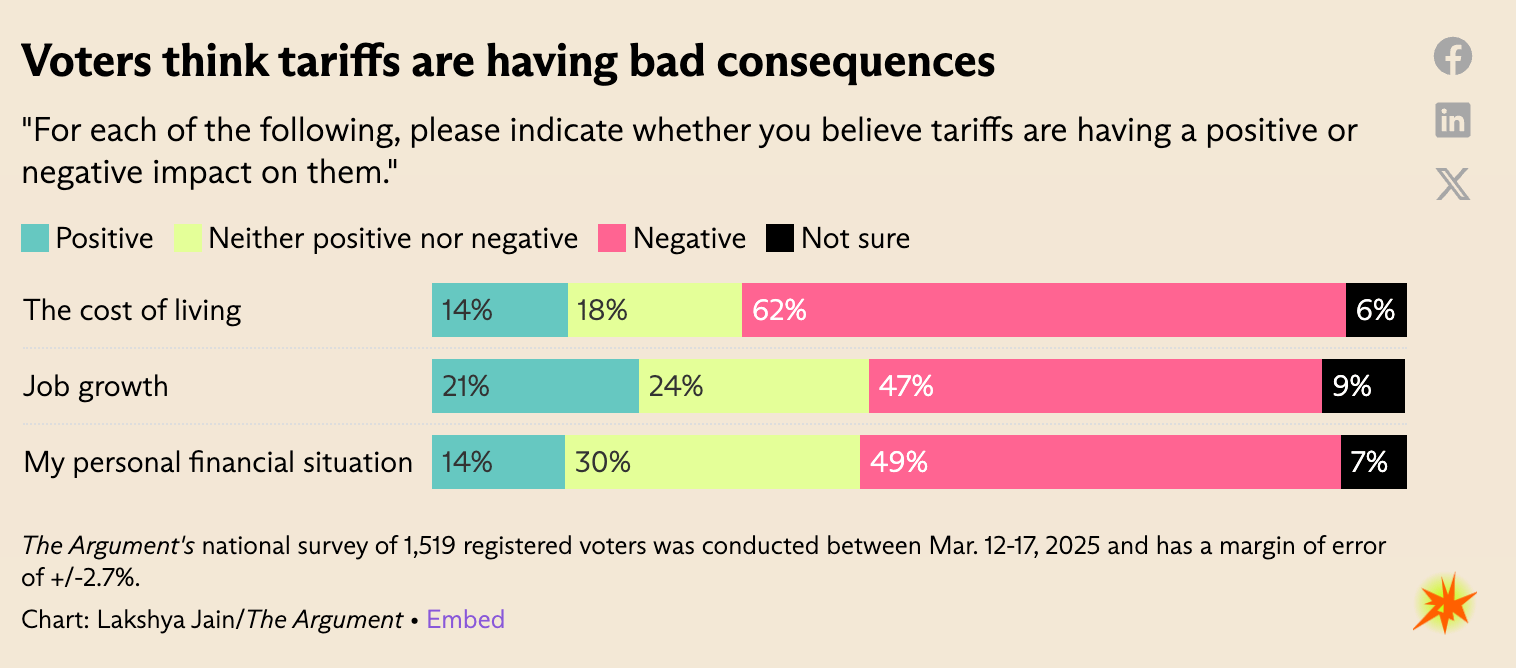
Tariffs, by contrast, are very unpopular:
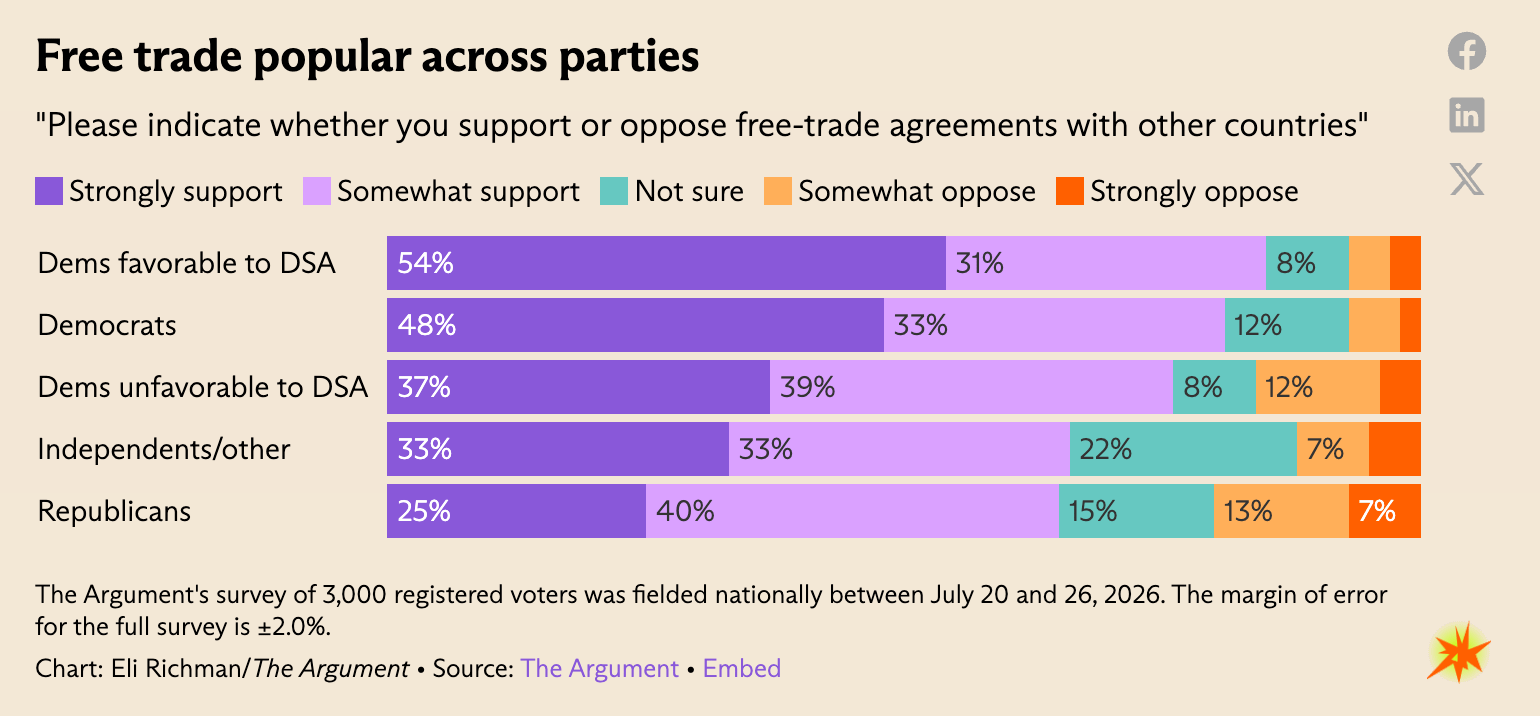
Notably, while free trade is broadly popular with everyone, it’s especially popular with Democratic Socialists of America-curious left-wing insurgents. It’s a free-market idea on the merits, but socialists see it as expressing strong opposition to Trump, and they like it.
Here I’ll concede that if you look beyond the Canada situation and consider tariffs writ large, Democrats do face a bit of a conundrum.
Democrats tend to spend too much time cooking up “big ideas” and not enough time thinking about priorities. And given that Trump’s overall tariff structure is bringing in a lot of revenue and that the budget deficit is currently something that we should be worried about, ditching the tariffs is yet another promise that Democrats should have to slot in among competing priorities.
My pitch for making tariff repeal a major priority is that it hits the quadfecta of being disproportionately progressive, and polling well, and being certified as a good idea by wonkish technocrats, and being welcomed by the business community.
I understand that it would be a bitter pill for the advocacy community to pencil this in ahead of a new child-care program or whatever, and certainly it’s less exciting, but excitement is overrated.
The other thing I would note is that in budgetary terms, Democrats have grown gun-shy about repealing gimmicky Trump ideas like “no tax on tips.” And I get the caution there. But to say that you need to keep unpopular tariffs because you need the revenue and then refuse to close tax loopholes to raise revenue because you’re worried about opinion blowback doesn’t make sense. There’s no course of action with zero political risk or downside, so given that reality, you might as well make the choice that makes more sense on the merits.
The whole fiscal logjam clearly requires some bigger conversations among party stakeholders.
The conflict with Canada, though, is easy. Just say no.
What do SBers think Democrats' marketing of this surrender should be?
I wonder if we should just say everyone is getting a tax cut, nice and simple. Any other ideas?
I thnk Newsom's comments are an absolute disgrace -- and stupid to boot.