

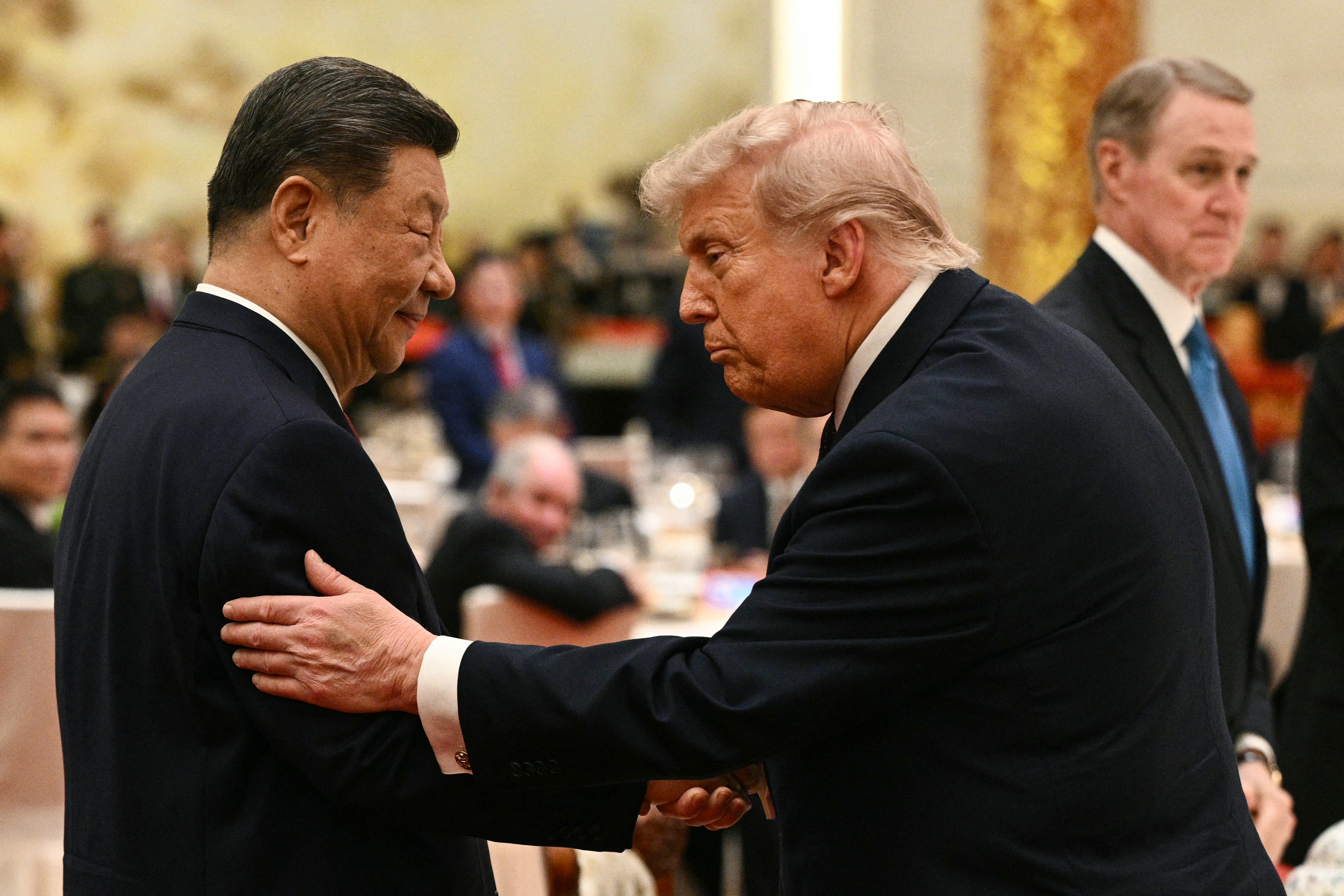
One way that smart people sometimes like to demonstrate their broad-mindedness is to give Donald Trump credit for something that he supposedly got right. And a common talking point among this crowd (here’s Jamie Dimon) is that Trump was “right about China.”
But as his trip to Beijing unfolded last week, I was struck once again by how deeply untrue that is.
It is clearly true that the circa-1999 optimism that trade with China would lead to domestic political reform in the People’s Republic has proven false. Some people, of whom Nancy Pelosi strikes me as the most politically prominent, were genuinely right about this all along.
The views of others evolved over time in response to events: The Great Firewall was erected in 2006, power gradually shifted from Hu Jintao to Xi Jinping between 2008 and 2012, and the Umbrella Revolution in Hong Kong was crushed in 2014, which was also when the government stepped up repression of the Uyghurs. Xi had entrenched himself as a personalistic dictator by 2018, and the last whiff of freedom was wiped out in Hong Kong in 2019–20.
By Barack Obama’s second term, the old consensus was dead and discredited, and the White House was pitching a vision that combined sound understanding of the economics of trade with a new skepticism of the geopolitical aspects of intensive economic integration with China.
That was the Trans-Pacific Partnership.
Trump, because he has insane ideas about the economics of trade, was always skeptical of trade with China.
But he’s also skeptical of trade with Canada, and he was definitely skeptical of forming a large integrated trade zone featuring Japan and Vietnam and Australia and other Pacific Rim countries. He’s incapable of approaching the economic relationship with China in a way that makes sense because he doesn’t understand any of the relevant issues. He’s incapable of positioning the United States as the leader of a coalition of free nations to defend the value of liberal democracy because he does not believe in the value of liberal democracy.
There have been plenty of efforts to backfill his dumb ideas with better ones. If the president is inexplicably fond of Vladimir Putin, his defenders might say, “Maybe he’s hesitant to make generous financial contributions to Ukraine’s defense because he wants to conserve resources for the Pacific.”
Maybe!
But in practice he promotes the domestic political fortunes of pro-Russian political parties in NATO member states and runs down our munitions stockpiles in Iran.
Obama’s grand strategy of pivoting to Asia and confronting China was very much open to criticism. The Biden administration had a somewhat different view of these issues, and I think there are reasonable alternatives to both the Obama and Biden views.
But Trump is not doing either of those things.
In his first term, Trump spent the critical early months of the Covid pandemic lavishing praise on China’s handling of the situation because he was hoping to score a major soybean sale.
That was dumb. But this time around, he is once again touting agreements to export soybeans and energy commodities to China. He also brought Jensen Huang with him on the trip and keeps handing favorable decisions to Nvidia on export controls.
These are the actions of a man in the grips of a sick obsession with bilateral trade balances, not someone serious about geopolitical competition.
If not free trade, then what?
As a basic conceptual point, I think it’s good to start with the fact that “free trade” is basically one idea, while “not free trade” is a bunch of different ideas.