

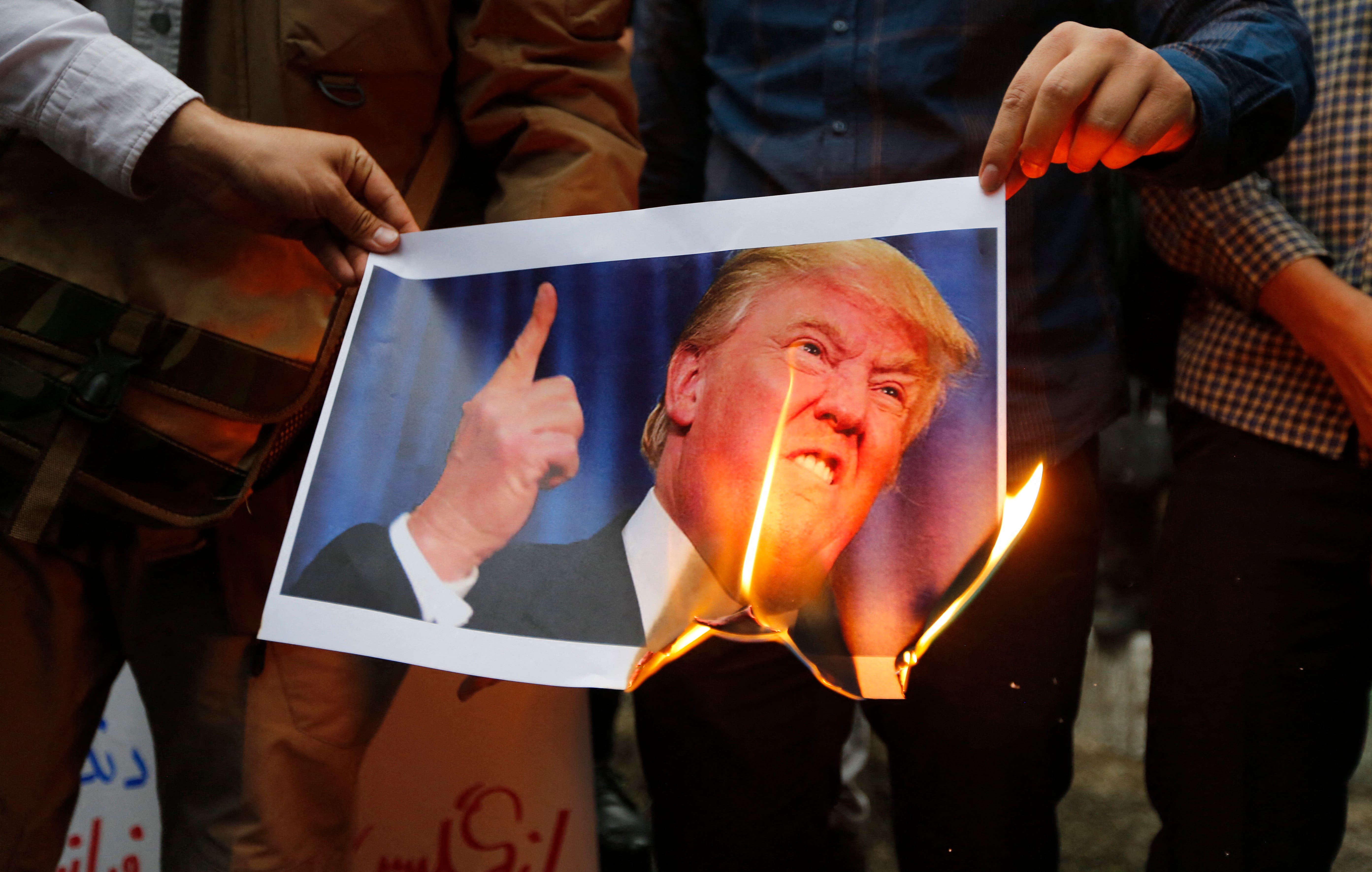
There’s more to foreign policy than being liked, but part of being a great power is dealing with the choice lesser powers face between bandwagoning with a strong country and counterbalancing against it.
For a long time, most observers have seen this as an underlying American advantage vis-a-vis China. Many countries that are geographically near the People’s Republic — notably Japan, South Korea, and Taiwan — have expressed a strong and clear preference for an alliance with the United States of America in a way that has absolutely no counterpart among America’s neighbors. Even countries, like Vietnam, whose historical relationship with the United States was quite negative seem to prefer aligning with a distant and relatively benevolent United States to being under the Chinese Communist Party’s thumb.
But things have taken a pretty sharp turn lately. In Pew polling from earlier this summer, China is now viewed more favorably than the United States in a wide range of countries, including Mexico and Canada and most major European countries.
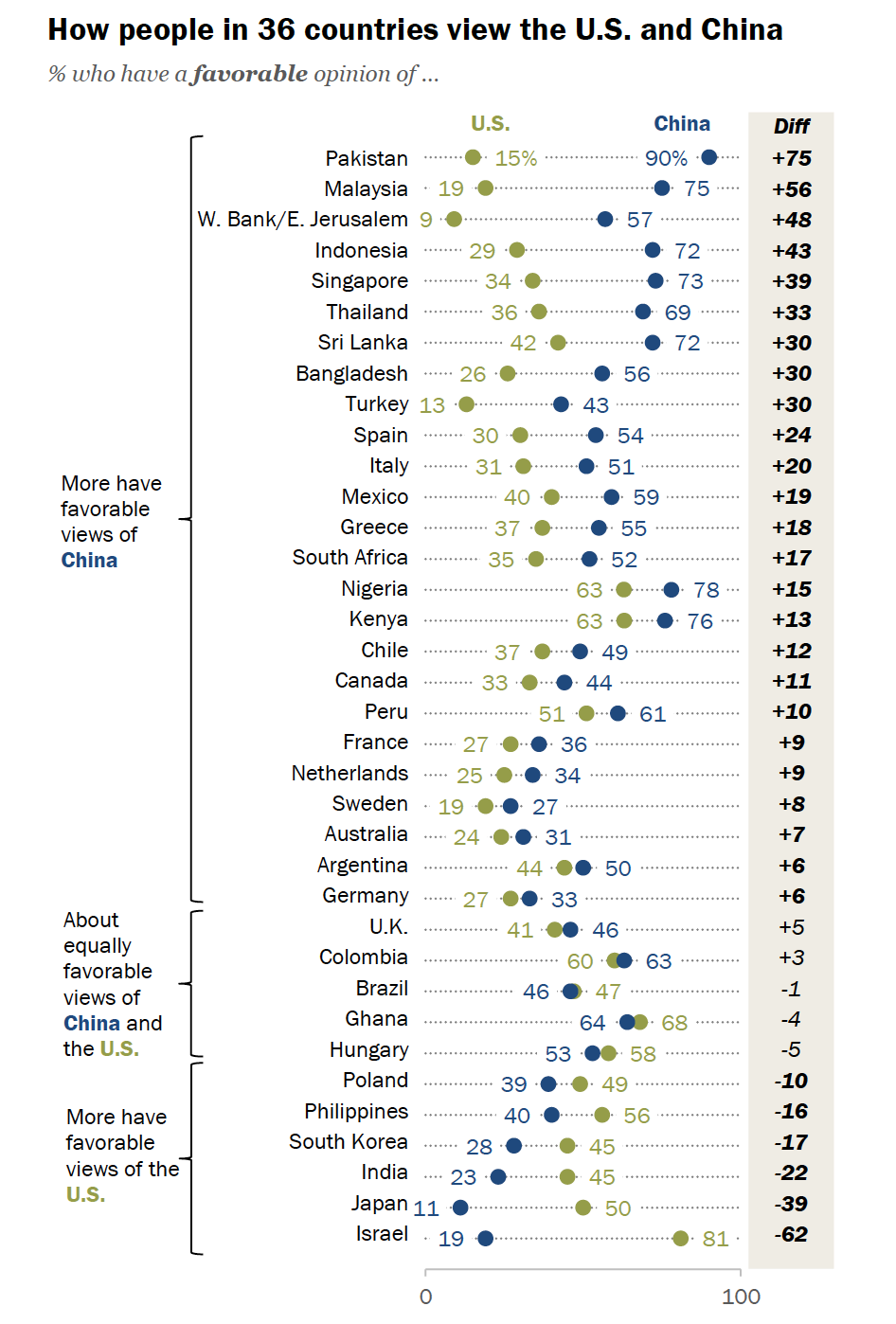
Some of this seems like polarization around Israel, with Israel itself expressing the most favorable views of the United States and a number of Muslim countries exhibiting the biggest gap in China’s favor.
But beyond the specifics of that conflict, I think this reflects the wider implications of Trump’s decision to go to war with Iran.
The higher energy costs brought about by the war have been extremely unpopular domestically. But the economic impact abroad has been worse than the impact at home, and people globally are justifiably angry that as much as Trump has screwed his own constituents on this, he’s inflicted even more pain on them.
And then there’s the bizarre “bad neighbor policy” that has characterized Trump’s second term. Trump transformed Canadian politics with pointless threats to invade the country. He’s got European governments wargaming a fight with the United States over Greenland. Every few months he muses about invading Mexico to fight drug cartels.
None of this stuff is popular with American voters, but it’s also remote from their key concerns, so it gets less attention than purely domestic concerns.
Yet in terms of the long-term harm done to the country, torching America’s reputation with friendly countries for the sake of what mostly amounts to a gag should count among the worst of the Orange Man’s actions.
The anti-Roosevelt doctrine
Teddy Roosevelt articulated the view that the United States ought to “speak softly and carry a big stick,” letting the objective realities of American power speak for themselves while presenting a friendly face to the world.
Trump has done something like the reverse, engaging in maximum bluster while in practice having little interest in anything other than personal corruption and his White House ballroom.
That’s how we end up in bizarre situations like a feud with the government of Italy that started with him bragging for no reason that Giorgia Meloni “begged” him for a bilateral photo op. There’s no actual dispute between the United States and Italy, no real conflict of interest, and Meloni and Trump are pretty like-minded in their approach to domestic politics. Trump is just a jerk who seems like he has trouble with women and never wants to apologize for anything.
Trump is funnier and more entertaining than the average politician — there’s a reason he was a successful reality-television host. And even though becoming president is more impressive than hosting “The Apprentice,” there’s a strong case that the ratings of “The Apprentice” relative to other shows were a good deal more impressive than his approval ratings relative to other presidents.
I think this is why he gets really into these bits like calling Justin Trudeau “governor” of Canada or dispatching JD Vance to Greenland. I’d like to say in a very serious tone of voice, “But there’s nothing funny about the central pillar of the Western alliance acting like a petty bully.” In truth, though, it is kind of funny — it’s just also really bad.
Different jobs come with different responsibilities, and one of the responsibilities of the job of being president is to act in a dignified and appropriate manner, not provoke international incidents for the lulz.
The price of war
Something Trump does not seem to have considered is that some leaders take their jobs more seriously than he does.
After the audacious gambit in Venezuela paid off, Trump seems to have convinced himself that every regime is as hollow and corrupt as Maduro’s. He figured that after he killed a few top guys, whoever was left in Iran would cut a deal. That didn’t work, and he’s been floundering ever since.
The ensuing war has been a big deal for Trump politically because it has pushed up the cost of energy in a way that infuriates voters.
Notably, though, the United States is a net exporter of oil and oil products. So while the supply shock is still on balance bad for the American economy, it really is a balance. Increased domestic production and energy income partially offset the harm of higher prices and mean that the impact on the American economy is much milder than the impact on countries that import all or most of their oil.
With natural gas, we’re even more insulated. There are physical limits to how much gas can be exported from the United States because only so many liquefaction facilities exist. As a result, there are basically two separate gas prices: the price of gas that can be obtained via pipeline from American fields and the higher global price of liquefied gas shipped by sea. Limited pipeline capacity in the Northeast means that New England relies on seaborne gas and has to pay the global price. But most Americans are basically protected from the supply disruption.
Trump periodically tries to make this point, arguing that “we don’t need the Hormuz Strait” because the United States does not import oil and gas from the Middle East.
That’s not quite right. The global price of oil still influences American prices, and the global price of gas influences prices in part of the country. But he is correct that the price Americans are paying is much lower than the price being paid by people in Thailand or the Bahamas.
What Trump doesn’t quite seem to grasp is that this makes his policy look much worse.
After all, Americans are incredibly angry about what this war is doing to their pocketbooks and their economy, and Trump is correct to say that other people are suffering much more dramatically than we are. That’s real rogue superpower behavior. You’re sitting around in Chile or Bangladesh and, out of nowhere, your economy is being ravaged by some shit the American government started that you had no say in, and the president is actually bragging about how he’s better off than you.
The helpful Chinese
One point in the hawks’ favor is that global oil prices have actually spiked less than most observers (myself included) initially assumed they would.
It seemed like reducing global oil consumption by enough to make up for the lost output would require world prices well over $100 per barrel on a sustained basis. Why hasn’t that happened?
Well, China has dramatically cut oil imports, single-handedly absorbing 74 percent of the total global reduction in imports through a mix of rationing and drawing down its existing stockpiles. The Chinese government is a repressive autocratic regime, and so we never get really clear reporting on exactly what their thinking is. They surely have their own reasons for reacting this way. But the upshot is that while the United States has inflicted great economic harm on various countries around the world, China’s extraordinary steps have limited the harm to much less than initially expected.
So you have Trump picking pointless fights and making people mad for no reason and then plunging the world into a dire economic situation. Meanwhile, China is actually taking constructive action to improve things.
China has also been flooding the world with what seem to be affordable, high-quality electric cars, which is good for the environment and for the economic health of oil-importing countries. I’ve defended the logic of the Biden and Trump administrations’ efforts to keep these cars out and prevent China from totally dominating the global automobile supply chain.
But to pull this off — or to achieve the comparable goal of preventing Chinese companies from dominating artificial intelligence — we need other countries to cooperate with us.
And that won’t happen if the United States is slapping tariffs on everyone left and right in a totally unprincipled way. It’s not a remotely compelling pitch!
Trump mostly makes America look like a joke, but to the extent that we are not a joke — and certainly our frontier A.I. labs are no laughing matter — he’s made American primacy look alarming to the point where few countries welcome it and a majority seem to prefer our rival.
This is, rightly, not what Democrats are going to be campaigning on this fall. But on the merits, it’s easily one of Trump’s most egregious failures.
The US political reforms that will be needed to regain global credibility is under-discussed. At minimum some combination of dramatic limits to the president's tariff and war powers should be on the table.
It’s genuinely the stupidest thing in the world. One of the few issues Trump was right about was that by 2016 it was clear we needed to get tough with China and be prepared for a large scale war over Taiwan and be prepared to make this a huge hinge point of us policy our side or their side.
Instead of seeing china as a threat to tbe united states as the first among equals in a a global system that benefits the American middle class he sees it as someone to shake down for this or that tiny concessions like buying more agricultural products or something about a 20th century manufacturing job or maybe just corrupt dealings.