

The Oscars are coming up this weekend and odds are that “One Battle After Another,” which I loved, is going to win best picture.
I have to say that after “Anora” (which I also loved) won last year, I’m feeling kind of uncomfortable with the degree to which Academy Award voters are now tracking my personal taste. It feels incredibly lame and middle-aged to think best picture winners were amazing.
When I was a teenager, I’d walk into a store and all the music would be lame stuff that my parents were into. But these days, if I walk into a Target or wherever, they’re playing nothing but bangers and stone-cold classics. That feels great, until I realize that what’s happened is I’m the lame parent now.
In the late ‘90s, we had a streak where “Braveheart,” “The English Patient,” “Titanic,” “Shakespeare in Love,” and “American Beauty” won best picture. Those are all okay, well-crafted films that to me all paled in comparison to cooler, edgier, more innovative movies that were coming out at the time. So have Oscar voters’ tastes improved since I was a teenager, or have I become a boring, middle-aged establishmentarian who likes boring, competent movies?
Oliver: What would happen if Emperor Maxmillian was not defeated by US support for the rebels? Is it likely that per his wishes Mexico would transform into a liberal constitutional monarchy and be much more stable and better run? Ex-Hapsburg domains today are better run than neighboring regions within countries even today.
My understanding of this history is limited, but it genuinely seems like there were some odd twists and turns.
Benito Juárez established a new liberal regime in Mexico that did various things to alienate right-wing Mexicans and also repudiated old debts that were owed to France, Spain, and Britain. This led France to intervene militarily in Mexico and install a new regime under Habsburg Prince Maximilian as emperor. The feeling among Mexican conservatives was that this new regime was supposed to do all the stuff that they wanted, but he actually turned out to have fairly liberal views: sticking with freedom of religion, confirming the legitimacy of previous sales of church property, and so forth. He even tried to pardon Juárez and bring him into the political system.
But Juárez refused, led a rebel movement, and continued to be recognized as the legitimate president of Mexico by the government of the United States. The American Civil War was happening at the time, so American support for Juárez was not very effectual. But after the Confederate surrender, the U.S.A. turned its eyes to the Mexico situation, backed Juárez more forcefully, the French were defeated, and it was all over.
From the American perspective, this was basically a Monroe Doctrine issue and we didn’t want a France-aligned regime on our borders. From a French perspective, this was basically a debt collection issue and they didn’t want to let Juárez get away with repudiating loans. From a Mexican perspective, this was an ideological struggle between liberals and conservatives, but one in which the ostensible head of the conservative faction was actually pretty liberal.
My main take on this is that French ruler Napoleon III was a pretty bad decision-maker and they should have just eaten the losses on the loans and not bothered with all of this. But there’s also a world in which the U.S., instead of backing Juárez so forcefully, negotiates the Monroe Doctrine point with France more directly. Could there have been a deal where French troops leave but in exchange the U.S. stops backing Juárez and pushes him to accept a pardon from Maximilian and together they stabilize a liberal order in Mexico? Maybe??
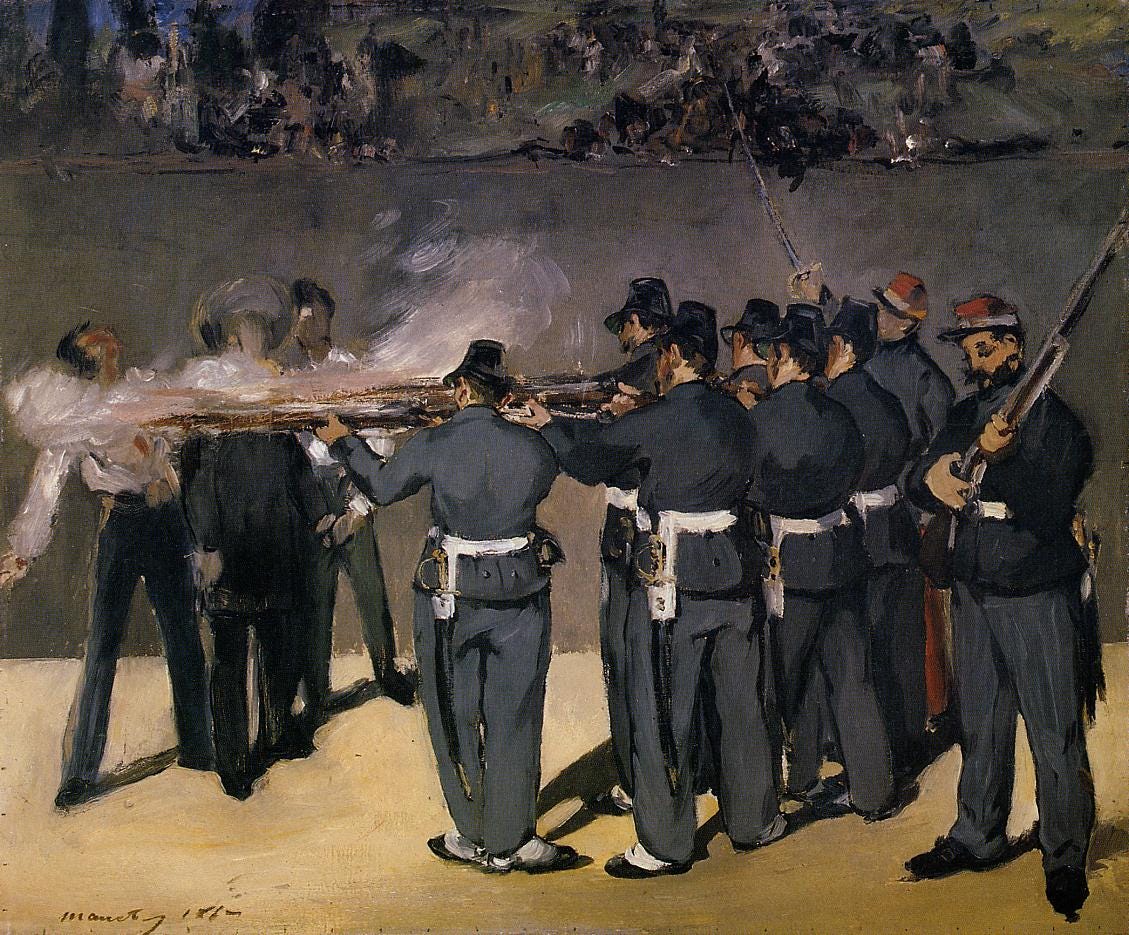
My stronger opinion is that of the various versions of “The Execution of Emperor Maximilian” that Manet painted, the one that’s in Copenhagen is the best. Back in 2006, MoMA in New York had a cool show where all five versions were on display simultaneously.
B Wilder: Should more states adopt Alaska’s electoral system? It seems to lead to less partisanship in a positive way.
Alaska has a jungle primary like several other American states, except instead of the top two finishers proceeding to the next round, the top four finishers move on. That reduces anxiety about lockouts, and seems to have successfully allowed independent-minded politicians like Lisa Murkowski and Mary Peltola to thrive. Plus, a lot of unaffiliated members have been elected to the state legislature, which has generated interesting coalitions there.
If somebody suggested making this move in Texas or California or New York, I would probably be inclined to favor it.
That said, I do not recommend that people spend a lot of time, money, or energy on this kind of electoral reform or on other instances of tinkering around with primaries.
This is in part because I think the primaries themselves are overrated as a source of polarization and dysfunction. The main reason that primaries empower extremists is not that primary voters are particularly extreme themselves — it’s that extreme actors are a lot more engaged and activated. Most people who vote in Democratic Party primaries, for example, are favorably disposed to labor unions and to the Sierra Club in an abstract way. So if they hear that one candidate is good on workers and the environment and the other candidate is bad, they are likely to vote for the candidate who is good. Now if you peer under the hood, it may turn out that what being “bad” on labor amounts to is that you think school districts should be able to offer higher salaries to their best teachers rather than compensating them strictly on the basis of seniority. And being “bad” on the environment could mean favoring natural gas exports that help keep Europe safe from Russian aggression with no impact on global emissions.
A very informed electorate would not necessarily agree with the groups about those positions, positions that after all are not in fact bad for working people or for the environment. But we don’t have an informed electorate; we have an electorate that is deferential to advocacy groups, and there aren’t that many well-organized advocacy groups that push for reasonable policies.
On the environment side, my strong sense is that some of the groups’ own donors don’t quite recognize how firmly anchored they continue to be in ‘70s degrowth thinking.
A lot of center-left business people got interested in climate change over the course of the 21st century and want to contribute to addressing it, and sort of mindlessly assume that supporting name-brand environmental organizations is a good way to do that. If you poke under the hood, you’ll see that these groups are relentlessly hostile to nuclear power and actually somewhat ambivalent about utility-scale solar and onshore wind and that this policy mix is in fact not a good way to address climate change at all.
The political right is structured differently and is pathological in different ways, with the key modality largely being that people working on the vote-winning cultural side of conservative politics are never supposed to point out or notice that their ostensible causes are constantly being sacrificed on the altar of regressive tax cuts and unpopular health-care rollbacks.
In both cases, though, I think the proximate solution to extremism isn’t to engage in a long-term organizing project to alter the primary system — it’s simply to engage in first-order organizing projects on behalf of better ideas.
You can see that a relatively modest amount of money invested in YIMBY organizing has made a huge difference to national politics.
A relatively small number of people in San Francisco organizing to put together a comprehensive common-sense platform has made a big difference in the city. There is an observed empirical reality that ideological extremists are more engaged in the political process, but that’s not a law of nature. If people who think the Republicans are kinda crazy but Democrats are also kinda crazy in a totally different way actually bother to do the work, you can get different outcomes.
Beyond that, though, if I were to get deeply invested in political reform it wouldn’t be on behalf of tweaking primaries; it would be in favor of proportional representation.
Lee Drutman at New America is the lead guy on this, but I agree with him that proportional representation helps address several problems simultaneously.
A big one is that depending on exactly how you implement it, it would make gerrymandering either a lot less relevant or a total non-issue.
Another is that it would surface the reality that every state has a median voter. In a deep blue state like California, the center of political gravity is a moderate Democrat, not a far-leftist. And in Texas, it’s a moderate Republican, not a far-rightist. But moderates only wield real political power in these states when the stars align in very specific ways.
Beyond just improving representation, this would lead to better policy outcomes: Texas would expand Medicaid, and California would stop wrecking its public university system. That’s because you wouldn’t be counting on weird unicorn figures like Andy Beshear or Charlie Baker to pump the brakes on partisan monocultures.
Even better, though, is that proportional representation would allow weirdo localist parties that don’t necessarily exist in other states or run for Congress to rise. That would help mentally focus people on the idea that the actual issues in play in state government are meaningfully distinct from the issues in federal politics and that you shouldn’t treat your vote for state legislature as a mechanical function of your attitude toward the president.
BJ: How many of the 50 states have you been to?
The states I have not been to are Alaska, Hawaii, Idaho, Utah, Montana, Wyoming, North Dakota, South Dakota, Nebraska, Iowa, Arkansas, Indiana, Mississippi, and Alabama.
If you don’t count airport layovers, the largest American metro areas that I’ve never been to are Atlanta (number eight by population) and Charlotte (number 21), which always makes me feel like my visits to Georgia and North Carolina are a little bit weird. But Savannah is lovely, and I used to have a ton of fun renting a big house on the Outer Banks with friends. Never having covered the Iowa caucuses is my great shame as a political journalist.
Vasav Swaminathan: You wrote a bit about urban transit in the last mailbag. New York is obviously difficult to emulate due to its size, but is there any city that you think does a good job of running its busses and trains or has a good system that meshes well and should be a model for the rest of the country?
After New York, the other U.S. metro areas with non-trivial transit modal share are Boston, Chicago, the Bay Area, and D.C.
Boston is smaller than the rest, so I think it probably counts as the highest performance system. But I’m not actually sure there’s very much to emulate there; the main issue is that because contemporary Boston inherited a much more extensive set of legacy railroads, you can run commuter trains on them without needing to build them from scratch.
The catch here is that the whole American concept of “commuter rail” is a kind of catastrophe relative to international best practices. Most American cities just don’t have these kinds of legacy rail lines and shouldn’t build them. But those that do have them ought to be upgrading them to the kind of service that’s called S-Bahn in German-speaking countries or that is probably most familiar to American tourists from the RER in Paris.
That would mean electrification of service so that you can accelerate and decelerate in and out of stations faster, proof of payment with spot checks rather than conductors to reduce operating costs, fare integration with buses and subway, and through-running of service (they do this part in Philadelphia), which in the case of Boston would require building a tunnel to connect North Station and South Station. Precisely because M.B.T.A. commuter rail is so extensive relative to Boston’s modest population, the failure to do this generates really substantial underperformance relative to what you see in medium-sized German cities.
If you want to nerd out on this stuff, read Transit Matters’ report on Boston. And also consider that the Boston suburbs are one of the most under-housed places in America and that all these transit changes could be usefully complemented by zoning for tall apartments near the stations.
James L: Is Slow Boring going to continue its relentless focus on domestic policy going forward? Beyond the Iran War, which is now a significant domestic issue with bearing on the Trump presidency, SB doesn’t seem to have much to say on NATO, the EU, Russia-Ukraine, Sudan, the Indian subcontinent, or even Canada or Mexico. Is this a deliberate decision for SB in its programming now and going forward?
My primary interest is in American politics and public policy, so I tend to comment on world affairs insofar as they are the subjects of big American policy debates (as Iran is at the moment) or shed light on American policy issues (per the discussion of the United Kingdom “triple lock”) yesterday.
I reserve the right to occasionally delve into other things or for my interests to shift over time, but I would not generally expect to see a lot of coverage of India unless there starts to be some significant India-related debate in the American political system. That said, Slow Boring has absolutely covered Sudan, the war in Ukraine, the European Union, India and Pakistan, Mexico, and Canada. We run a lot of articles!
DWD: Is it possible to support both assimilation and multiculturalism? Because I see a lot of people who treat opposition to multiculturalism as equivalent to explicit racism. Am I missing something here?
I don’t really know what this question means specifically.
American political culture is self-consciously pluralistic and always has been, and thus I think needs to be “multicultural” in the sense of respecting different groups of people’s religious practices. But I think we in America could maybe do more than we do in terms of explicitly promoting assimilation into American civic culture and norms. Does that work?
James Thomas: I’ve enjoyed David Frum’s analysis of Iran. He suggests a form of gunboat diplomacy could be viable — where you effectively work your way down the list of regime insiders until you find someone who is sufficiently non-ideological and willing to be turned and work with them going forward.
Obviously there are downsides to this, but it seems like the only approach that even seems like a possible strategy. It also suggests to me that gunboat diplomacy is much more powerful as an approach for a hegemon than its lack of use by previous presidents would suggest. Have you listened to Frum’s views, and what do you think?
This definitely could work, but my fundamental objection to trying remains that Iran is on the other side of the world and its regional antagonists like Saudi Arabia and Israel are not small minnows who desperately need our help. Ukraine would just be crushed by Russia in a war if it didn’t receive outside assistance, which creates a prima facie case for assisting. There is just no such case in the Middle East.
We just have an excessively polarized political debate where influential stakeholders want you to either put Israel under sanctions and arms embargo or else go halfsies with them on regional conflict with Iran when the actual correct solution is to be less involved in this.
City of Trees: At around this time last week, Noah Smith tweeted the following:
“I love Barack Obama. On domestic issues he was a great President. Plus he got Bin Laden. But I’m forced to admit that on foreign policy, he was terrible — he ignored Russia’s first invasion of Ukraine, didn’t address growing Chinese power, and trusted Iran’s leaders.”
Do you agree or disagree? How would you rate Obama’s foreign policy compared to his presidential peers?
I have my own critique of Obama as a foreign policy president, but I think Noah’s take is dead wrong and sort of broadly anachronistic. The whole point of what Obama was trying to do in his second term was to address growing Chinese power. His downplaying of Russia as an antagonist in the 2012 debate with Mitt Romney didn’t age well, but his response to the invasion of Crimea absolutely was not to ignore it. He was restrained in his provision of aid to Ukraine for two reasons:
He did not want to get too far out ahead of France and especially Germany, since he wanted European countries to be the primary drivers of European security.
He believed that if America ratcheted up aid to Ukraine, Russia would likely ratchet up the intensity of its own anti-Ukrainian efforts so net-net you wouldn’t actually accomplish very much.
I think this viewpoint was broadly vindicated by history. After the 2016 election, Democrats got more hawkish on Russia and congressional Republicans continued to be hawkish, so suddenly Congress voted to provide Ukraine with more lethal aid. But that didn’t lead to Ukrainian victory in Donetsk — it led to Russia doubling down on its invasion of Ukraine. That invasion radicalized European opinion and greatly ratcheted up the willingness of major European countries to confront Russia. At that point, it made sense for the Biden administration to also greatly ratchet up its assistance to Ukraine. But Obama’s approach was prudent given the actual situation at the time.
Similarly, Obama’s J.C.P.O.A. deal with Iran was just absolutely not based on trusting Iran’s leaders. It was based on the idea that America’s core interest was in non-proliferation and that a good non-proliferation deal would let the U.S. disengage to some extent from the Middle East and shift resources to the Pacific. Israel and the Arab Gulf states understandably did not think that this approach was good for them and they got Trump to abandon that posture in favor of “maximum pressure” in his first term. That unglued the non-proliferation successes and helped set the stage for the current conflict. You can defend the Trump approach if you want to, but the defense would have to be to say that Obama was wrong to want to focus on countering China and leave the Middle East to the countries located there. It’s the opposite of him doing nothing to address growing Chinese power.
Last but not least, you had the Trans-Pacific Partnership, which was very explicitly an effort to defy some of the basic logic of economic geography and ensure that countries that are closer to China on the map were closer to the U.S. in terms of their trading relationship.
So I don’t think any of Smith’s criticisms really hold up.
That said, I don’t think Obama’s foreign policy record was great. My critique would be that like a lot of presidents, he found dealing with Congress frustrating and was tempted by the idea that the president has much greater leeway to act in the international realm.
This, I think, turned out to be pretty illusory. I believe that the J.C.P.O.A. was a good idea, but he never convinced Republicans that it was a good idea, so it ended up not sticking. He sank political capital into getting it done, but getting it done didn’t accomplish anything.
Something similar is true of his efforts to engineer an opening with Cuba. I supported this. I think it was a good idea that aligned with the effort to refocus the country on China, but it was done on a unilateral party-line basis and wound up being completely ephemeral. The Trans-Pacific Partnership had a slightly different dynamic but, again, created a lot of political headaches and did not result in anything that actually got done. Going back to his first term, there was a similar issue with his effort to coerce Israel into declaring a freeze on West Bank settlements and to tip the scales in favor of a Tzipi Livni election win.
Getting Israel to freeze settlements would have been great. The world would be much better off if Livni had become prime minister after the 2009 election. But Obama didn’t have the juice in Congress to make the settlement freeze play work, so again he was expending political capital but not actually achieving his goals.
Which is just to say that even though the institutional constraints on foreign policy are not as formally binding as they are on the domestic sphere, it doesn’t really follow that the president should just throw caution to the wind.
You've finally realized the wisdom of your father's taste. Took a little too long, imo.
I no longer remember exactly who I was reading on twitter (not "following", fuck your algorithm) in the immediate aftermath of the Russian invasion of Ukraine. But one contributor was some retired US Army general.
He pointed out that, in his experience, the Ukrainian military of 2014 was (my words, trying to paraphrase what I remember reading) woefully undertrained and obviously former East Bloc in anti-professionalism in a soldiering sense, and they would have had basically no shot in resisting what the Russians were up to at the time. After the Donestk-Luhansk operation, NATO (or maybe just the US) really stepped up how we were communicating/transmitting our understanding of how to maximize the effectiveness of soldiers and weaponry, rather than the Great Patriotic War meat-grinder approach. And it worked really, really well. All that is to say, the 2022-present Ukrainian resistance to Russian invasion would not have been possible without the post-2014 reforms.