


Social media, by allowing people to post ideas that are unmediated by any editorial planning process, brings forth whole modes of engagement with political ideas that I think simply could not exist in a world of rigorous journalistic feedback.
An example you see, repeatedly, on the contemporary right is a tendency to make invidious comparisons between the present day and half-remembered notions from advertisements or works of fiction.
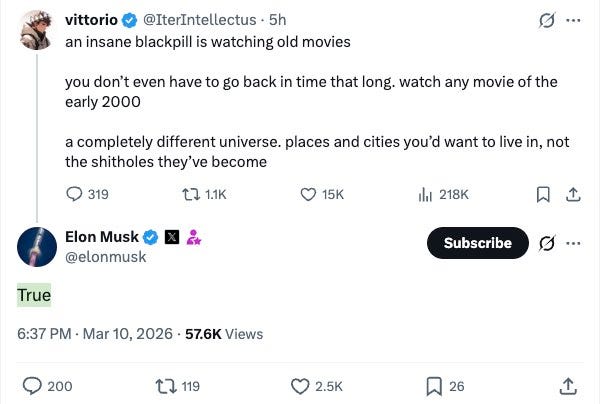
A huge share of expressed nostalgia for the economy of the 1950s, for example, just involves mistaking the lifestyle of disproportionately affluent characters for the typical situation.
It’s as if you read Jane Austen’s books and decided that most people in England 200 years ago were living like her characters, rather than as servants or as peasant farmers. An easy enough mistake to make, but one that would be corrected if you had to talk the idea over with anyone.
I moved to D.C. in 2003 and I can promise you that the D.C. of the early 2000s had a dramatically higher murder rate, much worse restaurants, worse public-school performance, an insane taxi system, and many other problems compared to the D.C. of today. It’s true that if you watch the 2005 comedy classic “Wedding Crashers,” you won’t see any of that in its depiction of D.C., but that’s because sociological realism is not the goal of R-rated comedies.
A more typically left-wing tic is to express what sounds to me like the symptoms of clinical depression, but frame them as political critiques of the status quo.
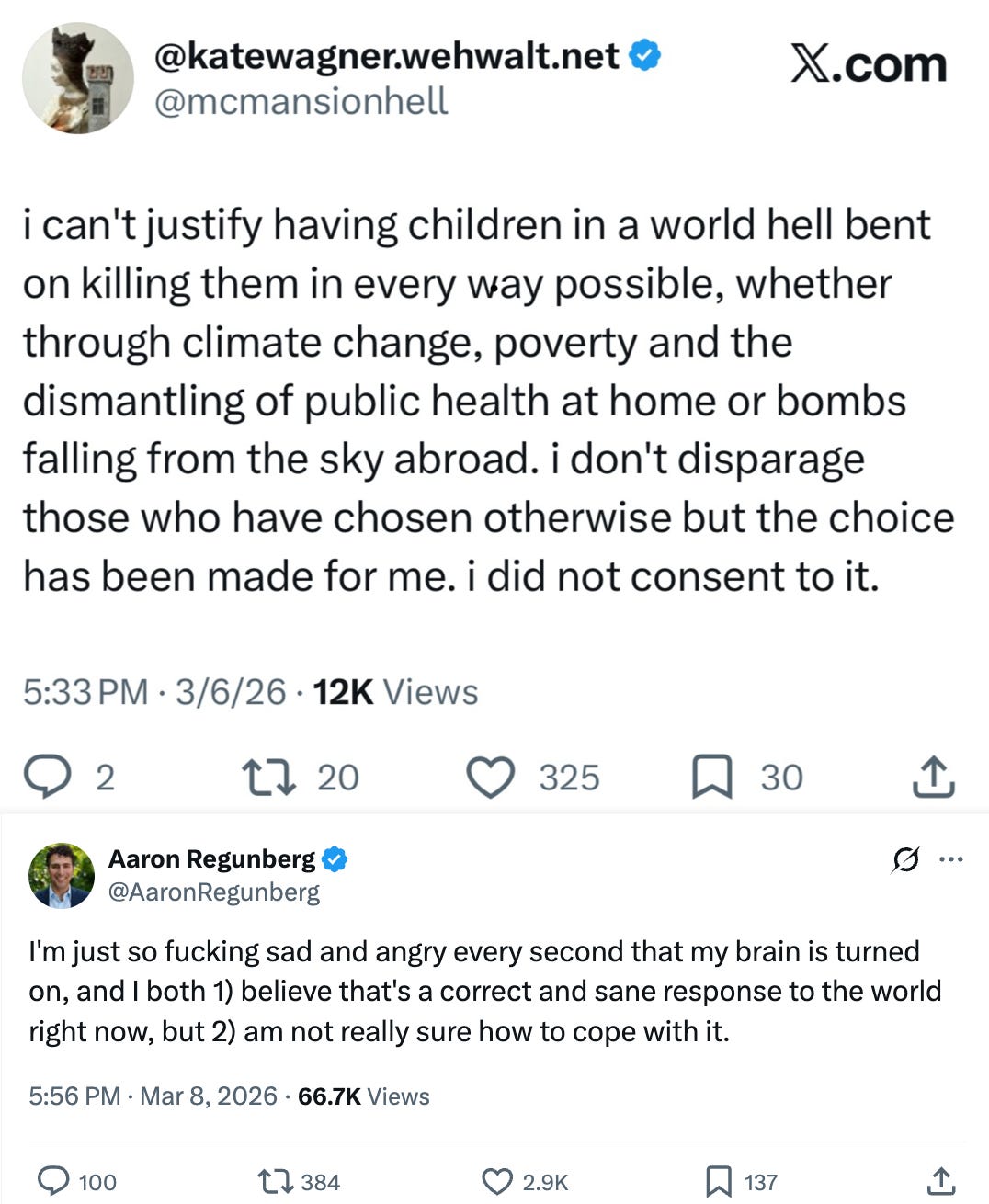
I don’t want to be Mr. Pollyanna and tell you that everything is going great in the world and there’s nothing to worry about. But people had children all through the Vietnam War. Black families raised kids under Jim Crow. Several generations of us grew up under the cloud of a world-ending U.S.-Soviet nuclear exchange.
If you genuinely don’t want to have kids, that’s fine!
But the idea that middle-class Americans in the year 2026 are experiencing uniquely dire circumstances in which to raise children doesn’t make any sense. In fact, I would offer as one argument in favor of parenting that focusing on something concrete like a child can be a good way of extricating yourself from a psychology of political dooming.
Speaking of which, Aaron Regunberg and I have various political disagreements, but one thing we agree on from the tweet above is that a lot about the status quo is really bad. But there’s a big difference between deciding that something is bad and then trying to develop a strategy for stopping it, and becoming “sad and angry every second” to the point where you’re “not really sure how to cope.”
Successful political movements of the past met great challenges, solved problems, and made the world a better place, but they didn’t achieve this by being constantly overwhelmed by feelings of sadness and anger. Paralyzing despair is not a correct or sane response to the world. It’s pathological. And in the most sincere and non-snarky way possible, I urge people who feel this way to get help and then go do something politically constructive.
The paradox of depression
The thing about depression that is tough is that to get out of a cycle of depression you need to change things, but the nature of depression is that it makes you not want to change.
I managed to climb out of some depression several years back, but it took a whole sequence of events.