

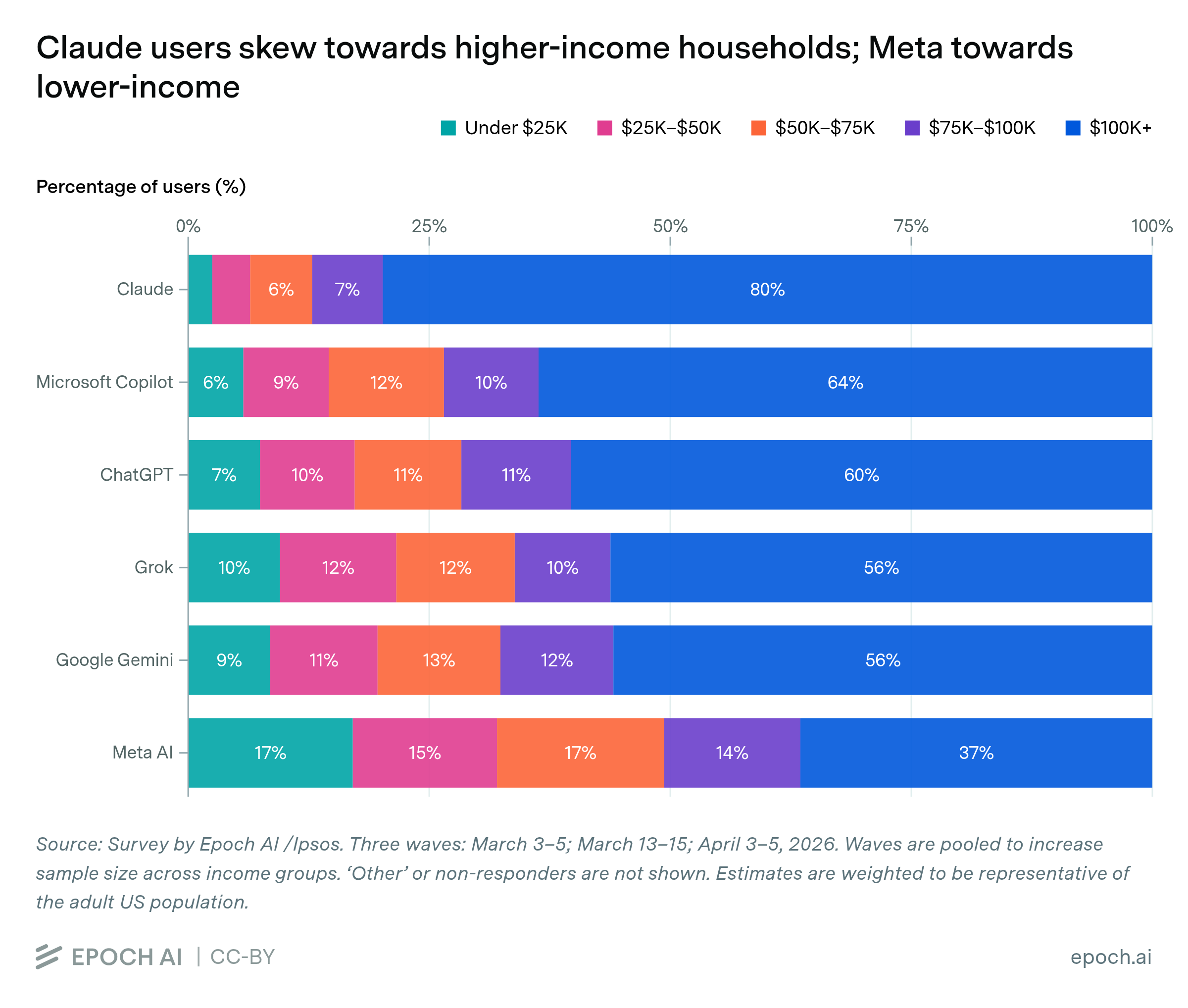
I suppose this isn’t a huge surprise, but I was interested to learn that there’s meaningful class divergence in choice of A.I. models, with Claude skewing more upscale and Meta skewing more downscale. I don’t quite know what that signifies, but maybe something!
Logan: As of today the generic ballot is D +5.7 according to Nate Silver. Democrats have been over performing in special elections by much more than this and even won the Wisconsin Supreme Court race by 20 points. Do you think polls could be underestimating Dems in the generic ballot? It obviously won’t be D +15-20 in November but if polls are currently underestimating dems by 3-4 points then it has huge implications on the senate.
Brian and I discussed this on a recent Politix episode and he articulated exactly the case that you’re making. I don’t think that this is a crazy opinion, and one thing I would note is that at this point generic-ballot polls are a mix of registered voter and likely voter polling. Democrats are currently doing quite a bit better in the L.V. polls than the R.V. polls, which is consistent with a midterm intensity gap. So I have absolutely no problem saying that as we see more pollsters apply their L.V. screens, the Dem generic-ballot edge will increase.
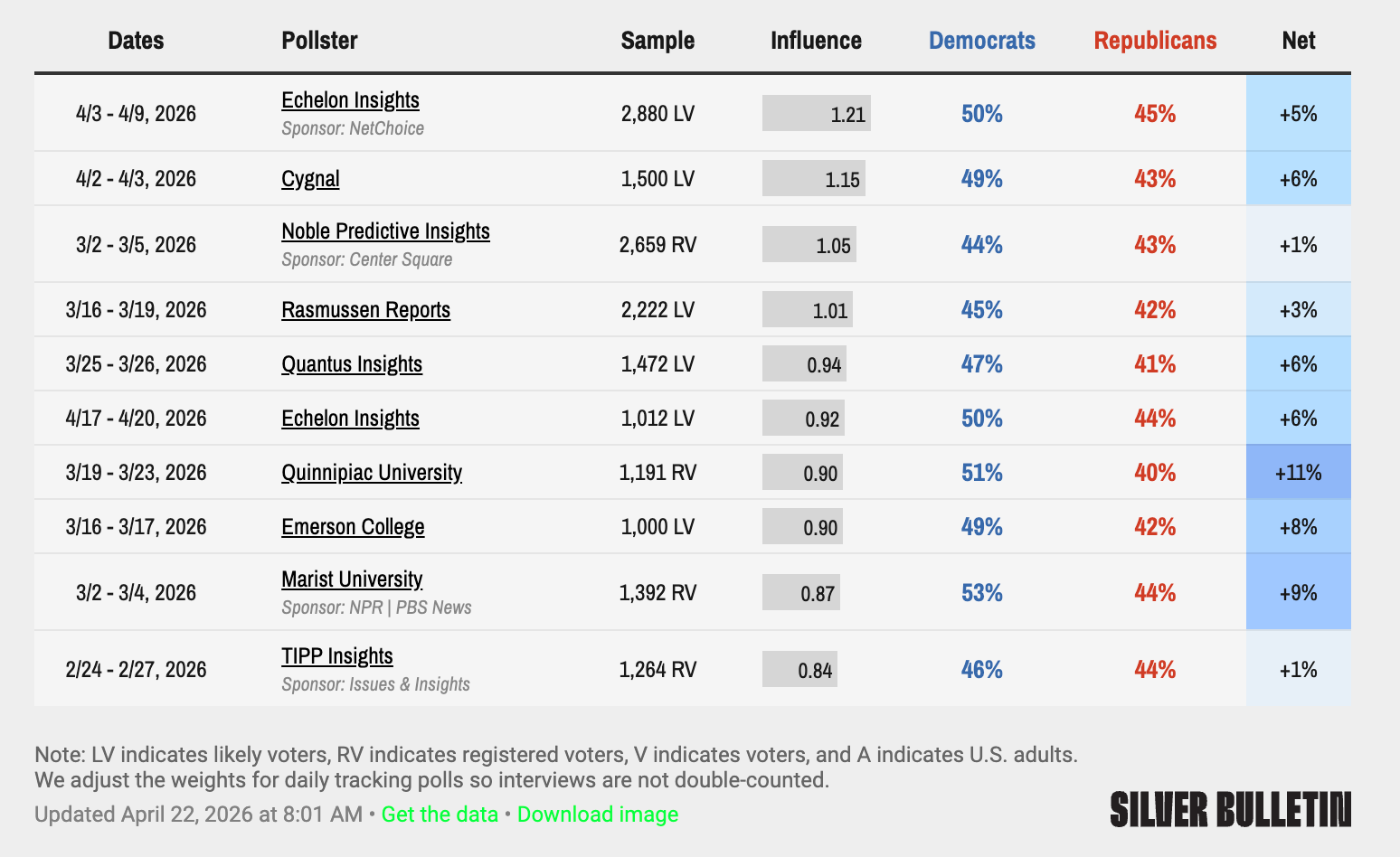
But this is just another way of saying that we should pay careful attention to what the polling is actually saying. What I do not agree with is that we should sharply discount polling and take the special election results as illustrative of the “real” political situation.
I’d urge everyone to remember that we actually had this debate in the 2024 cycle.
Simon Rosenberg got a lot of traction with his Hopium Chronicles Substack, which leaned heavily on special elections and the argument that we should trust actual voting behavior over surveys.
The counterargument was that in the Trump era, we were witnessing a lot of polarization that correlated with political engagement. People who followed the news closely and cared a lot about politics tended to be repulsed by Trump and especially by things like January 6 and the threat he poses to the basic stability of the political system. As a result, we should expect Democrats to have an edge in low-salience low-turnout elections that diminishes in something like a presidential contest. This was an inversion of the Obama-era paradigm in which people with low propensity to vote tended to be Democrats, and where Democrats started investing a lot of effort into boosting turnout.
What we learned in November of 2024 is that Rosenberg was wrong and the polarization theorists were correct. Not only did Democrats fail to overperform their polling, but the people who didn’t vote favored Trump even more strongly than those who did.
Since his inauguration, Trump has, of course, become much less popular. And it seems that his declining popularity has been concentrated among low-propensity Trump voters. These are the people who were really swayed by inflation and thus are counter-swayed by his failure to deliver on his promises.
It’s also the case more generally that if you’re going to lose a subset of your voters, it’s probably going to be the ones who are least engaged.
But this doesn’t change the fact that low-turnout elections are sharply skewed to Democrats. If anything, it’s the opposite. Convincing a disgruntled Trump voter to actually go vote for Democrats is hard. But if the disgruntled Trump voters are people who were somewhat disinclined to vote in the first place, it is extremely easy to convince them not to vote. Or, rather, it’s extremely hard for Republicans to persuade even slightly disgruntled disengaged voters to come pull the lever for a G.O.P. candidate in an obscure state judicial race taking place on a random spring Tuesday.
But all of these dynamics should be baked into a properly conducted likely voter poll.
Democrats are going to do way better in 2026 than they did in 2024. One reason is that some of the people who voted Republican in 2024 will vote for Democrats in 2026. And another is that some people who voted Republican in 2024 won’t vote at all in the midterms.
Of course Democrats will suffer defections and drop-offs, too, but in much smaller quantities than Republicans. What I don’t see, though, is any reason to think that there is anything going on over and above what’s available in the surveys.
My main take about all of this is that we should set a high bar for what constitutes a good midterm result for Democrats.
I worry that if after the midterms Democrats decide they did well in 2026, they’ll become complacent about the need for policy change to do better in 2028. That said, genuinely doing well would of course warrant a certain amount of complacency. So, considering both of those things, what does it mean to genuinely do well?
In a “good” midterm, you take control of both houses of Congress. That’s important not just as a political benchmark, but because if you want to stop backsliding on the rule of law you need to be able to prevent the MAGAfication of the judiciary.
Democrats right now are polling worse on the generic ballot than they were in 2018, even though Trump’s behavior has been objectively worse and his approval rating is worse. Performing worse than in 2018 is a clear sign that the party has significant problems that it needs to address.
Brian’s endorsement of special election theory was significant to me because, for all his sharp criticism of Democratic leaders (while I am an apologist for their caution and deference to frontline members), at the end of the day he is much more bullish on Democratic midterm fortunes than I am.
My interpretation is that in a profound way, progressive anger at the establishment is actually driven by complacency. They believe Trump and the G.O.P. are so weak that it’s almost trivially easy to beat them, and Democrats should be trying harder to shoot the moon on governance after they win. I don’t think that this is correct. I think the base case is that Republicans hold the Senate, expand their control over the judiciary, and head into a jump ball of a 2028 election with maps skewed in their favor, a fundraising edge, and an increasingly consolidated Musk/Ellison media sphere.
City of Trees: If you were born in America under similar circumstances but at any different time in the past, are there any of your views that you think would be different and contradictory to your actual views today? Feel free to pick as many different times and views as you’d like.
I guess it’s more that I would have had the same kinds of views as I have today rather than the views that are considered correct in the verdict of history. Like I sometimes hear from left-wing people that if I’d been alive in the 1850s, I would have been criticizing the abolitionists as being extreme and impractical. I think that’s probably true — I would have been one of the moderate Republicans urging the party to nominate someone like Abraham Lincoln rather than a Radical from New England. I also think that decision was vindicated by the actual unfolding of events.
At the same time, “Slavery is morally wrong and should be abolished” is obviously a take that aged extremely well, whereas Lincoln’s actual position of “We should abolish slavery in unpopulated western territories but not elsewhere” sounds pretty stupid.
I’d have spent the entirety of 1968 being mad about anti-war activists for making trouble and electing Nixon. That, again, is a correct analysis of the narrow situation. But at the same time, the anti-war people were correct about the war.
Matt Bruzunski: Will Steakin recently had a viral tweet: “Dems like Shapiro (Newsom, Buttigieg too) keep ditching ties with their suits, meanwhile the younger Mamdani almost always wears one.”
What do you think is the secret to dressing appropriately in politics for male politicians now: when to wear a tie, what kind of tie etc. etc. And was this whole no-tie era driven by age, class, or just the post-pandemic drift toward casualness? Are we starting to swing back the other way?
I hope that Mamdani helps spark a “wear a damn tie” revival among younger politicians because, fundamentally, if you’re wearing a suit, you should wear a tie.
That doesn’t mean every politician needs to run around dressed like Trump every day. But if you want to dress more casually, you need an actually casual look: a sport jacket with slacks or nice jeans and a shirt with more texture or pattern than you’d wear with a suit.
Speaking as someone who is not particularly fashionable or well-dressed, the challenge most male politicians have with trying to dress well but casually is that it’s hard to have good outfits unless you are sincerely interested in fashion, which most men aren’t. The traditional business suit is a pretty great cheat code for looking good without spending a lot of time thinking about what you’re wearing. If you own a few correctly tailored suits in normal colors and a few basic shirts and ties, then you have a bunch of good outfits you can assemble without much thought.
It’s just been a long time now since it was common for men to wear suits to the office daily, so a lot of politicians seem to want to bend with the spirit of the times and not wear a tie. The problem is that leaves you in the suit / white shirt / no tie dead zone that just doesn’t look very good.
If you want to be a creative, stylish dresser I think that’s great. But if you don’t, you should emulate Mamdani and just dress like a politician.
I have said this before but will say it again: If you feel that wearing a tie is uncomfortable, that is because your shirts don’t fit. Because most men these days don’t wear ties, they are not in the habit of shopping for shirts that fit comfortably with the neck buttoned. You probably only need one or two shirts like this in your life, but it’s worth your while to get them so that when you do need to wear a tie, you’ll be comfortable. And if you’re planning to run for office, you should get a bunch of shirts that fit. I promise you, it’s not supposed to be uncomfortable to have your collar buttoned.
Zelta Levine: Why do you think so many minority “firsts” end up being such atypical representatives of the group they’re meant to symbolize? I don’t just mean that they’re elite or highly educated. I mean that, in ethnic, cultural, and historical terms, they often seem somewhat removed from the core experience of the people they’re said to represent: Obama, the first Black president, was not descended from American slaves. Kamala Harris is the daughter of Indian and Jamaican immigrants. And Zohran Mamdani was raised by a Hindu mother (who was apparently married to a Jewish photographer) when she first met his Indo-Ugandan Muslim father on a film set in Africa. That is such a cosmopolitan biography it’s probably not even representative of affluent immigrant Muslim households in NYC. So why do these minority “firsts” often turn out to be people whose symbolic identities are real, but whose actual backgrounds are unusually mixed, elite, or cosmopolitan?
I think this is a little bit contingent on what you mean by a “first.” But in America’s system of geographically defined districts and ethnic niche neighborhoods, it’s common to see a process where a particular ethnic group becomes locally dominant in some place and then a member of that ethnic group wins election to some office. That kind of politician is often quite rooted in the typical experience of neighborhood residents, but precisely for that reason has trouble “moving up” to a larger geography where his ethnic group is not dominant.
Obama was not even remotely close to being the first Black politician to win a state legislature seat representing the South Side of Chicago. But his atypical background probably helped him transcend the “Black politics” niche and win over white audiences. Similarly, while Mamdani clearly has a strong following in Asian immigrant communities, he also has a very strong following among educated young New Yorkers writ large where it’s helpful that his background is at least as much “global intelligentsia” as it is specifically South Asian Muslim.
Avi: You’ve argued that Obama ran a much more moderate campaign than Hillary Clinton. But wasn’t that at least partly a function of the time? If you compare them today, ObamaWorld (PodBros, Patrick Gaspard) and Obama himself is so much more open to leftists like Mamdani than Hilary Clinton and ClintonWorld (Neera Tanden, Kristen Gillbrand). Hilary just last month was implying Mamdani’s voters are stupid and it is reasonable to have “concerns” about him, while Obama is singing songs with him at a preschool center. If you adjust for the political moment then, doesn’t Obama seem to have always had more sympathy for the party’s left than Clinton did?
I think that right now, elite Democratic Party factional politics is very heavily indexing on Israel.
Israel is the one issue where Hillary Clinton in 2016 clearly positioned herself to Obama’s right and it’s also the one issue where Joe Biden governed to Obama’s right. There’s something perverse about post-Obama Democratic leaders getting more left-wing than Obama was on every single issue except the one where public opinion has shifted to the left, but that’s how the Democratic nominees in 2016, 2020, and 2024 ran.
Meanwhile, in the 2026 primaries you’re seeing tons of factional fighting about Israel and very little factional fighting about the topics where I think moderation would be helpful: energy policy, immigration, crime, racial preferences. I myself have various thoughts and feelings about Israel and the Middle East more broadly, but I don’t think this is a particularly important issue substantively or something that swing voters particularly care about.
I also think it’s a little unfortunate that Obama personally seems to have so little interest in pushing back on the progressive critique of his own administration.
I don’t know exactly where his head is at these days, but I don’t think he’s decided that leftists are right and he deliberately let a ton of criminals off the hook because he’s a pawn of the oligarchy and that his economic policies directly led to Trump’s election. But he genuinely does not speak much these days about these questions or about more banal issues like how he got voters in Iowa to like him.
Sam: You’ve said before that a primary motivating force among leftists is dislike of Barack Obama and the Obama administration. To steelman this view, don’t they kind of have a point that Obama’s choices led to Trump? Are there any inflection points you can see between 2013-2016 where Obama could have made different choices that would have lessened the chances of a Trump victory?
But this is the whole thing. They’re not saying, “Obama’s decision to move left on fossil fuels and immigration while embracing criminal justice reform and alienating police unions led to Trump.”
Obama, like any incumbent, had to make decisions about what to spend political capital on. During his first term, he both hoarded enough political capital to get re-elected and also spent political capital down on the Affordable Care Act and Dodd-Frank, both of which left enduring policy legacies.
In the second term, when he wasn’t on the ballot anymore, he got less disciplined in his decision-making in ways that created problems. This is part of why same-party three-peats are hard to pull off. But the argument leftists are trying to make is that the fact that Trump succeeded Obama somehow proves that Obama was insufficiently left-wing, especially on economics. Not only is there no evidence for this, but on economics specifically, Obama won the argument with Republicans about Medicare privatization and Trump responded by abandoning the Romney-Ryan position.
am: What is your (Matt’s) view of what US antitrust policy should be? I am not asking for legal analysis but do you think US policy has overall been too hard on monopolies or not hard enough?
My problem with this mode of discourse is that talking about “monopolies” is question-begging. When Lina Khan says the government should be tougher on Amazon, I disagree with her not because I disagree with the idea of being tough on monopolies but because there’s no market that Amazon monopolizes.
If you go back in time 10 years, I think there are two areas where there is a reasonable argument for more antitrust enforcement:
Mergers that aren’t particularly large in dollar value can still be anti-competitive in a world where most of the economy is locally facing services. A hospital merger, for example, can very significantly impair competition in a specific city while still being too small to even trigger review. The enforcement agencies probably need larger budgets to just scrutinize more deals.
For a while, the government got in the habit of approving deals that it knew had problematic aspects by having the merging entities agree to abide by certain rules of conduct. The classic example is that Comcast was allowed to buy NBC Universal and then had to make a ton of promises not to favor Universal content on Comcast-owned cable systems. These conduct remedies turn out to be very difficult to enforce in practice and it’s probably better to just prohibit the merger.
Fundamentally, though, I think this whole area is just not that big of a deal. The antitrust hawks were right about the Comcast deal and it shouldn’t have been approved. At the same time, from the standpoint of 2026, all of cable television is a dying industry and this conversation is completely irrelevant. Persistent monopolization is extremely difficult in the absence of regulatory barriers to entry, which are the main thing to talk about if you’re fired-up about competition.
Grigori Avramidi: Since Matt had a tweet about visiting Edinburgh: any architecture takes? I remember that they have some curious buildings combining classical and modern styles. And, nearby Glasgow has some charming semi-classical rowhouses.
I would mainly offer Edinburgh as an example of “street design” being more important than “architecture” in terms of creating a quality urban environment. If you walk around New Town, there certainly are individual nice buildings and even whole blocks of traditional Georgian architecture. But there are also streets that freely mix traditional and modern styles and those actually tend to be the liveliest, most active ones.
What makes it all work well is that there is a dense network of streets, many of which are narrow. The buildings don’t have setbacks. “Green space” exists in the form of explicit usable parks rather than little dead areas that exist just to be looked at. There’s not that much parking. You can sort of see why more modern areas don’t get built this way. From the standpoint of any individual, there isn’t quite as much elbow room as you’d ideally like to see. So things get built with more parking and wider streets and more setbacks and trees. But the result is ultimately a more vacant, deader space that’s less fun to inhabit.
BronxZooCobra: In a NYTimes article about GLP1s the author posted the following comment:
“When I suggested to my editor that we run a poll of GLP-1 users to capture their lived experiences, I expected a very different story—one focused on disappointment, side effects, and access issues. Instead, we heard from current and past GLP-1 users that they were mostly enthusiastic about staying on these drugs. Many simply felt better...”
What does that tell us about the state of journalism?
It mostly reinforces my two main points for any sound media criticism. The first is that the biggest problem with the media is the audience and in particular the fact that the audience demonstrably prefers to click on and share negative stories. Therefore a journalist who is good at her job is going to pitch story ideas that she anticipates will reveal accurate negative angles. This person for whatever reason believed that a survey of GLP-1 users would reveal a lot of dissatisfaction, which is exactly why she thought it would be a good story: There is a huge market for negativity, so finding a fresh negative angle about GLP-1s would be great content.
The second is that not only does the audience love negative stories, it also loves to express negativity about the media. So any time the audience discovers that journalists are biased toward seeking out negative stories, it likes to dunk on the media for being biased. But that bias is simply journalists reflecting back the audience’s own bias.
Patrick: Thoughts on the CA governor race or CA-11 (SF) confessional race? For governor it seems like there’s no clear front runner, and it feels weird to have Tom Steyer hitting the progressive talking points hard on tons of ads funded by his wealth. For congress, Saikat is also media blitzing (tech $) and door knocking hard, touting he worked with AOC, but without an endorsement from her. And while Weiner made real incremental improvements to housing policy at the stage level, is that track record useful for the federal level?
Scott Wiener is a housing policy hero.
Now obviously this is not a big part of the work of the House of Representatives, so if you had some other strong reason to prefer Saikat Chakrabarti, I could understand the argument for overlooking Wiener’s strengths as a housing advocate. But are there any reasons like that? I can’t see them. Wiener is an incredible housing champion and moderate by San Francisco standards (which means he’s actually very progressive). I think you should infer from the fact that he was genuinely way ahead of the curve on the housing issue that he’s also a smart and insightful person who is good at thinking about contested public policy questions. We could use more people like that in Congress.
In terms of California governor, I’ve said before that Matt Mahan seems like the best choice.
I know some people who are considering other candidates for tactical reasons, but I don’t think the differences between Steyer, Xavier Becerra, and Katie Porter are particularly important. I’d just vote for the best choice and tell my friends to do the same. Conversely, I would encourage California Republicans to consider voting for a moderate Democrat rather than expressively voting for Steve Hilton or Chad Bianco.
Steven: Is there a point of diminishing returns in campaign fundraising’s ability to deliver more votes? The actual amount needed for virtual saturation will vary by a state’s population, geography, and number of media markets, but it seems like there should always be an (approximate) amount beyond which the next expended dollar nets no gain.
Diminishing returns set in really fast if you think about it because the value of going from “zero money” to “enough money to open a campaign office, hire some people, and do a launch video and some early rallies” is really high.
Serious political campaigns obviously spend way more money than that. But that first tranche of spending — basically the spending that determines whether you have a campaign — is way more valuable than the stuff that comes later.
After that you have kind of a plateau. Depending on what state you’re in, there is a financial cost associated with “produce a good ad and run it enough that everyone can expect to see it at least once in the week before the election.” That’s pretty valuable. So is producing a second good ad, highlighting a different message point, and running it enough that everyone can expect to see it at least once. So is producing a good attack ad and a second attack ad and running those enough that everyone sees them at least once. Tripling the spending so everyone sees all four of those ads at least three times and definitely remembers them is probably pretty good. So is tripling from there, such that you are hitting people not just the week before the election but consistently for three weeks before the election.
But then, sure, your returns are diminishing. The seventh impression of your best ad is not as good as the first impression. Your seventh-best ad is not as good as your best ad. An impression seven weeks before the election is not as good as an impression the week before the election.
Still, there’s a long way from “diminishing returns” to “the money is useless.” A solid attack ad against your opponent running in July probably does not move a lot of votes in November — ad effects tend to decay pretty fast. But it’s possible that an attack ad, if it’s good, will launch a negative earned-media cycle that hurts your opponent. There’s no way to know if that kind of early ad gambit will work, but if you have enough money, you can at least try and it might work.
The big thing I would say about ad money isn’t that it doesn’t help or that returns diminish too much, but that it can’t work miracles.
Voters in South Carolina know, broadly speaking, what the Democratic and Republican parties are about, and most of them have made a considered judgement that they prefer the Republicans. For Jamie Harrison to win in the 2020 cycle, he’d have needed to say or do something that convinced someone who generally prefers Republicans that he is somehow different or better than a baseline Democrat. If Jamie Harrison had some kind of argument to that effect, then raising a ton of money to run ads explaining the argument would have been very useful. But he didn’t. And no amount of generic Dem messaging is going to move the needle with a conservative electorate.
Sam asks: "don’t they kind of have a point that Obama’s choices led to Trump?"
The most substantial choice Obama made that "led to Trump" was repeatedly insulting him at the 2011 White House Correspondent's Dinner. The man has very thin skin and holds onto personal grievances like a mother clutching her baby.
This I think is very important: "My interpretation is that in a profound way, progressive anger at the establishment is actually driven by complacency. They believe Trump and the G.O.P. are so weak that it’s almost trivially easy to beat them, and Democrats should be trying harder to shoot the moon on governance after they win. I don’t think that this is correct. I think the base case is that Republicans hold the Senate, expand their control over the judiciary, and head into a jump ball of a 2028 election with maps skewed in their favor, a fundraising edge, and an increasingly consolidated Musk/Ellison media sphere."
Unless and until Democrats can become broadly competitive geographically in a way something like the 80s-90s (roughly) where they could still compete with farmers etc, being structurally limited to urbane educated urbanites and sub-urbanite geography is a long-term weakness that will lead to repeats of Biden-2020 type momentary 'storm-surges' that deceive the activist class into thinking they are achieving their pet agenda, that the water level -to use my own dumb analogy- is permanently higher but it's really just a storm-surge (the storm being reaction against Trumpy overreach) and then fall backs