


Now that the Graham Platner Era appears to be in our rearview mirror, I think an important point to make about this episode has nothing to do with the scandal that brought him down.
The point is that polls, as Greg Sargent wrote during the campaign, showed Platner trailing badly with non-college voters even while he was beating Susan Collins handily with Maine college graduates. That’s not particularly surprising — he’s a Democrat running against a Republican in a state with almost no African Americans and all kinds of Democrats run weak with non-college whites.
But the lack of surprise is the point. There’s a big faction of Democrats who are absolutely convinced that if you pound the table hard enough with Bernie/Warren economics that you’ll win non-college voters. Then there’s an identity-obsessed sub-faction that acknowledges this doesn’t really work but thinks that if you cast the perfect gruff white man you can make it work and Platner was supposed to be their perfect gruff white man.
And the thing is, he really might have beaten Collins absent the scandal — not because of any special working-class appeal, but because Maine is a state Kamala Harris won pretty handily in a bad national year for Democrats.
The truth is we know the names of the Democrats who do well with working-class voters. They’re Jared Golden and Marie Gluesenkamp Perez in the rural north. They’re Henry Cuellar and Vicente Gonzalez in South Texas. They’re Josh Shapiro and Gretchen Whitmer and Elissa Slotkin in the Rust Belt. They’re Ruben Gallego and Mark Kelly and Katie Hobbs in Arizona. People knock these candidates as too boring, but the truth is that a network of political operatives and sympathetic media figures were incredibly successful at generating enthusiasm for Platner because they felt enthusiastic about the idea of Graham Platner. Which is fine. But if they chose to get excited by — and spread excitement about — people who are actually good at beating Republicans, then Democrats would have a lot less trouble making those candidates seem exciting.
Bergend: Andrew Prokop claimed in his recent Vox piece that abundance seems to be failing as a tool for building factional power for moderates. What is your theory of the case for making the “Promise to America” project succeed, and what can actually be done differently? When Jonathan Karl asked Mamdani about the moderate manifesto, he seemed to swat it away effortlessly, implicitly casting moderate Dems as scolding manifesto-writers while he is out there “delivering”. Ritchie Torres, OG abundance guy, in an interview last week described Mamdani’s synthesis of populism and abundance as something he aspires to. In fact, Torres wouldn’t even criticize the ill advised rent freeze. Auchincloss, another abundance star, is facing a credible primary challenger over Israel. Meanwhile, Josh Gottheimer becoming a face of the mod project feels like a major optics problem. Is there more appealing young talent out there capable of leading the mod faction successfully?
I think this take involves conflating a lot of different things.
Abundance, in practice, is mostly the YIMBY movement and the YIMBY movement continues to be an incredible success story on a policy level. My only real criticism of YIMBYism as a tendency is that it’s excessively self-critical. There is all this constant concern-trolling of what YIMBYs are getting wrong, but YIMBYs have passed a ton of bills in state legislatures, a bunch of local reforms, and now a landmark piece of federal housing legislation. It’s true that not every YIMBY reform has been effective, but some of them have. And precisely because a lot of reforms have passed, YIMBYs are able to learn from experience and focus more effort over time on better proposals.
Abundance, as a policy concept, continues to have the half-drawn horse problem I wrote about last fall — housing abundance is really robust, energy abundance has ideas and some legislative momentum, and then beyond that it gets really sketchy fast. Which is just to say there’s a lot of work to be done.
Moderate factional organizing inside the Democratic Party very partially overlaps with abundance, but they are not the same thing. I think the overlap is great. I, personally, am in it, I think Slow Boring is in it, and if you come to one of our happy hours, you’ll find yourself surrounded by people who are in it. But these are different ideas. Most abundance legislation is, in practice, bipartisan. Bipartisan legislation tends to appeal to members from frontline districts. And members from frontline districts naturally have an interest in moderate factional organizing, so that’s another place where there’s overlap. But by definition bipartisan legislation and factional moderate partisanship are different ideas.
One consequence is that it also wouldn’t really make sense to try to gatekeep abundance and say that Zohran Mamdani isn’t allowed to make zoning reform a priority. I did think it was a mistake of D.C.-area YIMBY activists to be so credulous about Janeese Lewis George, but if she proves me wrong by delivering a big increase in housing production I’ll be thrilled.
But the thing I say any time I’m invited to secret factional scheming is that the main reason abundance doesn’t work as a factional pillar is that it’s too far removed from the main issues in public opinion.
Being bipartisan and being in some sense “pro-business” are both politically good for Democrats. But the barrier to Democrats winning more elections is that lots of voters think the party is dominated by culturally alien weirdos who practice anti-white racial discrimination, won’t enforce the law, and have bizarre beliefs about sex and gender. The best Republican issues are ones that hit on multiple topics, like Democrats are soft on illegal immigration because they hate enforcing the law and also want to do a great replacement of white people. Or (per Trump’s ad) Democrats have both weird ideas about gender identity and also are soft on crime, so they want government-funded sex-change operations for convicts.
The most common failure mode for contemporary Democrats is believing that if they somehow get the economic messaging just right then people will stop caring about those cultural issues. But clearly Democrats themselves care a great deal about these issues and that’s why they are so reluctant to compromise with public opinion on them. If Democrats are allowed to care a lot, so are swing voters. But I think a niche subset of Democrats wants to make the same mistake in reverse and say that if the party embraces “abundance,” that will scratch the itch for being different without taking on the actual electorally relevant sacred cows. Rob Sand in Iowa just taking the popular position on girls’ sports teams or James Talarico saying he likes the Texas oil and gas industry is politics with real impact. The energy heterodoxy arguably fits in the abundance frame, but if it does it’s Big-Ass Truck Abundance and not high-speed-rail abundance.
If I got to puppetmaster all of moderate politics (which sadly I do not) the two core principles would be:
Helping the poor
A big tent on culture
The former distinguishes moderate Democrats from Republicans, of course. But it also distinguishes moderate Democrats from degrowth eco-fanatics and the really toxic strands of socialism and neo-Brandeisianism that center hurting the rich over lifting up the poor.
The latter I mean in a much more robust way than most current moderate Democrats. I think that on questions of broad moral and cultural values, politicians should try to mirror their constituents, not aggressively lead them. I think someone like Scott Wiener who is very left-wing on culture but also represents San Francisco should be a welcome voice in moderate circles but that we should also be finding a cohort of politicians like John Bel Edwards to run in states like Louisiana. My personal views are between Wiener and Edwards, but their views reflect the places where they live. With location-appropriate cultural politics in place, you can then try to do good economic policy — whether that means housing abundance in San Francisco or Medicaid expansion in Louisiana — to make people’s lives better in a pragmatic and thoughtful way.
What I would ask of everyone at the table is simply that they respect the diversity of America and the wisdom of trying to compete effectively across this vast and varied land rather than trying to cancel each other. And I would urge people whose passion in life is shifting public opinion rather than responding to it to find a different line of work than electoral politics.
Marcus Seldon: Let’s say Obama was more politically restrained in his second term and doesn’t try to enact DAPA or the clean power plan. Would this have been enough for Hillary to win in 2016? Or even have prevented Trump from building a coalition large enough to win the GOP primary?
Hillary Clinton lost by a very narrow margin, so it’s plausible to construct all kinds of but-for counterfactuals where relatively small changes lead to her winning.
I don’t necessarily think that Barack Obama being more restrained would have accomplished that, though, because the dynamic of the 2016 race was to consistently put Clinton to Obama’s left. Clinton had already come out in favor of killing the Keystone XL pipeline by the time that Obama did it, for example. If he’d rejected the idea of an executive action approach to immigration and climate, I don’t think that would have stopped her from embracing them.
The basic dilemma Democrats faced in the 2016 cycle was that the normal trajectory is for public opinion to become more conservative with a Democrat in the White House. This is why pulling off the presidential three-peat is very challenging. Republicans did it in 1988 because George H.W. Bush had been the moderate factional candidate back in the 1980 primary and he was perceived, mostly accurately, as more moderate than Ronald Reagan. By offering voters a chance at a recalibration toward the center that didn’t require voting for a Democrat, the Republicans won four more years in power and really entrenched Reagan’s legacy.
It looked at one point like Democrats might pull the same thing off with Clinton.
She was seen as more moderate than Obama in the 2008 primary, her husband’s administration had been more moderate than Obama’s, and in the 2014 midterm cycle she and Bill were in-demand surrogates for vulnerable Democrats terrified of the then-unpopular president. But the basic problem is that while public opinion got more conservative in Obama’s second term, the appetite of the Democrats’ interest group infrastructure got larger. The groups, in essence, were escaping the veal pen.
To the extent that there was an avoidable error in all this, I believe it was the Clinton camp overreacting to the tie in the Iowa caucuses by getting to Bernie Sanders’s left on identity issues. I don’t think there is any evidence that this strategy actually worked against Sanders in the primary and it made it very hard for her to spend the general election season suggesting she was maybe a bit more of an old-school Democrat than Obama.
Ben Frustuck: This week Jay Caspian Kang got into it with you on Twitter. Previously, this happened with John Ganz. Both these writers seem like they would be pretty simpatico with you (willing to criticize the left from the point of view of some of its own ideals) and also seems like you’re fairly supportive of them. What’s your explanation of their pushback? Question of intended audience? Fear of being seen as politically conventional? Something about the legacy of data journalism?
I think Kang and Ganz are both pretty smart, insightful writers whose work I enjoy even if I don’t always agree with them. But they both tend to discuss me, personally, in ways that I find extremely unfair and annoying. As you say, they are both very happy to engage in critical scrutiny of the left and of the left’s projects in a way that I find valuable and in many respects congenial.
The risk when you’re a smart and insightful writer who’s willing to engage in criticism of left political projects is that you may find yourself getting kicked out of the gang. One way to try to avoid that — or perhaps just to reassure yourself that you still belong in the gang — is to go out and be a jerk to me, who is definitely not in the gang.
At any rate that’s my speculation.
Tim Nichols: I’d like an updated list of recommendations for donations in advance of the midterms.
Working on it!
Lea: I first went to Costco over a year ago and it has low key changed my life. Amazing shopping experience. Great quality of products. Clean, orderly store. I can eat healthier for cheap. I can host parties more cheaply. It’s fun to go there. And so I started watching business news on Costco and turns out they pay their workers really well AND return substantial dividends to stockholders. They minimize markups and encourage high employee retention. They think long term and minimize per-unit profits to maximize long term value and customer loyalty. Is there a way public policy can encourage more businesses to operate like Costco? It’s truly amazing how they serve everyone involved with the company so well and also make lots of money. Is there any way federal rules could encourage businesses to value employees and think long term? My first thoughts are a higher minimum wage or change publicly traded companies reporting requirements so that profits are reported every six months rather than every three. Doubt that would just magically create more Costco-like behavior in American business, but it would be nice for Costco Thought to proliferate.
I think the basic tightness of the labor market is an important consideration here along with the minimum wage. When the government acts to keep the unemployment rate consistently low, that encourages managers to think about employee retention and high productivity. When the government allows high unemployment to linger (as it did from 2002–15), that encourages a management focus on squeezing workers.
The one thing I’d flag about Costco is that while I love it to death, you can see that the warehouses have relatively few employees per square foot compared to a normal supermarket. If you need help finding something, you’ll have trouble flagging someone down. That’s part of the business model. The employees are well-compensated, but the whole enterprise is structured around using labor somewhat sparsely relative to the overall scale of the stores. By the same token, the stores are enormous and require an incredibly wide intake zone of potential customers. I’m currently in Hancock County, Maine, hours away from the closest Costco and with no prospect of one opening up anywhere near here any time soon. So while I think Costco is great, it’s not necessarily a model for how everything could work.
David Muccigrosso: Haley Stevens is emblematic of the core failure mode in Matt’s recent way of thinking: We keep trying to force *losers* like her onto the primary electorate, then we panic when they predictably lose the primary or general, and blame the left for the loss either way.
This is a great model for never having to accept blame, but a bad model for actually winning elections.
I think it’s pretty obvious that McMorrow was the strongest general election candidate, and simply got squeezed out between two camps who would’ve otherwise been OK with her. In an RCV primary, she probably wins out.
So I ask Matt, what do we as a party need to do to empower the McMorrows who can actually win elections, instead of foisting the Stevenses on voters who don’t actually understand Median Voter Theorem?
Begging everyone to read the articles — I want to flag that I said the following in my September 2025 preview of the election map:
The state I’m sweating is Michigan. I’d expect a generic Democrat to beat a generic Republican in a Trump midterm climate in this purple state. But the left is making a strong play to win this nomination with Abdul El-Sayed, who’s a very nice, very smart person, but I just see no reason to think that voters in this slightly red state are particularly excited about an unusually left-wing Democrat.
To make matters worse, the party establishment decided to line up behind Haley Stevens as the electable alternative. Stevens is an unremarkable mainstream House Democrat on ideology, but she has literally the worst wins-above-replacement (WAR) rating among the six House Democrats from Michigan. You guys know that I think moderation and policy positioning are incredibly important, but they’re not all that matters in politics and Stevens is literally a worse performer than Rashida Tlaib.
As a result, I said my favorite was the third horse in the race Mallory McMorrow. And note that there was a long stretch of time when McMorrow was in fact the favorite.
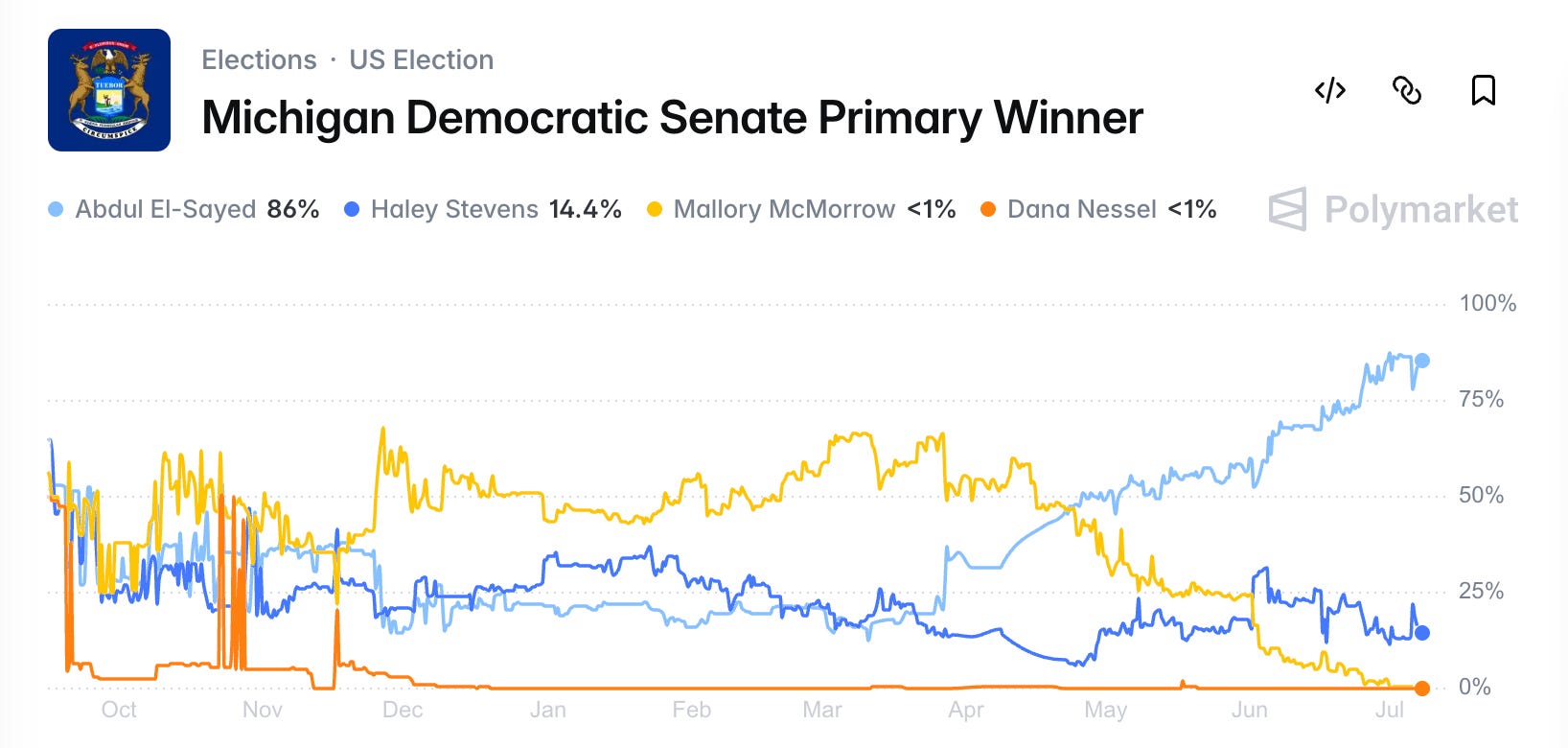
I don’t think she actually was undone by a center squeeze here. She was more or less on track to muscle Stevens out of the race and beat El-Sayed. The proximate issues were she picked an unwise proxy fight with Hasan Piker and also was revealed to have deleted a bunch of disparaging tweets about the state of Michigan. I think it’s tough for any kind of transplant in highly rooted Midwestern states like Michigan and especially tough when you get caught out mocking the state like that. And it’s triply tough when there’s not actually some huge ideological or policy void between McMorrow and Stevens that would bind supporters tightly to her. It just became a tipping point where it’s either Stevens or El-Sayed and she eventually chose to do the right thing and bow out. But that still leaves us with the fact that Stevens is a relatively poor communicator and electoral performer.
I’m told that Debbie Stabenow is a huge fan of hers and that helped get her the establishment nod. But obviously Gretchen Whitmer would have been the ideal choice here. I think Kristen McDonald Rivet would have been a sounder electability pick among the House delegation and former Detroit Mayor Mike Duggan would have been an interesting option, but he chose to launch an independent bid for governor that he abandoned. All things considered, a big disaster. But I think my analysis here held up. I just didn’t know about McMorrow’s old deleted tweets.
Glenn Dunmire: In last weeks mailbag you said in response to a question about increasing House terms to four years (and I am paraphrasing): “there are reforms that are a good idea but not worth dedicating resources to.” So that begs the question, what are some reforms that do seem worthwhile to pursue and put resources behind? For example, I would argue keeping the Electoral College but making states allot electors proportional to the popular vote is a reform worth putting some effort behind. Curious as to what your take(s) would be.
The big kahuna of worthwhile political reform is to end gerrymandering as a problem by using proportional representation. For House elections, that’s easy: Just make a national rule. For state legislatures, it’s tougher because you’re not going to want to unilaterally disarm in the states you control, but hopefully something can be worked out. Proportional representation naturally facilitates the rise of multi-party politics, but that raises the question of how to handle elections for single offices (Senate, governor, etc.). The answer is fusion voting — politicians in those races should be allowed to seek the endorsement of more than one party.
EC-2021: I was fiddling around with some stuff and was thinking about two related phenomena of oppositional reading (that is reading the text in opposition to its intended meaning) and I think I’ve noticed a sorta weird pattern? Both the right and the left do this (see e.g. ‘Zootopia is secretly racist’ and ‘the true Red Pill is waking up from liberal brainwashing’) but the pattern I’ve noticed is that the left seems to take something that is supposed to be progressive and decries it as secretly rightist, while the right attempts to coopt something popular and say that it’s secretly rightist, or proves their point, or whatever? Is this a real pattern, or am I letting my annoyance with folks make me overread?
Isn’t this just downstream of the fact that to the extent that contemporary pop-culture figures overtly espouse political views, they tend to be progressive? It would be funny to find an exception and try to do an against-the-grain leftist reading of “Citizen Vigilante” or something.
Max Haas: I basically agree with AOC on policy I want enacted, but am fully Yglesias-pilled on how I believe politics in America actually functions. Given that, who’s the sort of candidate I should look to in the next presidential election?
Let’s say it’s 2008.
You’re in your early 20s. You think the Iraq War was a huge mistake, you believe in same-sex marriage equality and marijuana legalization, and you also think a Canadian-style health-care system would be good. Should you vote in the primary for Barack Obama, who agrees with you about item one, disagrees about two and three, and has said he kind of agrees with you about four in principle but doesn’t think it’s realistic, so he’s proposing something much more modest?
Well, that’s not just a hypothetical — it’s how I felt in 2008, and it’s how all my friends felt.
At the time, absolutely nobody thought there was a serious case that instead of voting for Obama we should try to find someone who was going to run on single-payer, gay marriage, and marijuana legalization. Suppose we’d gotten a nominee like that. And suppose he was very charismatic and media savvy and also benefited from strong economic fundamentals in 2008 and actually won the election. Well, he would have won fewer states than Obama. Say goodbye to Indiana, North Carolina, Virginia, and Florida on that map. Democrats would have picked up fewer Senate seats.
And for what? To pick a legislative fight over marriage equality that was doomed? So that you could pass a health-care bill that was narrower and did less than the Affordable Care Act? To make it harder to get Sonia Sotomayor and Elena Kagan on the Supreme Court? What would the point of that have been?
One thing I just find incredibly vexing about the post-Obama left is that it’s hard to tell what “agree with A.O.C. on policy” actually means. What are her priorities? What does she think is important? How does she envision building a just national economy while Republicans totally monopolize political power across 20 states indefinitely? But I raise these questions not as an indictment of her as an individual but as an indictment of the larger left ecosystem that she’s part of. Because it’s not just that she would never in a million years embrace Obama-level pragmatism on cultural issues; neither would Gavin Newsom. The conventional wisdom about how to conduct politics has changed for the worse.
The whole concept of what it means to be engaged in the political process has become much more expressive to the point where I don’t really understand what elected officials are trying to do or what they want me to think of them exactly.
Oliver: Do you think that much of the public is unaware of Ottoman, Barbary, Korean, Roman, Arab, Byzantine slavery etc and that influences their view on American slavery? There seem to be genuine surprise when other slave owning societies are mentioned in discourse.
Clearly the mass public is just broadly unaware of any kinds of facts about the history of foreign countries. So I think it’s both true that the public is unaware of the extensive Ottoman slave trade but also that this isn’t particularly remarkable.
If you push a progressive intellectual on this point, they will tell you that Ottoman slavery was not foundational to the economy in the way that Western Hemisphere plantation economies were based on enslaved labor. So then you might note that 19th-century American plantation economies actually had a lot in common with the unfree labor on 19th-century Russian plantation economies. But the counterpoint is that while serfs were “bound to the land,” they were not chattel who could be sold off as individuals; they were simply sold as part of whole estates. So you end up with a lot of wrangling where every specific aspect of American slavery has close parallels elsewhere, but no other system is exactly the same. But that kind of taxonomy misses the point.
What’s notably distinctive about American slavery is that most foreign slave societies were chock-a-block with illiberalism and exploitative economic relationships, while early 19th-century America had made incredible moral and political progress and yet maintained this barbaric system of forced labor through the first two generations of the Republic. That’s a remarkable fact about American history: We had this great Enlightenment revolution and wrote the Declaration of Independence and still went forward with slavery. Absolutely nothing the Ottomans or Tsarist Russia did aligns with modern ideas of freedom and equality, so the forced labor doesn’t stick out like a sore thumb in the same way. But people are confusing the figure and the ground when they see American slavery as exceptional. What’s exceptional is the Declaration of Independence but then slavery was the exception to the exception.
For all of this week’s housing news in one place, check out Halina’s roundup.
Charles Munger’s monocausal explanation for why Costco is great seems right — it charges a membership fee.
People who shoplift or create messes or otherwise act disorderly are not going to take the time and spend the money to get a membership card, so your selection of customers is much better.
Whether it’s schools or public transit or warehouse-style grocery stores, removing the bottom quintile solves all kinds of problems.
The key issue with Platner is that a lot of Democratic activists learned the wrong lesson from Donald Trump. All they see is the aggressive anger and fighting and attribute all his success to that. They either don’t know, or minimize the way he forced the Republican Party to moderate - on entitlements as well as being able to acknowledge the failures of the wars in Afghanistan and Iraq. So the idea is- we too can have Donald Trump success, we just need to find fighters like him! But they don’t want to do any kind of issue moderation so it’s not really clear it’s going to work. I really fear that Abdul El-Sayad is going to run an aggressive “fighting” campaign, he’ll win (because Trump has been so disastrous- the war with Iran is back now- Yay?) and people will take that as evidence to run a “fighter” with no moderation for president in 2028 - and, well hello President Vance.