

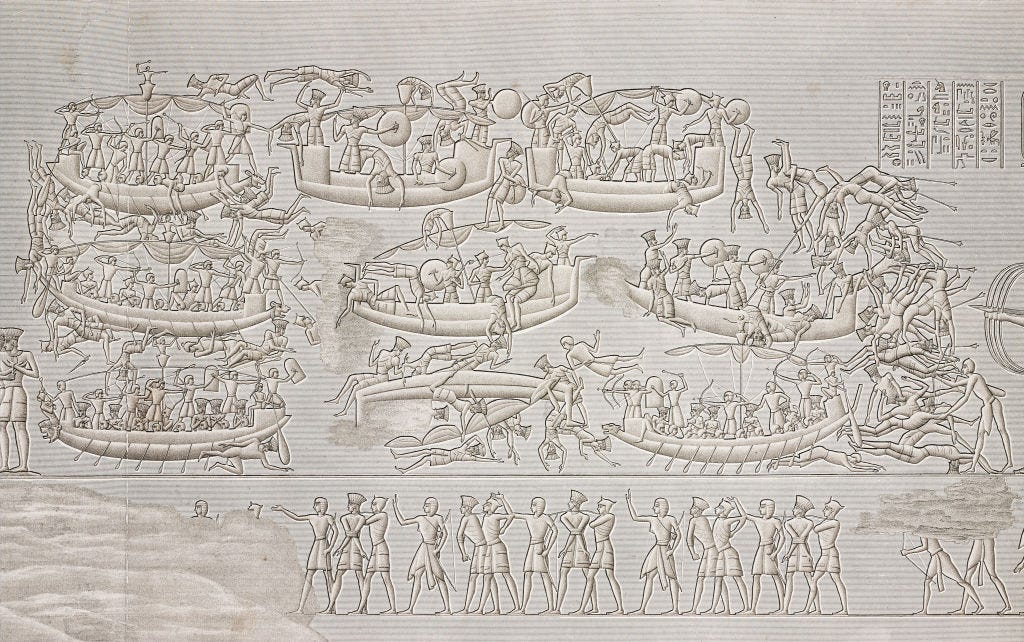
When I finally went to see Christopher Nolan’s “The Odyssey” (it’s harder to get to the movies in rural Maine), I was surprised that relatively little of the gargantuan discourse around the film focused on what I thought was the largest departure from Homer’s text: Nolan inserts multiple references to a historical phenomenon known as the Sea Peoples and a historical episode known as the Bronze Age Collapse.
Some of this falls under the general heading of historical inaccuracy — a person living in the Bronze Age would not refer to himself as living in the Bronze Age, because the idea of a Bronze Age is a modern characterization of the past. It’s based on knowledge that in the future, people would learn how to work with iron on a large scale and bronze weapons would become obsolete. The Sea Peoples, similarly, is a phrase coined in the 19th century by a French Egyptologist putting forward a hypothesis about something he thought happened in the ancient Eastern Mediterranean. It’s not a phrase that we have any evidence was in use at the time.
But anachronisms aside, these references are a bold adaptive choice by Nolan.
We know that the Mycenaean Greek civilization depicted in Homer’s epic would eventually collapse, that there would be a Greek Dark Age with no written material, and that later the rise of Classical Greek civilization would bring about a return to writing with a new script. One strain of thought holds that this collapse was linked to the near-simultaneous collapse of several other civilizations in the region and that this may have had something to do with the Sea Peoples.
But none of this is in the text of “The Odyssey.”
This is all information that I (and many others) learned about from Eric Cline’s well-regarded 2014 book “1177 B.C.: The Year Civilization Collapsed.” And Cline himself wrote a 2013 book on the Trojan War as part of the Oxford University Press Very Short Introductions series that suggests some of the linkages Nolan makes in the movie.
Nolan is incorporating it to reinterpret, recontextualize, and to a substantial extent subvert the source text, suggesting that the Greek attack on Troy sowed the seeds of Mycenaean Greece’s downfall.
Given the incredible commercial success of the film, you clearly can enjoy it without knowing much about these historical debates. I think the point Nolan is trying to make about the present is clear enough: The contemporary West risks collapse not because of external adversaries but because we are abandoning our own values.
But I enjoy a good ancient history debate, so let’s get into it anyway.
The two ancient Greeces
Ancient Greece is foundational to Western culture. It’s not true that all of philosophy is just footnotes to Plato, but Plato’s inquiries set the stage for the whole discipline of Western philosophy, just as Herodotus gave us the template for what it means to be a historian.
Math, medicine, drama, and so much more have their origins in Greek culture.
This is why the old Greek epic poems “The Odyssey” and “The Iliad” have such enduring importance in the West. Both those specific texts and the more general set of topics they deal with were important to people in Classical Greece and the works of the Classical Greeks are the building blocks of so much of our society.
A diverse “Odyssey” is the triumph of Western civilization

My ninth-grade history teacher was a bit old-fashioned. She’d taught the class for many years and always referred to it as Western Civilization I rather than its official title World History I, presumably because that was the name when she began teaching it.
But importantly, even though the Homeric epics were important to people in Classical Greece, they are not epics about the people of Classical Greece.