

Just to flag something relevant to the ongoing themes of this blog, a New York Times/Siena poll last week showed that 52 percent of rank-and-file Democrats think the party should “move to the center” in some unspecified general sense versus only 25 percent who think it should “move to the left.”
And yet virtually every elite discussion happening among Democrats is about moving to the left on Israel. I’m not even against moving left on Israel. But if the entire intra-party conversation is about whether the D.N.C. post-mortem should have talked more about Gaza and about whether the next administration should eschew re-hiring Biden administration foreign policy people, that’s a very limited and inadequate exercise.

Voters were primarily unhappy with Biden’s handling of inflation and immigration. If people consciously and with their eyes open make the call that Biden-era personnel were flawless on these topics and/or that all the relevant lessons have already been learned by the relevant people, then so be it. But I think it would be a big mistake to just sleepwalk into the presumption that marginal Trump voters were primarily unhappy with Biden’s foreign policy — or to completely erase things like the fairly successful defense of Ukraine — rather than looking at the calls that alienated larger numbers of swing voters.
Adam: This article in the Economist about Graham Platner says his theory of power is ‘that voters in the centre and even on the populist right are far more drawn to economic causes such as universal health care than they are repelled by cultural ones he also believes in, such as welcoming transgender athletes into girls’ sports.’
Isn’t this theory obviously wrong and has been disproven in every recent election? It’s only slightly true during economic crisis and snaps back pretty quick (see 2010). Why does the Left have a hard time accepting that culture/values matter to voters on all sides of the political spectrum? Clinton got it. Obama got it. Even Platner’s hero Sanders knows this. Only progressive activists would think something as untrue as this statement. So why do they continue to organize around this obvious untruth? My experience with progressive activists they are well-educated, hard-working, and well-organized. Yet when I tell them that voters care as much about culture as economics they go ballistic. Why is that?
Just to level-set here, the strange thing about a lot of the discourse around Platner’s Senate race is it just misses the fact that Maine is a blue state. I don’t think that Platner’s approach will solve the problem of how Democrats win support from working-class voters who’ve pulled the lever for Trump three times. But I also don’t think Platner needs to solve that problem. Maine is a Clinton / Biden / Harris state, and it’s a state that has moved left compared to the national average since there’s been a large amount (relative to its small population) of in-migration of liberals there since Covid.
The thing that makes this Senate race hard isn’t that Maine is full of working-class Trump voters who Democrats need to win over — it’s that Susan Collins is a formidable contender who has wielded her reputation for moderation to secure victories in the very difficult 2008 and 2020 cycles.
Clearly both Platner personally and the brain trust of his campaign have a lot of interest in meta-narratives and national implications. That’s fine for them, but if you are literal about it, this Maine race has almost no meta-narrative value since “moderate Republican incumbent in a place Trump lost three times” at this point only describes Collins. There is no larger set of races like this to win, and thus no need to establish a particular theory of how you win that kind of race.
Platner and his team want to say that what they hope will work in Maine will provide a path for victory in other places, and I think that basically doesn’t make sense. But the first step either way is for him to win. And the way for him to win is just to get people who voted for Harris to also vote for him. The risk is that factionalism on the Democratic side creates a permission structure for Biden/Collins crossover voters from 2020 to vote for Collins again. And the best solution for Platner is to just find as many non-factional figures as he possibly can to come campaign with him and normalize the race. If he wins, his path to the Senate will have been unusual enough to be noteworthy anyway to get all the attention he could want. But in the medium-term, he needs to try to normalize this race.
In terms of the larger phenomenon you’re talking about, I don’t think it’s a big mystery why progressives keep deluding themselves into thinking that they can use economic policy to avoid the need to come to terms with public opinion on cultural issues — it’s because progressives themselves prioritize cultural issues over economic ones. They regard economic policy disputes as technical issues about which reasonable people can disagree, whereas espousing the wrong views on cultural values means you need to be anathematized.
But of course this is exactly why the strategy doesn’t work. Short of an acute economic crisis, a lot of people are going to put more weight on values questions that have less technical content than on contestable questions about tax policy.
This is why, even though I do not personally find the “anti-oligarchy” framing that the left-populists are running with very compelling, I do think you could work with it. You’d just have to take it seriously. Look at different policy issues through the lens of whether or not you are helping to build a political coalition to check the power of the economic oligarchy. Clearly wedding yourself to an unpopular view of sex-segregated sports teams is counterproductive to fighting oligarchy. Standing up for abortion rights is mostly helpful to fighting oligarchy, but you’ll fight oligarchy better if your candidates in the South are anti-abortion and your candidates in places like Ohio and Iowa are open to late-term restrictions. Banning plastic straws does not fight oligarchy. To fight oligarchy, you should listen to Alaska labor unions rather than out-of-state environmentalists when it comes to managing Alaska’s natural resources.
Don’t be a sucker around this stuff. The oligarchy doesn’t care whether or not people pay their bus fare, but it loves when Democrats attract a soft-on-crime reputation that discredits them electorally. I know there are left-populists who sort of quietly agree with this, but they are not in the driver’s seat and they worry that any hint of cultural moderation would just be used against them the way it was by Hillary Clinton in 2016.
DWD: Alternate Middle East history: What if the Arab countries didn’t expel their Jewish populations after the founding of Israel? Would a peace deal have been reached because of a combination of there being less need for land and not having the Mizrahi and Sephardic the hold a grudge against Arabs? Would the Ashkenazi population end up giving up on the project after a decade or two once other immigration options opened up? Or would the Mizrahi and Sephardic Jewish populations have simply migrated anyway due to anti-semitism resulting in the same situation we currently have?
For starters, we need to clarify that the narrative of a mass expulsion of Jews from Arab countries in the wake of 1948 is a huge oversimplification of the history.
Libya formally expelled its Jewish population in 1970, for example, but by that time there was almost nobody left. The vast majority of the Jewish population had already left in the wake of pogroms that happened in 1945 and 1948 in a situation that left Libyan Jews feeling unsafe and unwelcome but was not a literal expulsion. Jews left Egypt in multiple waves following episodes of violence and harassment that eventually ended in expulsions connected to the Suez Crisis. Iraq is probably the closest to true post-founding expulsion because a denaturalization law passed in 1950, but even then many Jews remained and then left in the face of informal violence. At the other end of the spectrum, the government of Morocco made what I think is generally understood to be a good faith effort to make the Jewish population feel safe but still had a steady outflow of its Jewish population over a 20-year timespan.
The upshot of this is that it’s a little hard to say what the counterfactual here is exactly.
Suppose Iraq had never passed that denaturalization law. That was the most expulsion-y short-term measure, and I think helped craft the narrative that pogroms in other countries constituted a kind of de facto expulsion. Well, you still would have had the pogroms as a major push factor. And you still would have had the newly formed State of Israel as a pull factor. And we see from the Morocco case that the ultimate outcome isn’t very different here.
You could say “Well, what if public opinion throughout the Arab world hadn’t turned hostile to Jewish people and thus there had been no pogroms and no soft pressure to leave?” Well, that would be a very different world — including a world where the 1948 war probably doesn’t happen at all and the actual State of Israel ends up being quite a bit smaller than the one that emerged from the war.
It’s interesting to recall that if you turn the calendar back to 1914, before the creation of Mandate Palestine this is all just bits of the Ottoman Empire and not administratively organized in a way that reflects current thinking. There was an Independent Sanjuk of Jerusalem that contains today’s Gaza and parts of Israel and the West Bank. The rest of Israel and the West Bank were in two different Sanjuks that were subordinate to the larger Vilayet of Beirut. Nothing that corresponds to today’s Lebanon really existed either.

In this Ottoman period there was a longstanding but small Jewish community in the Holy Land. There were also two waves of emigration of European Jews to the region. These emigrants were highly ideological Zionists and most of the “Founding Fathers” of Israel descended from that population. But at this time there was a larger Jewish community in Baghdad than in Jerusalem, and substantial ones in Aleppo and Damascus as well. Thessaloniki in contemporary Greece, which was Ottoman until 1913, had a Jewish majority at this time. Legally speaking, Ottoman Jews could have moved en masse to Palestine back before World War I, had Zionist ideology been popular among Ottoman Jews. Realistically, the same sentiments that led Ottoman authorities to resist European immigration to Palestine probably would have induced them to try to restrict internal migration if there had been a lot of interest in internal migration. But there wasn’t. And similarly we don’t really see people from North African Jewish communities trying to move to Ottoman Palestine even though many of them would have had more relevant linguistic competencies than the European Jews who did move.
Evan Bear: Will Slow Boring be announcing an endorsement in the Colorado gubernatorial primary?
I think we at Slow Boring have been trying to avoid delving too far into conflict-of-interest terrain with extensive coverage of that race. But I was thinking back to the 2020 primary, when Democrats ultimately landed on Joe Biden as a moderate electability candidate. Michael Bennet, like Biden, was one of the few candidates with the wisdom to avoid hopping on the bandwagon of decriminalizing illegal entry into the country. And he, like Biden, wisely proposed building on and expanding the Affordable Care Act rather than chucking the whole thing overboard. But he stood out as having the best energy policy in the field, and his idea to focus specifically on expanding the Child Tax Credit was a better idea than layering C.T.C. expansion on top of an unfocused care agenda with three other major items, as Biden ultimately did.
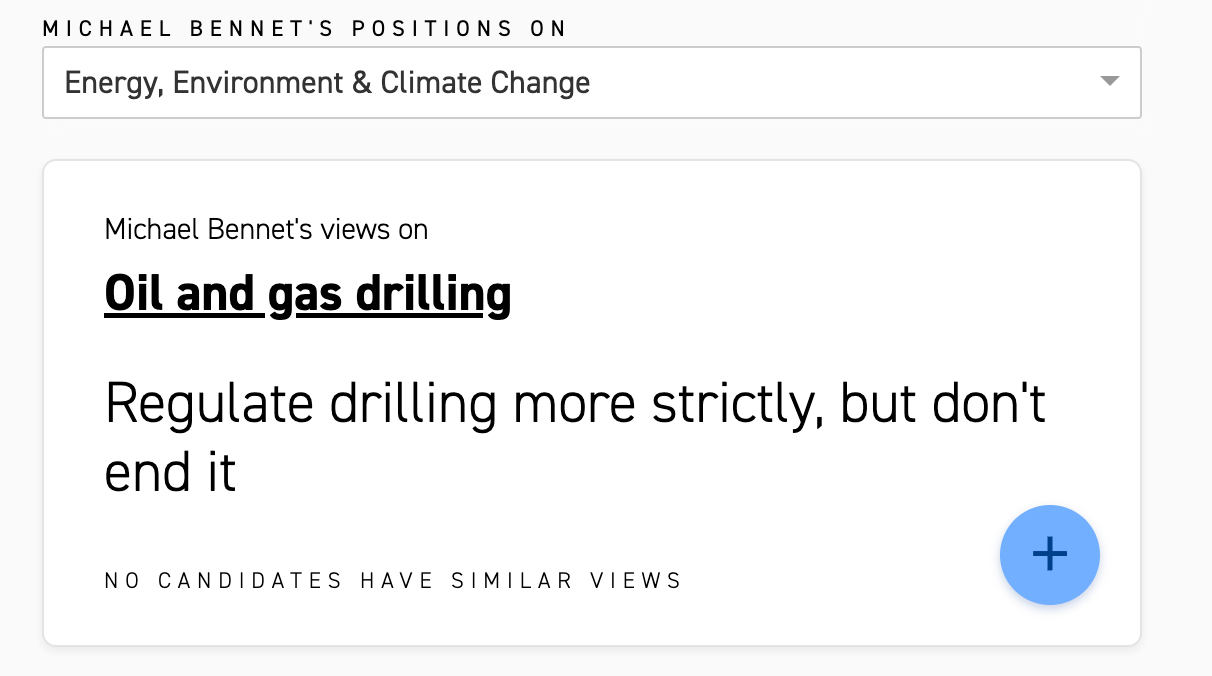
Bennet also had better takes on K-12 education than Biden.
So I think he would have brought to the table similar electoral upside as Biden, he displayed somewhat better judgement on policy substance all along, and you obviously would not have had the same age issues that Biden did. So is it fair to say that we as a country wouldn’t have all these problems if people had been willing to look farther down on the list of options than Biden before settling on the most famous straight white man in the race as the electability pick? I think probably yes.
Evan Bear: Are people like Lindsey Graham and Marco Rubio heroes of the ethic of responsibility? By debasing themselves and brown-nosing Trump, they’ve probably prevented their offices from going to dyed-in-the-wool Trumpist true believers and arguably achieved the best possible outcome.
Graham I think is too much of a mess and Rubio too clearly acting on his own ambition to really qualify like this. What I do think is true is that there are a bunch of “quietly reasonable” red-state Republicans, headlined by Todd Young of Indiana but also including Shelley Moore Capito of West Virginia and others who are keeping their heads down and trying to legislate constructively.
As someone who cares about the future of the Republic, I do think these kind of people are on some level complicit in helping Trump and the MAGA movement consolidate power in this country. On the other hand, if they decided to become vocal critics of Trump’s corruption or whatever, they would just be replaced by MAGA dittoheads. Their presence in the Senate not only facilitates some reasonable bipartisan action via Secret Congress, but also probably acts as a restraining force at the margins around stuff like ballroom funding.
The deeper underlying problem here, of course, is that Democrats have just stopped meaningfully contesting statewide elections in Indiana or West Virginia. That creates a basic structural vulnerability in American politics where the best you can hope for across a third of states is a quietly reasonable senator, and you always worry that if the senator in question becomes too reasonable he’ll be replaced by a sociopath who underperforms by five points and wins easily anyway. And this is the dialogue I am always trying to have with Brian on Politix: It is true that I like the existing crop of frontline Democrats better than I like his safe-seat resistance-posturing heroes. But what I am really advocating for is not that everybody act like John Hickenlooper. It’s that when a deep red state gives us a politician who is not quietly reasonable, I want Democrats to make a good faith effort to appeal to the median voter of that state.
Bill Cassidy just lost a Louisiana primary pretty badly. But he still got 25 percent of the vote, which is not nothing. Trump beat Harris there 60 to 40 in 2024. If you think of the state as 40 percent Democrats, 15 percent people who liked Cassidy, and 45 percent MAGA fanatics, that adds up to a potential anti-MAGA coalition. But Democrats are not within light years of trying to put those kinds of coalitions together.
Wandering Llama: The Trump admin seems like genuinely the most corrupt presidency in living memory, with some highlights including:
Coercing multi million settlements against media/tech companies that no one believed had much of a chance in court
Trump crypto coin raised a billion dollars, seemingly selling access
Placing thousands of trades with insider information ahead of tariff/war developments
How should the next administration approach this?
What I think the next administration should do is what neither the Biden nor Obama administrations did and actually make “accountability” the main thing that they are willing to invest political capital in. And I think that resistance types who desperately want accountability for Trump’s malfeasance to be the centerpiece of the next administration need to understand that their enemies in this are not frontline members who are cautious about expenditures of political capital but progressives who demand that capital be invested in other things.
The Brian Beutlers of the world don’t need to like the fact that the next president will only have so much capital to spend and will be constrained in his political risk-taking by more cautious members of Congress. But it is true that every president does have limited political capital and is constrained by more risk-averse politicians. Trump has chosen to invest political capital in things like personal corruption rather than on federal restrictions on abortion or cuts to Social Security and Medicare. It is not true that his corruption reflects totalized political recklessness or a lack of constraint. He has made a deliberate choice to sideline certain longstanding but politically painful conservative policy goals in order to focus on what he cares about.
The way to pull out of the downward spiral of corruption — and I think the odds of this happening are extraordinarily low — would be big-tent candidate recruiting as per the previous answer plus clear prioritization of anti-corruption over a transformative policy agenda.
Beyond the specifics of political capital, it is worth keeping in mind that voters do not clearly distinguish between “corruption” and “politicians making decisions I disagree with.” Voters think that if you take an unpopular view on how to sort people into sex-segregated sports teams because you’re afraid of getting yelled at by activists, that’s corruption.
I think the voters’ expansive view of corruption is a little over the top. But I do also think that Democrats get a little bit soft on some of their own behavior because of sentimentality about nonprofits and Democrat-aligned interest groups. There is definitely a difference between climate donors leaning on Chuck Schumer to whip a vote about whether or not to allow California to ban gasoline-powered cars and a member taking an envelope of cash from an oil company to vote a certain way on that measure. But progressives who are happy to characterize as corruption campaign contributions from businesses they don’t like tend to have a blind spot to the role of donor influence when it comes to enforcing ideological orthodoxy.
Jeff: What is your take on the autopsy report?
I think it would be a great idea for the Democratic National Committee to commit, in advance, to doing routine after-action reports every two years — regardless of the outcome of the election — in which you just survey the key stakeholders from the various party committees and affiliated Super PACs and write down “here’s what we were trying to do, here’s what we accomplished, here’s what we did not.” That would be a fairly boring and technical exercise that, by definition, would not get to the really interesting issues of politics.
But I think it would be good practice. How good a job did we do of targeting the most pivotal races? That kind of thing. What people want, though, is an after-action report on big picture strategy, which I think gets far too deep into the substance of policy disputes to be something that the D.N.C. could even plausibly do.
Michael Adelman: The venerable Lawyers, Guns & Money blog this week made a keen observation: “In a just universe, the sheriff who threw someone in jail for 37 days over a clearly constitutional protected Facebook post he didn’t like would be at least as famous as the Oberlin undergraduate who politely told a student reporter that it was kind of insulting to call a pulled pork sandwich a banh mi ...” For principled supporters of the First Amendment, this point is unassailable, which makes me wonder — what accounts for the fact that in the real world, the opposite is clearly true? Are there just depressingly few people who support free expression in principle regardless of content? Do conservatives tend to win out here simply because their cultural views are more popular?
Jesse Ewiak: Because the right-wing movement has a whole very well-funded system them even infects ‘centrist’ publications to push their worldview while the left-wing has a bunch of people who have very left-wing views and get into media, but then run into the issues that ownership are largely small c-conservative at best.
This is another case where I think the blame has to be laid not with the nefarious “well-funded system” of the right or the “‘centrist’ publications” but with the authentic views and priorities of progressives.
The case at hand here is Larry Bushart, who was wrongfully imprisoned during the crackdown on free speech led by conservatives in the wake of Charlie Kirk’s murder. He won his case and is now owed substantial damages. This was covered in the New York Times and Bushart was defended by the free speech warriors at the Foundation for Individual Rights and Expression (FIRE), an organization that has consistently defended free speech from attacks from all sides. Greg Lukianoff, who runs FIRE, said after the resolution of the case that “I’ve been doing this work for 25 years, and I can honestly say this is the worst First Amendment case I’ve ever seen.” Steven Pinker highlighted the case on Twitter as establishing the indispensability of principled defenders of free speech (I did too).


That being said, it was not a huge news story. Clearly if a progressive sheriff had arrested someone over a Facebook meme in terms that got condemned by free speech advocates as the worst First Amendment case of their lifetime, it would have dominated conservative media and as a result become a major story in progressive media. But that was not the case here.
Is that because conservative media is better funded than progressive media? I think to understand the real asymmetry you have to look at what left-wing media is interested in. And what they are interested in is primarily D-on-D primaries in blue states and districts. They very extensively covered Chris Rabb’s successful primary win in Philadelphia and did a lot to amplify his attacks on his opponent. They are interested in Tom Steyer vs. Xavier Becerra and advancing Steyer’s narrative that being a self-funded billionaire on an ego trip is more ethical than doing normal fundraising. David Sirota likes to interview Graham Platner to get Platner to say negative things about abundance. Sometimes you get a race that features a Democrat running against a Republican in a red state — like is happening this year in Alaska and North Carolina — and progressive media has zero interest in that. And they are definitely not interested in finding stories where Mary Peltola and Roy Cooper will agree with the progressive base and where Republicans will be divided. Their interest is in playing up issues — recently that often means Israel but in the past it’s often meant Medicare for All or the Green New Deal or neo-Brandeisian antitrust policy — that divide Democrats and provide grist for the factional mill.
So if you put more money into progressive media, you would not bring more attention to stories like the Bushart case that unite Democrats and divide Republicans, because progressive media stakeholders don’t care about those stories.
rootpi: Movie question: my pick for under-appreciated / under-the-radar film is “Falling Down” - any thoughts? The protagonist (Michael Douglas) is not in the right, but he is sympathetic and understandable and captures a legitimate & perennial frustration. The side plot with the retiring cop (Robert Duvall) is well done and thoughtful in its own right. The overall narrative is slightly exaggerated but very compelling (moment-to-moment gripping) and internally consistent with a strong momentum. All the acting is excellent as I recall (however it’s been a while and I’m not a fantastic judge). To be fair when I Iooked at imdb and rotten tomatoes just now it does better than I expected (albeit not amazing), but I still feel like it never got much love or attention from either critics or general audience.
“Falling Down” has a great premise, and I love this movie as a reminder of a specific moment in time — the Southern California mini-depression of the early 1990s associated with cuts to military spending after the Cold War — that has been largely forgotten. But the execution of the last third of the movie is not very good in my opinion, so it deserves its somewhat mixed critical reputation.
The 21st Century ROAD to Housing Act has finally passed the House. Read about that and other news in Halina’s housing roundup.
>I don’t think it’s a big mystery why progressives keep deluding themselves into thinking that they can use economic policy to avoid the need to come to terms with public opinion on cultural issues — it’s because progressives themselves prioritize cultural issues over economic ones.<
A simple yet profound insight.
Matt really has a gift for unwrapping things that seem obvious after he explains them. But weren't at all obvious the moment before you read the explanation.
On the free speech point, it's important to recognize that Matt, and also his audience, is _also_ more interested in left factional disputes than doing stories about Republicans being bad about free speech. That's why there are numerous stories from moderates at the NYT about left illiberalism on college campuses but fewer about Republicans. That's why the Letter on Justice and Open Debate was signed not just by Matt but also by tons of other free speech types, but there's no comparable letter about Republicans.
Additionally, there is also the point that Matt made on a podcast recently, which is that a big issue that gets censored is criticism of Israel, which most center-left commentators don't want to be vocal about. But to my point, Matt couldn't remember any episodes of this off-hand, while I would be surprised if he struggled similarly with remembering left factional censorship incidents.