

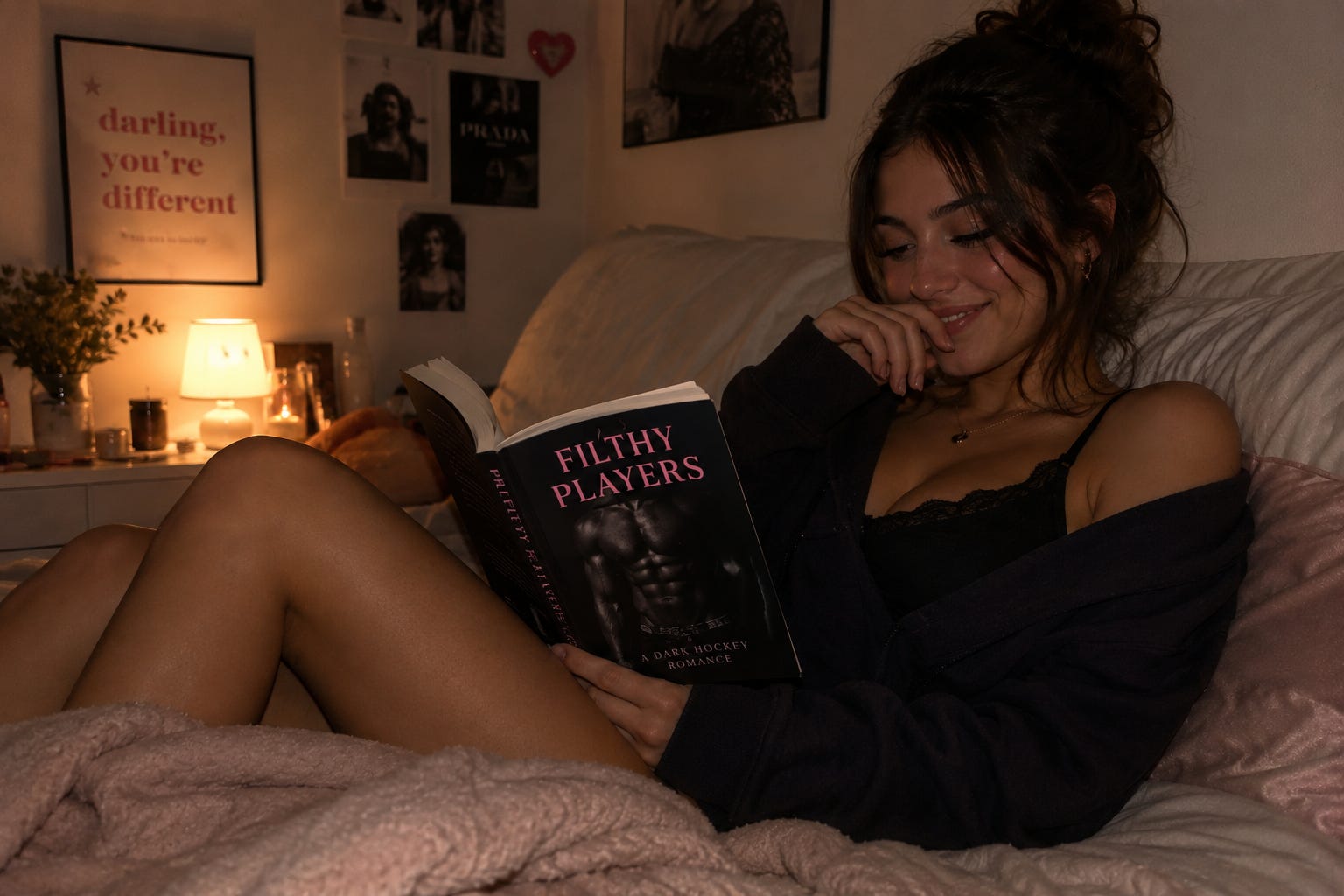
My older sister was, growing up, the coolest and smartest person in the world. She would kill me if I didn’t clarify that she still is, but as a middle and high schooler, I watched her excel socially and academically with a confidence that I spent years studying and failing to replicate.
She also introduced me to romance novels.
Along with access to her Kindle account, Caroline gave me permission to enjoy this kind of literature. That gift transformed my perception of books and reading. Before, I had understood that certain books were serious and certain books were not, and that certain people read serious books and kept quiet about the others. Romance novels were meant to be carried with shame and without a cover, on a Kindle and in private, like Biff Tannen’s nudie mags tucked within “Sports Almanac.”
I was a Smart, Serious Girl headed to a Smart, Serious College and then to a Smart, Serious Job. The books worth mentioning were by Hemingway, Salinger, Franzen, Plath, Woolf, and Gladwell. The other books were meant to be kept secret, guilty, saccharine pleasures to binge when no one was watching.
At my Smart, Serious College, I was a Smart, Serious English Major, and four years of close reading, literary theory, and seminar tables full of 21-year-olds with strong feelings about Chaucer, Eliot,1 and great American authors gave me a thorough education in what the culture considers Serious Literature.
Romance novels don’t qualify unless they’re Shakespeare or Austen, in which case they’re not called romance novels — even if “Romeo and Juliet” and “Pride and Prejudice” are the urtexts of the genre. Neither does most “chick lit,” a category loosely defined to include any book marketed toward women, whether because it’s about family, desire, or features a woman protagonist — or even simply because it’s written by a woman.2
Despite their popularity, these books are overwhelmingly read with shame among people who are taught to prize intellectualism and prestige, especially among women in male-dominated spaces. The usual counter-argument against this embarrassment and for embracing romance is that these books are actually good — underrated literary achievements, emotionally sophisticated, dismissed only by misogynists who haven’t read them carefully enough. This is true enough in some cases, but arguing for the genre on the grounds of literary merit concedes too much.
I’ve read romance novels I think are excellent. I’ve also read some that are jaw-droppingly, almost impressively bad. And those are worth reading, too. Certifying books as Literature based on merit accepts the premise that “literary merit” is the relevant standard and then tries to prove that the under-appreciated genre meets it. That argument undercuts and misstates the true value of this kind of “women’s literature.”
The value of these books is not in their quality. It is in their broad appeal, how pleasurable they are to read, and, when the shame is removed, how much fun they are to share.
The “Yesteryear” problem
Last Sunday morning, I barreled through “Yesteryear” by Caro Claire Burke. The novel follows a tradwife who suddenly and disorientingly wakes up in 1855 Idaho, where she is forced to confront the realities of living in the world she glamorizes and performs online.
I loved it.
The critical reception, though, has been … mixed. Nearly everyone seems to agree that the premise is genius and the pacing and plot genuinely compelling, but also that the character development is nearly nonexistent and the rich themes suggested by the premise go largely unexplored.
In Jerusalem Demsas’s critical case against “Yesteryear,” she notes the book’s shallowness and its failure to “tell us about women anywhere.” Alisha Ramos writes that the novel “doesn’t fully explore the interesting themes and questions it raises” and critiques its lack of character development, its “under-researched overgeneralization, hand-waviness, little nuance.” In her review for The Guardian, Rhiannon Lucy Cosslett condemns Burke’s seeming disinterest in investigating fundamental aspects of motherhood, including a mother’s relationship to her body and her child’s: “It feels cynical and under-researched,” Cosslett writes. “In her attempt to create a clever plot twist, Burke lets her characters’ humanity fall by the wayside.”
These points are well-taken; I certainly don’t disagree. And I also don’t begrudge anyone their critical analysis. Burke has presented the book as a commentary on our times, and I think it’s fair for readers and critics both to wrestle with the author’s stated aims. But I think it’s equally fair to simply take a pass, at times, from engaging with a text as Literature and choose instead to engage with it as an artifact of mass culture.
The book might be maddeningly lacking in rigor, but it is also the most-talked-about novel of the year. I’m certainly not arguing that popularity is necessarily an indicator of quality, but I think it would also be a mistake to dismiss readers of popular works as unsophisticated themselves simply because the texts are not particularly deep.
Because while Burke may not deliver on her promise to answer or even explore them, the questions “Yesteryear” poses are anything but shallow: What is the role of men — fathers, sons, husbands — in women’s lives? What is freedom? What is authenticity? These questions and the conversations the book has ignited, overwhelmingly among women, are evidence that unsophisticated but enjoyable stories can still play an important role in our culture.
Books like “Yesteryear” that drive these cultural moments are worth our time, even if they aren’t particularly Literary. And I’d argue that what the most popular book of the year tells us about women is that they sometimes want a deliciously frivolous story and are capable of extracting meaning and — more importantly — camaraderie from said frivolity.
Permission, passion, and the things we share
Romance (which “Yesteryear” technically is not) is the best-selling category of fiction in America by a significant margin, consistently outselling literary fiction, mystery, science fiction, and everything else. It is not a niche preference, and yet it is treated by the culture that takes books seriously as an unserious genre — or, more condescendingly, as evidence that most readers aren’t sophisticated enough to handle real Literature.
In taking these books seriously and enjoying them (almost) shamelessly, though, I — despite being a very Literary Woman — have made durable social connections with other women.
Caroline and I used to be at each other’s throats when our family dynamics got the best of us during breaks from our long-distance sisterhood. Now, we avoid regressing into our teenage tendencies by reading the same novels simultaneously, giggling, swooning, and cringing in tandem from opposite sides of the couch. (Fortunately, we read at the same speed.)
She, her best friend, and I have had a group chat for three years based entirely on discussing the genre’s latest releases. My little sister, Anne, caught the romance bug during a road trip with my mom to visit colleges. Listening to Emily Henry on audiobook, the two of them passed the time that would otherwise have been filled with tension during a particularly volatile time in her high-school life. They kept the stories going as they lay side by side on their hotel beds each night, unable to take a break before the resolution.
I had seven Smart, Serious female roommates in college. Most of them, it turned out, had a private affinity for romance novels that we did not address until senior year.
When I admitted one night what kind of books I was consuming between classes, the room lit up. I had made the confession they were each holding in, giving everyone else permission to share this thing they had secretly, shamefully loved for years. A new shared experience was unlocked, and we would spend the rest of the year — and the years since graduating — delighting in the simple pleasure and glorious freedom of sharing this thing that makes us all giddy.
And perhaps if more men took a chance on romance, we could do away with this alleged male loneliness epidemic. Early in their courtship, Caroline and her boyfriend exchanged vacation books. He gave her John le Carré’s “The Spy Who Came in From the Cold.” She gave him Emily Henry’s “Beach Read.”
Caroline thought Carré was fine but wasn’t exactly stirred by it. Her boyfriend, on the other hand, finished Henry in shambles.
The son of Serious Literary types and a graduate of Serious Schools, it had never occurred to him to read something like that. His foray into romance, he said, helped him discover a new relationship to literature: one where, as a reader, he found himself meeting characters he might well have encountered in real life and relating to plot points that mirrored his own experiences (as opposed to those that can only be found in books for those of us who, like him, are not spies).
“It sounds ridiculous that I had never read a book about the world I actually live in,” he wrote when I asked about his foray into romance. “But in a way, I think that was true. I hope I get insight into my own life from everything I read, but with most ‘serious literature’ that connection is so abstract and mediated. Somehow, I had got it into my mind that if a story is too relatable, it must have nothing interesting to say. Where did I get such a silly idea?”
He is now a middle-school teacher in Tulsa and encourages his students to read whatever books interest them. Making his rounds in his classroom, he asked one girl what she was reading. Her face turned beet red when she revealed the romance novel she had been devouring. Fortunately for her, she had a teacher who, instead of making her feel embarrassed for her choice, validated it.
Books are for learning, yes, and books are also for sharing. Shame closes down the possibility for conversation before it can begin and, with it, the potential for connection.
The case for reading “chick lit” isn’t that every novel ever written by a woman is secretly as good as “Middlemarch.” It’s that enjoying something because it is pleasurable and accessible is a complete justification. And, like March Madness, embracing things on their own terms creates the possibility for connection.
I don’t really care if “Yesteryear” makes good on its premise in a literary sense. I’m still grateful for the conversations it’s inspired and for the romp it was to read.
Weekend letter of recommendation:
Read a contemporary romance novel or a little bit of chick lit. Here are some of the greats, with varying degrees of romance:
“Beach Read” and “People We Meet on Vacation,” by Emily Henry
“Writers and Lovers,” by Lily King
“Normal People” and “Conversations With Friends,” by Sally Rooney
In a departure from the topic at hand, I recently enjoyed “Empire of Pain” by Patrick Radden Keefe. And to be quite fair to my sister’s boyfriend, I do love Carré’s “Tinker Tailor Soldier Spy.” If you haven’t already, read one of those after you finish your women’s lit assignment.
I’m watching “Margo’s Got Money Troubles” on Apple TV and finding it to be simultaneously fun and stressful. The pacing is great.
Take a mother in your life dancing over the weekend. My mom went to a public dance class in her local park with a couple of her girlfriends this week and was positively beaming when she told me about her experience. (Consider this your reminder that Mother’s Day is on Sunday.)
“Yesteryear” by Caro Claire Burke
We called her Mary Ann Evans, obviously.
By that standard, most literary fiction qualifies, since women are the primary consumers of books across every genre.
Respectfully, serious Title / Content disconnect on this one. “Smut” specifically refers to having the character of being sexually titillating. This piece’s thesis seems much more broadly aimed at an apology for popular chick lit with minimal emphasis on its specifically erotic character.
The Virginia Supreme Court’s decision to overturn a redistricting plan that was explicitly endorsed by the voters further radicalizes me against the Republican Party.
This does nothing to settle the intra-Democratic fight between centrists and progressives — and for the record, I remain firmly on the side of the centrists. But it does perversely create a kind of procedural unity: the factional war matters a lot less if the party itself is simply never going to be allowed to win elections on fair terms.
And spare me the lectures about the evils of gerrymandering from a court whose ruling lands at the exact moment Republican-led states are openly moving to eliminate what remains of blue representation. The message is clear: when Democrats try to answer asymmetrical hardball with democratic approval at the ballot box, the rules suddenly become sacred. When Republicans dismantle opposition districts outright, it’s just politics.
Also, I warned against Hakeem Jeffries spiking the football. As I predicted, now he really does look like a damn fool.