

In February, approximately 59 percent of America’s full-time workers planned to put money in an office bracket pool. Not all of that 59 percent had watched a regular-season college basketball game in the past year or could name the coach of the team they’d picked to win the tournament. It didn’t matter. They were in.
The madness began Thursday. Their bracket was busted, and they spent the day after complaining about it across cubicles and Slack channels to people they had barely spoken to since the office holiday party. This is a good thing, even if March Madness might cost employers billions in lost productivity.
Despite the distraction, the office pool is valuable, and the people who roll their eyes at it, who might find the whole spectacle a little embarrassing, are missing the essence of what holds a fragmented society together.
The real madness is social isolation
The loneliness context that makes this argument necessary is familiar by now, and I have incidentally been writing about similar social phenomena recently.
More than half of American adults report feeling lonely and emotionally disconnected, according to a 2025 American Psychological Association poll, and the church, historically one of the most important community institutions in American life, a place where you showed up every week and sat next to people across the full spectrum of income and age and personal drama, has been emptying out for a generation.
Political polarization has made this worse. You are less and less likely to know the random set of people you once might have met through church, civic organizations, and other third spaces. Americans are increasingly sorting themselves — whether by geography, by education, or by media consumption — into communities of the like-minded. The shared public square has largely been replaced by a set of parallel, mutually incomprehensible discourse zones.
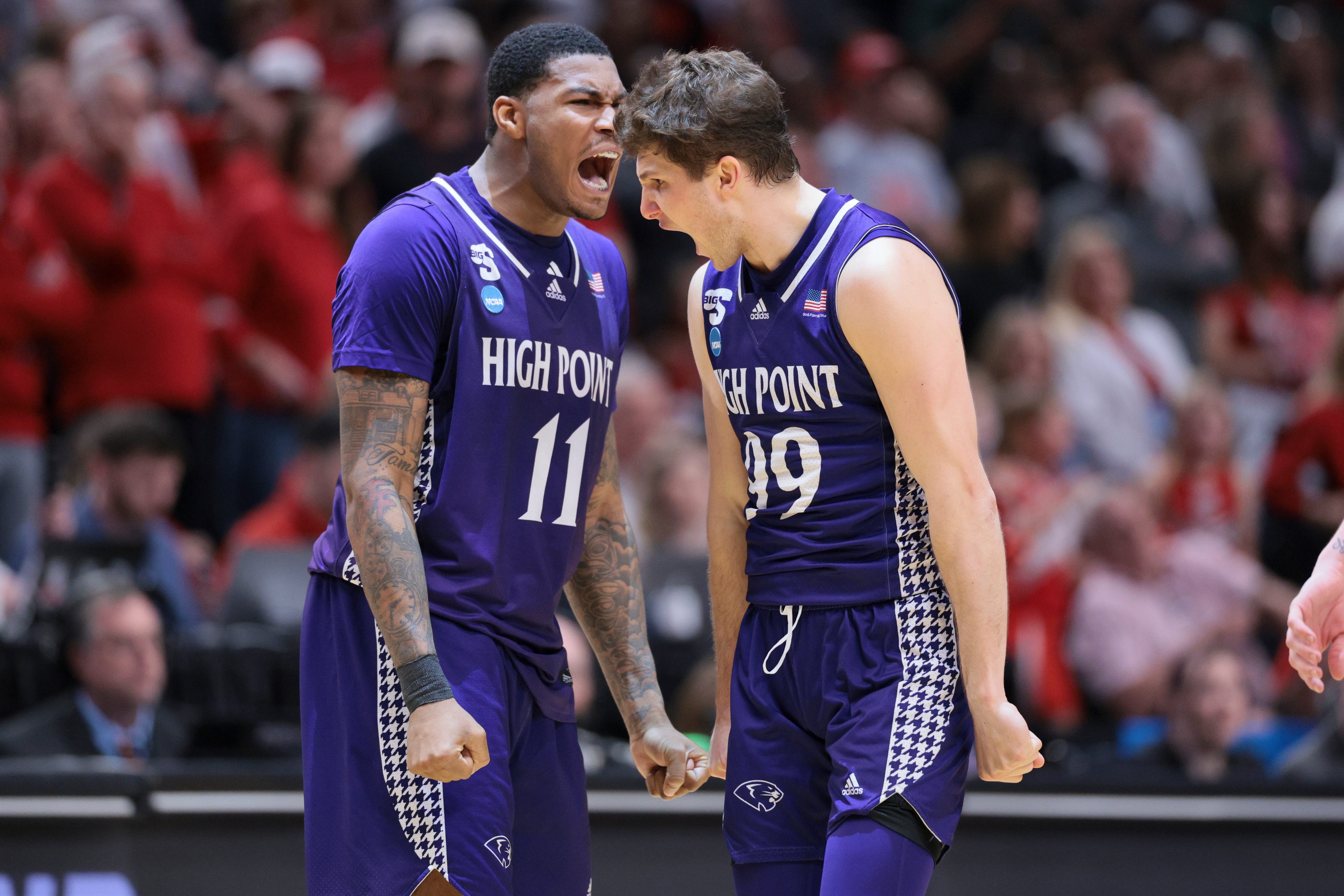
Every March, a 68-team single-elimination basketball tournament begins. Roughly a quarter of all American adults participate by filling out a bracket “every year” or “some years,” according to an Associated Press-NORC poll. The full-time workers who put money in an office pool contribute an average annual spend of around $97 — suggesting that somewhere north of 80 million workers are collectively putting something like $7.7 billion into bracket pools each year. In 2025, the tournament drew its largest audiences in more than 30 years, continuing to grow year over year. Roughly 80 million people filled out brackets this year.
March Madness is big enough to be worth taking seriously as a consequential driver of national unity.
Everyone is running the same statistical experiment
Part of what makes March Madness sticky in a way that most sports aren’t is that participation forces you to have opinions in advance. Participants must go on record, committing to a position on how the tournament will shake out, rather than rooting only for one’s allegiances. The bracket is a prediction market, and everyone who fills one out is engaging in a low stakes way in probabilistic reasoning about uncertain outcomes.
I am far from being a statistician, but, from my understanding, the math is comically hostile to success. There are roughly 9.2 quintillion possible bracket outcomes.
The N.C.A.A. officially puts the odds of a perfect bracket at 1 in 9.2 quintillion if every game is treated as a coin flip; with basketball knowledge, stats, and matchups guiding selections, the odds improve but still sit somewhere around 1 in 120 billion by most serious estimates. Warren Buffett once offered a $1 billion prize for a perfect bracket. No one came close. This year, the sports betting company Kalshi picked up the baton. As of Friday afternoon, the N.C.A.A. estimated there were around 5,000 perfect men’s brackets left after the tournament’s first day.
And yet tens of millions of people engage with this experiment every year, not because they expect to win but because the act of choosing — committing, being wrong, arguing about it, winning your pool with an embarrassingly low score — is itself the point. The bracket is what game theorists call a “commitment device.” By locking in your picks before the games begin, you give yourself a reason to care about outcomes you’d otherwise be indifferent to. The Siena-Duke game, which you might not have bothered to watch, is relevant because you have Duke in the Elite Eight.
This is not intellectually embarrassing. It is, at a basic level, how social engagement works. Fantasy leagues generate the same effect for football. I have rolled my eyes many times at my boyfriend’s commitment to his annual drafts with his friends from middle school, but I vow to approach next year’s with more empathy for his social reconnection. Television recap culture generates it for prestige and reality television.
We manufacture stakes because stakes make us pay attention, and paying attention together is one of the main mechanisms through which people form connections.
Why we keep chasing water cooler television
The original must-see TV — “Seinfeld,” “The Sopranos,” “Scandal,” “Lost” — was the thing everyone was watching and could therefore talk to anyone about. It is a more interesting conversation than talking about the weather.
There exists a debate about whether water cooler television, programming so culturally pervasive that people would discuss it the next day at work, was killed by streaming. When everyone watches everything on their own schedule, we have less to say to each other on Monday morning. Some series are pushing to make episodic television great again with shows like “Succession,” “The White Lotus,” “Severance,” and “The Pitt” dropping episodes weekly and dominating internet chatter the next day. But the scale of the viewership is dramatically smaller than in the pre-streaming days.
Viewership of prime-time television was massive. Season 1 of “Lost” had an estimated 16 million viewers per episode on ABC — about 688 million minutes viewed per episode. “Severance,” AppleTV+’s most-watched show, reached 681 million minutes viewed during this week last year, when the show was midway through its second season. Nearly half of that viewership, though, was of the first season. March Madness is one of the last mass cultural moments that truly cuts across the fragmentation. You cannot watch the tournament on your own schedule because games happen live and simultaneously, and the results all land in real time. A buzzer-beater on a Thursday afternoon cascades across group chats, offices, every social media feed at once. Either you saw it or you didn’t, but either way, you’re talking about it.
These moments are increasingly rare. The Super Bowl is another example — one game on one night, watched by roughly 125.6 million people at the same time. The Oscars, which drew nearly 18 million viewers this past Sunday, gestured in this direction but signaled a four-year low. Taylor Swift-level cultural events do something similar. But March Madness sustains it for three weeks across dozens of games, and it does it with a form of engagement — the bracket — that pulls in people like me who would never watch a game otherwise.
“It’s a conversation where everybody can talk about the same thing,” Matthew Bakowicz, the director of the sports management program at American University’s Kogod School of Business, told InGame this week. “And it doesn’t matter who you are, where you come from, or what you look like.”
The cross-class, cross-geography thing is real
It is easy to be cynical about March Madness as a unifying force. The tournament has real class and race dimensions worth considering — the labor of predominantly Black athletes is generating unbelievable revenue for predominantly white administrators, even as players can now be paid by their schools. The betting market that now surrounds the tournament benefits from and arguably exploits the same dynamics. As with all gambling, losses are hardest for people with the least money to lose.
But the fan base itself is genuinely heterogeneous in a way that most cultural products are not. About 45 percent of N.C.A.A. men’s basketball viewers are adults over 55, according to S&P Global data, while 20 percent are under 35. The audience is roughly 70 percent male but not exclusively so. It spans geography — from small-town alumni networks rooting for regional schools to office pools in Manhattan. The tournament’s particular magic is that it can feature teams from places like Winthrop, S.C., and Oral Roberts University in Tulsa, Okla., alongside powerhouses from major media markets like Duke and U.C.L.A., which means that the Cinderella upset disrupts the coastal, elite-school assumption that prestige comes out on top.
In an era when cultural taste has become a reliable proxy for class and political identity, the March Madness bracket is one of the few remaining domains where a corporate lawyer in New York and a warehouse supervisor in Dayton are doing exactly the same thing.
A serious defense of dumb things
The highbrow version of this argument runs something like: Mass culture creates false community, a simulacrum of connection that substitutes for real civic life rather than supplementing it. You could argue that the three hours you spend watching games on Thursday afternoon are three hours you didn’t spend volunteering in a soup kitchen, attending a city council meeting, or catching up with an old friend. The bracket pool is social glue, but maybe it’s cheap.
I think this criticism underestimates something fundamental. The office pool, the group chat, and the shared experience of watching the same game and suffering the same upset are on-ramps to deeper connection. The research on loneliness consistently finds that what isolated people need is not a single transformative relationship but a web of weak ties: casual acquaintances, shared contexts, repeated low-stakes interactions. A Harvard study published in 2024 found that 75 percent of adult respondents said they felt their loneliness would be reduced by “finding ways to help others” and participating in community. What it did not include, but what the social science broadly supports, is that community participation begins with showing up to the same things together, regardless of what those things are.
March Madness is one of those things. So is reality television and the Super Bowl. These shared cultural objects are the raw material of casual connection, and casual connection is the building block of relationships. In 2026, when the social and political fabric is fraying, those casual connections are a singular force that cuts across the country.
The surgeon general declared loneliness a public health crisis, and policy wonks are writing earnestly about third places and social infrastructure. Meanwhile, 80 million workers put $97 in a bracket pool this week, argued about whether Duke can take it, and felt, for a little while, like they were part of the same game.
Weekend letter of recommendation
Now here is where I can really get into the madness beyond my failing bracket. A. Natasha Joukovsky’s latest novel, “Medium Rare,” which was published earlier this month, looks genuinely awesome. Set in Washington, D.C. in 2019, the reinterpretation of the myths of Icarus and Phaethon centers a guy who fills out a perfect March Madness bracket. I’m in.
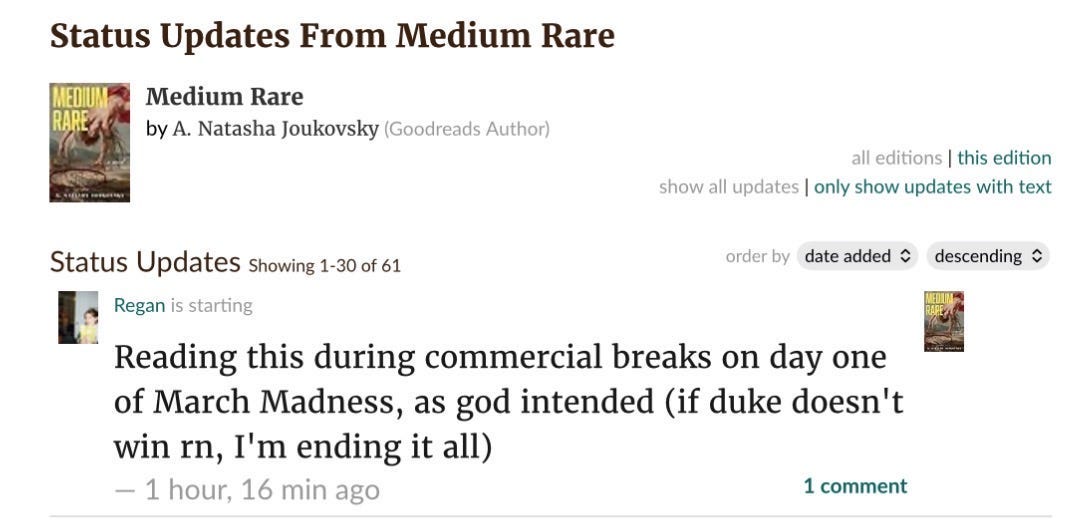
I stole this screenshot from Natasha’s Substack. Watch the New Yorker’s Oscar-nominated short, “Retirement Plan.” Domhnall Gleeson’s narration is a particular gut punch for those of us who are fans of “About Time” (which I believe I’ve recommended before — it’s my favorite movie).
I went to trivia on Tuesday with some friends, which is something that I’ve done a few times but is not a part of my routine. Even though I’m absolutely terrible at it, I enjoyed myself tremendously and would recommend incorporating it into your life.
McKay Coppins’s piece in The Atlantic today, “The Incredible Story of the Cartel Olympics,” is unbelievable.
Were Mexico’s cartel leaders really operating with such impunity that they could routinely force scores of kidnapped athletes into a “Squid Game”–style tournament for their own amusement?
I am vehemently anti-anti-sports on social grounds. Sports fandom has allowed me to reignite high school friendships 15 years after the fact. I've had a sports chat of 15 guys and growing for four years now, and like half the chat is in Spokane where I don't live. This is the healthy side of social media, the actual SOCIAL part. So yeah, March Madness rules, sports help bring people together, totally healthy thing. The High Point v Wisconsin game yesterday with the guy who shoots 3s hitting his first layup to win the game was pure cinema.
Unrelated, remember me talking about the acid test of a free society is being able to say "F U" to a public official? The Afroman case is EXACTLY what I was clumsily referring to. If the cops raid your house for no reason, you have the God given right to roast the hell out of them. This is what separates us from Iran or the UK or wherever.
Excellent article, Halina. College basketball is the particular subject right now, but this is also why sports in general are very good for society. They help us bond around a common subject that make for an easy icebreaker for those who are also interested. They create community bonds in having something for those near us to unite about. They also provide a constructive outlet for the tribalism that is innate in we humans, as we can express it over something that ultimately doesn't matter, compared to much more serious things in life that we should not be tribal about.
Trey Parker and Matt Stone had it right (with much particular approval from Ben, Halina, and myself) when they concluded an episode with the declaration of Go America, Go Broncos.