


Back when I was a teenage political junkie, overall interest in politics was low, and interest in politics among young people was especially low. This was considered a big problem in many quarters of the adult world, and those who worried about the lack of youth political engagement would sometimes ask young people like me what I thought about it.
I didn’t have any useful advice to dispense, which was probably for the best because the problem rapidly solved itself.
It was challenging to persuade my fellow college students to care about voting in the 2000 election, but many of them became interested in the disputed results and had the sense that George W. Bush and the Supreme Court were stealing the election. Then came 9/11, Iraq, and the financial crisis. On the flip side, a lot of young people were enthusiastic about Barack Obama.
But, of course, the premise of those famous “Hope” posters was that people were feeling a lot of despair in the mid-aughts, which wasn’t the vibe in the disengaged 1990s.
In retrospect, the low level of interest in politics when I was younger was clearly downstream of a benign situation. As a citizen of a democratic republic, you were certainly invited to care about things like the 1996 Telecommunications Act or the content of the 1997 budget deal or the wrangling around Social Security that ended up not amounting to anything.
But people who didn’t find this inherently compelling felt that it was largely permissible to tune it all out. Bill Clinton was undeniably charismatic in his heyday, but I don’t think he was an “exciting” politician in the modern sense. Maybe the best signpost of how different politics was back then was that in October of 1996, Clinton had a 54 percent job approval rating but only got 49 percent of the vote. In every recent election, the key swing vote has been “double-haters” — could Kamala Harris persuade people who thought Joe Biden did a bad job that Donald Trump was too terrifying to let back into the White House? The swing voter of the 1990s was complacent and content, someone who thought Clinton was fine but might vote for the other guy anyway.
This has all been kicking around my head for a few weeks, ever since Jon Favreau was kind enough to have me on the weekend interview segment of Pod Save America to talk about my case for a moderate 2028 nominee and what I think a viable center-left political agenda would look like.
Something he pressed me on quite a bit is that a lot of the politicians who seem like objectively strong electoral performers are too boring to be viable presidential prospects in the contemporary political climate.
I think this is probably correct, as an analysis of the situation. It’s really hard to imagine Andy Beshear securing the presidential nomination on a platform of managerial competence and Medicaid expansion. But without denying that today’s game requires a little razzle-dazzle, I want to say that this is bad. The point of representative government is to select leaders who will make reasonable policy choices and be effective stewards of citizens’ rights and interests. It’s not pro wrestling.
A primary problem, not a general-election one
In particular, I think it’s important to be clear that when we say that “boring” is a handicap for a politician, we’re really just talking about primaries.
Every time a weak electability candidate wins a primary over a stronger one, some annoying troll chimes in with, “If so-and-so was so electable, how come they didn’t win the election?”
That’s dumb.
Anyone who bothers to think about it for five seconds understands that primary electorates are different from the electorate in a general election. Banning abortion is a fine message in a Republican primary but a terrible one in the general election. Democratic Party primary voters are desperate for politicians who will “fight Trump,” but general-election swing voters worry that Democrats are too knee-jerk hostile to anything Trump says. Anyone who’s not stupid or dishonest can see that the issue landscape is very different.
But I think that because media figures spend so much time thinking about the media itself, they over-index on the practical upside of being a good interview or podcast guest.
In particular, while the ability to command attention always has some value in politics, it’s critical in a primary. Candidates in primaries are poorly distinguished from each other, especially in the eyes of normal voters who are not intensely focused on factional issues. Being somebody who is either already famous (like Biden in the 2020 primary field or Andrew Cuomo in the recent New York City mayoral primary) or else good at going viral is a real advantage. If you’re not like that, you have an uphill battle. David Crowley eventually beat Francesca Hong in the Wisconsin gubernatorial primary, but it took a lot of effort on the part of Governor Tony Evers to turn Crowley — a low-key county executive — into a well-known figure.
But while I don’t want to dismiss virality altogether in a general election, it doesn’t matter that much. The fact that Crowley needed so much help to stand out in his primary has essentially no implications for a general election in which both candidates will be widely covered by local media and run lots of ads.
Crowley is currently up in the polls, favored in Nate Silver’s model, and way ahead in the betting odds. Of course, I don’t know who’ll win in every race in November. But I do know there are lots of politically successful governors — Laura Kelly, Andy Beshear, Katie Hobbs, Josh Stein, and Evers himself on the Democratic side and Phil Scott and Kelly Ayotte on the Republican side — who are extremely low-key and even a bit dull. We also know that boring former Governor Roy Cooper is cruising to a Senate election win in North Carolina.
Because Cooper is not a master of attention politics in the way that Zohran Mamdani is, we’ve had about 100 times as many articles asking what lessons Democrats can learn from Mamdani as articles asking what they can learn from Cooper.
But beating Republicans in North Carolina is obviously more relevant to the broad question of how to stop MAGA than beating Andrew Cuomo in a primary in New York City!
We pay attention to Mamdani because Mamdani is better at commanding attention. With our rational brains on, though, the lesson we should learn from Cooper is that mastering the attention economy isn’t actually all that important. You could certainly imagine a world in which some young African American state legislator in North Carolina who endorsed Bernie in 2020 decides to challenge Cooper. I think, based on everything we know, someone like that would have had support from the national insurgent left and that an anti-AIPAC, Medicare for All message would have gotten a lot of traction in the primary.
Cooper might have ended up flailing and we’d all be asking, “Is he really as good of a politician as we thought? Isn’t this just another moderate with no juice and no understanding of vertical video?” But we know that a guy who doesn’t need to battle it out in a contested primary can in fact be a formidable Senate nominee without being an exciting, viral attention-master.
The peril of over-indexing
The reality, of course, is that presidential primaries are the most crowded primary elections of all, and whether I like it or not, skill at commanding attention really does matter here. Ultimately, political parties are largely defined by their presidential nominee, so the stakes are high, and in the real world you can’t just dismiss boringness as irrelevant.
But I do want to insist on the importance of adding the “and that’s bad” clause because the audience for high-end political information needs to understand that we all as citizens have some volition and control over what we choose to view as exciting. Tons of people say that they care deeply about beating Republicans and checking the power of the MAGA movement. And if that is genuinely the thing you most care about, then you ought to choose to get excited about the politicians who are demonstrably good at it.
When I first saw this Split Ticket table of which 2024 races were decided by candidate quality, I had no idea who Kristen McDonald Rivet was.
She’s not a vertical video superstar or an in-demand podcast guest or generally spoken of as the most fascinating person in the caucus. But because I’m interested in candidate quality, I got interested in a person who the numbers say is a stellar electoral performer.
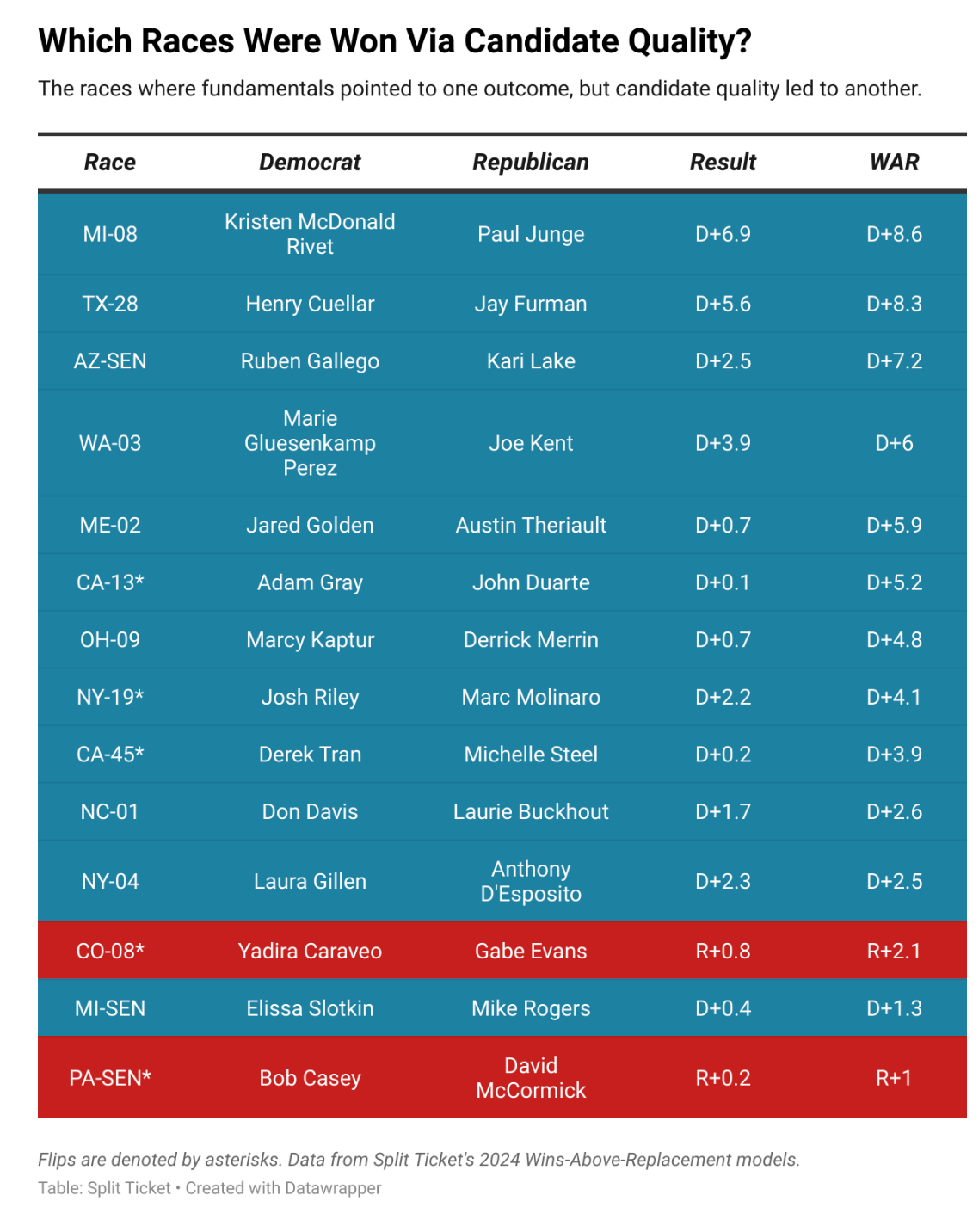
Having met and spoken with Representative McDonald Rivet twice now, heard her deliver a talk, and watched her on two panels, I’m not surprised that people who live in Brooklyn and socialize primarily with other people who live in Brooklyn find her to be less exciting than Mamdani. She seems more like the kind of person who might appeal primarily to the kind of fairly square people who live in Michigan’s Eighth Congressional District.1
I think all of us who work in the media should be at least a little bit self-reflective about the fact that not only is excitement in general not necessarily all that important to political success, but “exciting” can easily become a stand-in for the idea of appealing to our specific social peers.
But this is a big country. Most voters are over 50 years old, live in the suburbs of mid-sized metro areas, and don’t have college degrees.
Of course, an ideal politician speaks to the hearts of many different kinds of people. Obama was beloved by “wine track” upscale liberals but also by working-class African Americans, and he also spent an enormous amount of time pandering to the views of non-college white Midwesterners. But it’s important to remember that while it was the first two groups that powered his underdog 2008 primary win, it was the latter that secured his re-election in 2012.
Governing is kind of boring
Everyone is upset right now about prices, affordability, and the cost of living.
And it’s good for the democratic public to be mobilized on its own behalf. That being said, when you get down to it, the question of how policymakers can effectively address these concerns really hinges on a lot of tedious technical issues that most people are not inclined to study. By the same token, if you look at what held Obama back from being a truly great president, it amounts to the fact that the economic recovery was just too damn slow. And why was it too slow? Well, because congressional Democrats had an incorrect analysis of the macroeconomic situation and when the White House made its stimulus proposal, it did so based on an incorrect analysis of the legislative dynamics.
By the time Biden became president, Democrats were determined not to repeat those mistakes, and they overshot in the other direction.
I’m still not entirely sure what went down with Biden-era immigration policy, but it’s clear that on some level the administration made a mistake. They underrated the push and pull factors that created the surge of asylum claimants, were overly optimistic about it just going away, and reacted too slowly. Once they acted, their actions worked pretty well, but it was too little too late.
Conversely, George W. Bush presumably had a sincere belief that invading Iraq would work out well and reflect positively on him. Similarly, if Donald Trump had known how his decision to go to war with Iran would work out, he probably wouldn’t have gone through with it.
Presidents, unfortunately, sometimes judge the situation incorrectly even when they’re incentivized to get things right.
Of course, when bad analysis leads to bad calls that lead to bad outcomes, people get very interested. But the policy analysis itself is just sincerely not something that most people really want to do in a particularly serious or detailed way. Which is fine. It just goes to show that the parts of politics that people find exciting or interesting aren’t really the parts that are central to governing.
So when you put it together, how “exciting” you are isn’t important to winning general elections, and it also isn’t important to doing a good job once you’re in office. Given those two facts, if being boring is a crippling handicap in the nomination process (and I agree that it seems to be), that seems like a really damning indictment of the process. After all, while political junkies find the primary process entertaining, providing entertainment to political junkies is not the point of the process.
The point is to pick a nominee who can win the general election and govern well, so we shouldn’t be selecting on a criterion that’s not related to either of those things.
That’s Flint and its suburbs, plus the Saginaw-Midland-Bay City combined statistical area, which Wikipedia reliably tells me is “commonly known as the Tri-Cities,” but I suspect in practice is not commonly known as anything to anyone outside of Michigan.
My most "can't say that out loud" take in politics is that a high voter turnout is actually bad. It usually means one of two things:
1.) Politics/the government began to meddle in your life in such a way that you had no choice than to go vote in order to stop it (abortion bans, self-inflicted economic crises, stupid wars)
2.) Or the electorate got extremely fired up about some dumb shit, driving a lot of uninformed voters to the polls. (Culture wars, racism, Israel/Palestine)
As Matt says, if a lot of voters feel like they don't HAVE to go vote, that is often downstream of a benign societal situation. It should be the goal that people don't feel forced to care about politics!
I remember when I was a kid in the 90s and early 00's, pundits here in Germany would be hand-wringing about the low voter turnout in our state and federal elections (which was routinely in the 50s and low 60s). Now our voter turnout is 80 percent, and seeing how the AfD performs, most of those pundits probably regret curling that monkey's paw.
There's an obvious missing piece in this analysis even from a Yglesias perspective: being charismatic is important for coalition management. Obama could keep the groups under control because he had independent standing with them. Clinton could because he had beaten them.
Biden's immigration mistakes were tied to his weak hand at coalition management with the pro-immigration groups.
Picking a President has a further leadership dimension than a Senator or Representative. You can literally pick Darlene Graham and you will be fine in the former. Though I wouldn't recommend it.