

Video of F.B.I. Director Kash Patel partying in a Milan locker room set in motion two parallel sets of political stories.
On the one hand, there’s the legitimate question of why Patel was using taxpayer money to take what amounted to an Olympic vacation in Italy that concluded with him wearing a Team U.S.A. jersey, slamming beers, and singing along to country music while Matthew Tkachuk placed an Olympic gold medal around his neck.
The other is about liberal fans’ relationship to the team. Patel is in the room, but Donald Trump’s voice is on the phone inviting the champions to the State of the Union and cracking a joke about how he should probably invite the women’s team, too, lest he face impeachment. The room breaks into laughter and many progressive fans’ parasocial relationship with a team whose victory delighted them is broken by the realization that Patel is among genuine political friends.
The women’s team declined Trump’s days-late, begrudged invitation to the White House. Most members of the men’s team traveled by charter to Miami and military jet to Washington, while the women’s team headed home on a commercial flight that involved a connection through Atlanta. Just viewed in simple demographic terms, the split is fairly unsurprising. The men’s team is composed overwhelmingly of white men while the women’s team is made up of predominantly white women. Both groups belong to a generational cohort whose politics have split along gender lines like never before. But it’s also the nature of the Olympics to bring in new, very casual fans who’ve never thought much about the politics and culture of the world of professional men’s hockey. And this year’s game took place in the wake of “Heated Rivalry,” the queer men’s hockey show that has elevated interest in the sport among people who were not traditionally fans.
The game itself was thrilling — the Canada-U.S. rivalry is perhaps more heated than the show, and it had been nearly 50 years since the U.S. men’s team won gold. When the Olympics came around, people showed up ready to root, regardless of their prior interest.
Then the locker room footage dropped, and they discovered, rather quickly, that the N.H.L. is a real league with real people who have real political opinions — up to and including a disappointing-to-many inclination to go along with Trump’s misogynistic joke rather than stand up for the women’s team.
Athletes’ partisanship varies widely by league
Most professional athletes are not particularly vocal about political issues, though of course hints do break through based on perception surveys of fans, the occasional conspicuous White House visit, or stray players’ social media posts.
But last month, Peter Lutz, a political science student at George Washington University, set out to do something driven by data.
Using publicly available voter-registration data from 24 states and the District of Columbia, Lutz matched 1,506 professional athletes across the five major North American sports leagues to their voter records, producing what he describes as the first league-by-league examination of athlete partisanship in the United States. The results, published in January on VoteHub, show wild variation in party affiliation — differences that largely track each sport’s underlying demographic composition.
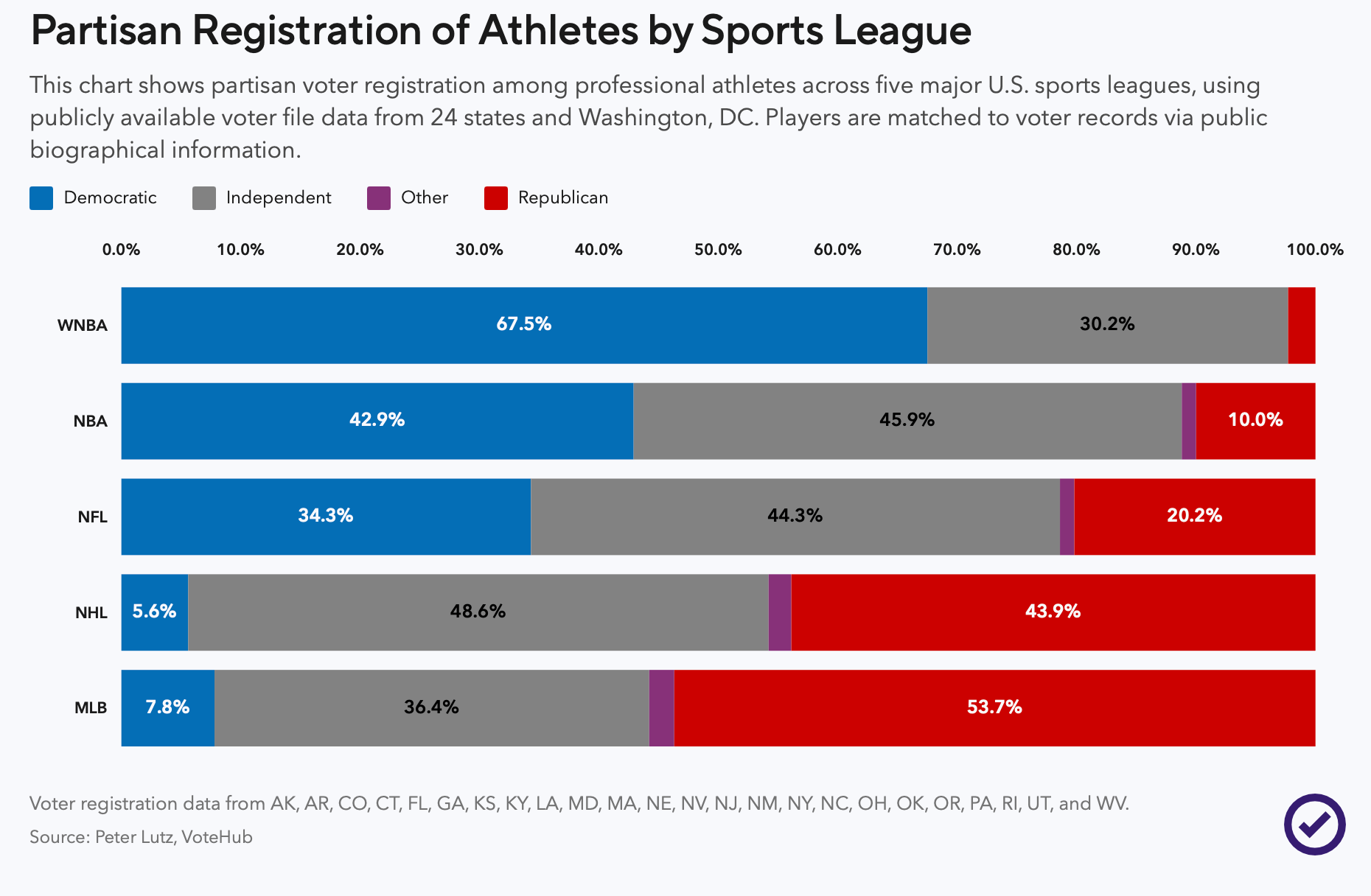
Of the 107 American N.H.L. players Lutz sampled, 47 are registered Republicans, six are registered Democrats, 50 are independents, and four belong to other parties. That is a ratio of roughly eight registered Republicans for every one registered Democrat among players who affiliate with one of the two major parties. The number of N.H.L. players who registered with a third party is nearly equal to the number registered as Democrats.
The only sport that’s more conservative is Major League Baseball.
Conversely, the Women’s National Basketball Association, with 29 Democrats out of the 43 players sampled, is even more lopsided in the other direction. The National Basketball Association lands at 42.9 percent Democratic and 10 percent Republican, a nearly 33-point margin that, while not as extreme as some others, is still substantial. Pro football, America’s most popular sport, is the swing league: 34.3 percent Democratic, 20.2 percent Republican, with the largest independent bloc of any league.
Some notes:
The 24-state sample excludes California and Texas, two states where voter-registration data is not broadly available to the public. The broad patterns almost certainly generalize but don’t take the specific numbers as gospel.
Non-citizens are not eligible to vote and thus not in the sample; fewer than one-third of N.H.L. players are Americans and baseball has a large minority of foreign-born players who are often from Latin America.
Broadly, though, the partisan breakdowns are not particularly mysterious once you account for the racial composition of each league.
Most professional basketball players are Black, and W.N.B.A. players are women. The N.H.L. is overwhelmingly white — the league does not publish official figures, but Lutz notes you could count the number of Black players on your fingers. While the M.L.B. has many Latino players, they are largely non-citizens.
The N.F.L., though, is more racially mixed. After being roughly three-quarters white in 1960, it is roughly three-quarters Black today, and every team employs large numbers of both African American and white players. That makes it less surprising that the league’s partisan profile is more mixed as well. It has also experienced more overt political conflict — think Colin Kaepernick and the ensuing “stick to sports” backlash — than the more demographically lopsided leagues.
League culture matters
Beyond individual players’ views, different sports leagues also develop different locker-room cultures. Most athletes, like most people, are not highly engaged with politics and take cues from those around them, recognizing established norms about which kinds of expression are rewarded and which kinds are penalized.
The N.H.L. locker room has particular norms. I’ve never been in one. But a former college classmate who played Division III hockey and follows the professional leagues closely describes a culture of social conservatism that spans everything from the suits players wear on game days to the country music they listen to in the locker room. When the N.H.L. wanted to recognize Pride Month to try and broaden its fan base, Pride jerseys became Pride tape due to player complaints (the tape was then an entire saga unto itself).
The N.B.A. locker room is essentially the reverse. Progressive political speech has at times received explicit institutional support — that is, until about 2021, when the N.B.A. removed overt references to racial justice from courts and jerseys. It is not uncommon today to see players advocating for progressive causes. This stems from the league’s largely Black workforce but extends to several prominent white current and former coaches. The league also saw the first openly gay active player in one of the four major men’s professional sports leagues in North America.
These environments are self-reinforcing. Players enter them and are shaped by them, and the culture they produce reflects and perpetuates itself. Progressive values tend to predominate in most corners of pop culture, but pro sports is not Hollywood and the whiter leagues have the political inclinations that follow from their demographics. When you root for an N.H.L. roster, you are rooting for a group of people who, to the extent that they have American partisan political allegiances at all, are overwhelmingly Republicans.
Progressives are of course still entitled to be disappointed that the men’s team didn’t do more to stand up for their women counterparts. But on another level, the surprise was simply not warranted: The sport’s political leanings are clear, and Trump is who he is. No one who has paid any attention to the women who have been fighting against sexism in sports since they were allowed to play them should be shocked by the presence of misogyny. And the same political sorting that has reorganized American neighborhoods, media habits, churches, and educational institutions has organized professional sports, too. The W.N.B.A. and the N.H.L. are not just different sports. They are, in a meaningful way, different political communities.
Weekend letter of recommendation:
The Professional Women’s Hockey League has four games this weekend. Watch one.
I just finished “There Is No Place for Us: Working and Homeless in America” by Brian Goldstone, and I thought it was excellent.
I’m told “Nirvanna the Band the Show the Movie” is good. I may see that this weekend. Or maybe I will see “Send Help.”
Maibritt just told me “All We Imagine as Light” is “amazing” and “a little bit artsy.” Maybe I’ll watch that instead.
A) Be fans, but like with celebrities and politicians, don't develop parasocial relationships with athletes.
B) As far as I can, Republicans widely celebrated Alysa Liu winning gold even though she probably does not like any of them. It shouldn't be that difficult for Democrats to do likewise for the men's hockey team.
I was hoping we could inject politics into the sports arena, as we shouldn't have any part of American society that is an escape. If only we can figure out a way to have partisan grocery stores (yes, I know Whole Foods exists, but still).