

After you read today’s post, I hope you’ll take a break from midterms coverage to listen to the latest episode of “The Argument” podcast, where Jerusalem and I discuss the new Elizabeth Holmes documentary, the difference between fact and fiction, and what makes a “true story” trustworthy. Paid subscribers can watch or listen ad free and read the transcript and show notes here. Free subscribers can catch the episode on YouTube here or listen wherever you get your podcasts.
Subscribe: Apple Podcasts | Spotify | YouTube | Overcast | Pocket Casts
I used to have a bit where I would tell people that the real secret to AIPAC’s power wasn’t their famous (or infamous) financial clout — it was that voters basically agreed with them on the issue.
Not that voters deep in their hearts agreed with every detail of U.S. policy toward Israel or truly felt that the United States should be sending aid money with no strings attached. But that in a big-picture sense, Americans had a clear view that Israel was “the good guys” in an entrenched conflict.
This meant that there was a simple playbook for taking out basically any member of Congress who drew the organization’s ire: AIPAC would put the word out that money was available to anyone who wanted to challenge said member, and politicians would leap at the opportunity because it was basically free money.
Sure, the person you’re challenging could complain that they were being targeted by the nefarious Israel Lobby. But most Americans didn’t actually think the Israel Lobby was nefarious, because they didn’t think Israel was nefarious.
The challenger wouldn’t even talk much about Israel during the campaign — very few people cared that much about it. They’d just use the money to run good ads on whatever subject their voters did really care about.
What we saw in the 2026 cycle was the degenerative version of this strategy, what happens when AIPAC tries to win purely on financial clout without having the sympathies of the public on their side.
And what happens is that it doesn’t work very well.
In 2026, a candidate really could say, “hey, I’m getting hit with tons of AIPAC money and that’s bad,” and large swaths of the electorate would agree that it was bad. Rather than wanting their financial clout to be known for the sake of the intimidation factor (like how the crypto people bragged about their spending in the 2024 cycle), AIPAC started disguising their spending because association with them was harmful to the candidates they supported. And it became relatively easy to countermobilize support and money based on being the candidate who stands up to AIPAC.
These dynamics were most present on the Democratic Party side this year and are driving the formerly bipartisan pro-Israel consensus to become sharply polarized.
Except it’s worse than that for AIPAC, since Donald Trump on Election Day just randomly announced that he wants to end aid to Israel and then Vice President JD Vance put out an election response essay on Twitter basically blaming the U.S.-Israel relationship for the G.O.P. wipeout.
It’s so over for AIPAC.
The V.P.’s aggressive election analysis
I honestly don’t think much more needs to be said about the Democratic side of this. AIPAC put everything they had into beating Abdul El-Sayed in Michigan, but “everything they had” was just money, and El-Sayed could also raise money. There just was not any amount of cash that was going to turn Mike Rogers into a winner in Michigan in the political climate of 2026. Beyond that, while you can find me any day of the week waging Twitter war on behalf of the claim that El-Sayed was an electoral underperformer, there’s no reason to think his much-litigated stances on Israel were a major source of underperformance.
We don’t have an example at hand of a politician saying “no aid to Israel” while also having moderate views on internal-combustion-engine cars or sex-segregated school sports teams. Haley Stevens was, in fact, quite left-wing on those issues, so we didn’t even get variation on those fronts in the primary.
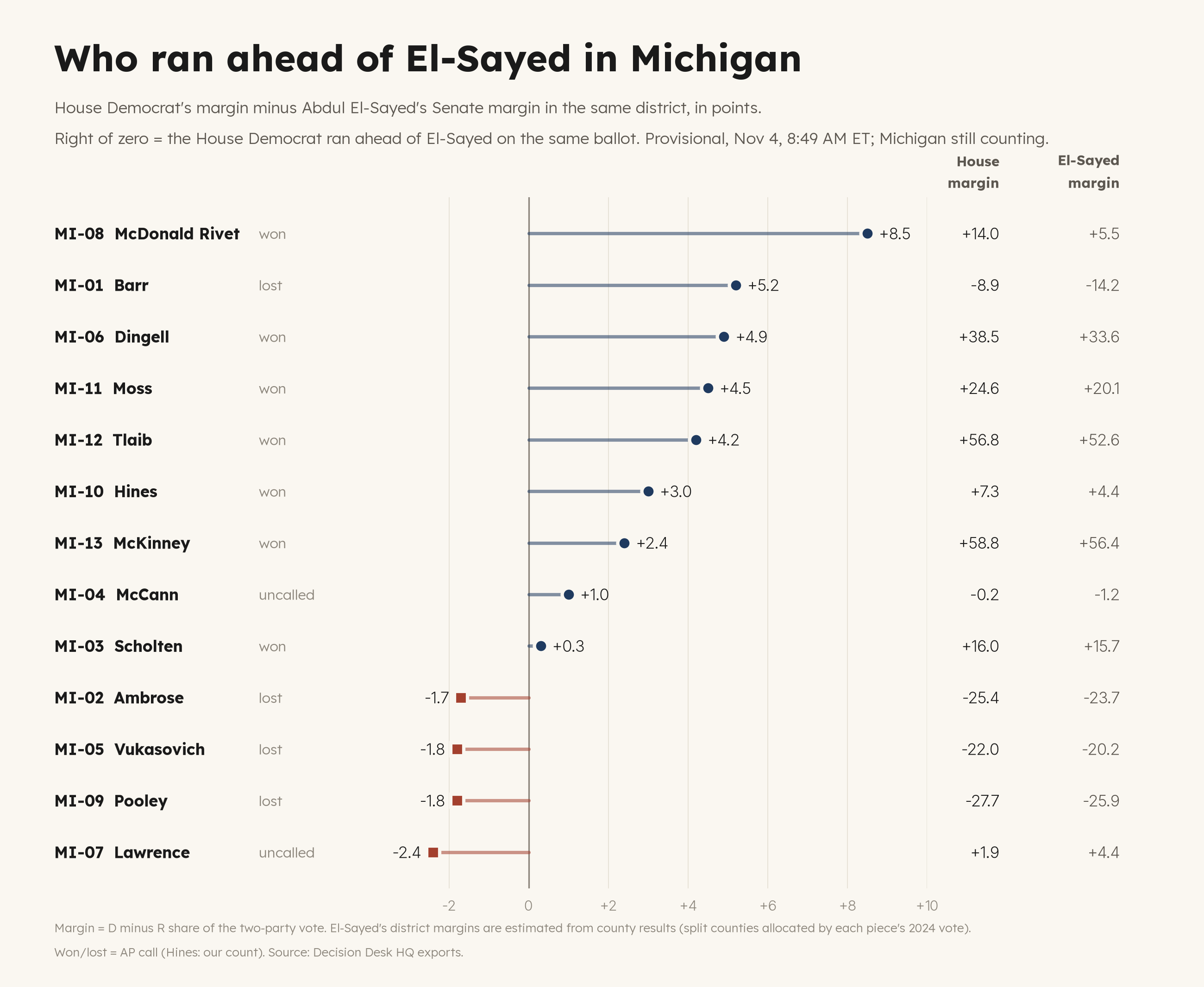
If you look at Michigan politicians, El-Sayed ran weaker than most of the Democratic House candidates, but one of the exceptions is Will Lawrence, a fellow leftist who is more associated with the Green New Deal than with being anti-Israel.
Instead, what I find really shocking is the shift on the right over the past week. Here’s what Vance said about the election:
But the real reason we lost is obvious to almost everyone.
Another pollster—one of the smartest people I know in politics, told me yesterday we’d lose the generic ballot by 13 points. I felt negative going into Tuesday, but even I was shocked by this. In his polling, he saw that a lot of Trump 2024 voters were angry and planning to vote for Democrats. He asked those voters who had abandoned us what would cause them to come back on our team. The top four answers, accounting for nearly all of the responses were:
1) End the war
2) Focus on cost of living/inflation
3) Put America First
4) Change our relationship to Israel
Our voters showed up. And the above four reasons are why many of them voted for Democrats. This is according to a pollster who nailed the results.
Between 2.5 and 3.5 of the four factors are just Israel.
And this puts pro-Israel Republicans in the pain cave because while Vance is massively over-blaming Israel (what about tariffs, corruption, health care cuts, immigration agents murdering two American citizens, or the bizarre decision to embrace A.I. accelerationism?), you can’t reasonably deny that the war was very politically costly for Republicans. The absolute worst time to be turned into a scapegoat is when you are, in fact, guilty. And make no mistake, that’s what’s happening here — one genuinely disastrous bit of decision-making is being made to carry all the weight for the Trump administration’s many, many errors of judgment.
But if Trump does pivot in this direction and Vance becomes his successor, where is pro-Israel support supposed to flow?
This cycle showed that AIPAC’s presence in Democratic primaries has become toxic, and pro-Israel institutions just spent the past three months whining that it’s not good enough to disagree with El-Sayed about Israel — you need to embrace wildly over-the-top criticisms of him and become a Republican to stay kosher in their eyes.
So what’s left here?
The perils of overreach
I think the extent to which AIPAC and other pro-Israel institutions basically brought this fiasco upon themselves is really striking.
If you go back to Barack Obama’s term in office, there was a solid bipartisan pro-Israel consensus. The thing that shattered that consensus was not anything Palestinian activists did; it was the nuclear deal with Iran.
Obama upheld all the main elements of traditional pro-Israel American foreign policy — aid, recognition, diplomatic support, arms sales — but also pursued diplomacy with Iran focused on America’s non-proliferation interests. Benjamin Netanyahu did not think this deal was good for Israel, which is certainly his right. But then pro-Israel groups went to war with Obama over this, massively resetting the bar for what constituted pro-Israel policy and rightly annoying lots of Democratic Party partisans and foreign policy hands.
Then Trump became president and tore up the deal in a way that created an unworkable situation for the Biden administration. Joe Biden very loyally stood by Israel after 10/7, making this the one issue on which he really meaningfully held firm against criticism from the left.
But what Biden wouldn’t do was get America into a war with Iran, so even as the Biden/Harris administration took on water from the left, they got little reward from pro-Israel groups, many of whom just basically preferred Trump.
Under Trump, they finally got the war they wanted.
And while Vance is wrong to solely attribute the Trump administration’s political problems to Iran, it is unquestionably true that the war supercharged anti-Israel sentiment in the United States by imposing massive costs not just on Palestinians but on everyday Americans — and for that matter, on literally billions of people around the world.
It’s of course wrong to cast this as all Israel’s fault. It’s Trump, not Netanyahu, who bears responsibility for Trump’s bad decision-making. Neither Obama nor Biden did this, and Trump could (and should) have simply told Netanyahu no. But while Trump is responsible for Trump being terrible at his job, it is factually true that this is the outcome Israel wanted and worked toward for years across multiple presidents, and voters are right to be angry about it.
I honestly have no idea what happens next. But I am quite worried that while American Jewish institutions were going all-in feuding with Democrats over foreign policy, they’ve been ignoring the rise of totally unambiguous Jew-hatred on the American right.


The specific ideological valence of Jewish American identity politics is different from other strands of ethnic-minority identity politics. And the factional alignment of pro-Israel institutions is different from the way most of “the groups” are positioned.
But in terms of overreach, backlash, counterproductive behavior, and a preference for expressive rather than instrumentally useful conduct, the structural pathologies are pretty similar. I hope the collapse of pro-Israel politics simply lands the U.S.-Israel relationship in a healthier position. But pushing so long and so hard for unreasonable levels of American support could lead to some really bad failure modes unless the leaders of and donors to these organizations are prepared to admit — fast — that they need to dramatically change course.
Before you go, we wanted to remind you that paid subscribers can watch or listen ad free to this week’s episode of “The Argument” or read the transcript and show notes here. Free subscribers can watch the episode on YouTube here or listen on your podcast app of choice.
At least AIPAC is explicitly a lobby organization, I find the behavior of supposedly civil right orgs like ADL more irresponsible. I’m not saying they should never call out Mamdani for some of the Israel stuff but there’s something unhinged about the level of scrutiny and reading supposed malice into his every tweet and action and loudly denouncing as insincere or insufficient any effort by him to assuage concerns. I’ve seen Jonathan Greenblatt call a New York Post story about DSA and Mamdani taxing the rich antisemitic because most of the CEOs it named were Jewish. I’ve seen him complain and imply antisemitism because Mamdani did not identify someone as explicitly Jewish while celebrating his work in an Eastern European celebration tweet. Mamdani mostly ignores it, and tries to engage with more reasonable critics but someone less disciplined, like El Sayed, worries me. If politicians start treating the ADL or mainstream Jewish groups as toxic, it’s not healthy for Jewish communal life.
Another crazy problem with AIPAC is that it’s quite obviously a lobbying effort on behalf of a foreign government, but isn’t required to register as so. If any other organization was registering for a foreign entity like that, they absolutely would not get away with it.