

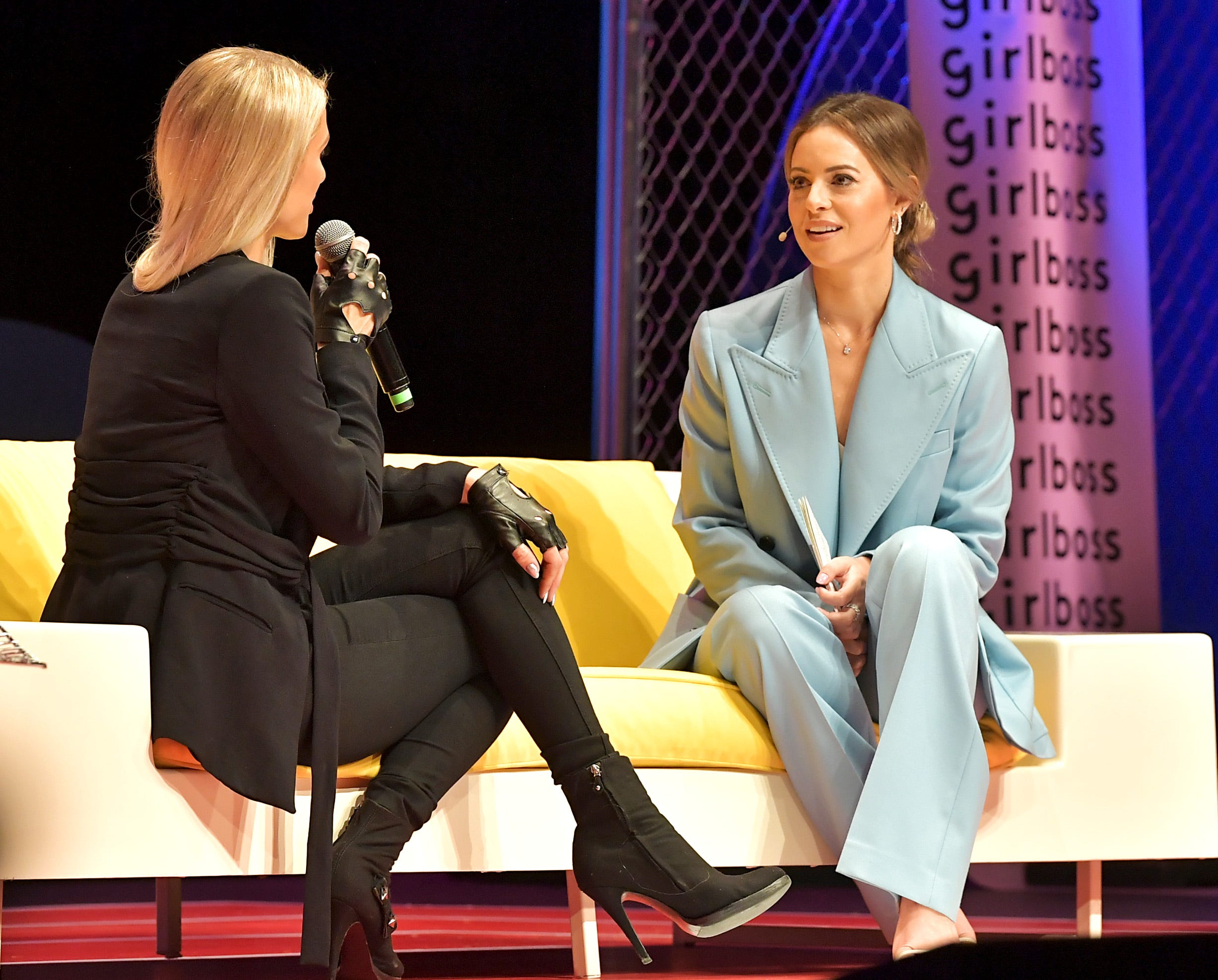
I have no particular desire to add to the Lindy West Discourse,1 but one thing I’ve noted watching it play out is that the #girlboss is catching a lot of strays.
West is a millennial and was a writer for (among other outlets) Jezebel, so she serves as a useful stand-in for a broad current of, as Helen Lewis put it, “Millennial Feminism.”
Sophia Amoruso, the founder of Nasty Gal and the author of the literal Girlboss book, is also a millennial. Sheryl Sandberg, arguably the quintessential girlboss, is not a millennial, but I think it’s fair to say that her 2012 book “Lean In” was primarily addressed to millennial soon-to-be mothers.
So while there are clearly strands that connect girlbosses, millennials, and feminism, the overlap isn’t perfect.
Jezebel itself was quite critical of Amoruso and her affiliated brands, and West is the kind of millennial feminist who launched her Substack by reminiscing about newspapers before saying “capitalism killed that ON PURPOSE and turned all of us into drowning gig-economy freelancers and it’s truly a nightmare for individuals and the collective and the flow of information itself.”
Which is just to say that millennial feminists disagreed with each other about capitalism, something that people have been disagreeing about for a long time.
When I was in college, I took a seminar taught by Ti-Grace Atkinson in which she (among other things) complained about Betty Friedan’s brand of feminism being an apologia for capitalism. These women were not millennials or even boomers but members of the obscure Silent Generation.
But while I enjoyed Atkinson’s class and of course think that a lot of clownish and dumb self-promotion and corporate marketing was done in the name of “girlboss feminism,” fundamentally, the girlbosses have the better of the argument.
I think it was, in fact, perfectly reasonable and correct for women to insist on fair treatment without becoming radical critics of capitalism, because capitalism is basically fine and good.
On both the politics and the substance, the cultural turn against girlbosses was a mistake.
Two great tastes that taste great together
Beyond the occasionally cringe self-promotion, the main issue at hand here is what in a formal setting would be called liberal feminism — a view that sees feminist commitments as extending and fulfilling a broader set of liberal commitments. It first arose as a critique of the classical liberal program for implicitly or explicitly leaving women out of its vision of human freedom and equality, but it extends to the use of the conceptual tools of liberalism to vindicate women’s rights.
Today, though, we have an anti-liberal horseshoe.
The right end of the horseshoe is Helen Andrews arguing that women’s professional empowerment threatens civilization. The left end of the horseshoe is Liza Featherstone writing in Jacobin about how “none of this takes away from the many feminist achievements of the USSR and its Eastern bloc allies, nor from the fact that capitalist society has also failed far more spectacularly to recognize and develop women’s full humanity.”
I’m not going to attempt a full-scale defense of the superiority of liberal democracy to the Soviet Bloc beyond a reminder that the point of the Berlin Wall was to keep East Germans in because men and women alike were inclined to flee to the west.
But by Obama’s second term, digital media was ensnared in a seemingly endless series of leftward spirals. No combination of opinions was more cringe in 2016 than the idea that electing a woman president would be a per se significant achievement and also that not-socialism was superior on the merits to anti-capitalism.
The reality, though, is that liberal feminism has always been the best kind of feminism because liberalism is broadly correct.
Liberalism needs feminism to make sense and be coherent. But feminism also needs a healthy dose of liberal individualism to be coherent. The (correct) point that critics keep making about West is that the style of everything bagel leftist feminism that defeated the girlboss feminism of the 2010s internet keeps collapsing under the weight of its own contradictions.
The big tent needs girlbosses
In a less abstract sense, the Democratic Party has historically functioned in part by incorporating the more culturally progressive segments of the business community.
In the middle of the twentieth century, successful Catholic and Jewish businesspeople were typically Democrats because Republicans were the party of the WASP establishment. As Catholics exited the coalition, African-Americans and women came to have more opportunities in the business world and took their places.
The presence of Business Democrats provided some ideological ballast to corporate America, but also to the Democratic Party, anchoring it in a progressive and inclusive vision of liberalism rather than in socialism or anti-capitalism. The idea that you could be a business executive who was pro-choice and wanted girls to learn to code and be a Democrat in good standing as long as you were on board with a modicum of progressive taxation and a welfare state was a linchpin of the political system.
Starting in the late-Obama era, there was a deliberate effort to push these Business Democrats out of the party. Jeff Hauser and the Revolving Door Project were particularly eager to block any possibility that Hillary Clinton would tap Sheryl Sandberg for a top role in her administration.
This logic carried forward into the Biden administration, which appeared to believe that taking a sufficiently antagonistic attitude toward business would win back working class voters who’d been alienated by the excesses of progressive energy and cultural politics.
In reality, radicalizing the business community against Democrats helped pave the way for Donald Trump’s comeback without offering any particular political upside. Meanwhile, part of Mark Zuckerberg’s pivot to the right was blaming Sandberg for Facebook’s earlier more progressive commitments.
If you’re not paying attention closely, you can see derision for the girlboss as a bipartisan cause.
But the practical endgame here is just the majority-male business class closing ranks with social conservatives to choke off any hint of progressivism. Unless you actually think there’s going to be a socialist revolution that overthrows the market economy, you need some kind of reconciliation between center-left politics and the private sector, and liberal feminist businesspeople are some of the most numerous and plausible bridges.
If you don’t know what I’m talking about, God bless. I will not even attempt to provide a summary. Maybe your favorite Large Language Model can help.
The girlboss vs. tradwife debate only has real stakes if you're coming from an illiberal premise. The obvious liberal answer is: women who want careers should pursue them, women who want to stay home should pursue that, and nobody should be hectored either way.
What makes this debate so tedious is that both sides treat a conditional strategy as a universal prescription. Tradwifery is a great strategy conditional on finding a good partner and genuinely preferring domestic life. Girlbossing is a great strategy conditional on having career opportunities you actually enjoy. These aren't competing visions of womanhood — they're different bets that make sense under different circumstances.
The choices are also neither fixed nor made in a vacuum. A 30-year-old frustrated with corporate life can change course. A former stay-at-home mom can reenter the workforce. The decisions are iterative. They're also shaped by class, era, and luck — it's a lot easier to girlboss your way to success if you have capital, credentials, and a functioning 21st-century labor market to operate in.
What Yglesias is gesturing at, and what I think is correct, is that the anti-girlboss turn from both the left and the right requires you to believe women are making systematically wrong choices — which means you have to believe women's choices are less reliable than your ideology. That's a much bigger claim than either side usually admits to making
Something that is often underrated in this discourse is that millennial husbands absolutely want an income earning wife -- or at least all the ones I know do. Who wants the pressure of being a single income household?
This is often framed as a woman's choice, and it is, but it's also a couple's choice. More and more couples are choosing to forego the additional flexibility of a SAHP in exchange for a higher living standard and income predictability.