

Happy Friday! The Slow Boring team is on the move today, so Halina’s Evening Edition tonight will be a short discussion post in place of her usual article. Evening Edition content and access to the comment section are just a few of the extra perks that come with being a paid subscriber.
This is the end of my summer in Maine; I’m looking forward to being back in D.C., though of course there’s much to miss about this state.
In professional terms, I have to say that I regret that Maine politics became a lot less newsworthy once Graham Platner was replaced on the ticket by Troy Jackson. I also think it would probably be worth everyone’s while to interrogate a little bit why exactly that is. Some of it, of course, is that Platner was making waves for bad reasons. But there was also tremendous genuine enthusiasm for Platner in some quarters that powered him through several bad news cycles. Everything that is noteworthy about Susan Collins as one of the greatest electoral performers of our time but a figure of tremendous annoyance to partisan Democrats is still there. Maine is still basically must-win for Democrats if they want to flip the Senate. Jackson is running on a very similar platform to Platner. If you’re a believer in the power of white working-class identity politics to win over non-college voters to the Democrats (I am not really), then Jackson is, if anything, a better avatar for this than Platner.
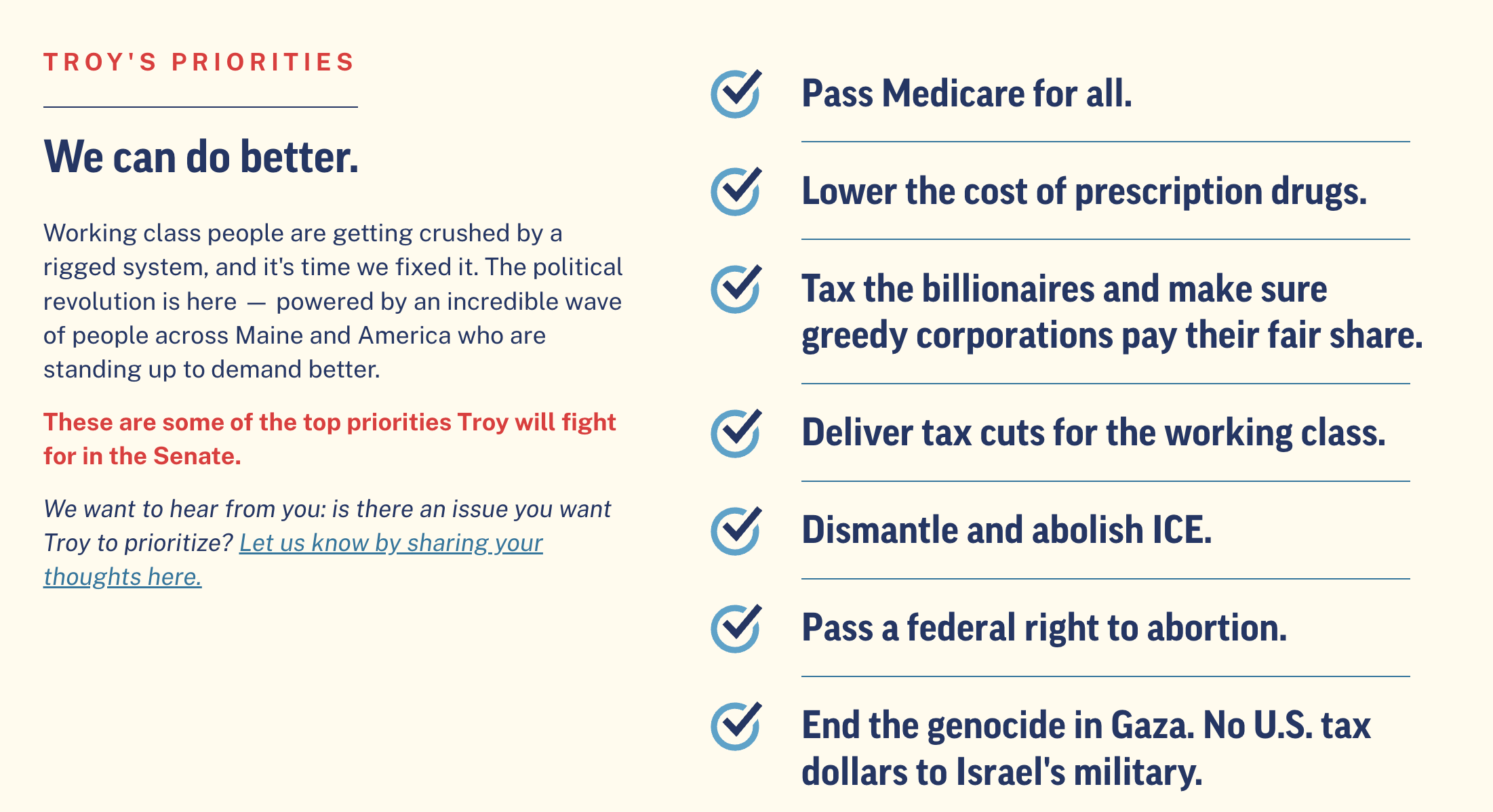
But nobody cares. Or, rather, I should say that the national media figures who got deeply invested in Platner don’t care. But their not caring does trickle down. There are markedly fewer Jackson for Senate signs than there were Platner signs. Local people on the ground in Maine enjoyed the idea of being part of something that national media figures thought was important. And Platner was raising lots of out-of-state grassroots money to power his operation here.
Jackson … nobody cares. I could speculate as to why, but I’d really be interested in hearing more from the non-Mainers who were really interested in Platner about why a different guy with a (non-fake this time) working-class background who’s fighting for Medicare for All isn’t interesting. He didn’t hire the right consultants? Is it just boring that he’s fighting with Collins rather than Chuck Schumer?
stieltjestransform: Data center discourse is heating up online. Proponents of moratoriums point to the 80-20 opposition in polling to new data center developments, they point to the broad unpopularity of AI, and they mention concerns with water usage and environmental effects (which I consider very fake), along with electricity usage causing strains and price spikes on local grids (less fake). Opponents talk about how they represent very cost-efficient ways to use land, about how opposition to them is just another kind of NIMBYism, and how building them in your county can massively raise revenues for localities through taxation.
What should a moderate Democratic politician do in this environment? Both in terms of messaging and actual legislative work.
So much time and energy is wasted on the incredibly dumb, incredibly uninteresting topic of debating whether or not politicians who move to the center by disavowing their party’s unpopular priorities do better in elections.
A much more interesting question is how you navigate tensions between what people say they want and what outcomes they would welcome. An obvious example is price controls. It’s clear that with the cost of living on everyone’s mind there is now pretty overwhelming polling support in favor of price controls. I think politicians should take this seriously. What they should not do is imagine that if they impose price controls on beef and then supermarkets start running out of beef, that voters are going to say “this is good, this is what I wanted, good job.” Voters are sometimes wrong about stuff and — worse — they’re just not very reflective or self-critical.
So while taking popular positions is important, you don’t want to commit yourself to things that will backfire or blow up in your face.
What makes the data center issue interesting is that it’s not quite like that. I think a lot of the current panic about data centers is factually wrong or grounded in bad analysis. But it’s not as if a state banning new data centers is going to lead to some disastrous outcome — you’re just literally keeping things the same. So I think it’s very hard for any elected official not to just listen to his constituents on this and find a way to press pause on new approvals. Substantively, though, I think the right thing to do is to try to make sure that it’s genuinely a pause — an opportunity for everyone to catch their breath, do a reset around tax abatements and utility rate structures, and find a way to get to yes.
Personally, I am writing this from a relatively upscale, scenic town in coastal Maine and it seems to me that I would welcome a new data center in this community. The town is on a peninsula and the homes are mostly either on the coast, right on the inland side of the main road, or else in one specific village cluster. There’s a big interior part of the peninsula that’s not as scenic as the coastal part and it’s largely empty. If you put a data center in there, nobody would notice. But with the extra tax revenue maybe you could pave Old County Road, which is currently dirt. Maybe you could fix up the badly weathered basketball courts at the town’s school. I would enjoy a property tax cut.
Obviously, though, if you totally botched the water and utility regulation sides of the puzzle, a project like that could end up having a negative impact on the town.
But this is just a general fact of life, isn’t it? Any substantial new investment could be a disaster if the water and utility regulation were bad. But the solution is to run your agencies properly, not to rule out new projects.
Again, though, you can’t take the politics out of politics. If people don’t trust that this stuff will be done properly and are demanding a pause, then they are going to get what they want — either from the current crop of elected officials or from new ones who beat them. So I don’t object to giving the people what they want here, but I still think the ultimate goal should probably be to try to figure out how to restore public confidence and get the spigots of investment flowing.
lindamc: I’m finishing up The Future and its Enemies by Virginia Postrel (also recommended for the Argument Book Club). It was written about 30 years ago but is extremely prescient on societal effects of rapid technological change. It’s framed as a critique of stasis vs dynamism, with “technocrats” generally falling into the former category, at least in part because predicting the future (and therefore making appropriate policy) is hard.
I think of our current unpleasantness as reactionary rather than stasist, but if we have the opportunity to move in the direction of technocratic governance again, do you have ideas about how to make the policymaking apparatus more flexible and dynamic?
I like to recommend this book precisely because it’s a little bit old and dated in a way that I think demonstrates the enduring value of the real insights. If you wrote a book today proposing that we consider politics on an axis of dynamism versus social stasis, people might say you were overreacting to contingent aspects of the present. The fact that Postrel saw this coming in 1998 when the general vibes of politics were extremely different indicates that she’s really onto something.
By dynamism, Postrel means a willingness to let decentralized experimentation and unpredictable change reshape society; stasis is the impulse to constrain that change in favor of a preferred, more predictable order.
The “technocrats” argument is an interesting subset of this.
One might think in terms of a contrast between rabble-rousing populists and pointy-headed technocrats, in which technocrats end up on the side of dynamism and progress. Postrel argues that this is a bit illusory. If I recall correctly, she names Al Gore as an example of a person who is very into technology but into it specifically in a central planning kind of way. I think you see a lot of this from the climate movement, where there is definitely enthusiasm about emerging technologies like cheap solar panels and better-and-better batteries but also a lot of certainty about the future. The whole movement is deeply invested in reasoning backward from a set of politically determined climate targets and likes to do things like draw up on a spreadsheet a big model of how to get all the energy we need from the kinds of sources they approve of.
This becomes a problem when, for example, leading A.I. companies end up making faster progress than most people expected while training A.I. models turns out to be fairly energy intensive. By inventing a new economically useful thing to do with electricity, the frontier labs have sort of scrambled all these plans and left the climate groups kind of glitching out in terms of what to say about it.
So I think this is a reasonably strong point on her part. There’s a difference between a kind of stylistic technophilia and a genuine embrace of dynamism.
In my core area of interest, this is the distinction between “New Urbanism” as it existed in the late 20th century and contemporary YIMBYism. The New Urbanists, correctly I think, appreciated the downsides of mandatory suburbanism as a central planning paradigm. But their alternative was just to centrally plan in a different direction. It’s true they’re planning in a way that suits my taste and my preference — if forced to live in a world guided by central planning of land use, I would prefer the central planners to be New Urbanists. But as an analysis of public policy, I don’t actually think this is the correct approach. The correct approach is to see that “old” urbanism involved planning mostly of street grids and sewers while leaving the actual construction of private homes and businesses up to market forces.
Where I think Postrel was maybe off the mark — or perhaps just excessively complacent — is that it turns out that having appropriate technical knowledge is actually pretty important. I don’t think Bill Clinton, George W. Bush, or Barack Obama did policymaking in just the way that trained mainstream economists would have wanted them to.
But I am fairly confident that all three men were consulting mainstream economic analysis and taking it seriously, even if for political or normative reasons they ended up rejecting it. The Trump and Biden administrations, by contrast, have tended to really sideline mainstream economics in a way that I think has bad consequences for inflation and interest rates.
In terms of the future outlook, I guess one way that my view differs from Postrel’s presentation is that I think the divide between dynamism and stasis often exists within the hearts of individuals rather than always cleaving them into separate camps. Trump is in some ways the most explicitly nostalgia-oriented politician I’ve ever seen. On the other hand, he’s a huge booster for A.I. On the third hand, this boosterism does not seem grounded in anything particularly coherent beyond a desire to see the stock market go up.
Suffice it to say, though, that I think appreciating both the promise and the peril of dynamism is what leads me to progressive or social liberalism rather than market liberalism. It is good to have a flexible economy and a dynamic society. But this causes real problems for lots of people and generates backlash. You want anti-backlash policies like “progressive taxation and the welfare state ensure that the rising tide will lift all boats” that preserve the underlying dynamism.
Brian: Arthur Brooks recently wrote about looksmaxxing, lamenting the phenomenon and explaining that it misunderstands the nature of women’s attraction to men, which, he claims, centers more around non-physical attributes—status, ambition, wealth—than physical attributes. I hear a lot of older men express similar views, and I can’t help but feel that it is terribly antiquated. Women are much more financially independent than they were forty years ago; the advents of social media and video streaming reduce their need for companionship; and dating apps allow them to be much more selective. Moreover, because dating is mediated by screens to a much greater extent than it was in the past, looks have never mattered more than they do today. Am I right that looksmaxxing is a completely rational response to the realities of the modern world, and that Gen-Z men who actually have to find a partner today are more aware of what is required to do so than Gen-X and Boomer men who found a partner many years ago?
It seems like “two things can be true” here:
Women, because of greater economic independence and shifting social norms, can afford to set a higher bar — including looks-wise — for what kind of men they are interested in dating or marrying than used to be the case.
However much you think women care about the physical attractiveness of a potential partner relative to other stuff, they (on average) care less than men do.
That seems like the kind of medium-temperature take that doesn’t make for very good content but is also true.
City of Trees: How often have you spent time in Rock Creek Park since you’ve lived in DC? And how do you think it compares to other great parks in the country and the world?
I’ve been there plenty of times over the years, but mostly to go to the zoo (which I love) or the tennis courts or drive on the parkway rather than visit the parky part of the park per se.
I don’t want to be a bad Washingtonian, but I guess my main take is that for a park in a city I prefer a more architected park like Central Park in N.Y.C. or Grant Park in Chicago or Golden Gate Park in San Francisco. Rock Creek, very much befitting its status as a National Park Service facility, is like a little nature preserve in the city rather than a landscaped urban park. The much smaller (but closer to my house) Meridian Hill Park is more my style.
Wigan: I’m a big fan of the podcast you do with Jerusalem Demsas. Have you considered reviewing books that are less explicitly about politics or policy? Would you do something like Albion’s Seed, or Narconomics: How to Run a Drug Cartel? Neither is primarily a policy book, but both have enough political and policy implications to fill an hour with fresh perspectives on your regular material.
Thank you! Glad you’ve been enjoying the show. I am definitely open to doing some books that are less explicitly political.
That said, while I enjoyed our conversation about Robert Putnam’s “Bowling Alone” very much, the episode mostly made me want to stick to the kinds of older books that we’d done previously. I felt like I was very anchored on what I remembered of the discourse about the book when it first came out, while Jerusalem was very focused on invocations of the book in today’s debates. What was most fun about “Silent Spring” and “The Feminine Mystique” was really immersing ourselves in the discourse of a completely different era. So I’m primarily interested in looking at books that are probably older than “Albion’s Seed” and came out before I was born.
Wigan: If a Democrat wins in 2028, should they abolish or reform ICE? Which is the stronger slogan in a Democratic primary versus a general election, and is there tension between the best politics and the best policy?
I think that this is a really annoying discourse that reflects an undue level of obsession with words and language in center-left politics. If you think about American immigration policy in 2029–32, then I think, by a large margin, the absolute least significant question on the table is whether or not there will continue to be an agency that is called “Immigration and Customs Enforcement.”
“Abolish ICE” has come to signify some kind of radicalism about immigration policy, but as a slogan it doesn’t actually say anything about what the radical change could be.
You can imagine a law that would disband the Homeland Security Investigations branch of ICE and assign that budget and responsibility to the F.B.I. while renaming the larger Enforcement and Removal Operations branch Federal Immigration Removal and Enforcement (FIRE). Then you’d have the same guys enforcing the same laws but using a cool new acronym. Congratulations, ICE is abolished! But to what end? At the same time, assuming this happened under a Democratic administration, there would be new leadership at FIRE and that leadership would have new orders. That new leadership and those new orders could make quite a lot of difference. But you could also make that exact same difference without abolishing (i.e., renaming) anything.
My basic takes on this are:
It is very unlikely that Democrats will kill the filibuster or have 60 Senate votes in 2029, so partisan immigration legislation is unlikely to pass.
If you are trying to persuade moderate Democrats to kill the filibuster, “we need to kill the filibuster so we can pass partisan immigration legislation” is not a very persuasive argument since there is going to be budget wrangling over ICE no matter what else happens. In those budget fights, Democrats will presumably argue that at the margin it’s better to spend money on health care than on immigration enforcement.
If there were to be partisan immigration legislation, its centerpiece would be giving legal status to the people Democrats want to give legal status to. It doesn’t make any sense logically or politically to pair that with reduced enforcement of immigration laws against the people you just decided not to give legal status to.
Since partisan immigration legislation is unlikely to pass, in practice a lot of weight is going to fall on executive branch discretion over how immigration enforcement resources are going to be applied.
I think it would really behoove everyone in the anti-Trump coalition to spend less time contemplating slogans about hypothetical immigration legislation that is unlikely to materialize and more time thinking about (4). There are dozens of different moving pieces around Temporary Protected Status, humanitarian parole, asylum, ICE deployments, guidelines for prosecutors and field officers and so forth. I think we learned during the Biden administration that you cannot simply outsource all this to the immigration groups or they will push for outcomes that Democrats themselves do not favor and are not prepared to publicly defend.
So what is the actual plan to roll back some of what Trump has done with executive discretion without sending a signal to the world that a flood of new asylum claimants would be welcome? This is a hard problem that the Biden administration specifically failed to solve and that requires some real thought both about specific policies and about who gets empowered to do implementation. I have some thoughts about this but also genuine curiosity. The key thing, though, is to acknowledge that this is a genuine policy question, not a question about what you say. Joe Biden ran and won on a totally solid immigration message, but what actually happened when he was in office made everyone mad and now Democrats have a credibility problem.
ON Data Centers: Did I hear, "Tax Abatments?" I guess there is an issue of how to value a data center for property tax purposes and that migh need to be sorted out in the local approval process, but it woud seem unnecessaril self defeeting for a propective center to seek an especialy favorable treatment. And more if the agreemens are not transparent.
Surely the project sponsers and their consultants have acquired expertise in how to avoid bad regulation that will just make the outcome a disaster.
Re what to do on immigration: process stuff faster! There is currently a 24 month backlog for spousal green card processing, getting slower at >1month/month. Despite being a bigger deal for legal immigrants than any fantasy about abolishing ICE, this (very effective) destruction of the system has attracted zero attention from Ds