

A couple of weekends ago, I went with friends to the Power to the People music festival in suburban Maryland. I was there primarily to see bands play, but part of the goal of the show was to raise money for a range of political causes, and I also got to hear brief political pitches from various artists.
The Dropkick Murphys shouted out organized labor in the building trades and brought the president of the painters’ union out on stage. I briefly got my hopes up that he would give people a pitch for taking the labor side of the labor-versus-green feud on data centers and permitting reform, but no such luck.
The show was fantastic. In addition to the Dropkick Murphys, it featured the Foo Fighters and Public Enemy along with legends like Joan Baez and Bruce Springsteen but also a surprisingly compelling performance by Jenny from “Gossip Girl,” who sang Soundgarden songs while Tom Morello played guitar.
At the climax, everyone came up on stage and the Boss led this whole crowd of musicians in a rousing rendition of Woody Guthrie’s classic leftist folk song “This Land Is Your Land.” Morello made a big deal about how they were going to sing the full version of the song, including the verses suppressed in many schools for their unduly leftist lyrics. (I was raised by weird leftists and taught this song at a very left-wing Ethical Culture day camp, so I had no idea there was any other version!)
Morello, at any rate, interrupted the song at one point to argue that Guthrie knew “that every inch of this land was stolen from the Indigenous people, so this land is actually their land.”
I don’t think this is factually correct about Guthrie’s politics. He and this song have long been a target of Native activists and intellectuals precisely because the rhetorical power of the song comes from denying the stolen land accusation. The point is that the American people (“you and me”) have a collective claim on American prosperity.
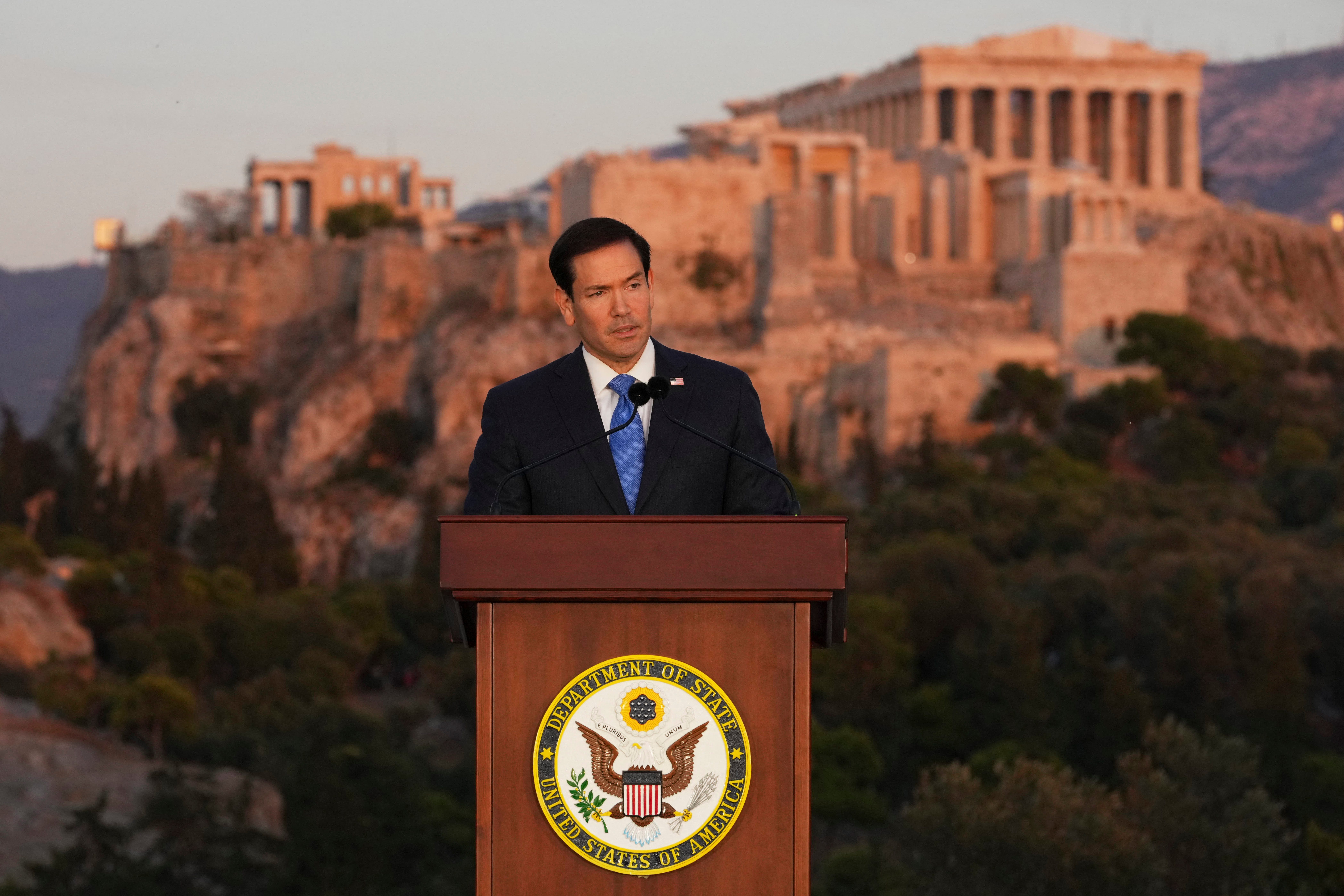
I was going to let this all go (it’s only a concert), but then I saw Marco Rubio fly to a foreign country and stage himself in front of the Acropolis specifically in order to lay claim to a transnational concept of “the West” but then proclaim himself strongly in favor of nationalism.


It’s a reminder that while Donald Trump and Rubio have substantively fumbled when it comes to defending the West and Western values or upholding American traditions, they do deserve credit for understanding the importance of symbolism to political life.
Especially in a country like ours that, contrary to the blood and soil trends in the MAGA movement, really is a credal nation, these choices of symbol matter. Guthrie’s song articulates a powerful message that is genuinely at odds with the political culture of land acknowledgments. And it’s worth defending America and the West and critical Western ideas from people like Trump, who are in fact tearing them down for a quick buck. But you have to be tough-minded about it and sing the songs correctly.
Progressive politics requires solidarity
Guthrie’s song, especially in its most controversially leftist verses, expresses outrage about the persistence of poverty in a land of plenty and skepticism about private property. This is meant to trouble us because if “this land was made for you and me,” then the idea is that “from California to the New York island” we all have a collective claim on American wealth.
This is just not compatible with the notion that the American national community is illegitimate.
Now what’s true is that Guthrie and other midcentury leftists, to their eternal credit, pushed for a more inclusive vision of the American national community.
The modern progressive coalition was forged by Black leaders like Martin Luther King demanding that Black Americans be accepted as fully equal members of the national community and by white liberals working with them to make it happen.
That’s why there’s a lot of patriotism associated with the high water mark of the civil rights movement — there were deliberate efforts to claim the Declaration of Independence and the iconography of Abraham Lincoln and the text of the Constitution as key validators. This same impulse toward racial equality also naturally and rightly leads progressives to care about what Native Americans think and to want to treat them better. And certainly on Guthrie’s terms, there’s plenty here to complain about. Native Americans have much lower household incomes and life expectancies than the American average, with worse educational and labor market opportunities. This is a failure of our national community, and it’s a failure worth trying to rectify.
But improving the conditions facing Native people is a hard problem that involves making tradeoffs and spending money. It’s a lot easier to throw a land acknowledgment into your program than to actually do something.
And I think it’s more toxic than generally realized to make symbolic concessions that undermine the legitimacy of the national community. One of the many questions facing Americans as we look at the rise of artificial intelligence is who should benefit from this boom. Should the rewards all go to the founders and shareholders of a handful of companies who’ll live out their remaining days among great wealth while consigning humanity to serving as a mere “biological bootloader” for their creations? Or should all the inhabitants of this land benefit from the upside and have a say in averting human extinction?


The idea that we have obligations to each other — some of which are grounded in the general moral dignity of human life but some that are grounded in mutual membership in a legitimate political community — is at the core of progressive politics.
You can’t make sense of Social Security or Medicare or Medicaid or any of the other cornerstones of the progressive agenda without the idea that Americans owe something to each other simply because they’re all Americans.
The question of what exactly we do owe to Native Americans in light of their specific historical relationship to the political community is deep and hard. But while certainly the land was appropriated from people who were already living there, so was all the other land on Earth — including the lands appropriated by Native American groups from the different nations that were living there before they arrived.
What we can do, though, is remind ourselves that our country — unusually among the countries of the world — is founded on egalitarian ideas and imbued with concepts of universal human rights and that while we should take pride in that, it also imposes on us certain obligations.
MAGA against the West
Which brings us around to Rubio.
When I was in college, Samuel Huntington’s “The Clash of Civilizations” was a hot topic of discussion. He posited that with the Cold War over, the future of geopolitics would be “civilizational” conflict, in particular around the margins of the Muslim world and with the United States anchoring a Western civilization that needed to acknowledge that our ideas about things like democracy were not necessarily universal. Given how central Classical Greece is in the concept of “the West,” I always thought it was a little funny that Huntington defined modern Greece as outside the scope of Western civilization.
That’s because he (correctly) saw that relations between Russia and the West would not go well, which he interpreted as reflecting a civilizational divide between Orthodox Christianity and a Catholic/Protestant West. Consistency then required him to define Greece as non-Western. He also posited that Ukraine was part of the Russian-led Orthodox bloc. Huntington got the object-level question about Russia right, but he misdiagnosed the problem.
He also insisted that while Spain was part of the West, Spanish-speaking Catholics from Latin America were not and therefore Hispanic immigration posed a profound challenge to American identity. Rubio, like me, is a descendant of pre-Castro economic emigrants from Cuba who moved to the United States at a time when the borders between our country and the rest of the Western Hemisphere were nearly open.
I find Huntington’s effort to define a narrow West not only silly at times — Spain clearly has more in common culturally with Chile than with Latvia — but a fundamental misapprehension of what’s valuable about the Western tradition.
It has positive universalistic aspects such that a country like Ukraine can want to get in on them. Vladimir Putin has a very specific nationalist vision that makes it impossible for him to conceive of an independent Ukraine or of a Russia that would itself seek integration into the Western world. But if you know Russian intellectual history, you know that this debate between Westernizers and Slavophiles has been going on forever. And while Rubio is happy to fly to Athens and talk about American greatness and the importance of Western values, it’s clear that this administration is relentlessly hostile to helping the frontlines of the signature war for the defense of the West.
The official doctrine of the MAGA right is that this is because the real threat to Europe is from immigrants rather than from Russia.
There are serious problems with immigration in Europe. But as someone who cares about Western values, the biggest thing I worry about is that European liberals’ blundering on this issue is going to pass power over to parties like Alternative for Germany that are also hostile to European re-armament, to the defense of Ukraine, and to the fundamentals of democracy.
If Europeans want to elect immigration restrictionist parties like Giorgia Meloni’s Brothers of Italy, so be it. And I think it’s smart that Danish Social Democrats have moved to the center on this. But fundamentally, I don’t actually live in Europe. These are democratic countries, and they’re entitled to vote for whoever they want to.
As an American, I care primarily about the foreign policy choices of foreign democracies, and I want Europeans to elect pro-Ukraine Atlanticist parties that will try to cooperate with the United States on important issues. The idea of the American government deliberately promoting pro-Russian parties because it agrees with them about immigration is insane.
And yet, here we are.
A tradition worth defending
The other thing that I’ve had my eye on lately is that President Trump directed the federal government to start using taxpayer money to run election season ads boosting him. This became controversial — because it’s outrageous and obviously illegal — so he said he would reimburse the government for the costs. Then he flipped around and said he wouldn’t after all. Then a new tranche of ads started running. The latest thing I read is that he’s now again saying he will pay for the ads after all.
Is this the single worst thing anyone has ever done? No. Is it the worst thing Trump has done? Also no. Is it the worst thing that’s happened this fall? Almost certainly not.
But it’s so egregious in such obvious ways — don’t take my word for it, read Noah Rothman at National Review — that it’s just really hard to stomach being preached at about Pericles and the sacred nature of our traditions by a member of this administration.
The contemporary United States really is the heir to a long political tradition that predates current ideas about racial equality or democracy and that traces back before our Constitution to the English Civil War and ideas about the rule of law and the misappropriation of public funds. And Trump just clearly does not give a shit about any of it. The interest in American patriotism and the idea of the West does not extend beyond lending an air of grandiosity to the petty cruelty of deporting harmless Cubans to the Central African Republic.
There is zero real appreciation for any of our best traditions or ideas or what they mean; they’re just perpetrating a smash-and-grab operation on the country’s wealth.
I am mad as hell.
Yet to return to Power to the People, I don’t think you can defend American democracy or the rule of law or the basic humane interest in not seeing Medicaid and SNAP slashed while the administration cuts taxes for the rich and loots the Treasury for propaganda ads if you also accept the premise that the whole country is an illegitimate enterprise founded on theft.
It doesn’t make sense logically. It doesn’t work politically. It on some level fuels a kind of cynicism that just enables Trump and his gang of crooks.
We seem to be torn between a group of people who want to tear down the substance of all of our ideals and a group who want to tear down the notion that these ideals are worth having.
The latter camp is, I think, in practice quite small. At the end of the day, the festival ended with singing the song, even though Tom Morello gently threw it under the bus. But I think it’s actually worth everyone’s time to exert a little more tough-mindedness and to go with the rhetoric and ideas that make sense and can really win. MAGA is not going to save this country by tearing down everything that’s valuable in its traditions, and the resistance is not going to save it without displaying some real affection for it, either.

If voters are forced to choose between a chauvinist political movement that grants the premise that America is a legitimate nation while be horrendously corrupt and a political movement that regardless of how nice it says it wants to be to people does not believe America is a legitimate nation, voters will tend to choose the chauvinists over time.
There is a bitter self-loathing streak in modern left-wing politics that needs to be eradicated. The environmental movement is shockingly misanthropic. Advocates of racial justice refuse to acknowledge progress and insist on a trend of social deterioration that doesn't exist. You can find similar trends in all manner of advocate groups. Asking them to wave the flag makes them wince. They'll do it out of perceived necessity, such as at the 2024 Democratic Convention, but I think most could tell their hearts weren't in it and it came of in retrospect as cynical. And it always will until the left can rediscover a genuine patriotism and pride in western values again.
It's interesting how both left and right have discovered their own Fukuyama-style Last Men. Both are struggling against prosperity and stability itself, with the left yearning for an external force to render judgement on our wickedness, and the right yearning to destroy the west to save a perverse version of it. It's bleak man
This can't be a novel theory, but did Samuel Huntington start getting into the computer game Civilisation around the time he came up with 'Clash of Civilisations'?