

In 2024, Donald Trump beat Kamala Harris 56.03 to 42.37 in Texas. Democrats in the state are currently engaged in a contested Senate primary between James Talarico and Jasmine Crockett — a race that until recently also featured Colin Allred, until he was squeezed out by Crockett’s entry.
In Florida, meanwhile, Trump beat Harris 55.87 to 42.82, a large margin that underscores the challenges any Democrat would face in a statewide contest there.
But the Florida margin is clearly smaller than the Texas margin, so on its face Florida should be a more promising pickup opportunity. And yet in the Florida Senate race, Democrats thus far have absolutely nothing. Not only has no one entered the race, the party has no real prospects. Top people keep assuring me that they’re close to sealing the deal with strong candidates in Alaska and Kansas, but even real optimists don’t claim to have anyone lined up to run in Florida.
This is a big mistake.
I don’t want to peddle some kind of unreasonable level of Sunshine State optimism since, yes, obviously the Republicans will probably win this race.
But the same is true of Alaska and Kansas and Texas and Iowa and Ohio, all of which are uphill, underdog races. And there’s evidence from special elections that suggests the national environment could be evolving in a direction that puts these states, including Florida, within reach.
A Senate majority could be within Democrats’ reach

I wasn’t paying much attention to last week’s special election in Tennessee until the votes came in and a little factional squabbling started about whether that race would have been winnable had Democrats not nominated such a progressive candidate.
That’s highly speculative, of course. If you look at the current polling, it does show that Trump is unpopular, and Republicans are down in the national generic ballot. But their generic ballot performance is stronger than Trump’s approval rating, and while the current generic ballot numbers project a House majority, they don’t project Senate wins for Democrats anywhere other than North Carolina and Maine.
So Florida is tough, and I’m not trying to kid anyone about that. I’m just saying that Florida is not appreciably tougher than any of the other states that Democrats need to compete in.
And in certain key respects, I think Florida is unusually promising compared to those other states.
Florida special elections hit different
One piece of evidence for this comes, again, from special elections this year.
The country has held 65 special elections in 2025, and Democrats have, on average, run 13.7 percentage points ahead of Kamala Harris. That does not mean that Democrats are going to do that well in the midterms; these results largely reflect turnout dynamics. But Democrats’ success in these races still tells us something about the political climate.
And in the nine of those special elections that have been in Florida (not a huge sample but not a tiny one either), Democrats have run 17 percentage points ahead of Harris on average.
Weird things happen in special elections, so I wouldn’t put too much weight on this. But the city of Miami also held a mayoral election a couple of weeks ago, and the Democratic nominee won with 60 percent of the vote.
Normally you wouldn’t think Democrats winning a big city mayor’s race would be a big deal for national partisan politics, but Miami is different and actually hasn’t had a Democratic mayor in almost 30 years. And this was not a low-profile race. Donald Trump and Ron DeSantis both weighed in on behalf of the Republican candidate. The Democratic nominee, Eileen Higgins, tried to downplay partisanship but Ruben Gallego and other out-of-state Hispanic Democrats came in at the end to help her rally Latino support (Higgins is a white lady whose local nickname is La Gringa).
So I think there is at least some basis for believing that Florida is experiencing an above-average anti-Trump swing relative to 2024.
Why might that be?
To an extent, we’re again in the realm of speculation. But it sure seemed like Floridians did not care for the non-pharmaceutical interventions (N.P.I.s) designed to mitigate the Covid-19 pandemic. Florida’s economy is strongly tourism-oriented, and DeSantis really pushed hard on anti-N.P.I. politics, even while Trump was president. This seems to have worked well for him and hurt Democrats’ brand in the state. But the Covid issue is obviously no longer salient to most people, so you’d expect any Covid-related swings to fade.
Another factor is that, looking at Bureau of Economic Analysis data, Florida stands out as having an unusually high cost of living for a red state.
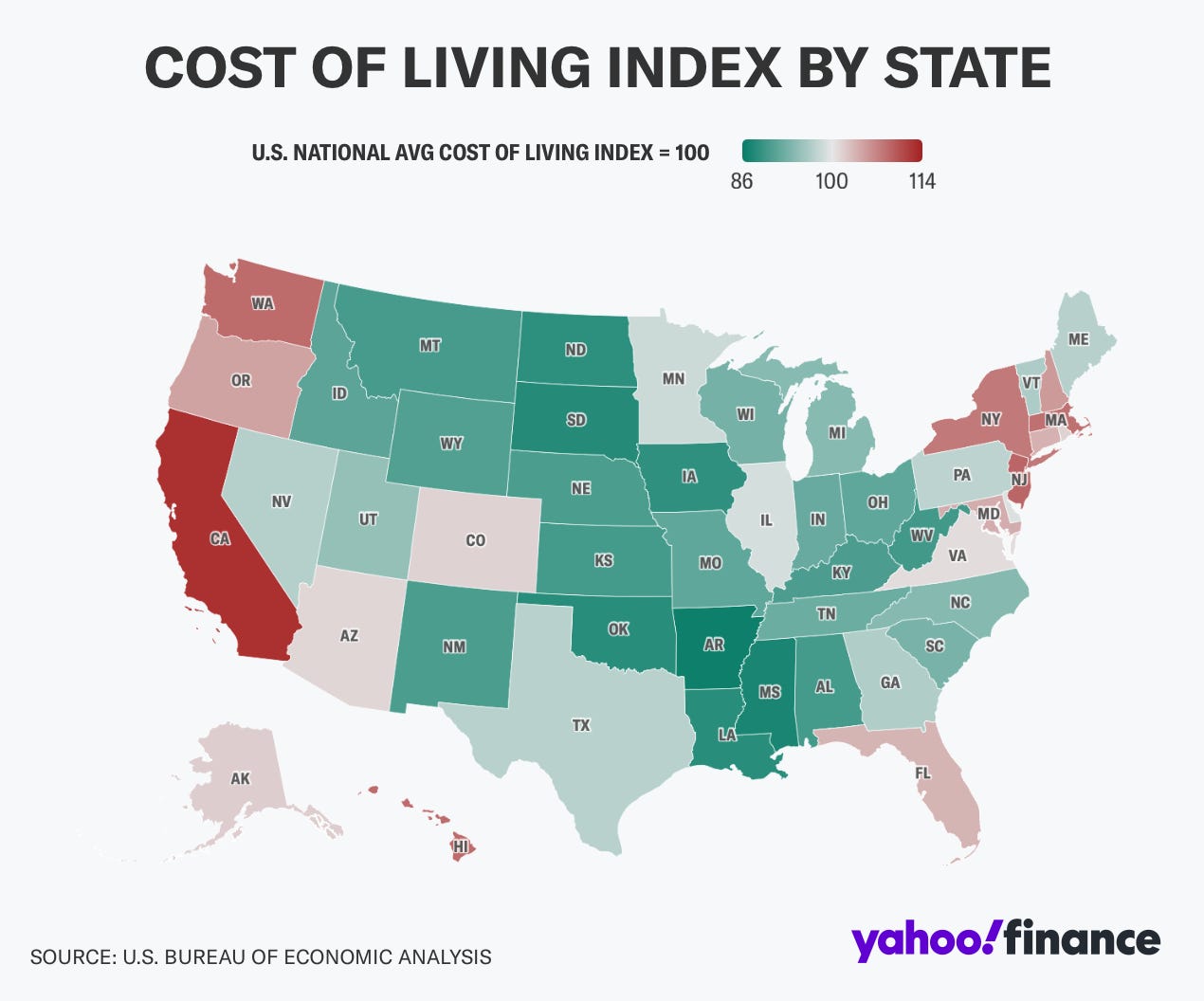
Everyone knows that Democrats have been making political hay out of the affordability issue. But I suspect that to many voters, an enduring source of G.O.P. advantage on this topic is the perception that blue states are expensive places to live. Florida has a more blue state geography, though, and is suffering from major homeowner-insurance cost increases related to natural disasters.
Beyond that, Florida has a large Hispanic population and, as far as we can tell, the voters who’ve swung against Trump are disproportionately Hispanic.
The backlash we expected
If you go back to 2012, Barack Obama won Florida — but he won it by less than his national margin of victory. And if you had told Republicans at the time that their path forward was to go really hard on restricting immigration, a lot of people would have said, “But won’t there be a huge backlash with Hispanic voters that turns Florida into a reliably blue state?”
Trump, of course, then won Florida in 2016, and he did better with Latinos in 2020, and then made even further Hispanic gains in 2024.
After that, a lot of people decided that perhaps Hispanic voters don’t care as much about immigration as we thought.
But here’s the thing.
Hispanic voters are, by definition, citizens. So maybe they don’t care about being nice to illegal immigrants as much as progressives would like them to, and there’s never been any reason to think they would welcome chaos at the border. The traditional view, though, was that getting tough on immigration didn’t mean getting tough at the border — it meant getting tough on interior enforcement. And it’s hard to do tough interior enforcement without lapsing into racial profiling that’s bad for Hispanic citizens.
Importantly, even though liberals expressed a lot of moralistic outrage at Trump’s first-term immigration policies, he didn’t really do a draconian interior-enforcement surge. Almost all of those big Trump One fights were about the border.
In 2024, Trump explicitly campaigned on mass deportation and a huge increase in interior enforcement. But you know what? He campaigned on that in 2016, too, and it didn’t happen. I don’t think it’s totally crazy that some people listened to Democrats’ warnings about mass deportation and thought, “Those guys are trying to scare us over nothing to cover for their own failures on inflation and border security and for hiding Biden’s diminished capacities — it’ll be fine.”
But it hasn’t been fine. The Supreme Court has formally authorized immigration-enforcement agents to randomly stop and detain working-class Hispanic people with no probable cause.
There was a story on December 10 about a Somali-American citizen who was detained because Department of Homeland Security personnel refused to check his Real ID to verify his legal status. Instead, they handcuffed him and brought him to an ICE facility, where he was fingerprinted and run through their system before being released. When people complained about this, Border Patrol chief Gregory Bovino tweeted in response that “One must carry immigration documents as per the I.N.A. A Real ID is not an immigration document.”
It’s true that the Immigration and Nationality Act says that lawfully present aliens must carry their immigration documents. But citizens don’t carry immigration documents — they’re citizens!
Misunderstandings or cases of mistaken identity can happen, but this was a case of treating someone like a criminal for no reason other than his ethnicity.
There’s been a particular emphasis recently on persecuting Somalis, but obviously the bulk of the illegal immigrant population in the United States is Hispanic. And this approach to enforcement is a clear and present danger to all kinds of Hispanic people — especially those who are in the habit of speaking Spanish socially, have darker skin, and/or work in fields like construction or restaurants that employ a lot of illegal labor.
Lakshya Jain’s generic ballot polling suggests that Democrats are currently running slightly ahead of Kamala Harris with white voters and quite a bit stronger with Hispanics, offset by running quite a bit weaker with African-Americans.
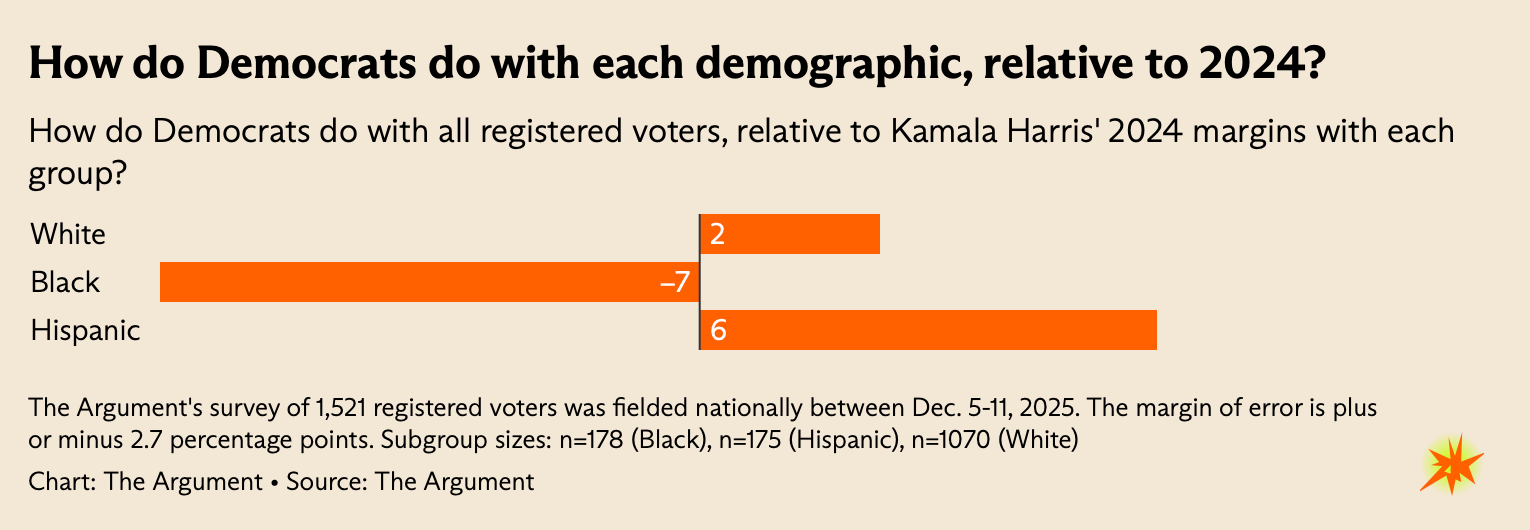
Again, I think this clearly points to Florida as an opportunity for the party.
A clear shot
The other thing I would say about the Sunshine State is that you know how I’m always talking about how Democrats need to rethink their ideology and issue-positioning in major ways?
I’m not really sure that’s true in Florida.
I mean, obviously they need to do something, because it flipped from being very-slightly-redder than the national average to quite-a-bit-better. But Florida is not like Texas or Ohio or Alaska (or even Kansas). It doesn’t have a fossil-fuel-extraction industry. In fact, Florida doesn’t like offshore drilling because it’s bad for their tourism economy. Florida is not an especially religious state.
In other words, there isn’t some fundamental barrier to winning here that requires a wrenching break with the national party ideology.
I do think that obviously the nominee would need to be a “different kind of Democrat” in some sense, including by being vocally hostile to Communist regimes in Latin America and clear-eyed about why a lot of people are allergic to the idea of socialism. They should be tough on crime and probably want to avoid stepping on obvious public-opinion rakes.
But this is a state that is actually seeing concrete short-term downsides of climate change, it’s a state where Trump’s immigration overreach is hurting people, it’s a state that suffers from the lack of Medicaid expansion, and it’s a state where abortion-banning seems to have run ahead of public opinion as DeSantis tried to position himself for the 2024 presidential nomination.
Last but not least, it’s not a Rust Belt state with a manufacturing legacy to feel nostalgic about — or with a legacy infrastructure of blue-collar unions that Democrats need to worry about angering. There’s no reason that Trump’s signature economic-policy idea should appeal to anyone in Florida, nor any reason that a Florida Democrat couldn’t just blast it and say she’ll reduce the cost of living by fighting to roll back tariffs.
It’s a nice, clear shot.
So who should the candidate be? Well that’s the problem — nobody obvious comes to mind. But that could be okay. When you need to slough off a bad party brand, someone who’s not well known can be an asset.
One name that comes to mind is Jane Castor, the mayor of Tampa, who used to be a police chief. Jared Moskowitz, a moderate House Democrat, also seems like he could be good. I always liked former Representative Joe Garcia. Or maybe there’s a businessperson or celebrity who’d take a crack at it. Further outside the box might be better.
The point is that while I get that Democrats feel like they’ve been burned by Florida before, the fact is there are no easy wins on the map and there’s no reason to think Florida is any further out of reach than the other states. The difference is that Democrats don’t have a candidate.
But the very lack of interest in running means it would be easy to get the nomination while sticking to a winning moderate platform. Someone should go for it.
Thank you, Santa, for bringing me a Florida-focused Slow Boring post.
Florida is ... diverse in ways that non-residents (and residents) can find hard to comprehend. Driving from Tampa to Miami takes about 3 hours but covers a cultural and demographic distance that stretches from the Upper Midwest to New York south to Puerto Rico and all stops between the three.
I think Matt overplays how Florida isn't especially religious, or rust belt-y or filled with oil rigs as reasons to make it "gettable". What it is, though, is older and full of immigrants. Not only immigrants from Cuba and Mexico, but also from NY, NJ, CT, Chicago, Minneapolis, Cleveland who left for weather and governance issues. As a result it is more culturally conservative in a Get Off My Lawn way than you might imagine.
The path to making inroads here needs someone who can meet those voters where they are culturally and promise to expand Medicaid using federal money. Nothing more from the party platform. The only blue-haired person the candidate should be seen with is 86 year old Edna from Beloit, WI.
I think the best path is to try like hell to win the Governorship (where you can do the Medicaid expansion), govern effectively for 2 terms (we have term limits) and then leverage that to a Senate seat. Unfortunately, the dearth of candidates Matt describes extends to many state-level races also. Don't forget that the last guy who *almost* became Governor was very Progressive but turned out after the election to have drug and male prostitute issues. (Andrew Gillum, look him up). Let's not do that again.
The best bet is to support David Jolly (former Republican, I know, but you gotta play the game in front of you) for Governor and rebuild the State Party from there. Might take a little longer, but the slow boring path often does.
https://www.floridapoliticalreview.com/whos-running-for-governor-in-2026-breaking-down-the-leading-republican-and-democratic-hopefuls-in-a-high-stakes-gubernatorial-race/
The great error among Democrats has been believing that 2nd or 3rd (or at this point 4th) generation Mexican or Cuban Americans feel some deep sense of solidarity with a Salvadoran or Guatemalan national that entered the country illegally or some other irregular way in the last dozen years.
The great error among Republicans is believing that those same people have no problem being harassed by law enforcement or treated as suspect in their own country in the name of whatever Stephen Miller's latest crackpot, racially tinged theory happens to be.
All of this seems like common sense to me, and yet... Anyway MY is right the Democrats should contest FL and everywhere else. They don't just need seats in the Senate they need to cultivate a lot of new talent.