


I wrote “One Billion Americans” during Donald Trump’s first term as president, without foreknowledge of what would occur during Joe Biden’s presidency.
As a result, the book doesn’t really have takes on the immigration policy questions that have been most salient over the past five years — years in which we’ve debated the procedural rights of people making asylum claims and the legitimacy of deporting undocumented immigrants who have not committed non-immigration crimes.
I have fairly conservative views on those issues and have been writing since the spring and summer of 2021 about my fear that the asylum debate would essentially swallow all of immigration policy, and I know many progressives now see me as very anti-immigration in a way that’s at odds with the book.
I do think that if you read the text, you’ll find that it’s consistent with my current views; it was just written before the Biden-era surge, so it doesn’t spend a lot of time on the issues that arose as a result.
But I want to make good on the broader point here by arguing today that I continue to think the economic benefits of a well-organized immigration system are underrated.
Over the past few months, I’ve been hearing more elite concern about the budget deficit, which is good. Obviously, the only way to address the country’s fiscal issues is to take some steps that are politically discomfiting. If they were easy issues to fix, they would be fixed already!
Yet I find that whenever I’m in these discussions, more and better legal immigration is almost always badly underrated as a part of the solution.
So I was really excited to see the Manhattan Institute launch this immigration interactive where you can punch in certain immigration policy ideas and it calculates the debt impact for you. I was able to dial in some policies that led to really big declines in the debt-to-G.D.P. ratio, especially over the longer term.
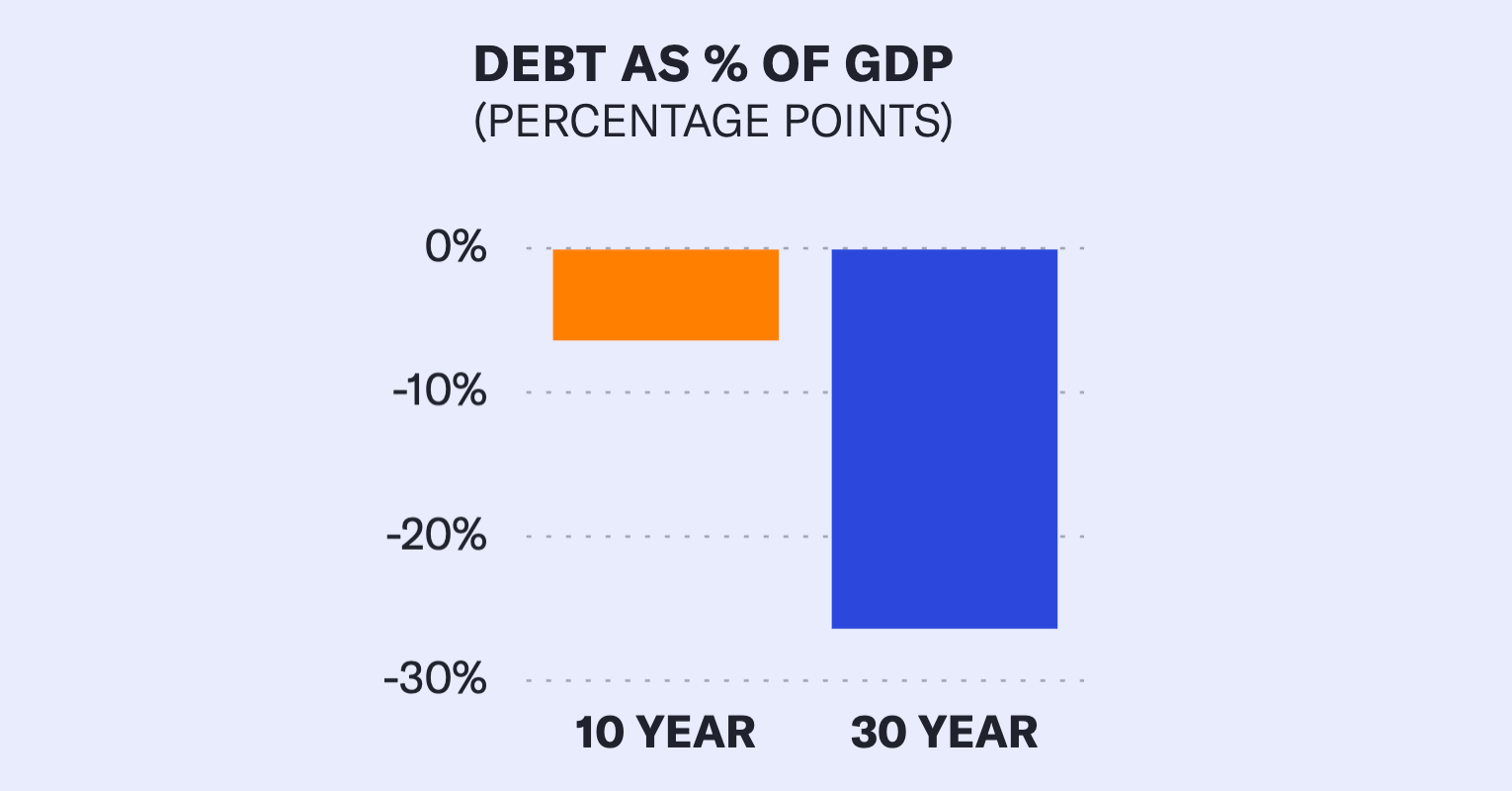
Changing our immigration policy would not obviate the need to prioritize using new tax revenue for deficit reduction and to reconsider the design of our retirement programs. But it would make a really big difference. And, frankly, I think Manhattan could have gone further in terms of providing people with options to maximize the fiscal benefits of immigration.
The main point I would make on that front is that there’s a lot of discourse about what the actual budgetary impact of immigration is. But we ought to be thinking more about what the budgetary impact of immigration could be if we took budget concerns seriously, rather than just using them as bludgeons in a culture war.
Allowing people to migrate to the United States for work has large aggregate economic benefits, and we can use tax policy to decide exactly where those benefits land.
Immigration for fiscal benefit
Manhattan’s calculator asks a lot of questions about specific policy options and provides associated estimates of their fiscal impact. This sometimes helps surface some pretty boring but important facts. For example, legalizing millions of longtime undocumented workers has a positive impact on the budget. But legal status is valuable, and when you’re giving someone something valuable, you can also charge them money for it. If you pair a path to citizenship with a fee — let’s call it a fine, even, a punishment for having broken the law — suddenly legalization for 10 million illegal workers turns into a fiscal boon.
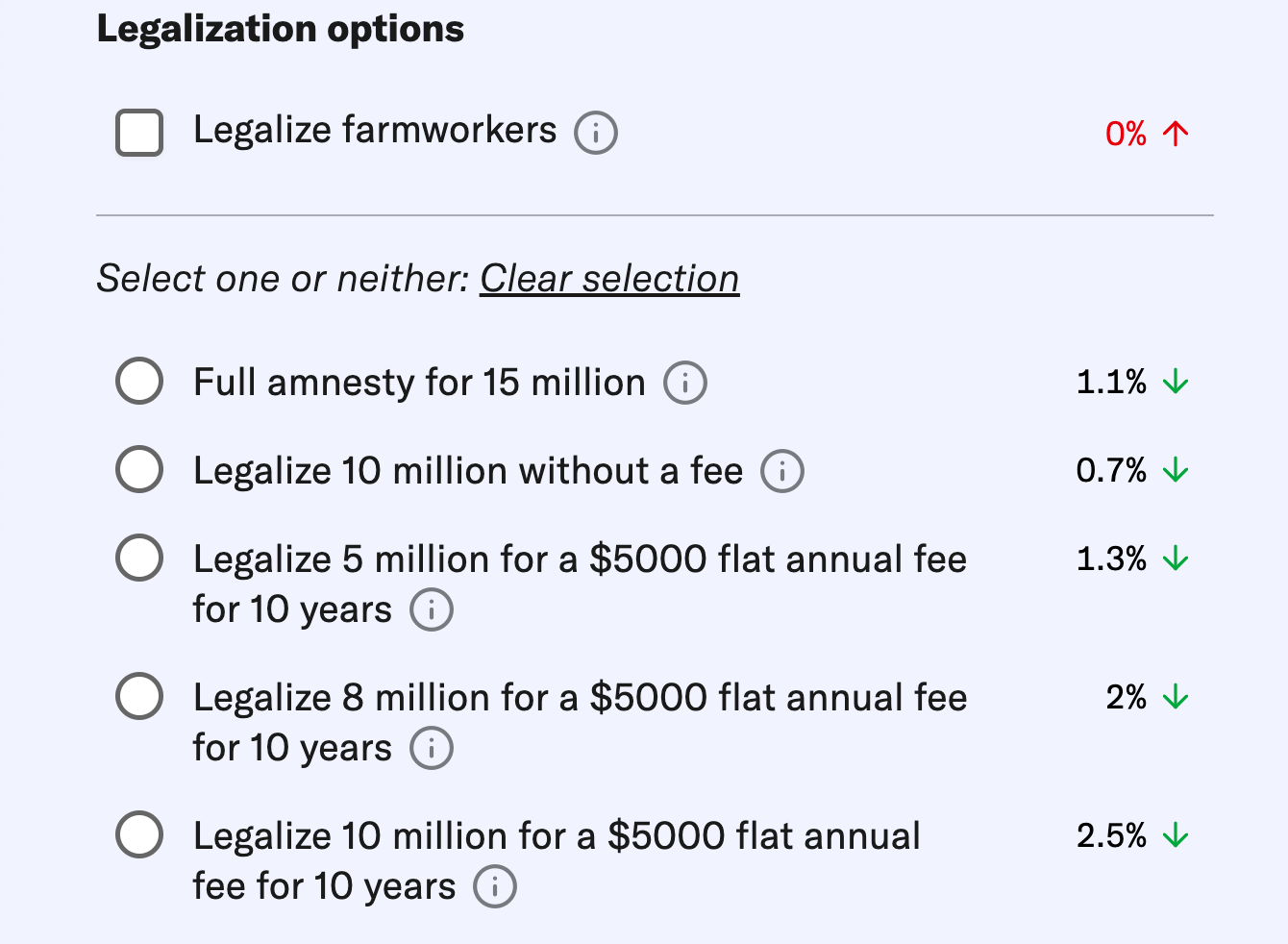
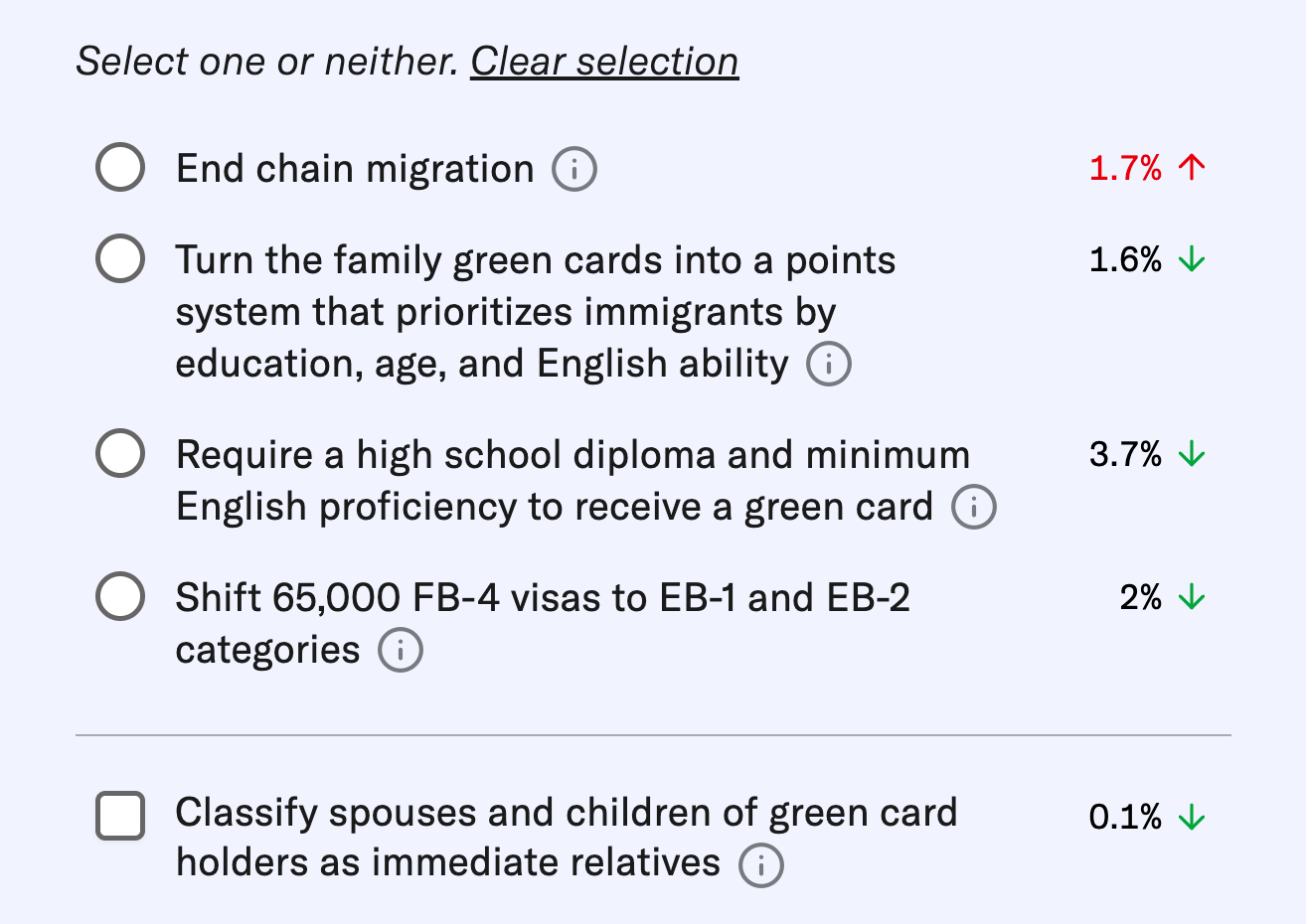
You can also make immigration better. Right now, a large share of immigrants come in through a family unification system. A lot of conservatives criticize this for not being sufficiently merit-based, which is a reasonable point. Still, ending the family visas and replacing them with nothing has a negative impact on the debt-to-G.D.P. ratio. But if you keep giving out the same number of visas and start giving an edge to people likely to succeed in the labor market, you get a big benefit.
Similarly, a lot of people complain that the process for issuing H-1B visas for skilled workers isn’t really selecting the best applicants. This is true, but it’s also true that the existing H-1B program is selective enough to have large fiscal benefits. If you change the program to simply prioritize the highest-wage offers, though, you get a much bigger fiscal benefit. If you make the program larger, that’s a big benefit too.
In this case, they unfortunately don’t let you both award the visas based on offered wages and also double the size of the program.
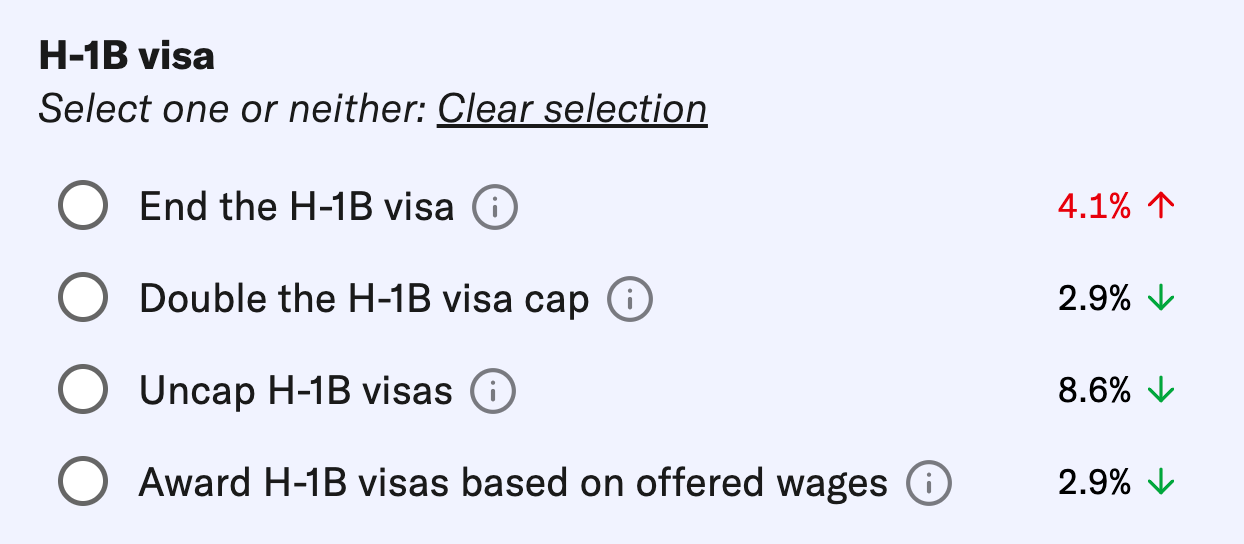
But that’s the way I’d like to see us thinking about immigration. Don’t identify flaws in our visa programs and use those flaws as an argument for cutting them. Identify flaws and fix them! And since you’re making immigration better, why not have more of it?
The basic story here is that skilled immigration in particular pays a kind of double dividend in terms of debt sustainability.
The United States has a progressive tax system, and a very large share of our spending is on retired people and national defense. A new worker with an above-average income pays a lot of taxes without increasing our spending burdens in the short term. Meanwhile, immigrants are also growing the denominator of the debt-to-G.D.P. ratio. A large country like Germany can sustain more debt than a small country like Portugal.
You can’t just pursue population growth as an alternative to responsible budgeting, because eventually your spending commitments will catch up to you. But even though “just kicking the can down the road” is easy to deride, it’s actually useful.
Making small changes to Social Security like adding an employer compensation tax could strengthen the program without fully saving it. But if you manage to extend the timeline with immigration, then those smaller tweaks have more time to work. It’s both/and, not either/or. I also know a lot of smart people who think all these fiscal issues will be obsolete soon thanks to artificial intelligence delivering a post-scarcity society. I don’t think it’s smart to count on that, but however far we manage to kick the can down the road, we raise the odds of being rescued by something like that.
Temporary migration for fiscal benefit
You could do a lot more than Manhattan proposes to maximize the fiscal upside of immigration, though. Right now, H-2A seasonal agricultural workers are exempt from payroll taxes.
This is theoretically part of the contributory structure of Social Security and Medicare. Temporary agricultural workers are not eligible to receive benefits from these programs, so they don’t need to pay into the funds that support them. That seems a little bit weirdly literal. The whole deal with taxes is that while it’s useful to have revenue, people also prefer not to pay taxes. But if H-2A workers needed to contribute payroll taxes, there would still be plenty of people who wanted the visas.
If anything, I’d consider tacking an extra one percentage point on to both sides of temporary workers’ payroll taxes. The extra bit that the employers kick in could be a “solidarity fee” for American workers, and the extra bit that workers pay could be handed over when they leave the country on schedule with a record of good conduct.
Of course, farm employers wouldn’t like any of this because it would raise their labor costs.
But the point here is that if you make immigrant labor more clearly beneficial to the American people as a whole, then you have a strong case for issuing more H-2A visas or making them easier to get. This would also become a model for expanding temporary work. Dairy farmers are always complaining that they want access to agricultural guest workers but are currently ineligible because dairy work isn’t seasonal.
I don’t know exactly how far we’d ultimately want to push this model where low-skill workers come to work in the United States for nine-to-18 months and then go home, having contributed payroll taxes without becoming eligible for Social Security and Medicare.
But during times of labor market tightness, relying on workers like that — vetted, legally authorized ones who are making a defined fiscal contribution to the United States — seems a lot better than the kinds of ad hoc parole programs the Biden administration tried to use.
In general, it makes sense to me that one of the best ways to deter illegal migration and total chaos is to create legal channels to meet demand for labor. But even though doing it through backdoor executive action is easier than working with Congress to change laws (almost everything is easier than getting Congress to change laws), legislation is required to really unlock the big upsides.
The flywheel of growth
There are, of course, other issues. The United States is short on housing at the moment, and even if an increase in immigrant flows has fiscal benefits, it could exacerbate that shortage. We also have big issues with our electricity grid.
But while I hear all the time from rightists who argue that restricting immigration, rather than pursuing land use reform, is the real solution to housing issues, I think that’s pretty terrible loser behavior.
Certainly I don’t see any of the people arguing for immigration restrictions pushing for big tax increases to solve the budget deficit. And the politics of a Paul Ryan-style push for an all-cuts approach is absolutely horrible. Donald Trump’s only really good political move was getting Republicans off that idea.
But you’ve got to do something.
Taking various critiques of the immigration status quo seriously and then actually trying to fix them rather than just complaining or posting deranged memes would be a much better idea. If we did what D.H.S. is suggesting here and deported every illegal immigrant plus every legal immigrant plus every naturalized citizen plus 50 million or so more native-born Americans, we would have a huge fiscal crisis on our hands, not fun beach vibes.

The United States continues to be a relatively sparsely populated country with abundant natural resources and the privilege of being a place where huge numbers of people would like to live. We should be selective about the people we invite to be permanent residents, but when you can recruit people of above-average ability and decent values to come to your country, it’s a good idea to do that.
We can also use the tax code to ensure temporary labor is advantageous to the American people as a whole. Building more housing to accommodate more people is not a difficult engineering problem. In the relatively recent past, small American towns became booming cities surrounded by extensive suburbs. If we do it again, we’ll still face some difficult choices about our retirement programs, but they could be made much less difficult and we ought to seize the opportunity.
This piece is completely right on the merits but unfortunately we live in a democracy and voters never seem to prioritize keeping our growth rate greater than our deficit/GDP ratio.
I have no real idea how you do this, but screening for high skilled immigrants *who also really want to be Americans* is really necessary.
One random thing I've noticed is that the prospect of expanding LEGAL immigration just doesn't really get the left excited like you'd think it would. The activist left seems to get excited about defending migrants already in the country and opposing the actions of ICE (same, for the most part), but there's no protests in big cities for expanding the number of green cards or H1Bs or anything like that. Similarly the (hopefully mostly online) right-wing freak out about Indian immigrants has prompted... pretty much no response from the left. There was a guy working in DOGE who had tweeted "I hated Indian people before it was cool" just three months before getting a (temporary) job in the federal government. JD Vance, whose wife is Indian, did his whole bullshit "he's a good White boy who's a victim of cancel culture" shtick. There was no "Stop Indian Hate" movement or anything. It's just odd to me. Obviously I'm not trying to find equivalence between a right that is actively hostile to a left who seems indifferent, but it is still strange to me how much this didn't capture the left's attention at all.
Anyways, glad Matt covered this tool. I posted it here a few days ago so not much else to say. Kudos to the Manhattan Institute for acknowledging facts about immigration (most immigrants are net GDP contributors) while being a conservative think tank. That's got to be a tiny sliver of the Venn Diagram.