


After you’ve read today’s post, I hope you’ll check out the latest episode of “The Argument” podcast, where Jerusalem and I dig into the Bipartisan American Affordability and Jobs Act (BAAJA), a bill that promises to make it easier to build energy infrastructure in America. Paid subscribers can watch or listen ad free and read the transcript and show notes here. Free subscribers can watch the episode on YouTube here or listen wherever you get your podcasts.
Subscribe: Apple Podcasts | Spotify | YouTube | Overcast | Pocket Casts
The civil rights movement was the defining moral drama of 20th-century American domestic politics.
Its highest-profile leader has a monument on the National Mall and is one of the few individuals for whom a federal holiday is named. It was also a distinctively progressive moral drama. Contemporary American conservatives, of course, are not advocating for restoring Jim Crow. But it’s also true that the conservative movement as we understand it is downstream of an intellectual project explicitly dedicated to building an alliance between Northern pro-business interests and Southern segregationists.
So American progressives are both very proud of the civil rights movement and also very interested in it, for understandable and laudable reasons.
By the same token, it’s not surprising that arguments between moderates and progressives often conclude with the progressives busting out analogies to the civil rights movement as a kind of trump card. I taped an episode of the “Mehdi Unfiltered” podcast recently (it should be out soon), and Mehdi Hasan is a shrewd debater, so that’s of course where he goes in the end. Because if you admit that your so-called pragmatic approach to politics is in tension with the lessons of the civil rights era, you lose the argument.
I believe, though, that it’s sort of the opposite: The civil rights movement is the exception that proves the rule.
It stands out for being extraordinary rather than typical of political controversies.
Progressives are often pattern-matching on the civil rights movement in a way that doesn’t make sense. For example, American politics in 2026 is very different from American politics in 1956. The specific dynamics of most public-policy issues are very different from the dynamics of civil rights. And the claim that the specific topic you’re working on has the same moral weight as civil rights is a bit dubious and, at a minimum, invites a debate with all the people working on different topics that they also believe are the modern-day civil rights movement.
I’m very interested in YIMBYism, housing policy, and land-use reform. These topics seem really important to me — and I think they’re more important than most people realize. But I don’t think it would make sense for YIMBYs to emulate civil rights tactics. Both because the moral stakes are not the same, but also because the entire situation is completely different. And the same is true for basically any cause today.
Midcentury politics hit different
The clearest difference between the civil rights era and today is the background structure of the American political system.
The 1930s, 1940s, 1950s, and 1960s featured famously low levels of ideological polarization between the American political parties.
The classic illustration of this comes from the DW-NOMINATE spatial representations of congressional votes. You can see below how this model characterizes the 83rd House of Representatives, which was elected in 1952. Clustered up at the top are a bunch of Southern Democrats who represent maximum Jim Crow. But then you see that among the Southern Democrats, some of them are more conservative than many Republicans on basic economic issues. Others, though, are to the left of all the Republicans on economics while still being very racist. The Republicans themselves have a wide range of views on the civil rights dimension even though none of them are up at the tippy top.
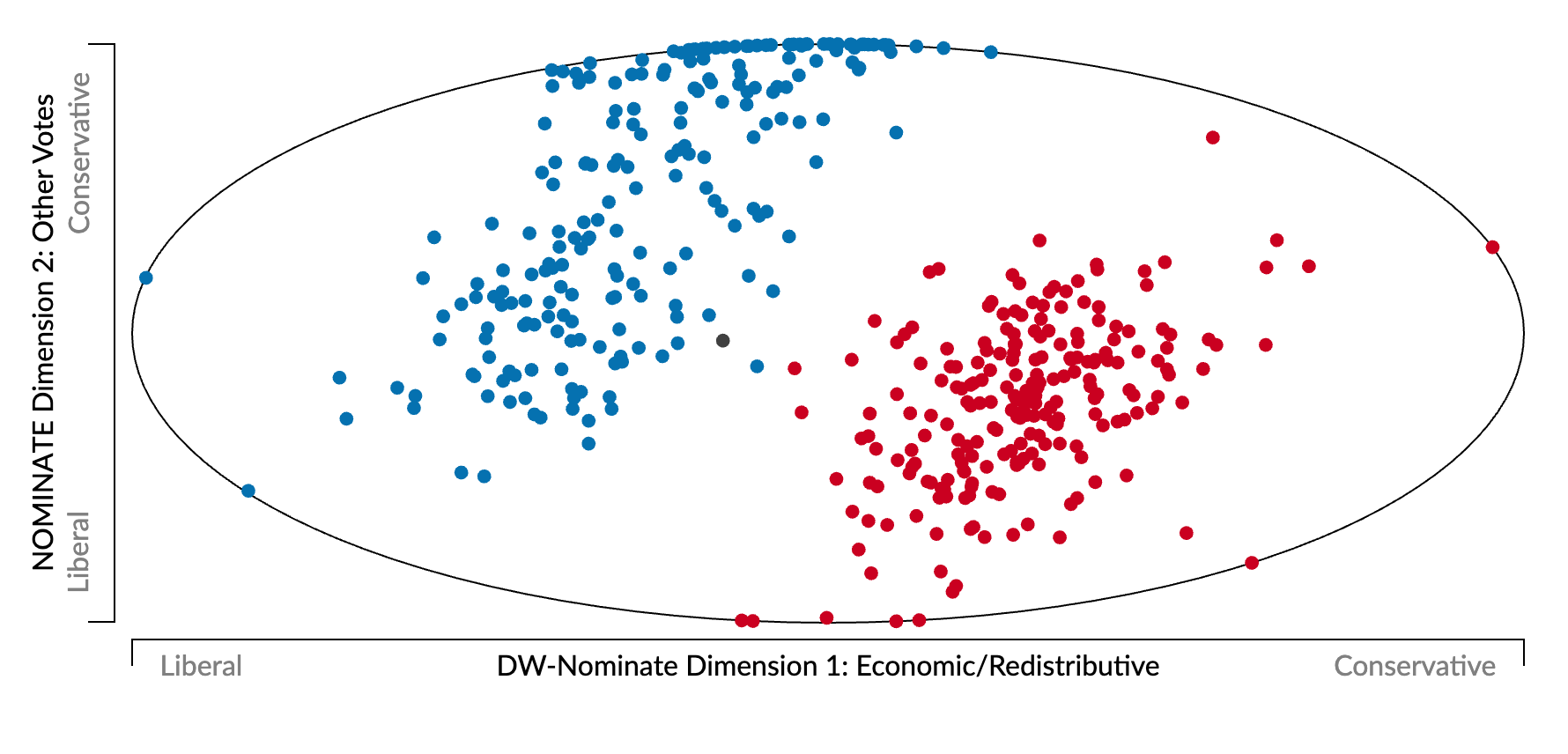
Modern Congress isn’t like this at all to the point where it’s hardly worth bothering with a visual representation. The vast majority of members vote with party leadership almost all the time. Even among the handful of moderates on Capitol Hill, there’s no topic I can think of where Jared Golden or Henry Cuellar is actually to the right of anyone in the Republican Party.
Today we just take for granted that the most moderate conceivable Republican is someone like Susan Collins who sometimes breaks with the G.O.P. — usually when her vote isn’t decisive — while still being more conservative than every Democrat. But that 83rd House featured Republican Jacob Javits of New York, who, though he was arguably slightly conservative by the standards of New York State, was nonetheless more liberal than lots of Democrats from more conservative states.
This lack of polarization was a big deal for the civil rights movement in part because the non-polarization was specifically downstream of Jim Crow.
But note (per the Javits example) that depolarized midcentury politics wasn’t just a question of Southern segregationists. It was also a different conceptualization of how political parties should work. Midcentury parties were essentially state-first organizations where the primary mission was to win power locally. The state parties then confederated up to a national organization. Today, it’s inverted and state parties are more like local branches of a national operation.
Everyone pretty much understands that if the United States had totally different formal political institutions, you’d employ different tactics to effect political change. If we had proportional representation, these endless debates about ideological positioning’s influence on candidate electability would all go away and we would have a different series of debates about bargaining posture in post-election coalition talks. If the Senate didn’t exist, the quirky independent streak in the Alaska electorate would be unimportant since so few people live up there.
The shift from federated, state-centric parties with ideological overlap to nationalized, fully sorted parties isn’t something that happened with a formal constitutional reform. But it’s a huge change in how American institutions function, and it means that tactics that made sense in 1954 don’t typically make sense in 2026.
Democracy (or its absence) is a big deal
Speaking of institutional changes, a central aspect of the civil rights movement is that Southern African Americans were systematically denied the right to vote.
One of the movement’s main goals was to pass a Voting Rights Act, and there was grassroots activism around voter registration as well. These things, of course, interacted with each other. James Chaney, Andrew Goodman, and Michael Schwerner traveled to Mississippi to register Black voters and got murdered for their trouble. The murders brought a lot of national attention to Mississippi, to the indifference of Mississippi public officials to murders that occurred on their watch, and ultimately to the fact that local law-enforcement officials were directly involved in the murders.
This was a genuine outrage that helped rouse elite consensus that something had to be done and impart momentum to voting rights legislation.
But the voting rights issue wasn’t just a target of legislative change; it was also a structural reality shaping everything that happened. You couldn’t really make incremental progress against segregation in Alabama by appealing to the median voter, because the whole electorate was wildly unrepresentative.
A lot of people miss that when Martin Luther King Jr. complains about white moderates in his “Letter From Birmingham Jail,” he’s responding specifically to a letter from white clergymen in Alabama.
Part of his point here is that the white moderates’ demand for incremental change is meaningless because no change is happening at all, because in the structure of Jim Crow Alabama, these white moderates were the extreme left of the electorate. They could represent themselves as favoring incremental change, but they were not in a position to deliver any change at all. The only way to get change was to get Northern white opinion invested in the struggle and overrule the local political system.
Obviously if it had been possible to cut deals in the Alabama state legislature with moderate whites to enact incremental changes to segregation, King wouldn’t have pronounced himself satisfied with half a loaf of equality, but I think civil rights leaders would in fact have tried to get what they could cut.
Indeed, in Congress there was a Civil Rights Act of 1957 and a Civil Rights Act of 1960 before the big Civil Rights Act of 1964 and the Voting Rights Act the following year. Fair housing didn’t come in until the Civil Rights Act of 1968. It’s just the case that the normal way legislative change happens is through a frustrating and somewhat annoying process of bargaining with stakeholders. But in the Jim Crow South it was genuinely impossible to pursue normal politics, so you needed a set of tactics and strategies that were designed to cope with an unusual situation.
Salience on your side
It’s also notable that while there was obviously plenty of racism among the Northern white population, Northern public opinion was genuinely not in favor of Jim Crow. I certainly don’t want to minimize the problems — there was discrimination, there was bigotry, there was de facto exclusion.
But Northern African Americans could vote.
Edward Johnson was elected to the New York State Assembly from Harlem in 1917. The Black community of Chicago was especially politically influential and sent Oscar Stanton De Priest to Congress in the 1928 election. You didn’t have separate bathrooms and water fountains. Railroad companies would segregate and desegregate their passengers as trains passed through border towns:
In Southern train depots, African American passengers waited in Black-only waiting rooms — crowded, unsanitary and poorly lit. They boarded segregated Jim Crow railroad cars with cramped seating, no luggage racks, insufficient heating and poor sanitation. Blacks were required to take their meals after the white passengers were finished or, in many cases, were simply denied access to the dining car. Upon crossing into the North, African Americans were able to move to integrated cars with greatly improved facilities. On the return trip, passing through Southern cities like Cairo, Ill., Cincinnati, and Washington, D.C., train conductors would force Black passengers back into Jim Crow cars.
The rules were different in the North because Northern white people had different opinions about how things ought to work. Northern white people also mostly wanted the government to do things to help them rather than spend time and energy on fighting with Southern governments about the living conditions of African Americans. That’s part of why polling always showed annoyance with civil-rights-protest tactics and (later, when more stuff happened) misgivings about the pace of federal action.
But when push came to shove, if you forced white Northerners to offer their view, most of them thought Jim Crow was bad, which is why they didn’t adopt Jim Crow laws in their states.
As a result, a lot of civil rights work was dedicated to raising the profile of the issue, not because raising the profile of your cause is always a winning strategy but because it was a winning strategy for this particular movement in this particular situation. Dwight Eisenhower didn’t particularly welcome having a school integration controversy in Little Rock dumped on his lap, but forced to address it, he sent in the troops. The movement was radical in a sense — it asked for big federal-policy changes and used edgy tactics outside the normal legal and legislative process — but it was also fighting against a system that most people believed all along was unjust.
The slow boring of hard boards
Taking the dynamics of midcentury civil rights politics seriously really just overwhelmingly generates the conclusion that the leaders and activists involved are heroes who deserve our admiration but whose specific tactics almost certainly shouldn’t be copied.
The polarization and sorting of contemporary political parties makes for a totally different situation. It’s always worth considering the possibility of taking a calculated political risk for the sake of advancing a policy goal. But under conditions of contemporary partisanship, a risk you take to expand access to health care is a drag on efforts to secure abortion rights or address climate change or help the poor. A risk taken for the sake of climate is a drag on health care.
These are all important issues and I can name a bunch of others — immigration, the assault on USAID, America’s relationship with allies like Canada — that are also important. When people pound the table and demand bolder, more fearless action on whatever we’re talking about at the moment, they are in effect calling for sacrifice on every other issue. But that’s rarely what they subjectively mean and almost never what they actually say, because almost nobody is so egomaniacal as to really believe their specific issue is such a transcendent moral crusade that it warrants dismissing all others.
What props the whole thing up is the assumption that tradeoffs don’t exist.
That assumption is wrong, but it’s also not at all in line with the civil rights analogy. The civil rights argument is that it was a transcendent moral cause where not only was Jim Crow policy wrong, but the systematic disenfranchisement of African Americans in the South violated the basic concept of democracy and warranted extraordinary political tactics.
And the idea that the way to make progress was to stage dramatic confrontations — the Freedom Rides, the March on Washington, the Edmund Pettus Bridge — was an analysis of a particular situation. Movement leaders had specific reasons to believe that Northern white voters’ first choice was for the government to ignore civil rights and focus on their problems but that their second choice was to overturn Jim Crow, a system that they genuinely did not support.
And they didn’t use this tactic all the time. There was a lot of successful low-key civil rights litigation in the 1940s that attacked edge cases of segregation and ultimately laid the groundwork for the Brown v. Board of Education case. Laws banning interracial marriage were considered politically risky to elevate and weren’t the focus of the big marches. The tactic of staging nonviolent but highly confrontational protests worked well, but it worked well for specific purposes. It was also undertaken in an extremely disciplined way, and when discipline broke down in the late 1960s and there was rioting, backlash was pretty severe.
The point of all this is that, yes, my general take on how politics should be pursued — cautiously, with a lot of attention paid to downside political risk, with a preference for non-polarized low-profile bipartisan bills whenever possible, and with overt messaging that is narrowly focused on small changes — is wildly at odds with the way the great progressive triumph of civil rights was achieved.
But that’s because the civil rights situation was really extraordinary. It’s sort of fun to imagine one’s own advocacy as the equivalent to this great moral drama. But most issues are not like that, and indifference to the partisan electoral implications of political interventions is not an attitude that makes sense in a very different party system.
Beyond that, we’re just not talking about a good and evil showdown where a huge share of the population has been disenfranchised. None of the main progressive causes of today — and none of the wonkier abundance causes either — are beyond the normal to-and-fro of political bargaining and piecemeal persuasion. Even the civil rights movement itself only sometimes operated in the register of its most famous moments, and the vast majority of politics is much more boring normal politics.
As a reminder, paid subscribers can watch or listen ad free to this week’s episode of “The Argument” or read the transcript and show notes here. Free subscribers can watch the episode on YouTube here or listen on your podcast app of choice.
I've posted this before, but due to its relevance to what Matt's saying here I want to say it against.
The civil rights movement accomplished so much so fast because it benefited from a perfect storm of circumstance: the Nazis giving racism a bad name, the Cold War need to look good to the nonwhite world, a Supreme Court liberal enough to issue Brown, a new communications media that allowed/forced people to literally see segregationist brutality, a leader as charismatic as King. That very success fooled generations of liberals and leftists into believing that if only we were dedicated enough, uncompromising enough, militant enough, life could be like that all the time.
Great piece. If I’m reading Matt correctly, the key difference with the civil rights movement was that even at the beginning of the movement, the persuasion part was already done. Northern whites in 1955 already believed segregation was bad. All that remained (I say that like it was easy and of course it wasn’t) was to get this issue prioritized to the top, but you didn’t need to change many minds in the north. But that certainly isn’t what happened with many other issues like interracial and gay marriage nor does it seem the current situation for trans rights. I’m not exactly sure where I would put climate change- I think if you really pushed most normies they would admit that climate change isn’t great but I do think climate activists seriously underestimated how much of the electorate was as concerned about the issue as they were, with more persuasion needing to happen.