


Emily Ekins has a Ph.D. in political science and runs the polling and public opinion research operation at the libertarian Cato Institute. She also got married when she was 22.
This is an unusually young age for marriage these days, especially for highly educated people, and Ekins recently wrote an article for the socially conservative Institute for Family Studies about her experience and why she thinks “marrying in one’s early-to-mid 20s can offer meaningful advantages for many young women.”
This is part of a whole series from I.F.S. touting early marriage.
One entry is a thoughtful gender-neutral piece from Helen Roy about the dangers of turning marriage into a weapon of memetic warfare. Another, from Amber and David Lapp, is about marriage and class. Mark Regnerus calls on parents to be more supportive of their kids marrying young, focusing on an anecdote about a young woman named Lillian whose parents discouraged her from marrying her college boyfriend. And Lisa Britton offers herself as an example of a “cautionary tale of what happens when you put family on the back burner for too long,” leaving her childless and unmarried in her late 30s.
Which is just to say that the implicit theory of the case here is that to boost marriage and family formation, we as a society should be telling young women — especially educated women with professional ambitions — to focus more on family life and to be more open to settling down early.
I don’t think this is terrible life advice. If you’re in your early-to-mid 20s and in a good relationship, I don’t necessarily think you should hesitate to make a big commitment. And if you’re in a relationship that you don’t see as working out in the long term, you probably shouldn’t just tell yourself that you’re too young to be thinking about that.
But the model of the world here in which young women are in relationships with great guys who are trying to marry them and the women are blowing them off to go girlboss just does not seem accurate to me.
I’ve never had a conversation with a young man that featured this particular sob story. I have tried to encourage young men in committed relationships to think about marriage (I want the marriage promoters to know that I have done my part), though I can’t say it’s ever worked.
And this seems to me like a recurring problem in center-right discussions of marriage and family: Cultural conservatives are either afraid to say what they actually mean, or else are just so accustomed to arguing with feminists about abortion and child care subsidies that they reflexively want to continue fighting with them.
Because, in reality, educated women get married at higher rates than working-class women, and the weak link in convincing more people to settle down earlier is, in fact, men.
The education gap in marriage
I can see how a machine learning system with access to America’s high-quality news outlets but no information about the birds and the bees could reach the conclusion that America really needs someone to hector young women about marriage. Because it’s true that there is a fair amount of marriage-skeptical content in highbrow media, and it’s almost all woman-focused.
But take a look at this chart from a paper by Clara Chambers, Benjamin Goldman, and Joseph Winkelmann looking at marriage rates by educational attainment.1 If young women focusing too much on their careers were the key driver of marriage decline, you’d expect to see decline concentrated in better-educated women. But we actually see the reverse.
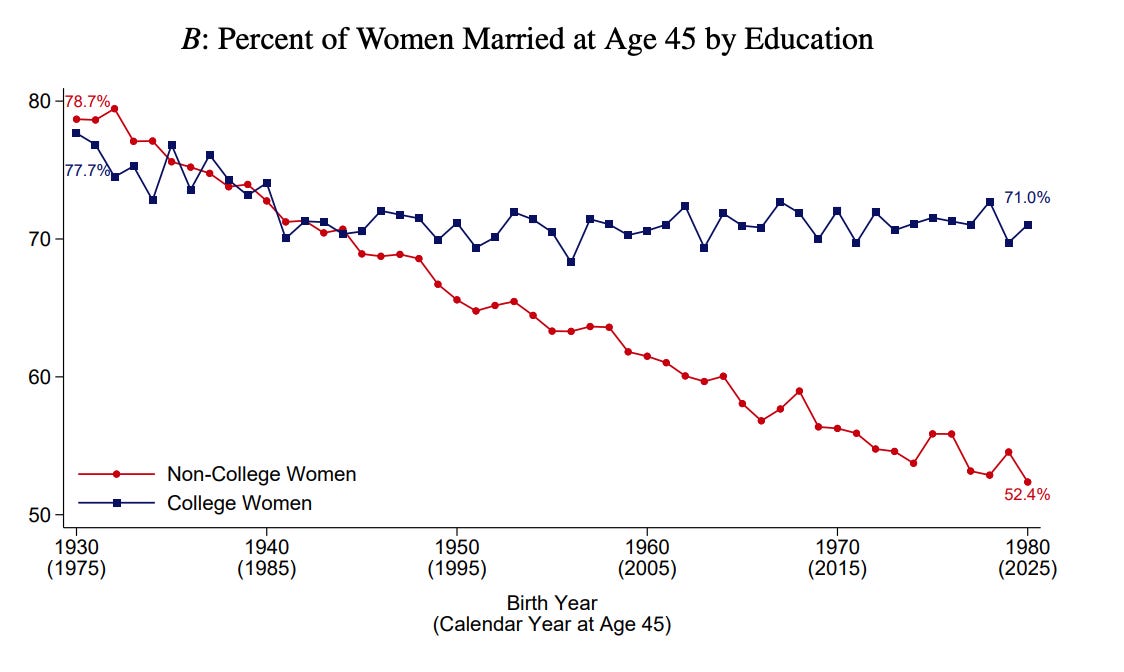
This suggests the constraint isn’t highly educated women opting out of marriage. The issue is pretty clearly that better-educated women meet better-educated men. These men are smarter and more conscientious than average, and thus are more likely to have the sort of financial and emotional stability that make them attractive long-term partners. Most of all, they’re also more likely to be seeking marriage in a serious way.
Back in 2008, when I worked at The Atlantic, the magazine published a piece by Lori Gottlieb titled “Marry Him: The Case for Settling for Mr. Good Enough.”
This is the kind of content that I.F.S. wants to see in prestige media, and it did a great job stirring the pot and driving conversation about the magazine. It also got Gottlieb a book deal.
But while women turning down marriage proposals from men they decide aren’t good enough for them is an important plotline in “Emma,” I did not think in 2008, and do not believe in 2026, that this is a major feature of the real world. It’s also contradicted by the education-based splits we see in the data.
What do social conservatives want?
The lowbrow version of this discourse is the “imagine how much propaganda it took to convince women that this is oppressive” meme that’s popular on the right-wing internet. The trick here, of course, is that nobody ever said that this was oppressive.
What’s oppressive is being trapped in a relationship with a husband who doesn’t treat you well and having no good exit options.
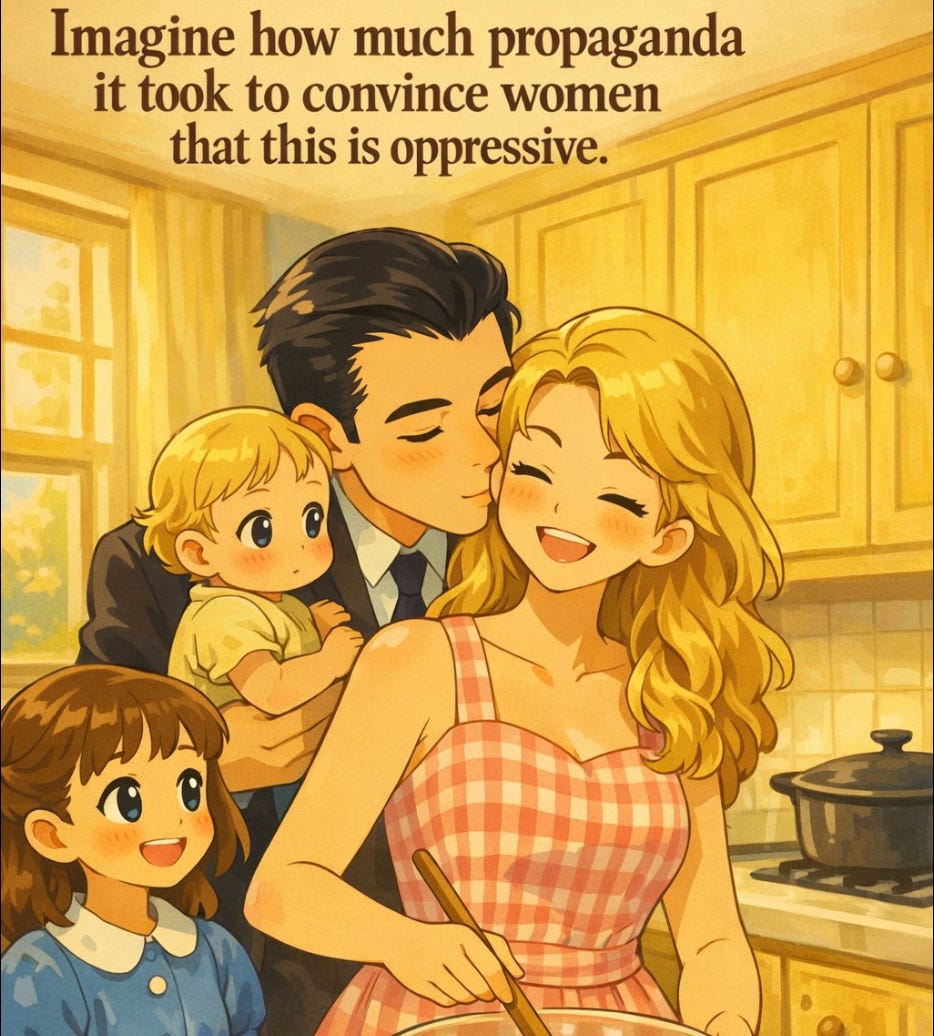
The dark interpretation of the social conservative obsession with hectoring young women is that the “real plan” to promote marriage and family formation is to cut off women’s economic opportunities so that they need to dramatically lower their standards and put up with sub-par husbands.
And clearly, that is the agenda for some.
But I think I.F.S. very deliberately held up Ekins — a woman who has an advanced degree and a prestigious career — because they, at least, are in good faith not trying to say that. The problem is, I’m not really sure what they are trying to say.
Rachel Jarrett, the president and C.O.O. of Zola, a website for planning weddings, wrote that more women should propose to their boyfriends. Perhaps trad types should take up that cause, though I’m not sure women are going to be proposing in large numbers no matter how many takes we write.
That just underscores, though, that if there’s going to be a change here, it has to come from young men — especially the kinds of young men who today aren’t getting college degrees. Someone needs to tell them to either stay in school or else take some other conscientiousness-demonstrating path (i.e., join the military, complete an apprenticeship). If they want to get married earlier in life, they need to get more serious earlier about being good life partners and aspire to real relationships instead of watching manosphere influencers tout “one-sided monogamy.”
Educational attainment has risen over this period, so “has a B.A.” and “non-college” are not really stable categories, and I wish that social scientists would give us charts of terciles of educational attainment rather than use these degree categories. But it’s not my paper, and doing it the way I prefer would only strengthen the conclusion.
To me this seems like conservatives are adopting the progressive prohibition against ever being critical of someone else less well off than you (who’s in the ingroup).
If you can’t say that the reason marriage rates are falling is because a lot of working class men are losers, then you have to blame an acceptable target (educated and affluent women).
I know a few very successful couples who started dating in college and IMO should have gotten married in their mid 20s, but there was exactly zero chance that would cause them to *have kids* in their mid-20s which seems to be the unstated desire here