

In an article comparing American and European living standards, Paul Krugman offered what he called “One more real-world aside: Should Europe envy the United States for its tech sector? No. Aside from the fact that Europeans are living well, tech generates a big negative externality, because among other things it generates tech-bro billionaires, who are corrupting our politics.”
That’s a puzzling assertion that would take a long time to fully unpack, but it made me miss the Krugman of old who wrote a lot about economic geography.
Because there is an interesting question here: Hollywood, the dominant player in the global film and television industry, is located in the United States of America. But it’s specifically located in Los Angeles. It’s easy to see that Hollywood being in Hollywood is an anchor for the economy of Southern California. But while people all around the world enjoy the movies and shows that Hollywood churns out, does anyone in Jacksonville or Cleveland enjoy large benefits from the American film industry that are denied to people in Vancouver?
Maybe not. The United States of America is a very large country. A lot of economic activity is non-traded and local, taking place on a scale that is dramatically smaller than our nation. And a lot of economic activity is traded and global, taking place on a scale that is dramatically larger than our nation.
There are things like political newsletters, where the audience for Slow Boring is quasi-bounded by the borders of the United States because interest in American politics (for good reason) drops quite a bit when you leave the country. With Hollywood, there are meaningful linguistic boundaries, but that’s why I mentioned Vancouver, where that doesn’t apply.
With the tech sector, a big reason why the tech-bro billionaires are able to get so very rich is that the market scales pretty easily to become truly global.
Google has created a lot of useful products, and those products are used by people all around the world. It’s also made a staggering amount of money for its founders and generously compensates a larger group of employees.
But for most Americans, the main benefit of Google is just literally that you can search the web or get your email or watch YouTube, which are all things that people in Canada and Cambodia can do as well. If you’re living in Columbus, then the wealth of Google’s actual founders and employees aggregates together with yours to raise America’s average statistics. If you live in Colombia, it doesn’t.
But is there any actual benefit accruing to people in Columbus, or is it just a statistical mirage?
I think the real answer is that there are some benefits. But the broad benefit to the country as a whole of Silicon Valley’s 21st-century boom has been much more limited than it should or could have been, primarily for reasons related to housing and transportation policy. And that even as “affordability” has become an obsession and YIMBY ideas have gone mainstream, this remains underrated.
Dude, where’s my megacity?
Cook County, Illinois (Chicago and its environs) went from approximately 607,000 people in the 1880 census to more than 1.8 million in the 1900 census.
And Chicago was not unique — look at Wayne County absolutely exploding between 1910 and 1930 as the American auto industry boomed. That’s what an economic boom used to look like. The nature of American growth during the Industrial Revolution was that when a local industry cluster boomed, the whole area experienced booming growth.
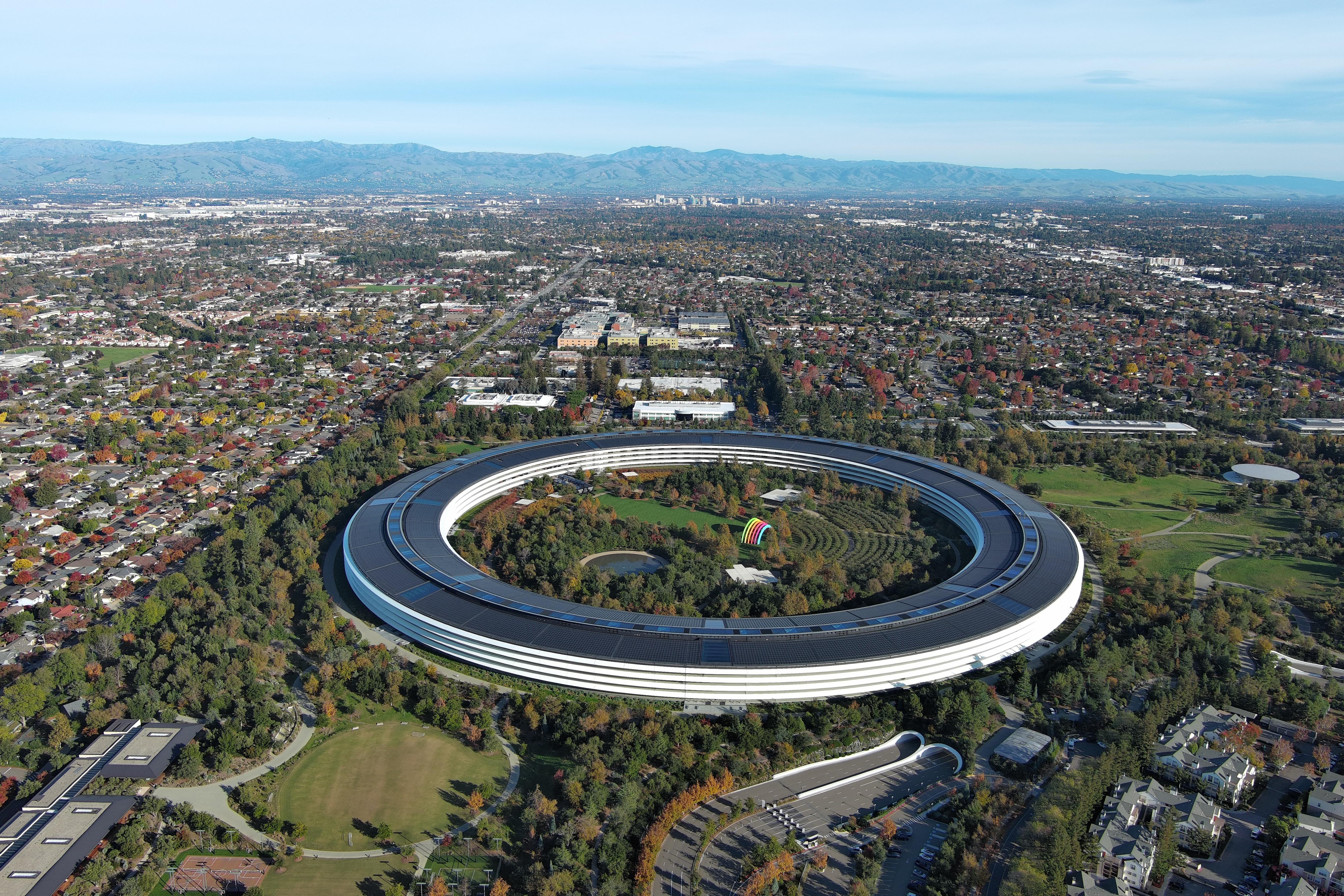
Santa Clara County in California, where Apple and Nvidia and many other tech companies are headquartered, had pretty fast growth from 1950 through 1970 as part of general suburbanization, but there is no 21st-century population boom.
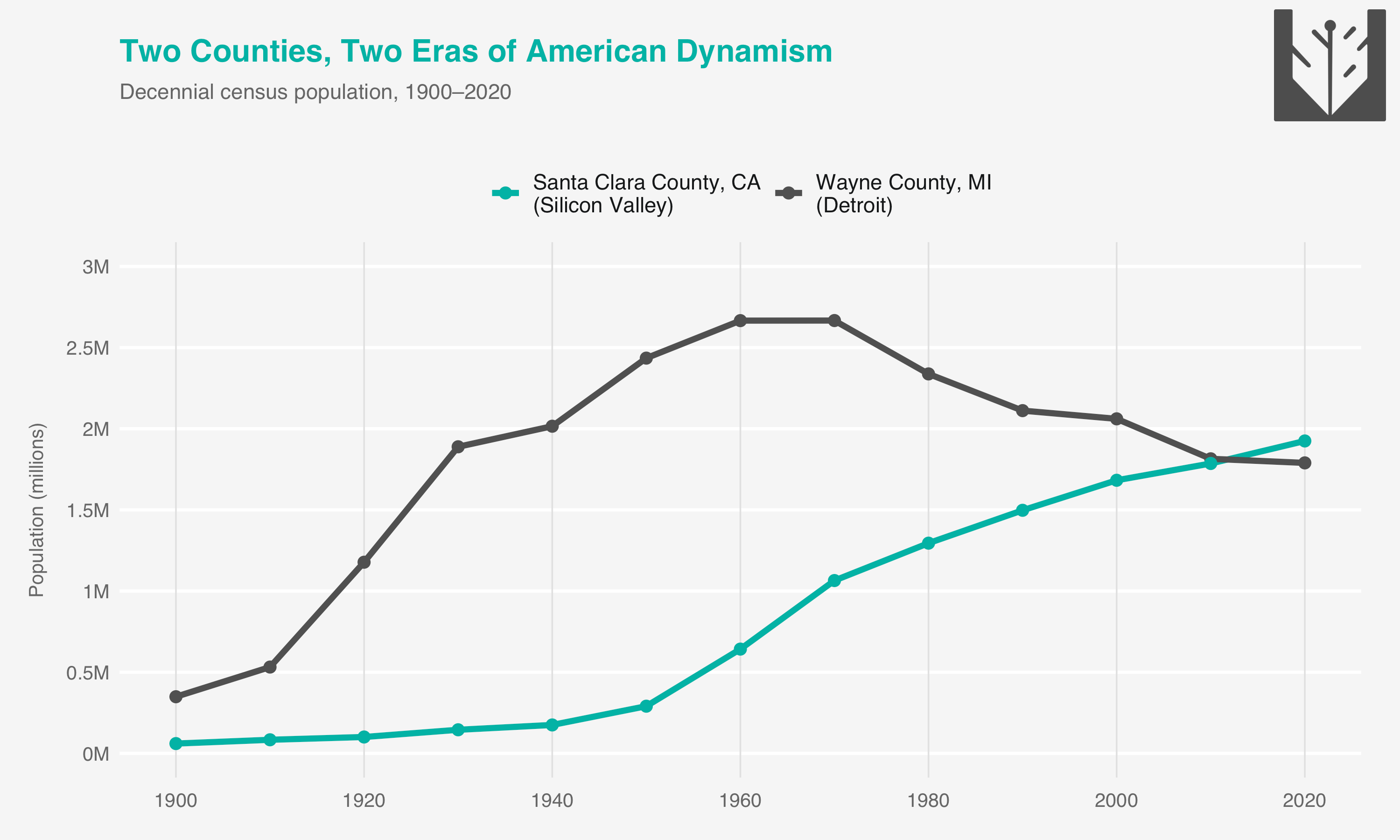
Of course, the tech boom played out in a different transportation context, with more cars and more sprawl. There are major Silicon Valley companies in San Mateo County, and meaningful spillover growth in San Francisco and in Oakland and the East Bay.
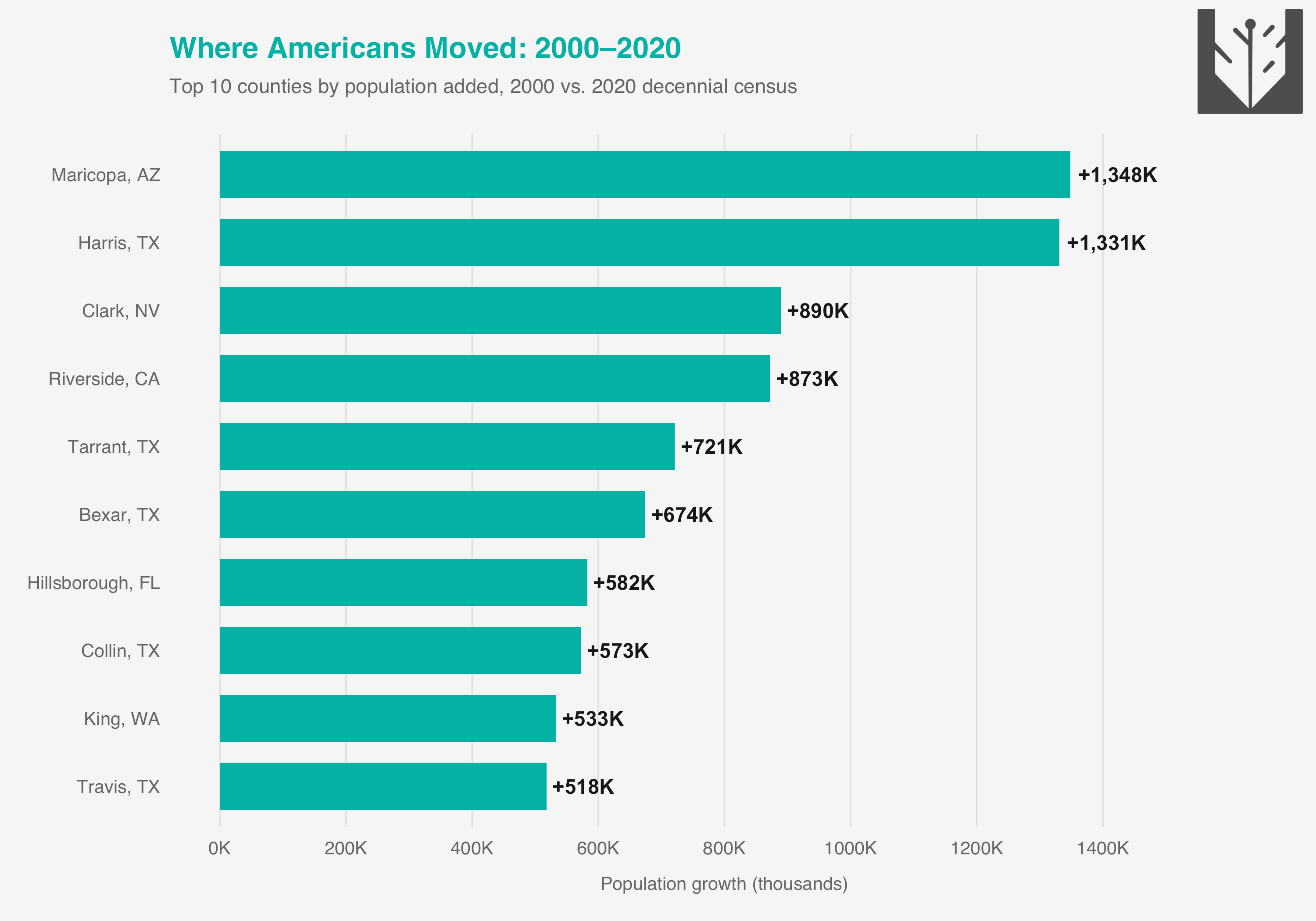
But there’s just no sign of any kind of Bay Area population boom. As high tech went from an interesting sector of the American economy to a globally dominant force, the places that saw booming population growth were Phoenix, Houston, Vegas, the remote exurbs of Los Angeles, and Fort Worth.
The three largest companies in the world by market cap are all located in the Bay Area. So is number eight and number nine, and number 10 was founded there.
But it’s not the largest metro area in the world. Or the largest metro area in the country. Or even the largest metro area in California. And that’s despite the weather and basic natural amenities there being dramatically nicer than those that greeted people who moved to Chicago and Detroit and other industrial hubs during their boom times. Alongside the trillion-dollar valuations and insta-fortunes, we in some sense should have been building a Tokyo-scale megacity, with San Francisco looking like Manhattan, skyscrapers next to Caltrain stations, and Marin County featuring the apartment towers it’s depicted as having in “Star Trek: Picard.”

Of course, mega-growth would have caused lots of traffic jams and stressed infrastructure and required the construction of new bridges or tunnels across the bay and new roads and rail lines. But it is possible to do these things. America has fast-growing metro areas. It’s just that unlike in the past, the growth is not concentrated where the economic boom is happening.
Booms without boomtowns
Americans sometimes look with envy on the rapid economic growth achieved in China during this period. But if you look at Shenzhen or any other major Chinese city, what you see is dramatic physical transformation across the course of the 21st century. That’s precisely what American public policy has been hostile to, not just in the Bay Area but almost everywhere that isn’t an unincorporated area on the fringes of a Sunbelt metro area.
To have a broad-based economic boom, we need a boomtown.
I get, of course, that “well, just move” is not the answer to the economic problems of struggling areas. At the same time, it’s just factually the case that millions of people did move during this period.
If they had moved to Mega City San Francisco Bay instead of to the suburbs of Fort Worth, almost all of them would have higher incomes. Not because they would have been rich software developers, but because they’d have been selling shovels during the gold rush — doing whatever jobs they do now, but at ground zero for global innovation.
It’s also true that the agglomerations around the tech industry itself would have been even sharper. But then beyond that, you have economic linkages across the country. You don’t build a megacity with only local resources. All of America’s manufacturing might would have gone into building the buildings and supporting the infrastructure that make a megacity. Even a dynamic as simple as “people with bigger homes would buy more appliances” would create jobs and economic opportunities for people far away from California.
Over the years, the housing supply conversation has expanded from its original focus on growth constraints in the most expensive cities to incorporate all kinds of good stuff about single-stair buildings, the “missing middle,” and manufactured housing, and that’s all great. But there continues to be unique economic value in allowing more people to live in places that are experiencing booming growth in their core tradable industries.
The fact that this doesn’t happen in the United States has greatly muted the value that the high tech sector generates for the average American, and that’s a huge problem.
Does the general population really hate tech billionaires as much as the messager class says they do? In my time amongst the normies, people seem to really like Starlinks, Amazon deliveries, and Chatpgt. What they really seem to hate are; crackheads rifling through their cars, school strikes, and rising property taxes. Someone is going to have to do a lot of explaining on how that stuff is the tech billionaires fault and not local officials.
Idk it seems kind of crazy for Krugman to assert, without any argument, that we haven’t seen huge benefits, so I’m not sure this needs to be shoehorned into the “housing theory of everything.”
Incomes have risen faster in the US than in Europe. One obvious channel: tech became a big, high-paying sector attracting high-skilled graduates. This pushed up demand for high-skill labor and wages. The extra income generated by tech was also spent on non-tradable services to a large extent, pushing up wages in those sectors as well. (Of course there are other reasons for faster income growth in the US, but it’s hard for me to believe this didn’t contribute anything.)
How would we know the counterfactual? Without building more housing, have we gotten 10% of the boom Matt would’ve expected or 90%? (I lean towards the latter.) How do we know that the story I laid out above somehow pales in comparison to Matt’s housing explanation for the lack of a boom?
(A note: Matt often talks up agglomeration benefits, but a lot of the quantifications of agglomeration benefits in econ are completely implausible garbage. Many of the Hsieh/Moretti papers, in particular, have horrible coding errors.)