


The Guardian published a piece earlier this month titled “DC’s highly qualified workers can’t find jobs: ‘What is happening?’”
The story led with the story of a former USAID officer struggling to find new employment after being laid off by the DOGE woodchipper. It strung together a few other anecdotes, alongside snippets of data, like “DC now has the highest unemployment rate in the country (6.7%), followed by California (5.5%).”
I found the piece quite aggravating, because it was sloppy with statistics in several annoyingly common ways.
For starters, while it’s sometimes tempting to compare DC to one or more of the fifty states, such comparisons invariably reveal that DC has the characteristics of a medium-sized American city rather than an American state. And in this case, while DOGE certainly had a huge impact on the area’s economy, the District itself already had a higher unemployment rate than any state back in 2024. If you look at pre-pandemic data from 2019, the District once again has higher unemployment than any state.
So while the scope of the DOGE layoffs is striking, as is the fact that DC has higher unemployment than any of the fifty states, these things are not particularly related.
One reason they’re not as tightly linked as you might think is that DC residents are a relatively small fraction of the DC metro area population.
New York City’s 8.8 million people anchors a metro area with a population of 20 million. The Washington metro area is quite a bit smaller at 6.4 million, but the District itself contains fewer than 700,000 people — it’s just not that large a share of the metro area.
And while we are the focal point of the region in many ways, Fairfax County in Virginia has both a larger population and more jobs, and Virginia as a whole has a below average unemployment rate. The jobless USAID officer in the Guardian’s story on DC unemployment actually lives in Maryland. And while Maryland’s economy has surely taken a hit from DOGE, its unemployment rate is unremarkable at 4.3 percent, tied with Louisiana and Texas for 28th place. An NBC News story profiling 13 DOGE’d federal employees and their various economic struggles, similarly, almost entirely features people who live in the suburbs.
I’d love to be able to do a contrarian take that says, no, despite what you read in this sob story about laid-off federal employees who couldn’t get new jobs, the DC economy is doing great.
Unfortunately it is actually doing terribly! The Guardian is correct that the DC economy is in trouble. DOGE completely wrecked the economy of the city, and did so without achieving anything useful for America’s budget woes. But it’s not generally because of the kind of job losses the article profiles — those of highly educated senior government workers — but because of the downstream consequences of those job losses for working class people.
The unemployment rate is not the problem
Because so many federal workers live in the suburbs, anyone trying to understand the impact of DOGE layoffs on the local economy should probably look at the labor market impacts on the metro area rather than the district alone.
There are 56 metro areas in the United States with a population of over one million, and out of them Washington ranks 27th with a totally unremarkable 4.4 percent. We’re in a three-way tie with San Francisco (the white hot center of the artificial intelligence boom) and Phoenix. The fact that the economic trends in these three metro areas don’t seem to have very much in common is probably a hint that this metric alone is not an especially informative indicator.
One issue here is that the unemployment rate is a ratio, so the denominator matters a lot. The lowest unemployment metro in America is Honolulu, which is not because the Honolulu economy is so insanely good so much as it is that nobody can afford to live in Hawaii if they don’t have a job.
People with money to spend go to visit Hawaii, of course. But if you want to live there, you need work. If you can’t find a job, you need to go elsewhere. Conversely, I don’t think there’s anything particularly wrong with the economic situation in metros like Houston or Orlando or Tampa that all have higher unemployment than DC. These are places that a lot of people are moving to, maybe speculatively in hopes of finding work or just because they’ve decided they want to go somewhere warm and relatively affordable, and it may take some time to find a job. Who knows?
At any rate, the DC area did in fact suffer catastrophic job loss over the course of 2025.
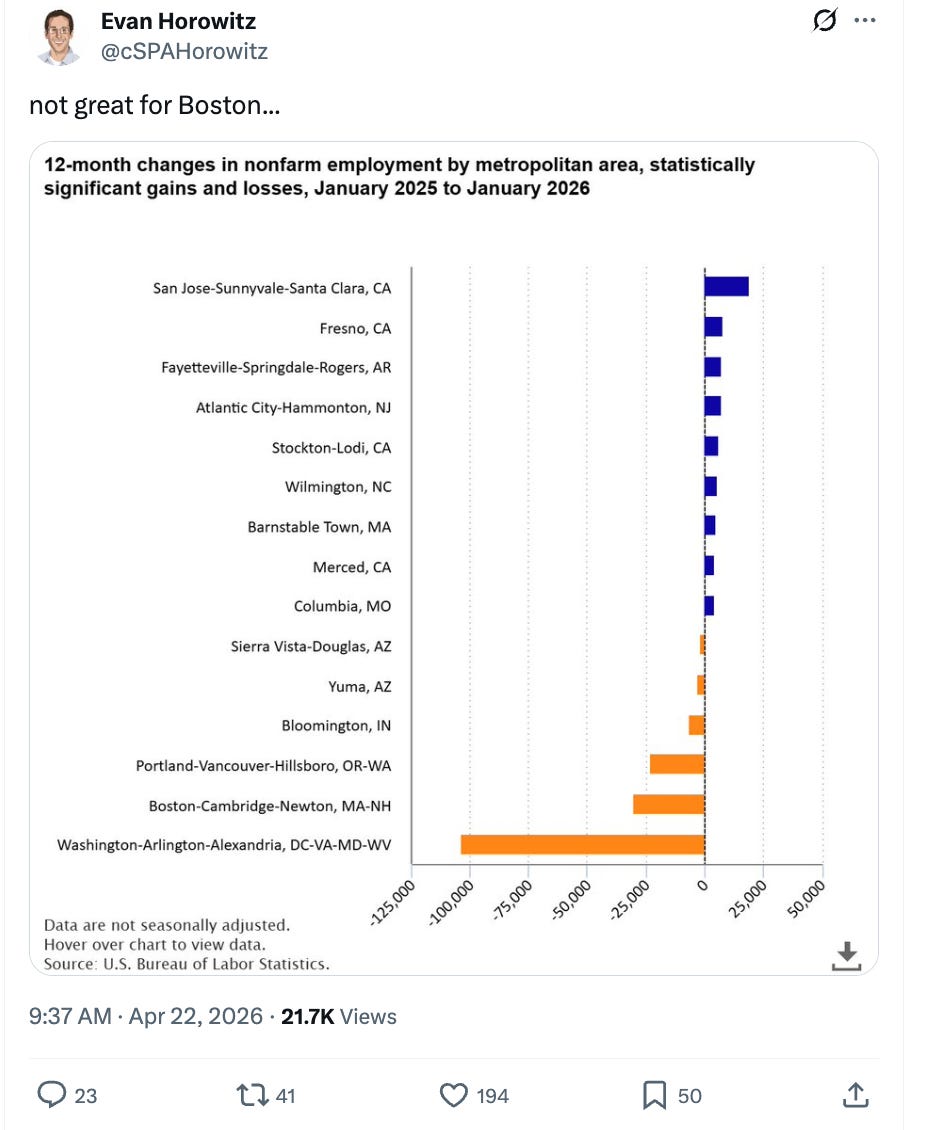
What’s kept a lid on unemployment is outmigration from DC and the suburban counties. In the District itself, we experienced a population crash during Covid and though there’s been partial recovery, there are still fewer people living in the city today than there were in March of 2020.
Labor market problems manifest at the low end
Layoffs of highly educated senior public sector workers are likely to be covered by highbrow media, but that’s not really where economic problems arise.
I know some people are eagerly peering at the unemployment rates for young college graduates, trying to figure out whether AI is hurting entry-level white collar hiring. But even if it does hurt entry-level white collar hiring, I wouldn’t expect that to show up specifically as unemployment for recent college grads. If you’re looking to hire someone for a retail job, a person with the intelligence and conscientiousness to get a bachelor’s degree is going to be an above-average candidate. It’s true that if you used to be a such-and-such at some agency, you might feel the jobs that are now available are beneath you. But if you really need work, you’ll be able to find it.
The problem is that this leaves the people who’d be getting the retail jobs in a boom locked out of the job market.
The District publishes monthly labor market data, including the unemployment rate by ward. And it’s clear that unemployment has risen the most in the poorest wards.
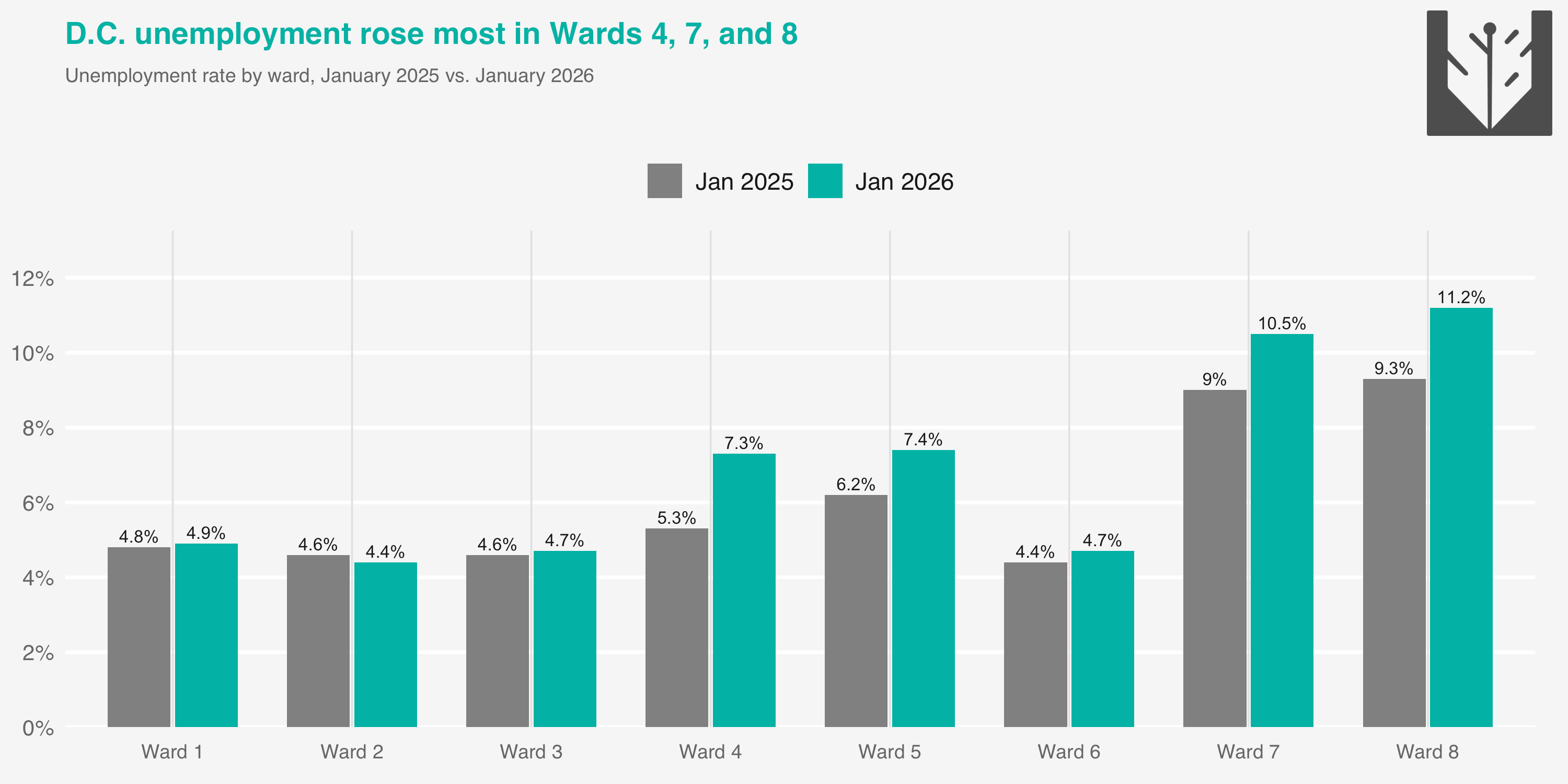
Some of this is the aforementioned outmigration. Upscale professionals who moved to DC for work are more likely to leave in response to a layoff than a working class lifelong resident.
But a lot of it is that we’re seeing a large overall contraction in the district’s economy. Most of the laid-off federal employees lived in the suburbs and don’t show up in the DC unemployment rate cited by The Guardian. But many of them worked in the district and bought meals here. They spent discretionary entertainment dollars here that are no longer being spent in tough times.
And the entire flow of funds through the service economy has slowed down — this shows up in things like the high number of area restaurants that closed last year.
If fewer people are commuting into work then fewer people are buying lunch downtown, meaning fewer people who used to work at the downtown lunch spots are going to the barber shop nearby. The people who end up suffering the most are the ones “last in line” in the broader economic hierarchy. They just don’t have affinity groups of laid-off feds to shop their stories to the media.
What was this for?
DC is like any other city. Most people are working class, and most of them make a living providing locally-facing services. They’re security guards or retail or food service workers or they cut hair or clean houses or answer the phone at the dentist’s office.
Obviously, the federal government should not spend wastefully on public sector employees just to prop up the larger economy of one metro area. But you have to contextualize the harms of DOGE against the lack of benefits. Aggregate federal spending has not fallen (or even slowed), because personnel is a tiny share of the budget that’s easily offset by things like expensive wars and higher interest payments.
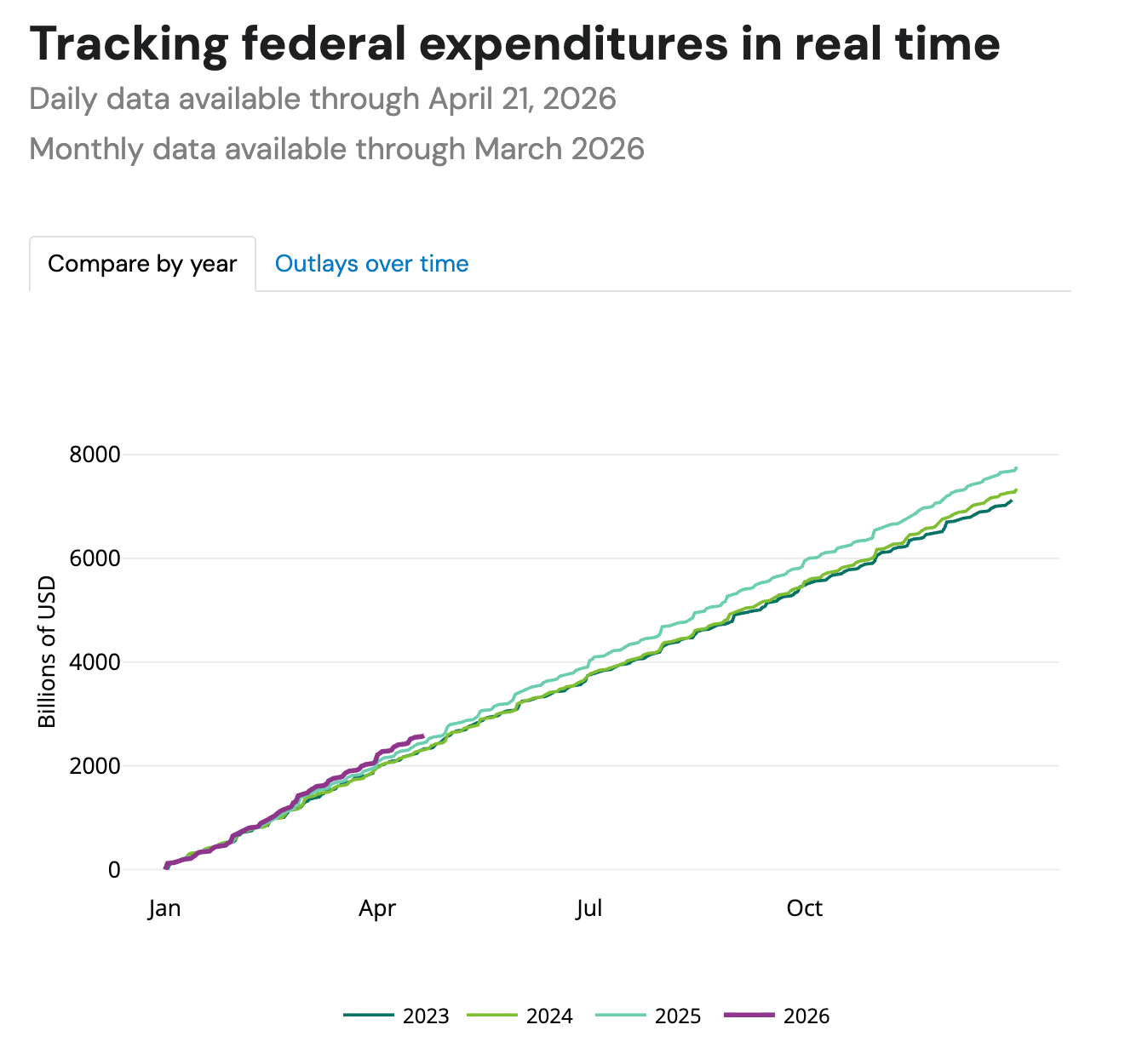
Trump’s One Big Beautiful Bill Act is adding trillions of dollars in new debt, including $800 billion in higher interest rate spending. By contrast, DOGE itself “had no noticeable effect on the trajectory of spending” according to analysis from the Cato Institute.
Again, personnel costs are just not a major part of the federal budget.
And despite “efficiency” being in the name, nothing DOGE did was intended to improve the cost-effectiveness of government. They didn’t do anything to make public sector hiring smoother, or to make promotions and pay raises more merit-based, or to improve the evaluation of the work people were doing.
In fact, they cut a bunch of grants that were dedicated to program evaluation and weakened the actual day-to-day oversight of contracts and federal spending. Kneecapping the IRS is costing the government hundreds of billions of dollars in tax revenue, leading to more borrowing and more interest rate spending. All the major claims about Social Security fraud were fake. Real fraud was identified in Minneapolis through normal channels by the career prosecutor who’d been investigating it since the Biden administration until he and several of his colleagues quit because the Justice Department was pressuring them to engage in unprofessional behavior related to the killing of protesters by immigration enforcement personnel.
Basically Trump started with two reasonable ideas:
We should reduce the deficit
We should make federal spending more efficient
He has not done either of those things. But he has kneecapped the economy of a mid-sized American city.
As is typical for most Trump Administration efforts, DOGE approached a real problem with haphazard and ineffective tactics. There still exists a need to address Government spending funneled through opaque, interconnected, crony-filled, wasteful and potentially fraudulent NGOs.
Much hay has been made of the woman highlighted in the NYTimes article making $272,000 at a USAID-funded NGO now reduced to applying for a $19/hour online job. Which, yes, seems perfectly designed as a story to induce anger rather than understanding. But it does highlight the need for effective oversight of spending, even if said spending doesn't rise to the level of Social Security, Medicare or Department of Defense (I refuse to use Department of War).
At least inmy corner of the Substack there are lots of people who feel that the discomfort of the high income federal employees who lost jobs WAS THE POINT of DOGE. The exercise was vengence for being Woke or Liberal or competent or insuffiently appreciative of crypto-IT MAGA-ism or something!