

Reminder: Paid subscribers are invited to join us this evening for our fall happy hour in downtown D.C. Full details here!
Fifteen years ago, the H-1B visa program that provides temporary employment opportunities for workers with technical skills was relatively uncontroversial.
Or, rather, the controversy was over how to respond to the fact that this one aspect of the immigration system had broad political support. Republicans wanted to expand skilled-worker visa programs, but only by cutting other visa programs; Democrats wanted to expand skilled-worker visa programs, but only as part of a broader immigration-reform package. And a minority in both parties thought that if we all agree on expanding employment visas for skilled workers, maybe we should just do that.
The wheel of history has turned, though, and H-1B discourse has increasingly focused on the program’s flaws.
Most notably, while many incredibly high-achieving people came to the United States on H-1B visas, the program is very much not optimized to attract the “best and the brightest” from all around the world. A large fraction of H-1B recipients are serving as the U.S.-based staff of companies whose main line of work is outsourcing I.T. work, usually to India, rather than helping American software companies grow.
I find this backlash a little bit misguided.
Pointing out flaws is good. Putting forward ideas for improvement is good. But the general tenor of the discourse around outsourcing, H-1B abuse, and “body shops” (basically high-tech temping firms that rent their workers out to other companies) has created the impression that this program people used to say was good is in fact bad.
But actually it’s good! Adam Ozimek and Sarah Eckhardt show that the median H-1B worker earns $130,075 per year (the 91st percentile nationally), meaning that the average H-1B household makes a net federal fiscal contribution that’s 2.6 times as much as the typical American household’s. This is a big win for the federal budget and for state and local governments and also means customers for the large majority of working Americans who provide locally facing services.
Immigration of full-time workers always generates a positive impact on the economy. When these are low-wage workers, though, there are concerns about the impact on inequality and on the fiscal balance. But the actually existing flawed H-1B program raises neither of those concerns. Even if you don’t want to believe the most optimistic research findings about positive innovation spillovers and agglomeration benefits, it’s just straightforwardly a good thing to have these high-earning workers in the country. If you took the program exactly as it existed pre-Trump, made zero reforms, fixed zero problems, and just made it bigger, that would be good.
Of course, an even better idea would be to improve the program. And if you improved it, the case for expanding would be even stronger.
The Trump administration, though, is basically just shrinking America’s skilled immigration programs under the guise of addressing legitimate concerns about them. That’s in part through a misguided effort to impose a six-figure fee on H-1B visas, which they are then exacerbating with a plan to kill off work opportunities for foreign-born graduates of American colleges and universities.
Donald Trump wants a big tax on skilled workers
From a policy-design standpoint, the H-1B visa program has two big design flaws.
One is that it relies heavily on a lottery mechanism. Applicants need to hit certain thresholds to be eligible (which is why the average earnings of recipients are so high), but the decision is ultimately made by a lottery. So while the average earnings are high, there is a lot of variation, and the government is being stingy with the visas but only slightly selective about who gets them.
The other design flaw is that while there are a bunch of wage requirements associated with the program, it’s all sort of based around a desire to avoid undercutting occupation-specific earnings. Instead of asking whether an applicant is highly paid relative to the entire wage spectrum of the United States, it asks about the salary relative to the occupational category, assuming it’s an eligible occupation in the first place.
Again, I do want to emphasize that despite this flawed design, on average the H-1B visas are in fact going to highly paid workers who generate positive fiscal effects and meaningful G.D.P. gains. But the program design is pretty flawed.
The Trump administration has proposed two changes here: 1) shifting to a wage-weighted lottery and 2) imposing a $100,000 fee on employers who get H-1B visas for people filing from abroad (many H-1Bs go to people who are already here on another visa).
The fee idea was struck down in court on the grounds that a presidential proclamation can’t create a large new tax. The administration is now trying to accomplish essentially the same thing as a regulation rather than a proclamation. I am not nearly lawyer-brained enough to tell you whether this new process will pass muster. Notably, though, the administration is also trying to impose a similar $100,000 fee on foreign students who want to work through the Optional Practical Training (OPT) program after they graduate. Even skilled people in highly paid occupations tend not to earn very high salaries in literally their first job. If you make a company pay a special $100,000 tax on hiring a foreign-born person for an entry-level job, that basically kills the OPT program entirely.
Setting that aside for a minute, the virtue of the $100,000 fee for H-1Bs is that it should eliminate the use of these visas for low-paid workers.
This makes sense as a policy goal, but think about the numbers here. The median H-1B worker is earning $130,075, which is a top decile wage in the United States. But a $100,000 fee per visa kills off not just the bottom 20-30 percent of current H-1B uses — it kills off the typical H-1B job. This isn’t taking a flawed program and improving it here. It’s shrinking the program dramatically.
Counterproductive program-design elements
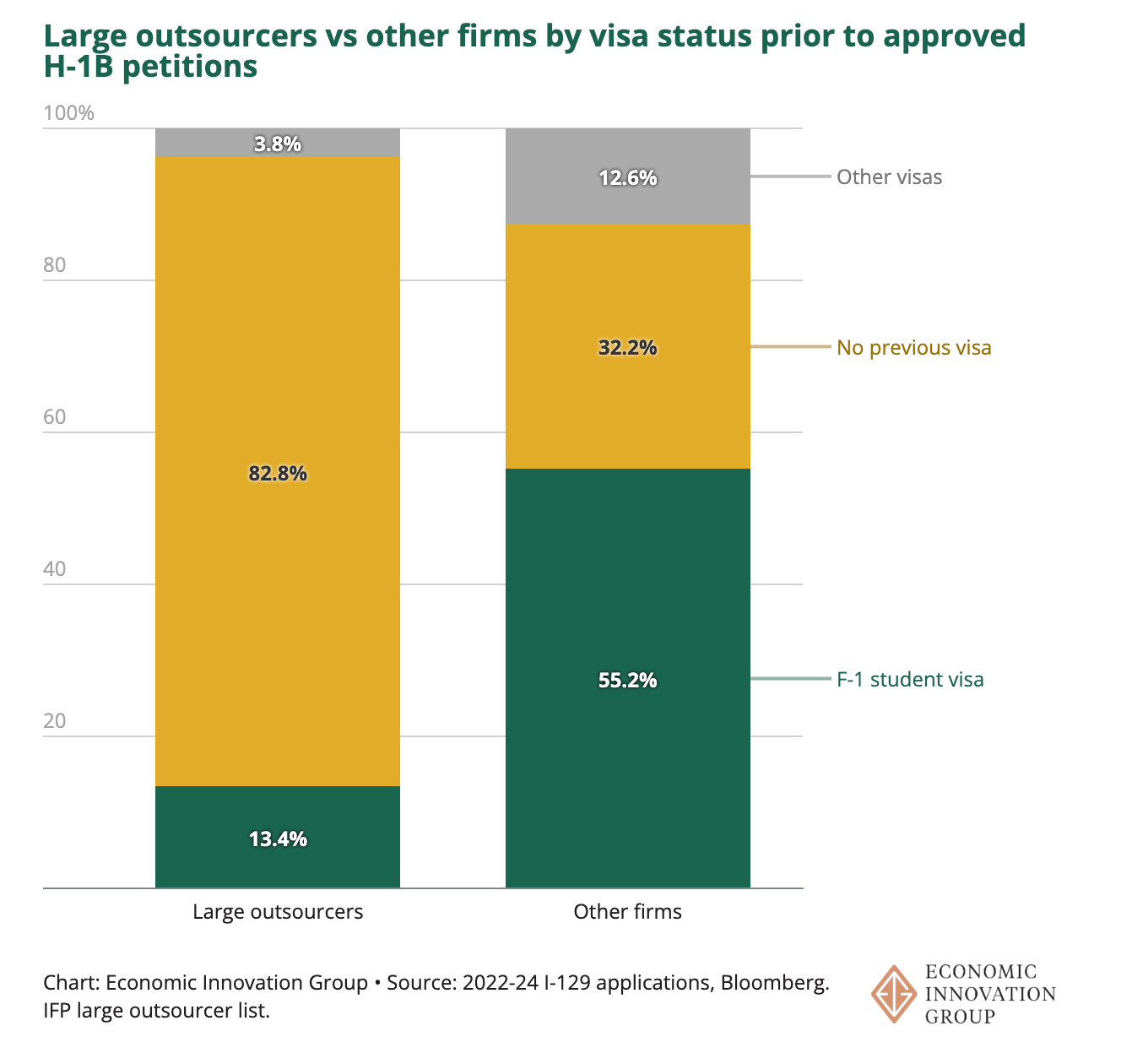
Worse, as Sam Peak and Jiaxin He wrote in an August policy brief, the move to kill off OPT actually shifts H-1B further in the direction of being a visa program for outsourcing firms like Infosys and Tata.
The reason is that American companies normally prefer to hire foreign-born workers who’ve already lived in the United States, speak English, and have other “soft skills” that make them good colleagues. Companies that are not large outsourcers normally use H-1Bs to hire foreigners who had student visas and did OPT before getting their H-1B.
But if we kill OPT, that whole pipeline collapses, and what’s left is a visa program for outsourcing companies.
It’s true that the $100,000 fee will also kill off a lot of current outsourcing practices. But this is not reallocating visas to higher-value uses. It’s just squeezing the balloon from multiple directions simultaneously.
Incorporating wage-weighting into the lottery system, meanwhile, sounds like a good idea, but the actual implementation doubles down on the flaws of the program rather than fixing them.
The problem is that the weight is determined not by the actual wage being offered but by the Wage Level, a four-part classification scheme that compares a given job’s wages to the wages paid to other people doing a similar occupation in any given labor market. You can look wage levels up using this tool. It shows that, for example, an accountant in Birmingham, Ala., earning $85,000 would be at Wage Level Three. By contrast, a chemical engineer in Atlanta earning $95,000 would be at Wage Level Two.
Now, I’m not an accountant, but I can tell you that $95,000 > $85,000. If you’re talking about fiscal contribution or impact on the national income distribution, it’s the actual salary that counts. I don’t want to be a total utopian about the efficiency of labor markets and say that salary offers precisely correspond to the economic value of the work done. But roughly speaking, if you want to weight the odds in favor of higher-value immigrants, you should just give more weight to higher-paid jobs, not do this Wage Level rigamarole.
A better way forward
A wiser path forward on skilled immigration would start with an intuition previously offered by Donald Trump: when foreigners come here to study, we should facilitate them staying after they graduate.

Back in 2015, I might have agreed with Trump’s proposal exactly as stated there. From the vantage point of 2026, though, we know that it’s a bit more complicated than this. The precedent from Boris Johnson’s unfortunate tenure as prime minister of the United Kingdom reminds us that if you turn an educational institution into an automatic pathway to a work visa, that incentivizes the creation/expansion of diploma mills as loopholes in the immigration system.
We need to have standards for allowing a former student to remain in the country, based either on the academic caliber of the student (minimum SAT/GRE score or something), the salary of the job, or both. Erecting some guardrails will let us select for bright people with good career prospects, but then we should welcome them, not drive them out with a $100,000 tax.
We should give recent graduates who meet those standards a year or two or three to work in the United States and prove themselves and perhaps switch to a new visa category.
For H-1Bs, trying to further improve the wage profile of the people who get these visas makes perfect sense. But the way to achieve that isn’t with a $100,000 tax or further monkeying around with the Wage Level. Just allocate the visas preferentially to jobs that pay more!
Right now the program does, in effect, select for highly paid workers, but we could better optimize for this and make the fiscal and economic benefits of the program even larger. I would say that since the current program is already good and the country would benefit from expanding it, we would benefit even more from expansion if we made the program even better. If it were up to me, we would make both changes simultaneously — double or triple the number of H-1B visas and allocate them by salary rather than by lottery.
But stepwise reform works, too. If you allocate the visas by salary, then the marginal candidate who just misses out on getting one would still be a very highly paid worker and the political argument for expansion to let more people in would be very compelling. It’ll be good for growth, good for the fiscal balance, and ultimately good for America.
I'm not sure if the average Trump supporter or administration staffer understands all this, but if they were ignorant of it and you explained it all to them, they would still want to cut H1-Bs.
I used to work for a large international company. We would often hire smart people from excellent schools who would have to go through the H-1B lottery after a year or two working. If they didn’t get an H-1B, they would often keep doing their job and just relocate to Canada, England, etc. So, Americans were not getting these jobs. We were just pushing these smart people with high earning potential to another country. MY’s proposal makes a lot of sense!