

There is a midterm election coming up soon, as you have probably heard, and I am hoping that Democrats will do very well in it.
One reason for this is that due to the way our political system is constructed, the Democrats I have the biggest doubts about are definitely going to win no matter what. Melat Kiros and Darializa Avila Chevalier are coming to Congress even if Democrats underperform the current polling by 11 points or whatever. But there are a whole bunch of people who I really like — Josh Turek, Mary Peltola, Adam Hamilton, Bobby Pulido, Johnny Garcia, Jamie Ager, just to name a few — who will win their seats if and only if Democrats win by margins about as big as what Nate Silver is forecasting. Indeed, the slightly stupid way the House speaker election works means that if Democrats have a huge majority, then Hakeem Jeffries will be installed with no problem, but if it’s a very narrow majority, then the hard left can block him and hold the caucus hostage to their nutty ideas. If Democrats flip the Senate, then the big story will be the senators who flipped Senate seats — Turek, Peltola, Hamilton, Roy Cooper, Sherrod Brown, and James Talarico — but if they don’t, then it’s the Abdul El-Sayed Show.
But the other reason is that I really would like to see the spell of Trump mania come to an end. I don’t hold to Obama-in-2012 delusions that “the fever will break.” But there are just tons of conservative ideological causes and policy positions that keep getting dragged down by Trump’s bluster, corruption, and incompetence. Yet the leaders of those causes have spent the past few years taking the bet that working with Trump to try to consolidate authoritarian power is their best chance forward. I think a good midterm drubbing is the best opportunity to talk them out of that and into the idea that they should try to advance a 2028 candidate who’ll stand for right-of-center policy ideas but not stand for slavish devotion to personality cult politics and endless assaults on the rule of law.
Anyway, on to your questions.
Trisha Jha: Is the idea that prices communicate useful information and we mess with them at our peril the most hated insight of Econ 101?
This goes back to something I’ve noted before, which is that it would be useful in many cases to have a clearer index of exactly what the conventional wisdom is. My sense, personally, is that the fact that we mostly don’t see a lot of price control policies being implemented is evidence that the basic point about the value of prices is pretty well-understood.
My personal vote for a widely underrated Econ 101 insight is the explanation of why a certain class of policy ideas doesn’t scale up.
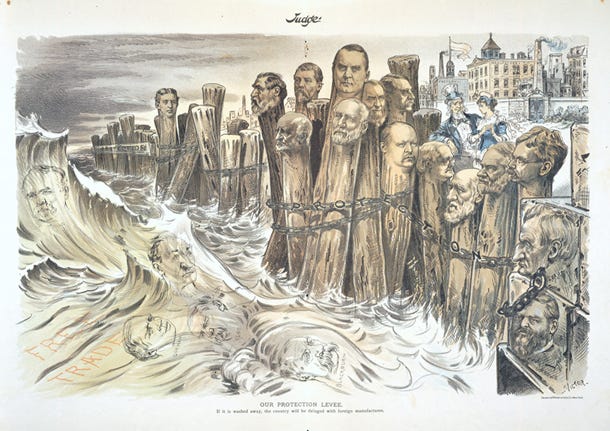
I write a Substack. If you created a cumbersome licensing system before other people were allowed to launch their own Substack, that would be narrowly good for me. Similarly, if it was illegal for Americans to read takes written by foreigners, that might also be good for me. Anything you can do with regulation, trade policy, immigration, or whatever else to block the supply of new takes helps the existing stock of takesmiths. This is pretty widely understood, and you see lots of examples of different groups of people clamoring for various sorts of protections and often getting them — or at least getting a serious hearing.
What Econ 101 tells you is that each of these moves imposes very small costs on a very large number of people, such that the aggregate costs exceed the benefits.
This means that while you can boost the fortunes of any given occupation by creating barriers to entry, doing so across a large fraction of occupations will end up making everyone worse off than if you hadn’t done it. You can help auto workers by imposing tariffs on foreign-made cars, but if you put tariffs on everything, then everyone is worse off. If you block new housing on Long Island, you can inflate home values and increase the wealth of incumbent homeowners, but if you block new housing in every desirable suburb of every city, the whole country will be much poorer on average.
What makes this insight powerful is that the people pushing for specific protections aren’t “wrong.”