
The two homelessness problems
Plus Rahm, Mamdani, and what to say about voters who might be bigoted

Something that I continue to hear not only from MAGA types but also from progressives with ties to industrial labor unions is that economists discredited themselves with doomsday Liberation Day predictions that didn’t come true.
I’m sure that there were some economists who overstated things. There are a lot of economists out there, and an unfortunate reality of the contemporary media climate is that whenever anything happens, the most overblown reactions are disproportionately likely to get attention. But the truth is that the tariffs announced on Liberation Day were swiftly rolled back, and what we actually landed on were tariff increases that were less than half as large as what Trump originally said.
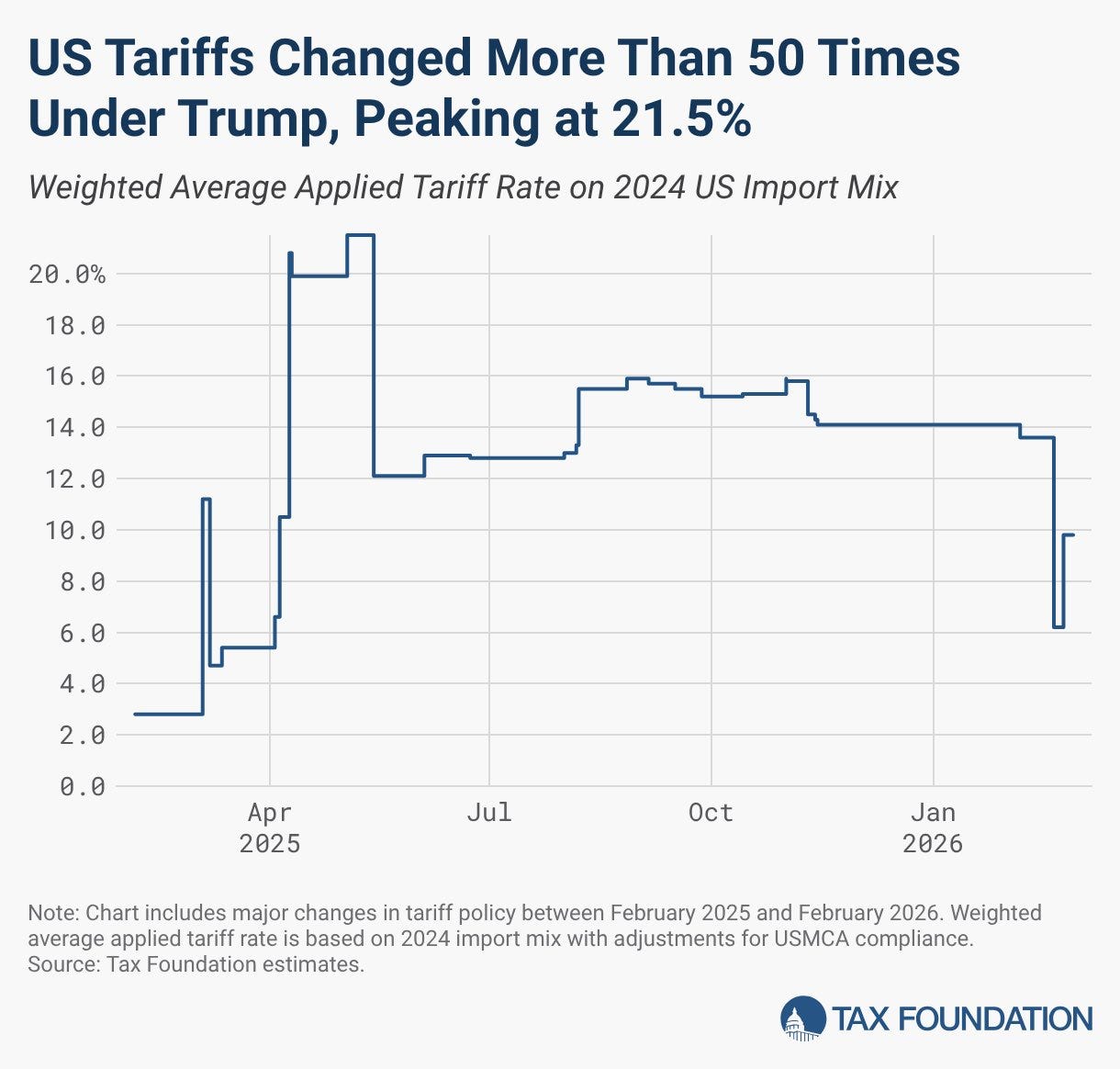
Would the impact of Trump’s original plan have been catastrophic? It’s hard to know for sure. But not only did a lot of economists say it would be, the Trump administration itself appears to have decided that the critics were correct, which is why they didn’t implement what they initially announced. It’s of course possible that the administration got this wrong and much higher tariffs would be fine. But if that’s what you think, you should take it up with them!
Swami: What should blue states do to solve the problem of hard-core homelessness (those that are mentally ill or addicts/alcoholics)? Is this even politically possible?
I always find the homelessness conversation a little bit cursed because a lot of it founders on semantic issues or people talking past each other.
What it means to be homeless is to not have a place to live. Homelessness, as a problem, is mostly driven by the economics of housing. A large share of the homeless population, as measured in various surveys, is gainfully employed. Quantitatively, the biggest driver of homelessness is the cost of housing.
This manifests in two ways. One is that low-end, very cheap housing has largely been made illegal in the United States, which creates problems for people who run into financial difficulties. A second is that when average housing costs are high, people are less likely to have spare space in their homes where a friend or family member could crash. So when you get an upsurge in housing costs under these conditions, you get a rise in homelessness: people sleeping in cars, people sleeping in shelters, and various other bad economic circumstances.
The solutions to this problem are fundamentally in the housing policy space. By which I mean generalized housing policy, not the specifics of subsidies or policies targeting homelessness. In a country that was both more open to new, upscale market-rate construction and also more open to low-end housing typologies (which would probably mean conversions of old structures in low-demand areas rather than new builds) we would have dramatically less homelessness.
That being said, when most people talk about homelessness, what they’re typically interested in are nuisances caused by people out on the street, in parks, or on mass transit.
The nuisances in question are normally actual nuisance behavior that appears linked to drug/alcohol addiction, severe mental-health issues, or both. Over and above disordered behavior, in an environment where people come to worry about disordered behavior by addicts or the mentally ill, the mere physical presence of a homeless person can spark fear. If you don’t have confidence that behavior is being effectively policed, then you worry about how the guy sleeping on the bench is going to behave when he wakes up.
I think it’s important to note that while, in my experience, people conventionally refer to the kind of disturbed individuals we are talking about here as “homeless,” that judgement is typically made without actual inquiry into their housing status.
I wish that we had a term that actually fit what people are talking about. There’s a little stretch between my house and our office in D.C. where I frequently see people wandering around who seem like they have some serious problems. But I have no idea whether they’re sleeping on the streets or have shelter space available to them at night or if they’re in some kind of subsidized housing situation.
As a humane person, I hope their living conditions are more on the pleasant side of the spectrum. I grew up in New York in the 1980s, so don’t personally find their presence all that alarming. But I also think it is clearly net negative for the business climate on that street to have them out there, and it’s the kind of thing that discourages people from living in and (especially) raising kids in the city.
All of which is to say that especially with the murder rate declining sharply, I would be favorable to policing behavior on the streets more strictly and having options to coerce people into treatment if they are routinely misbehaving in public spaces.
We should be real, though, that this would be expensive; it’s not like a “fix everything switch” where a little minor application of willpower would make the problem go away. I think most of the country has reached a kind of corrupt bargain where, instead of spending money on fixing things, politically moderate and conservative jurisdictions dump the troubled people onto progressive jurisdictions where the residents either tolerate it or leave.
The solution is to be both stricter and also more generous. And to acknowledge that the problem of people behaving inappropriately in public space is not actually the same problem as homelessness.
Joseph: You’ve described Kamala Harris, Gavin Newsom, and JB Pritzker as broadly similar types of Democrats: successful in blue territory, but not especially impressive politically. Where does Rahm Emanuel fit in your taxonomy? Since he’s openly pushing Democrats toward the center of the electorate, do you think he represents a real alternative for the party, or is he overrated in basically the same way?
I’ve enjoyed most of Emanuel’s takes on the quasi campaign trail for 2028, but I also find his desire to put himself forward as a candidate to be a little bit selfish and annoying.
I don’t think we need the banner of moderation and reform to be carried by a guy who served in the Clinton, Obama, and Biden White Houses. And realistically, if he starts to get traction, we’re going to end up relitigating Laquan McDonald and some other not-so-great calls he’s made in the past. The party needs fresh faces and it needs change, and the case for Emanuel isn’t that he represents that kind of renewal, but that he offers a different ideological direction. I don’t think that’s enough. I’d love to see Emanuel share some of his wisdom and experience and perspective with a contender who’s a bit younger, but I don’t think he’s a viable candidate himself.
Michael Adelman: Is it time to be a lot less indulgent of the left-factionalists? The embarrassing Code Pink trip to Cuba included members in good standing of the Bernie Extended Cinematic Universe like Ryan Grim, Kate Willet, and Hasan Piker, and this clarified for me that associating with these people is politically toxic. Slow Boring has at time been sympathetic to the BECU — and I take your point that the Dem establishment is bad. But what makes the Dem establishment bad is primarily that all mainstream and frontline Dems need to move dramatically to the right on cultural and energy issues, and the BECU is a singularly unhelpful force in this regard. Sure, vintage Bernie had his moments of cultural moderation to make progress on economic policies ... but it’s not like he is out there now telling people to appreciate Jared Golden. As a factional figure, he and his movement have pushed across-the-board ideological maximalism on behalf of an affluent and geographically concentrated support base. And the BECU has brought many bad habits of mind — sloppy policy thinking, hand-waving away trade-offs, proclaiming that all disagreements reflect corruption, using alienating rhetoric, ignoring clear data on left-wing electoral underperformance, etc. At this point, shouldn’t moderate Dems just confidently oppose these people?
I think a lot of these people are bad in roughly the way that you describe.
But the point I keep trying to make about this is that obsessive focus on freezing out the left is precisely how the Democratic establishment got too left-wing. I don’t think A.O.C. should be the nominee in 2028. But I also don’t think we should be so terrified of A.O.C. that the whole primary is moderates rallying around Gavin Newsom as he runs around the country pandering to all the groups to shore up his left flank. That’s what Democrats keep doing and it keeps not working. So I’m all for “opposing” them, but the question is what does that mean? To me, it means backing someone who is running on good ideas and accepting that the primary voters may not want that. But we need to try.
Joseph Stern: Matt has recently been leaning in to having Dems come out agreeing with the far left/progressive anti-Israel views and stay moderate on other issues. I understand the argument that Dems should just embrace issues that are popular, and right now it’s popular to be anti-Israel. But, at the same time, Matt has raised the issue of rising antisemitism, where polls show that a majority of young people straight up have a negative view of Jews. While of course it is possible to criticize Israel without being antisemitic, the rising unpopularity of Israel is surely strongly related to rising antisemitism. So is the conclusion that we should just embrace rising anti-Israelism and the connected rising antisemitism simply because they’re popular/poll well?
Antisemitism is unquestionably rising, especially in younger cohorts, but it continues to be very unpopular even in those younger cohorts. This is almost certainly “related” to the increasingly negative view of Israel among the mass public, but the numbers are genuinely very different.
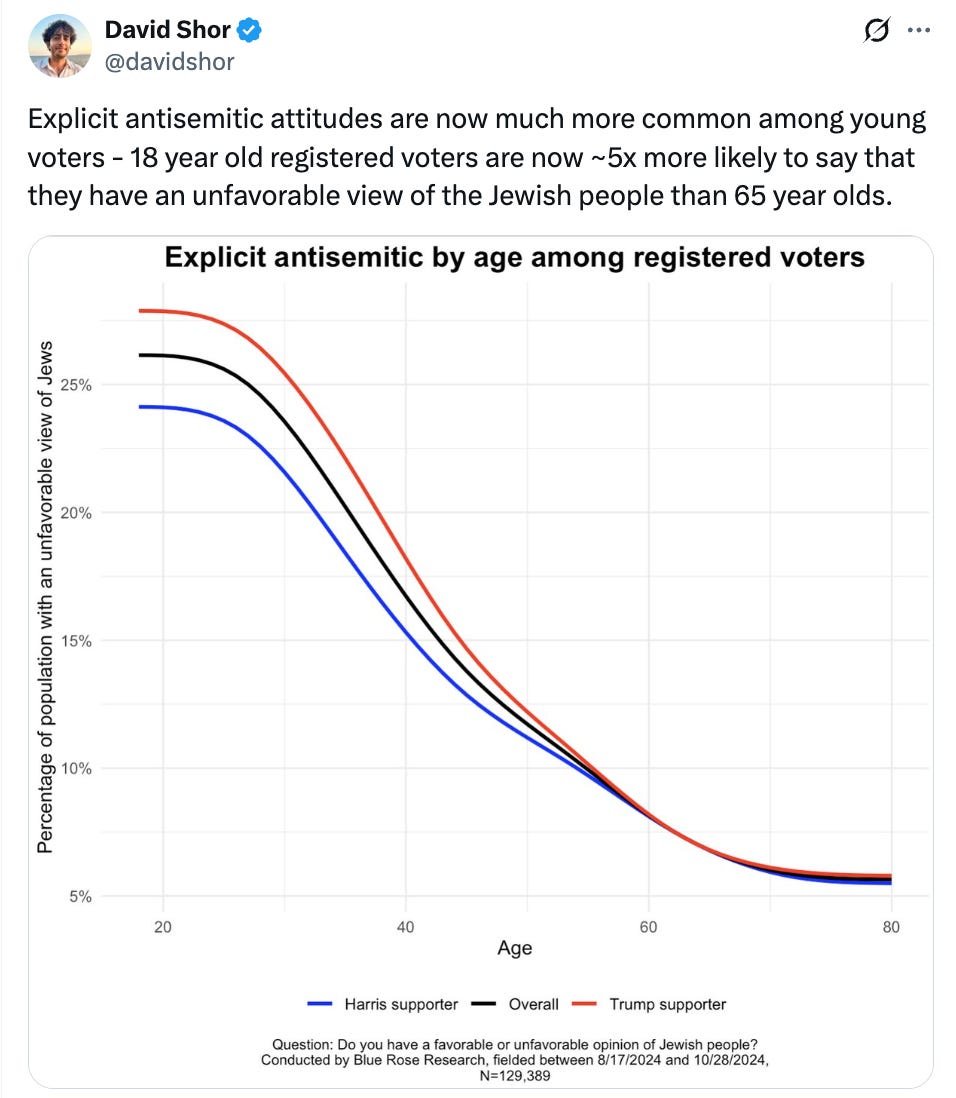
I would also note that it’s not exactly “popular” to be anti-Israel. It’s just that the polling on anti-Israel is fine. There are lots of issues — affirmative action, education reform, toughness on crime, and illegal immigration — where the political upside to moderates winning the factional argument is large. On Israel, it’s basically nonexistent.
I do not approve of antisemitism and don’t think Democrats should embrace hatred of Jews or insane conspiracy theories about who killed Charlie Kirk. But this war in Iran is very bad.
I wouldn’t say the whole war is entirely Israel’s fault, but it’s not not Israel’s fault, if you know what I mean.
Not just in the narrow sense of the decision to go to war, but in the sense that Netanyahu was a key player in the decade+ campaign against Obama’s nuclear diplomacy effort. I have a great deal more substantive sympathy for Israel’s response to 10/7 than is typical in progressive conventional wisdom. But it’s still true that since Tzipi Livni left office in 2009, Israel has consistently failed to pursue any political solution to the conflict and that’s bad.
I do not particularly want the United States of America to try very hard to coerce Israel into changing its view of this, but I also don’t want the United States to be directly subsidizing this irresponsible behavior or (as has happened more recently) actively joining in a very misguided military adventure. I think that’s about where the voters are. And if American Jewish institutions were smart, they would see some wisdom in adopting that approach, too.
The Israeli government, for better or worse, clearly makes these decisions based on its own assessment of Israeli interests without regard for the opinions or interests of the diaspora. That’s fine — it’s a foreign government. But that’s a two-way street.
Tibita Kaneene: How should a rational dem allocate $100 give today between Senate general elections in AK, IA, OH, and TX, if the goal is at least 51 seats and one is indifferent about the composition. Other assumption is that dems win NC, ME, MI, and GA, so only need 2 of AK, IA, OH, and TX.
I would do two things. I would give $100 to Mary Peltola and then I would send a note to the D.S.C.C. documenting the donation and saying, “I know that Chuck Schumer is under tremendous pressure from green donors and also that Schumer places enormous value on fundraising. But we all know that Mary Peltola is the best possible recruit for a Senate run in Alaska and we all want her to win that race, and as a Democratic Party donor I would desperately like Chuck Schumer to publicly affirm that if Democrats win the majority, Mary Peltola and not the League of Conservation Voters will be making the calls with regard to Alaska’s natural resources.”
Steve: As a literal minded person, do u not think the level of goodwill from certain centrist Dem factionalists about Mamdani is inexplicable based on policy and not proportional to his level of moderation? I’m thinking of prominent anti-leftists like Josh Barro, Ben Dreyfus, Tim Miller, Nate Silver, Searchlight guys, even Jesse Singal as well as centrist wonks like Alex Armlovich and Matt Zeitlin. I think you’ve been more reserved and Noah Smith seems to be really bothered by far left foreign policy stuff so he seems to be the only one in this space that doesn’t like Zohran. I would’ve expected the level of underlying hostility expressed by Noah Smith to be the norm and not the exception for the dynamic between factional moderates and Zohran. It seems to me they’re giving him the benefit of the doubt because they seem to just like the guy, undermining your thesis of charisma only working on your base?
I think you are underrating a few things:
Mamdani, for starters, openly courted abundance-minded moderate skeptics during his primary campaign and genuinely established himself as better than Andrew Cuomo on a critical urban topic.
He was also vulnerable on the basis of his record of soft-on-crime statements. He explicitly disavowed those statements and then made good on the disavowal by re-appointing his tough-on-crime predecessor’s well-regarded police chief.
He opposed the union-backed effort to end mayoral control of the school system, and has flipped to favor merit-based admissions to the city’s selective high schools.
What makes it easy for open-minded moderates to take “yes” for an answer from Mamdani is, of course, that the city doesn’t actually have any authority to implement his tax proposals. So in practice, he’s going to do on fiscal issues exactly what a moderate mayor would have to do — namely make difficult choices and deal with the objective politics on the city council.
None of this means that Mamdani has remade himself as a moderate or that Democrats could position themselves like Mamdani and win in Iowa and Texas. But it’s New York City, so anyone who wins is going to be pretty left-wing (Rudy Giuliani was not only pro-choice and anti-gun as mayor, but also pioneered the “sanctuary city” concept).
But he’s done what basically no other left-factionalist has and actually tried to address some of the concerns about him.
That’s a huge contrast with Bernie Sanders’s 2020 campaign. At the moment when it looked like Bernie stood a good chance of winning, I encouraged him to try to make some conciliatory noises and reach out to mainstream elected officials. Instead, he doubled down on rhetoric about overthrowing the establishment, which naturally led them to close ranks against him. Abdul El-Sayed in Michigan is just hoping to muscle his way to a plurality win in a three-way primary without even trying to appeal to the median Democratic Party primary voter.
Mamdani, on the other hand, is doing normal politics.
He’s picking a couple of priorities and showing flexibility on non-priority areas. He’s not just “not running on” de-policing; he’s saying he’s changed his mind. He’s not suddenly my favorite politician in America, but it’s a positive example that a lot of people could learn from.
BronxZooCobra: There is an infamous scandal in the UK the press called Bigotgate. Gordon Brown, the PM, was talking to a median swing voter in the UK and got into his car still hooked up to a wireless mic. He said, “Oh that awful bigoted woman.”
On the left there seems to be some performative virtue signaling where even engaging with the idea that a given swing voter might be pretty racist is just beyond the pale.
I think it is genuinely unhelpful for politicians to “go negative” on the electorate in that way, but I also take the point that you can’t really do politics if you can’t be realistic about the fact that some voters — including voters whose votes you want to win — may have some problematic views.
The way that I would encourage people to think about this constructively, though, is that most voters are not super-engaged with big-picture ideological constructs and are instead kind of selfish and parochial.
In the contemporary world, people who get interested in progressive politics are trained to try to avoid talking parochially. I’m reading Betty Friedan’s classic “The Feminine Mystique” right now and one striking aspect of it is that unlike a contemporary feminist, she is not stopping herself every five pages to acknowledge her privilege as an affluent white woman living in the developed world. I have a take on why that is that I’m not going to get into today, but suffice it to say that a contemporary progressive intellectual would not write that way. It’s important, internal to the dynamics of progressive politics, to show yourself to be intersectional, broad-minded, and aware.
Most voters aren’t like that.
When you think about a voter who has serious doubts about both parties, that person isn’t likely to be doubting the depth of Democrats’ commitments to intersectionality; they’re doubting whether Democrats will make life better for themselves and their family.
In a country where most of the electorate is white, spending a lot of time talking about the depth of your commitment to helping non-white people can suggest “Well, he doesn’t care about me.” The party that is stereotyped as caring a lot about various marginalized groups especially needs to try to persuade median-ish people that it cares about them.
This is, I think, what Democrats intend to convey with anti-billionaireism — the idea that they are standing up for everyday people’s economic interests. But everyday people’s economic interests include things like cheap electricity, straws that work, not having their kids discriminated against in college admissions, not having unpleasant encounters with insane people at the park, and not having local public services overwhelmed by people making asylum claims. Some of the concerns people express about this stuff may shade into bigotry at times, but I think the more generous construal is really just that people want the state to take their interests seriously.
Mamdani also not just totally reversed his position on homeless encampment sweeps but also got the NYC DSA co-chair to defend the sweeps on Brian Lehrer’s show lol
The answer about homelessness doesn’t quite seem to address the question. I’m sure the guy who asked it was aware that some of the “homeless” do have places to live. The homeless issue really hurts Democrats because not only are they not fixing the problem, but they seem committed to actually making it worse by doing absolutely nothing to prevent homeless people from completely taking over public infrastructure. Admittedly Democrats in office have made progress in this area over the past 3-4 years, but much of the rhetoric on the Left is still supportive of the theory of homelessness that held that clearing homeless encampments was unconstitutional and that is still probably the view from the left most often heard on the issue.