

This is the second of an ongoing series; part one is here.
In July of 2018, Chris Hayes released an episode of his podcast featuring Nikole Hannah-Jones, who at the time was best known for her reporting on school segregation. Hayes introduced the topic with a discussion of the achievement gap (emphasis added):
Hello, and welcome to "Why Is This Happening to Me?" with your host, Chris Hayes. So if you pay any attention whatsoever to education, to education policy to talks about education, you will hear this phrase all the time which is called the achievement gap. The achievement gap is the central problem at the core of modern education debate and policy, and it's the problem that all the conversation is meant to solve. And what is the achievement gap? The achievement gap is that white children in America and black children have a gap between what their test scores and their achievement are.
And sometimes that gap, depending on how the data is run, even controlling for things like socioeconomic status or income, you see this persistent gap between white children and black children. In fact, that was the whole No Child Left Behind Act was meant to get rid of the achievement gap. Charter schools, get rid of the achievement gap. School choice, right? It's vouchers, get achievement gap. Betsy DeVos' program, get rid of the achievement gap.
This conversation is from just five years ago, but the way we discuss (or don’t discuss) the achievement gap — the fact that Black and Hispanic students score lower on standardized tests than white and Asian students — has completely changed.
That’s in part because the phrase itself has gone out of style. But it’s also because the whole idea of emphasizing kids’ performance on tests of their reading and math skills now seems extremely old-fashioned. A K-12 education controversy in 2023 is overwhelmingly likely to feature conservatives complaining about excessively woke programming versus progressives complaining about conservative censorship. You might hear a debate about the presence of police officers in public schools or about admissions to selective schools. George W. Bush infamously kicked off the education reform era with his gaffe, “rarely is the question asked, is our children learning?” And during his presidency and Barack Obama’s, that question was asked quite frequently. These days, though, Bush’s observation seems relevant once again —we actually don’t ask it much anymore.
In his monologue, Hayes also clearly associates the achievement gap discussion with things progressives dislike (charter schools, school choice, Betsy DeVos).
The thesis of the episode is that school integration is a better, more progressive way to close the achievement gap, and perhaps there’s a world in which the progressive movement unites around this competing vision. Instead, we’ve largely moved on from talking about the issue. This is too bad, because the achievement gap continues to be a noteworthy feature of American society.
The education pipeline is a big deal
While the achievement gap has sort of disappeared as a topic, there continues to be a lot of public discussion around questions of representation and diversity in various high-profile roles.
It’s completely fair for individual institutions to face scrutiny over their internal practices that may lead to a lack of diversity. At the same time, we live in a country where Black students graduate high school at a below-average rate. They have below-average GPAs in high school and below-average SAT scores. Due to affirmative action, Black students are only modestly underrepresented at the very most selective colleges (ones with average SAT scores of around 1400), but as a result they are massively underrepresented at modestly selective colleges (ones with average SAT scores in the 1000-1200 range).
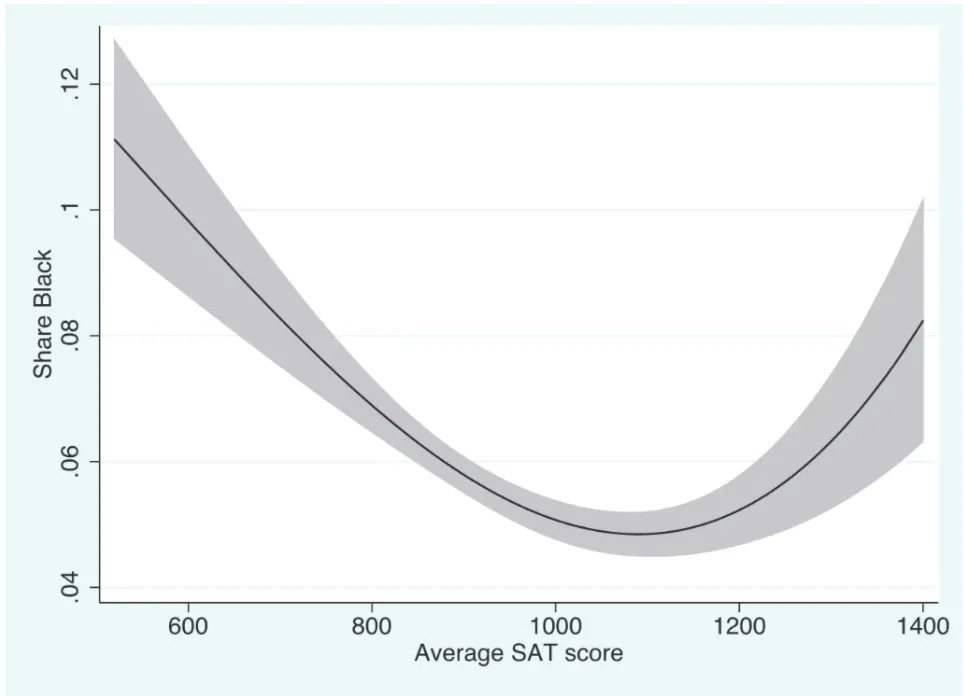
The upshot of this is that the kinds of institutions that are hiring graduates of somewhat selective colleges are fishing in a pool with a much smaller share of Black candidates than the general population.
Under the circumstances, it’s inevitable that the vast majority of American institutions will have a “diversity problem” as conventionally defined.
Diversity considerations aside, graduates of selective colleges also tend to have above-average incomes while high school dropouts have below-average incomes, so the gap in educational attainment directly relates to gaps in income. And to the extent that we believe education has important non-pecuniary value, the focus on income will understate the significance of the gap in educational attainment.
I think Obama’s framing of school quality as “the civil rights issue of our time” was probably a bad idea. But in the literal sense that people go to school when they are young and then do other things later in life, educational inequality is, mechanically, the precursor to many other forms of inequality. And it’s challenging to have a coherent discussion about anything related to racial inequality in the United States that doesn’t at least acknowledge the point that the achievement gap, per Hayes’ account, was at one time a major focus of the public discourse. I’ve argued previously that suppression of the pipeline discussion has become a major source of dysfunction inside progressive nonprofits. Each institution that employs graduates of selective colleges overrepresents white and Asian employees on its staff, which leaves it presumptively guilty of racism. A scammy class of DEI consultants exists to “solve” the problem. But because the issue has much more fundamental roots than any one institution’s internal practices, places like college campuses where progressive values are hegemonic don’t actually achieve diverse faculties — they just build enormous DEI bureaucracies.
That’s in part the legacy of having abandoned education reform. Yet at the same time, the education reform claim that schools could close the racial achievement gap was an exercise in massive overpromising.
School management only matters so much
Here are three propositions about K-12 education:
Many public school systems, especially the ones attended by low-income Black and Hispanic students, are sub-optimally managed.
Changing these sub-optimal K-12 management practices — reforming them —would be a good idea.
Implementing these reforms would mean Black and Hispanic students’ scores would improve to be on par with those of white and Asian students.
Propositions one and two seem extremely sensible; proposition three seems like a wild over-extrapolation of how much K-12 school system management could possibly matter. I think a big tell here is that Asian students do better on average than white ones, and as far as I know, nobody has ever argued that education reform is going to close the white-Asian test score gap. I’m not sure that we know (or need to know) exactly why Asian students — on average — do better, but it’s pretty clear that a large share of the gap is due to factors that arise outside of the school.
By the same token, Black students are more likely to grow up with above-average levels of poverty, below-average levels of wealth and income, above-average rates of single-parent households and other signifiers of family instability, and below-average levels of parental educational attainment. If you described any subset of the population that had those characteristics, you’d expect the kids to perform worse-than-average in school. You can debate how those disparities arise or what else might follow from them, but the broad facts are really pretty clear. And while obviously the quality of the school that you attend and the level of attention that the school gives to you individually is a big deal, all these other things are also a big deal, and it was pretty crazy to act like the school system could single-handedly fix everything.
But this was deeply embedded in the culture beyond the specifics of the education reform debate. On “The West Wing,” Sam Seaborn expresses the standard progressive view that what schools need is more money, not reform — but they also have him arguing that “education is the silver bullet.”
But is it? How much sense that does really make?
Hayes argues that the achievement gap is the gap between the results obtained by students at certain schools and the students at certain other schools, and thus the gap could be eliminated through integration:
So when you talk about the achievement gap, here's what you mean. You got separate schools in America, right? Different groups are going to separate schools, but even though they're separate, they should be equal. So the debate, the logic around the achievement gap, the entire logic of every conversation we have about education almost entirely is a logic of how do we take all these separate schools in which by and large white children and black children go to separate schools, how do we make those separate schools equal? How do we get to separate but equal? Separate but equal? Yeah. Exactly. That phrase. That's the phrase. That's the Plessy v. Ferguson phrase. That is the phrase that is the conceptual bedrock of segregation and Jim Crow. It's the con, it's the shameful, insulting, bad-faith con at the heart of a legal regime that was legalized apartheid in America. And the con at the core of legalized apartheid in America was that just because you separate people, doesn't mean that it's necessarily unequal.
I’m all for integration (check my kid’s school!), but I don’t think this is completely true. His guest on the program, Hannah-Jones, is an incredible optimist about the power of school integration, but the claim in her work is that integration cuts the achievement gap by half.
In other words, even in an integrated program, white students are doing significantly better on average. And that’s what’s driving a lot of present-day controversies about the racial equity implications of gifted and talented programs, or tracking for math classes, or special high schools that you need to take a test to get into. If the public schools were totally segregated, then tracking wouldn’t generate any controversy — the top third of the class at an all-Black school would by definition be made up entirely of Black kids. The issue arises because when schools or school districts are integrated, sorting is seen as re-introducing segregation since the achievement gap doesn’t vanish even if integration reduces it.
The recalibration we should have gotten
It was George W. Bush who kicked off the fad for calling changes to K-12 school management “the great civil rights issue of our time” in a Martin Luther King Day address that I think was pretty transparently cynical. Back on January 19, 2002, he made that claim while also saying “we have overcome the institutionalized bigotry that Dr. King fought — now our challenge is to make sure that every child has a fair chance to succeed in life.”
Bush was a Republican who was trying to improve the GOP’s performance with non-white voters without committing himself to anything ideologically unacceptable to his base.
Education reform — agreeing to increase federal education spending a modest amount in exchange for management changes that teachers unions didn’t like — was a perfectly plausible candidate for that role. In the course of things, he oversold the merits of his ideas somewhat, which is pretty normal politics. But somewhere along the way, things got out of control. Obama picked this rhetoric up as well, West Wing characters were talking about silver bullets, and as Hayes observed, we got such a monomania about the achievement gap that, on a rhetorical level at least, it sometimes felt like that was the only thing you were allowed to say mattered in education policy.
This got a little bit weird. Washington, D.C. implemented education reforms, and after the reforms took hold, test scores went up across the board. Yet rather than being celebrated as a success story, we got negative headlines in 2018 and 2020 about how achievement gaps weren’t closing. But it was because everyone was doing better!
I think a sane recalibration of the achievement gap discourse would have featured the following points:
There is a lot of evidence that racial discrimination continues to exist in the United States and that past discrimination has an ongoing legacy that has not, in fact, been “overcome.”
There are a lot of influences on school performance that are driven by material circumstances, parenting attitudes, culture, pollution, and other factors that are beyond the control of teachers and school administrators.
K-12 education in the United States is deeply shaped by segregated neighborhoods but more broadly by the practice of auctioning access to particular schools via the real estate market, and this is more a housing policy issue than something public schools can fix.
Everybody wants their kid’s school to do better, so it’s hard to sustain a super-literal focus on “gaps” that implies it’s bad if all the schools get better the way they did in D.C.
K-12 education policy does matter. DCPS changed teacher compensation practices and the results got better. New Orleans totally restructured its public schools and the results got better. Some charter school franchises deliver consistently above-average results.
With those five points in place, I think the stage was set for a semi-comeback of some more traditional progressive ideas alongside reform. It turns out that giving kids nutritious school lunches makes a difference. So does equipping schools with air conditioning. So does air pollution.
Broadly speaking, the left was in fact right that spending money on schools makes a difference. But the center was also right that how you spend the money matters and that certain structures deliver much better results than the standard system of geographically-zoned schools and seniority-based teacher pay. But the center did not hold.
The backlash we got
Instead of recalibrating, the idea that closing the achievement gap is important completely collapsed.
When Ibram Kendi published his 2016 article “Why the Academic Achievement Gap is a Racist Idea,” he was not yet a well-known figure, and the idea he was articulating was marginal. But the book he published that year, Stamped from the Beginning: The Definitive History of Racist Ideas in America, won a National Book Award and was a big success. The book isn’t primarily about K-12 education policy debates, but Kendi’s notion that the achievement gap was not a result of past racism or even a manifestation of present racism but an example of a racist concept didn’t go without notice.
The National Education Association, America’s largest teacher’s union, took note and published an interview with Kendi in which he reiterated his belief that trying to close the achievement gap is misguided and that we should just make sure that kids get equal resources and not worry about how they’re actually doing:
Q: What can teachers, and their unions, do to make their classrooms, their schools, and their school systems more antiracist?
A: Instead of so many teacher activists who care about racial justice issues focusing on closing the achievement gap, I think we should focus on closing the school resource gap. There is certainly a problem with the amount of resources dedicated to certain schools. And while it certainly doesn’t result in those children being intellectually inferior, it does lead to a different type of education and a different type of intelligence, which is not a type of intelligence necessarily valued in our economy. We need to focus on that resource gap, and teachers need to be at the forefront of that, because they can speak to how difficult it is for them to do their jobs in an under-resourced school. Those resources are based on local and state policies, and those policies can be changed.
By this standard, the kids in Baltimore City Public Schools where per-student spending is very high must be doing great. And the evidence from New Orleans where restructuring the schools led to better results is irrelevant.
In Chicago, Brandon Johnson, the progressive candidate for mayor and a former organizer with the Chicago Teachers Union, likewise maintains that it’s racist to observe that Chicago Public School students aren’t doing great.

I think most Democrats today would not go as far as Kendi or Johnson on this topic. But it’s become a touchy enough subject that they’ve moved from overpromising on the achievement gap to just not talking about it.
Meanwhile, the post-Trump right has largely decided that they don’t care about this anymore. There was, after all, something a bit counterintuitive about the Bush era focus on equality. Today’s Republicans do things like stand up for gifted and talented programs, test-based schools, and religiously observant parents who want to send their kids to private schools. One response I got from conservatives to Part 1 of this series was an insistence that proposals to completely privatize the public school system under the banner of “universal school choice” is a kind of education reform. I’m not really here to debate semantics, but insofar as the now-dead education reform consensus was specifically about focusing on the worst-off students (No Child Left Behind), the switch on the right from charter schools to unregulated choice is a perfect example of what I’m talking about. There used to be an overhyped idea that we could equalize outcomes by improving the schooling received by the least-advantaged students. But now neither side really cares about this at all.
I’m making this comment before I read the article, just because I’ve been waiting for an education related post.
Many years ago My step daughter was struggling in math and she was around maybe middle school or high school age and she was an algebra. She was basically failing after the first couple of weeks.
Coincidentally, there was an article that came out in the LA times I think, talking about how the main reason the kids were failing algebra was because they had never learned the multiplication tables to mastery.
So I had my stepdaughter, and I quizzed her, and I found out that she had never really learned the multiplication tables. She had learned a bunch of these little finger tricks and count by fives, but she just didn’t have them committed to memory.
Coincidentally, at the same time, she had two younger siblings that were in third grade, who were doing the multiplication tables. So I ended up buying this flashcards set off Amazon. It had every single multiplication fact cards separately.
I started drilling both my third graders and my older child on the multiplication tables. We made it like a game. We would play war with it. If they got it right immediately, they would take the card. We were drill at the dinner table just all day I mean it was just a thing they would quiz each other.
Within a couple of weeks, all of my kids knew their multiplication tables by rote memory. I then started quizzing them backwards. I would give them a number and then tell them to give me all the factors that can go into that number like for instance 24 would be two, 12, three, four, eight.
Wouldn’t you know it, within two months my older, daughters, algebra grade went up to an A.
In fact, since then, every single one of my kids has been an absolute mathematics whiz.
This whole incident actually got me into educational blogging for a couple of years. In fact, my blog is still out there on the inter-webs.
Anyway, I just wanted to share that story. I’m gonna go read Matt’s article now.
I almost forgot… The point of the story is parents you cannot trust the education system.
Hopefully there’s not too many errors in this post, I dictated the whole thing while waiting for a plane at the gate in Raleigh Durham.
Rory
So I want to go a little inside baseball as a charter school teacher. A couple of things that seem to me to have been really bad for measuring outcomes which I think is important.
1) The choice of proficiency and not growth as a metric is just insane. If a student comes to me in 3rd grade and they don't know their letter sounds and I get them to read on a late first grade early 2nd level according to NCLB this is a failure. I've never met a teacher who objects to a Did they learn anything while in your room in absolute terms evaluation. But gaps are just an insane metric because to fix them we'd have to not only get them proficient we'd have to not advance the excellent students as much. That I got evaluated for years based on things like percentile rank as if I can excise the possibility of a student being low relative to their peers is insane.
2) Only downward accountability, this is a big one. There are a lot of really bad charter school principals. On two occasions my school has seen enormous losses in staff followed by a letter grade decline (a B to a C) and it takes years to repair this damage. That they don't suffer a real repetitional damage for this and just get another Principal or assistant principal job making several times what a teacher makes without needing to go back into the classroom and start the ladder over really makes it hard to take accountability seriously.
3) Super teachers, I debated including this one in the list. The kind of teachers that the charter school movement wants, especially that you see in Waiting For Superman almost universally aren't sustainable. Teaching can't be based on people who are looking for an exit to an administrative position or some other career. There's not enough of these people coming into the system who want to work 75 hours a week and spend 20 percent of their salary on their classroom but that's who the charter movement wants. They do exist, but normalizing these type of expectations isn't something you can have if you want stable very good results over the long haul.