


If you consider yourself an intelligent person who thinks seriously about policy issues, you probably believe that your views about those issues should be grounded in the facts.
Values are important, obviously, but there’s a reason why policy arguments routinely start with an invocation of factual claims: Wages are stagnating. Inequality is soaring. Profits are on the rise.
These facts don’t prescribe particular solutions, but they orient us toward problems and areas of concern and at least point the way toward solutions.
But I think many people underestimate the extent to which a lot of seemingly straightforward factual issues hinge on weedsy methodological assumptions that are both technical and also subject to manipulation by biased researchers.
Even in situations where the methodological questions are relatively straightforward, a person acting in good faith can easily stumble into problems.
For example, FRED from the Federal Reserve Bank of St. Louis is by far the most convenient place to find economic statistical data. And a person poking around on FRED could easily find this chart and therefore conclude that inflation-adjusted median wages were lower in 2014 than they were in 1979.
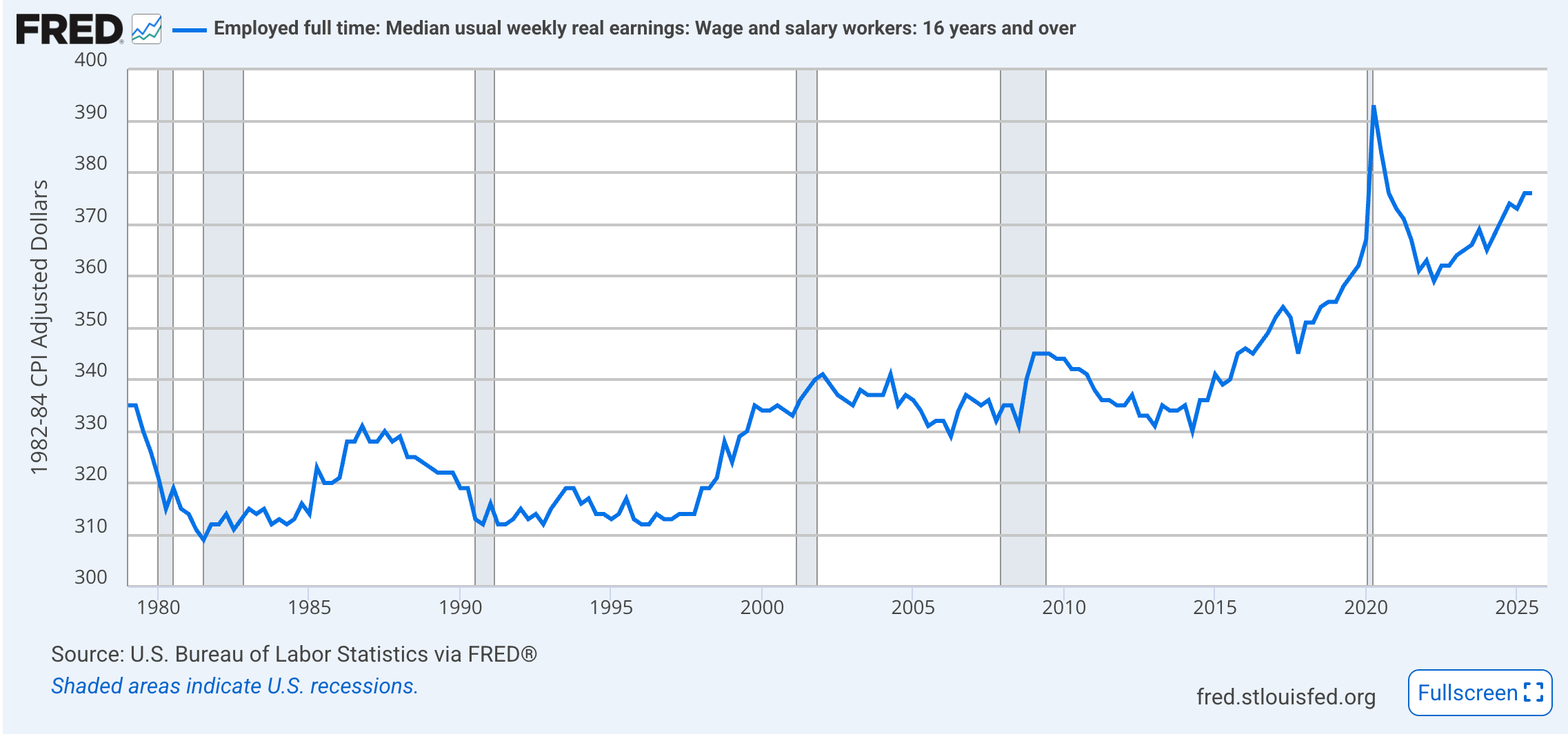
“Real wages fell slightly in the 35-year period between 1979 and 2014” does not necessarily imply any specific policy response. But it’s a dramatic finding that certainly has policy implications.
It’s not quite that simple, though.