

The American imagination is trapped in a binary.
On one side are the Superstar Cities — the New Yorks and San Franciscos — where the median home goes for well over a million dollars and a public bathroom can require years of environmental review and hundreds of thousands of dollars to construct. On the other we have the romanticized, struggling rural heartland, dotted with farm country and factory towns that feature prominently in essays about the disappearing soul of America.
We obsess over the stratospheric highs of the former, the tragic lows of the latter, and the American dream disappearing from both. But the American dream’s heartbeat persists, and its future is in its Solid B cities — the mid-tier metros that through their remarkable functionality and aggressive normalcy are today the most vital engines of national stability.
A defining characteristic of Solid B cities is elasticity. They have the physical and political room to grow, whereas A cities are inelastic for any number of reasons: Some are physically hemmed in by their geography, others are artificially constrained by zoning, and plenty more are just too damn expensive.
The Goldilocks level of bureaucracy
In a Superstar City, every square inch of land is a battlefield. A developer who wants to build anything at all will have to navigate a maze of environmental reviews, neighborhood opposition, and procedural delays in a process that can stretch over years and end in defeat. Mid-tier cities have not yet reached that level of vetocracy, which makes them far more capable of actually governing.
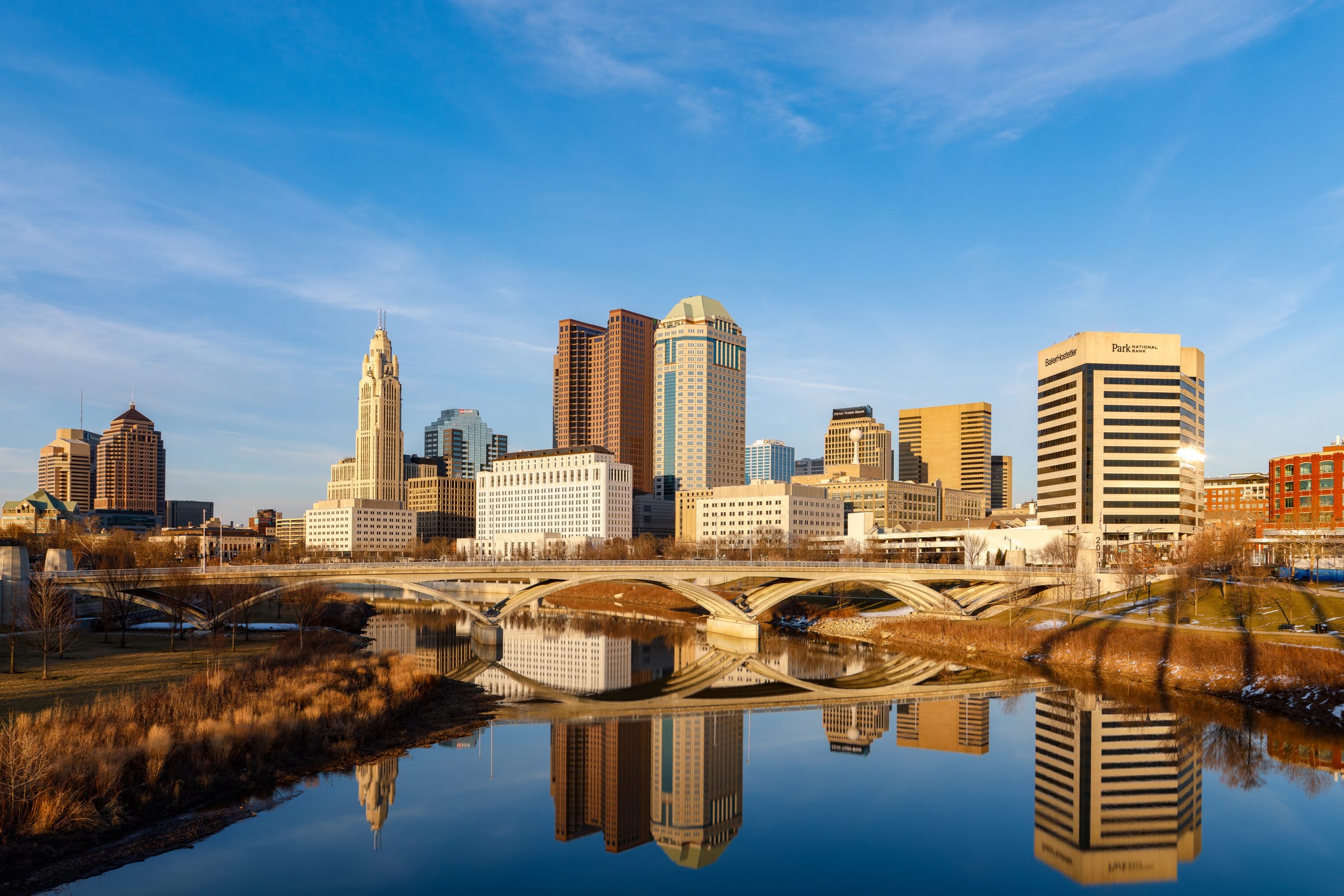
Columbus, Ohio, is a good example. It was the second-fastest growing city in the country in 2024, experiencing more than 1 percent year-over-year population growth, trailing only Indianapolis. It is growing fast enough to demand ambition, but slowly enough to permit execution. The city’s housing market reflects its growth: Throughout 2024, Columbus consistently ranked among the top 10 major apartment markets for rent growth, with steady annual gains of approximately 3 percent across all four quarters — outperforming the national average.
Industrial investment is driving much of the growth in Columbus. In 2022, Intel announced it would build two new semiconductor manufacturing facilities just outside the city. The investment is expected to directly and indirectly support 20,000 jobs, with more than 350 supplier investments projected to add $2.8 billion to Ohio’s annual G.D.P.
Columbus, a major Midwestern city with a diversified economy, a major research university, and affordable land, helped Ohio out-compete 39 other states for the largest private-sector investment in its history. This is how a Solid B city does its job, and it is how, while the coastal elites agonize about high rent and bottlenecks, America succeeds.
Intel is not arriving in a vacuum. Columbus has already attracted Meta, alongside fast-rising start-ups in fintech and biotech. The central Ohio region is expected to reach a population of 3.15 million by 2050, adding approximately 726,000 new residents, with a substantial portion of that growth occurring in the next decade. The region needs, by the Building Industry Association of Central Ohio’s estimate, 14,000 new housing units annually through 2032 — nearly double current permit levels — to keep up with its projected job growth. Whether it will build them is yet to be seen, but the city has the ambition and the institutional capacity to try. They’ve already begun to pass zoning reforms for new kinds of housing.
A policy laboratory
Because they aren’t under the same intense national spotlight as D.C. or Los Angeles, mid-tier cities can experiment with policy without it becoming a culture-war flashpoint.
Consider Fayetteville, Ark., which in 2015 became the first city in the nation to eliminate parking minimums citywide. The city created a quicker process to approve new permits for developments and business start-ups, and the result was that new restaurants opened, vacant lots were built on, and historic buildings that had sat empty for years became viable again. One such place, which had sat empty for 40 years, became a new restaurant founded by chefs who had grown up in Fayetteville and been convinced by its renewed potential to return home.
Of course, the laboratory runs experiments in both directions, and not every trial produces great results. Last year, a decade after minimums were eliminated for businesses, Fayetteville increased parking requirements for residential projects, despite the city having been under a declared housing crisis since April 2024. But this kind of experimentation is precisely my point. These cities are small enough to try things, see the result, course-correct, and try again.
Indianapolis, meanwhile, is in the middle of a remarkable transit transformation, as the city builds out a full bus-rapid-transit (B.R.T.) network across the metro. IndyGo received a $149.9 million grant in 2025 from the Federal Transit Administration to support development after a previous iteration of the project almost died. The future of the 24-mile Blue Line was nearly derailed two years ago by state-level legislative threats that sought to ban dedicated transit lanes, but after negotiating a two-lane compromise with the Indiana General Assembly, the city broke ground in early 2025. The plan’s success has inspired other similar metros like Columbus to develop their own B.R.T. proposals.
Mid-sized hubs like Indianapolis can implement transformative urban policy by negotiating workable compromises and keeping the focus on practical projects that benefit lots of people — something large, coastal cities often fail to achieve.
The slow, boring Kansas City model
When Kansas City, Mo., proposed a downtown streetcar in the early 2010s, the reaction was derisive: “Kansas City needs streetcars like a fish needs a bicycle,” one reader wrote to the Kansas City Star. By 2012, Kansas City had become one of the most unwalkable cities in America, with more highway-lane miles per capita than almost anywhere, and more than 30 percent of its downtown land dedicated to parking.
The streetcar launched anyway with a modest 2.2-mile downtown route. Fare-free and locally funded, it revitalized the surrounding area. Ridership exceeded expectations, businesses boomed along the corridor, and more than 1,700 new apartment units were built along Main Street — helping increase the downtown population by 44 percent in a 10-year period. A 3.5-mile extension opened in October 2025, and by November, monthly ridership had jumped 2.5 times compared to the same month the year before, with average weekday trips ballooning from 4,000 to 10,000. The streetcar now accounts for roughly 30 percent of all transit trips in the region.
What makes Kansas City instructive goes beyond the numbers. More impressive is the project’s slow, boring development process. The city started small, proved the concept, built political will, and expanded. It is evidence that competent, mid-stakes governance still works as big-city and federal governments stall.
The “boring” dividend
San Francisco is very exciting. It’s also a place where the cost of a public toilet famously ran to more than $1.7 million and whose downtown remains substantially hollowed out years after the pandemic. New York City rocks, and the median apartment rent now exceeds $5,000 a month.
The Solid B city, instead, offers predictable commutes, housing markets where a two-income household can still purchase a home, and a city government that, when it approves a mixed-use development near a transit stop, builds. In Columbus, the median home sale price was $327,500 in 2025 — a 26 percent increase from 2021. That’s appreciating, which means people want to be there. But it is not $1.2 million for a fixer-upper, which means people actually can be there. A city where a teacher, a nurse, and a software engineer can all afford to live in the same neighborhood and share a vested interest in its success is a city that can function.
The Grand Rapids region offers another example. It experienced the highest household-income growth among major Midwest metros in 2024, reaching $80,296. While that may not be comparable to a Wall Street salary, that wage goes much further in Michigan — and so do the tax dollars.
But who wants to live in a boring city?
This argument has real limits that boosters like myself should acknowledge. Not every mid-tier city is thriving — the gains are concentrated in metros with universities, diversified industry bases, and at least some amenity infrastructure rather than being diffuse across an entire tier.
The housing pressures that define Superstar Cities are also beginning to reach some of these metros. Columbus is still far more affordable than San Francisco, but the affordability window is narrowing, and it will narrow faster if the city doesn’t dramatically accelerate housing production. While the Solid B is not immune to the disease plaguing the Superstars, it has more time and room to find a cure.
There’s also the political complication. Some of the states where these cities sit are actively trying to make things harder. Many of these functional cities are blue dots in solidly red states that are increasingly preempting local authority on transit, zoning, and social issues. Can progress survive a state legislature that wants to blow up the lab? There’s evidence that it can: As Noah Smith pointed out, while blue states argue, red states build.
The NIMBY spirit is alive and well everywhere, and as these cities grow, develop, and lose their charm, there is increased pushback from residents who do not want to see their Solid B cities get swallowed up by transplants who want to shoot for an A.
This is what has happened in Denver, where I grew up. I would consider the Denver of my youth (from 2001 until the mid-2010s) to be a Solid B. I’d now call it a Solid A-, in the ranks of Austin, Chicago, and Philadelphia. I loved growing up in Denver, but I am now less bullish on moving there as prices rise and remote tech workers turn it into Silicon Valley Lite. It’s a trap that I must admit I don’t know how to fix.
As Matt wrote in 2021, many people move to Superstar Cities because they want the cultural and lifestyle amenities that they offer. Solid B cities might not have the MoMA, but they are likely to have good museums and local art scenes, a great brewery scene, a functional bike path, and a minor-league stadium. To live in a place you can afford with a municipal government that works, this hardly seems like a consolation prize.
The United States has fantasized about being a nation of Superstar Cities, but the cost-of-living crisis is largely the product of concentrating everything desirable in a handful of extremely expensive, extremely dysfunctional places. As long as those cities are focused on digging themselves out of that dysfunction and the federal government remains ineffective, the future of American prosperity is in cities that coastal elites only visit on layovers, run by a government boring enough to actually get things done.
Weekend letter of recommendation:
The next nationwide No Kings protest is tomorrow, Saturday, March 28.
Go see a live theater, music, or dance performance. “Inherit the Wind” is playing at the Arena Stage in Washington, D.C.
I am an AMC Stubs A-Lister, which I love despite D.C.’s offensive lack of AMC theaters. I wholeheartedly recommend it, and you can get your first month, during which you can see four movies every single week, for 99 cents.
Follow @slowboring on Instagram.
I think the most important factor for solid B cities is governments not taking economic growth for granted. For example, Seattle has now spent years fighting with its largest employer, Amazon, which has had serious negative impacts, but the city is mostly doing fine. Columbus does not have the luxury of being able to pursue policies like that.
College town/state capital combo seems pretty resilient. Austin, Madison, Columbus...