

I don’t have a whole article on this in me, but I did want to take note that after trying to destroy Anthropic’s business over a contract dispute, the White House is apparently now workshopping plans “to get around Anthropic’s supply-chain-risk designation and onboard new models, including its most powerful yet, Mythos.”
In other words, the Trump administration — or at least some elements of it — is aware that it screwed this up, but doesn’t want to admit it.
Part of the Trump era is that the strong cult-of-personality vibes around Trump mean that he can exit from awkward commitments with an unusual amount of ease. The ability to TACO out of tariff threats and just generally flip-flop gives him a lot of flexibility and is a real source of political strength compared to someone like Joe Biden, who felt like a captive of his own promises and interest group demands. But the flip side of this coin is that you can get situations like this, where there is no pressure on Trump to stand his ground at all, but the president just doesn’t want to admit that he was wrong and now everyone is working around his ego. It’s not a very good way to run the government.
Lakshya Jain wrote recently that Democrats aren’t doing as well in the generic ballot as you’d think given Trump’s unpopularity because voters still don’t trust them on a bunch of policy issues. Conversely, conservatives might want to consider that Democrats are about to win back a lot more political power than you’d expect from a party that is considered untrustworthy on key issues purely as a function of Trump’s unpopularity. He’s not doing his job very well, but nobody in the conservative movement wants to talk about this clearly or openly.
Theodore: Milan recently wrote: “when it comes to housing specifically, voters simply don’t believe an increase in housing supply will lower prices — in fact, they believe the opposite.”
What are the implications of this finding for a YIMBY who believes that more construction would lower housing costs, but also that the Democratic Party needs to be popularist to win elections?
I am aware that the supply-skeptics seem to be wrong in most of the empirical literature, but I actually have a great deal of sympathy for them on this specific point. Clearly if more housing exists, it follows that the price of housing has to be lower somewhere because of moving chains. But the geographical scope of the effect is completely ambiguous. To take a specific example, there has been a ton of new housing development in Union Market in D.C. That new housing development has also featured a lot of new retail development. And my intuition is that this has probably made the rowhouses across the street on the other side of Florida Avenue more expensive, since it’s more fun to live three or four blocks away from a thriving retail hub than it is from a semi-derelict warehouse district.
Now, conversely, the mere fact that additional dwellings exist must have alleviated housing costs for somebody somewhere. Maybe in another part of town that had reduced demand pressure? Or maybe in the suburbs? Or maybe it means marginally fewer people moving to Charlotte? It’s hard to say.
That’s why I’m not so focused on convincing the supply skeptics that they are wrong — specifying exactly what they are wrong about is actually pretty complicated. I also don’t actually believe that conquering supply skepticism is central to winning the argument in housing politics.
Homeowners outnumber renters, after all, and they have a higher propensity to vote and they also tend to stick around longer and are more likely to have deep relationships with elected officials. Searchlight framed the question as whether building more housing would have a positive or negative impact on home values, and opinion is pretty evenly split. I think that’s good. You can see below that the argument for more housing that people are most on board with is that it will create jobs. Conversely, they worry about higher crime.
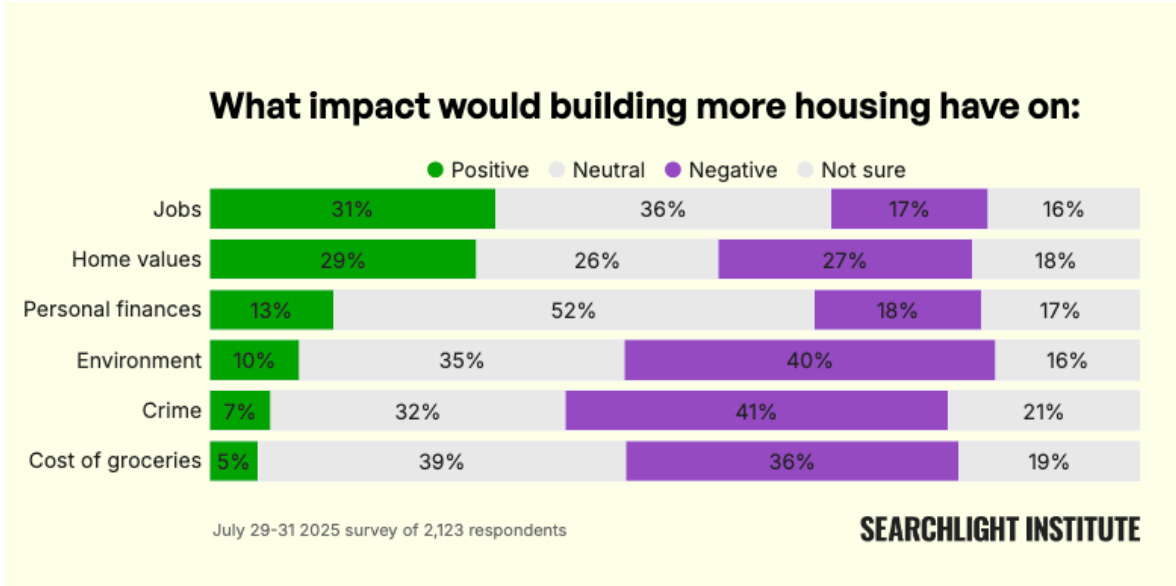
I feel like if you could get a person to think about it for five seconds, they would get even more optimistic about the labor market — allowing more construction in your town is clearly going to create more jobs. That is an unambiguous benefit.
Environmental concerns can make sense depending on the context, which is why legalizing dense infill in the places where it pencils out is so important. But then people worry that if new people live in the neighborhood, they might commit crimes.
This is a part of the politics that I worry about a lot because I do think that for a lot of Americans, a combination of NIMBYism and “never get out of the car” is their de facto solution to crime. Conservatives seem remarkably indifferent to the objectively high level of violent crime in most of the Sun Belt because they feel personally insulated from it in a way they are not when they visit a place like New York or San Francisco where the per capita crime rates are lower. The only way to make infill workable is for people to feel like their streets are going to be safe and pleasant.
But this brings me back to the prices issue.
The big holistic question about any land use reform is going to be “will this make my life better or worse.” If you’re a renter, then cheaper rent is part of “my life is better.” On the other hand, if the reason the rent gets cheaper is that the neighborhood is overrun with crime and people are constantly honking their horns in traffic jams, that’s not very appealing. Conversely, a reasonable concern a renter is going to have is that any change that makes life in your town better — improved schools, a brand new park, reduced crime, an A.I. start-up taking off like a rocket — is just going to lead to you getting priced out. The benefit of having a construction-friendly policy climate is that if your city becomes a better place to live and more people want to live there, new homes will be built for them instead of them outbidding the residents who already live there.
The key thing that you want is to be able to tell a story about how you’re going to deliver a win-win for people with living conditions that are improving and an economy that is growing and where the rising tide lifts all boats. There’s no way to make that happen without a housing market in which supply rises to reach demand.
Jeff: When Trump wanted Israel to stop attacking Lebanon to facilitate his failing negotiations with Iran, he just ordered Netanyahu to stop (somewhat rudely and by tweet, naturally), and Bibi just kowtowed and did what he was told without pushing back, dispite this not being in his interest. It was kind of amazing. US presidents have been trying to get Israel to be a good ally for many years now, and Israel hasn’t seemed to care much what we think. How did Trump pull that off? What gives him the power that prior presidents didn’t have? Are there any lessons there for US foriegn pollicy or future presidents?
I think this illustrates that it’s important not to get too literal-minded about the question of American leverage. The United States does a lot of things for Israel that are useful, and thus in some sense has enormous leverage over the Israeli government. But is this leverage credible?
Early in his administration, Barack Obama pushed hard for a settlement freeze from Israel. What Netanyahu quickly realized was that Obama couldn’t make any credible threats about this. Republicans in Congress would oppose him in a knee-jerk way on anything he did and, while most Democrats in Congress didn’t have strong feelings about Israel-Palestine, at that time the vast majority of congressional Democrats who did have strong feelings about it were pro-Israel. So if he actually tried to impair aid (the way George H.W. Bush had decades earlier), he’d pay a political price and not accomplish anything.
Later in his term, though, Obama was very successful at resisting Israeli pressure to get the United States ensnared in a war with Iran and so was the Biden administration later. This was structurally different in two ways. One, in our system with many veto points it is much easier to not do something than it is to take an affirmative step like cutting off aid. Two, Americans are just very skeptical of starting wars. Trump’s attack on Iran was unpopular before it started going badly. Netanyahu was able to sell Trump on this, but it was easy for better presidents to push back on him. At the same time, the Biden administration still had pretty limited leverage to make Israel cut a deal and end the war in Gaza before Election Day 2024. Republicans controlled Congress and would have united against Biden while anything Biden said or did about Israel would have divided Democrats at that point.
But now that Trump is president, the situation is transformed.
We know that Trump will bring a large number of congressional Republicans around to support him no matter what he does. And at this point the balance of power inside the Democratic caucus has totally flipped around. If Trump wants to squeeze Israel, left-wing Democrats will support him. And most moderate Democrats will leap at the opportunity to do something that is both bipartisan (support Trump) and also makes the left happy (squeeze Israel). As a result, any threats that Trump wants to make are extremely credible — probably so credible that he barely has to make explicit threats. It’s just clearly the case that if Netanyahu were to start feuding with Trump, that might cause the bottom to fall out of pro-Israel politics in the United States.
It’s a lot lower-profile, but this also more or less applies to the situation in Cuba.
I’m not entirely sure what’s going on with this, but the Trump administration is clearly trying to strike some kind of Venezuela-style deal down there. The basic template is that you’d have some turnover of top personnel — enough to allow the United States to declare victory — but with the regime fundamentally intact and receiving sanctions relief in exchange for geopolitically aligning with the United States. A Democrat would have a very hard time reaching a deal like that, because the Cuban emigré community would denounce it as a sellout of the cause of Cuban freedom while leftists would see it as cynical imperialism. But if Trump and Marco Rubio want to pronounce themselves satisfied with some arrangement, they will have support on the right absolutely locked down. The left won’t be happy, but will still see relaxation of the embargo as good.
These are all just basically examples of the longstanding “only Nixon can go to China” phenomenon. Conversely, on the domestic front, if you look at major deregulatory legislation, it is almost all Jimmy Carter (trucking, airplanes, natural gas) or Bill Clinton (banking, telecommunication) rather than Ronald Reagan. It often takes someone crossing the ideological center line to get something done.
Sidney Katz: Do you think some leftists’ interest in horseshoe politics is partly an attempt to win intra-party factional battles by demonstrating that they can also do bipartisan politics and build coalitions, just with the post liberal right rather than center right neocons?
It seems bizarre, but I’m fairly sure I saw more anger from leftists on Twitter over Mamdani meeting with Obama than over his meeting with Trump. And there seems to be a parallel dynamic on the Republican side: Vance has singled out Bernie Sanders, Ro Khanna, and Mamdani as Democrats he “sometimes respects”. How successful do you think this effort from leftists and the post-liberal right is going to be at trying to redefine which issues, and which political actors, are considered acceptable grounds for cross-partisan agreement?
I don’t think a lot of this is “horseshoe politics” at all. It’s just double standards.
Leftists like Mamdani, so when Mamdani does normal politician stuff (tack to the center on crime, try to have a good personal relationship with Trump, abandon unrealistic campaign promises, score a quarter of a loaf as a policy win) he gets praised in leftist circles as a visionary political genius. When mainstream Democratic Party politicians who leftists don’t like do this stuff, leftists scream and complain.
I was joking on a panel recently that one of my big disagreements with progressive activists is that unlike the activists themselves, I think the choices that they make are very important. Their decision — and it’s a decision, not a move forced on them by objective reality — to just let Mamdani cook is an important fact about the politics of New York City, similar to the grace that Trump is granted by conservatives.
There isn’t really a “lesson” here that other Democrats can copy.
I think progressives themselves should consider that being grumpy about Mamdani would have made it harder for Mamdani to accomplish stuff they approve of and the exact same thing is true of Hakeem Jeffries and Chuck Schumer and they should just accept that basically all Democrats have preferences to the left of the status quo. If they want to move politics to the left, the way to achieve that is to help Democrats beat Republicans.
The specific horseshoe stuff, however, is downstream of the idea that Trump winning in 2016 wasn’t a tragedy or fuckup but a kind of cosmic divine vengeance for the failures of neoliberalism.
The banal response to Trump would be to say that he successfully blunted Democratic attacks on G.O.P. plans to cut Social Security and Medicare and exploited the political vulnerability of post-2012 leftward moves on crime, immigration, and energy and this approach just outweighed his many defects. The argument that has prevented Democrats from responding in that way is that, no, Trump’s rise reflects the people’s righteous indignation at the grand failures of the system — indignation that Democrats need to tap into. If you start from that premise, you can’t just say that most of Trump’s schtick is straightforwardly bad. You end up on the post-liberal horseshoe where you are endorsing a broad zero-sum worldview, criticisms of free trade that don’t make any sense, and a lot of novel economic-policy ideas that had no particular relationship to the politics of 2016.
Edward: If AI meaningfully reduces the need for human labor, does the economic case for high or even medium immigration break down? How should immigration policy adjust in a world of widespread AI-driven job displacement?
This is a big “if” but, yes, if robots start replacing unskilled work — especially the kind of work that is currently done by people who don’t speak English well and thus aren’t providing “human touch” experiences — then that would dramatically alter the facts around immigration economics and make certain restrictionist ideas much more true.
Josh Turvey: I know you prefer Scott Wiener over Saikat Chakrabarti for Pelosi’s seat, but what do you make of the argument that Saikat is an unusually high-quality leftist with a kind of Ro Khanna potential? He seems sharp, YIMBY-pilled, and more tech-optimist than most leftists. More importantly, he seems capable of causing productive ruckus: not just antagonizing the Democratic establishment, but creatively exploiting existing divisions, and maybe creating new ones, within MAGA through legislation or procedural gimmicks. I could imagine him becoming a leader of the left who champions more thoughtful left-wing ideas, in a Matt Bruenig-ish way. I can also imagine him teaming up with right-wing nutcases to elevate nonsense MAGA issues that divide Republicans (like Epstein Files), in a way that Scott likely lacks the stomach for.
For starters, let’s just consider that the district we are talking about here (Nancy Pelosi’s seat in San Francisco) is either the most or second-most (after WA-7 in Seattle) left-wing district in the country. There are three other seats — MD-4, CA-12, and PA-3 — that are even bluer in a Democrats-versus-Republicans sense, but those all have much larger African-American populations that provide ideological ballast.
So relative to that baseline, I do agree that Saikat Chakrabarti is a relatively smart and hardworking and impressive progressive running in a place where you might get someone really bad.
He’s just also running against Scott Wiener, who has been one of the great titans of housing politics. I would like Wiener to win both because housing policy is heating up as a federal topic and his voice would be valuable there, but also because I think his work on housing is indicative of being a generally insightful and nuanced thinker on other economic-policy issues like A.I.
Wiener is considerably to my left on various topics, too, but again we are talking about an extremely progressive district. Relative to that context, I like them both. But Wiener is just better and I don’t think the specific idea that Chakrabarti would be better at political stunts has any real evidence behind it.
This cuts against the grain of the contemporary mood, but one thing that I think would be good about Wiener is that he has done the actual work on crafting bipartisan legislation, and that’s actually the main thing that members of Congress do. Even in California it’s challenging to make progress on important issues without some cross-party collaboration and that’s extremely true in Congress. Electing people who actually do the work has real value.
Marty Manley: To attract talented and committed public employees, we offer higher-skilled people lower pay but better benefits, notably very high job security and pensions compared with the private sector. This yields a mix of dedication, talent, and risk-aversion. Does this approach make sense to you? In this context, what limits, if any, should we place on public employee unionization?
I don’t know how closely related to unionization this compensation mix actually is.
My general sense is that it’s downstream of the fact that if you’re a politician, it’s appealing to offer public-sector workers things that have low fiscal costs in a way that helps you avoid budgetary tradeoffs. So offering job security (which doesn’t show up on a budget) or generous retiree health benefits (the costs of which accrue in the distant future) seems appealing.
Either way, on the whole I think it’s pretty non-optimal. The main issue is that if you look at civil service hiring, it is extremely stilted, inflexible, and difficult. It’s much harder than it should be to spin up new teams, to bring talented mid-career people in, to try a new approach, or to let managers take risks. The problem is that it didn’t get so stilted and inflexible for no reason. Even in private-sector settings with basically no formal employment protections, normal managers are moderately reluctant to let people go and as a result are moderately averse to making risky hires in the first place. In the public sector, this is all greatly exaggerated since bringing the wrong person in can become very challenging to address unless his conduct is truly egregious. The upshot is that not only are you creating careers that are primarily appealing to risk-averse people, but they are then specifically discouraged from ever taking any risks on anything. This makes it extremely difficult to build certain forms of in-house capacity and leaves the government dependent on a bad cycle of overreliance on contractors for flexibility.
Now in comes Trump and DOGE who managed to not actually address any of the structural inflexibility in the system. In other words, they didn’t say, “It’s too hard to get rid of the lowest performers, so we should do something about that.” What they said instead was, “We want to fire a bunch of people and the rules sharply constrain who you can fire and why, so we’ll just arbitrarily fire as many people as we are allowed to.” This helps undermine the civil service’s reputation as a stable place to work. That makes it less attractive to apply for a job there but doesn’t actually improve anything.
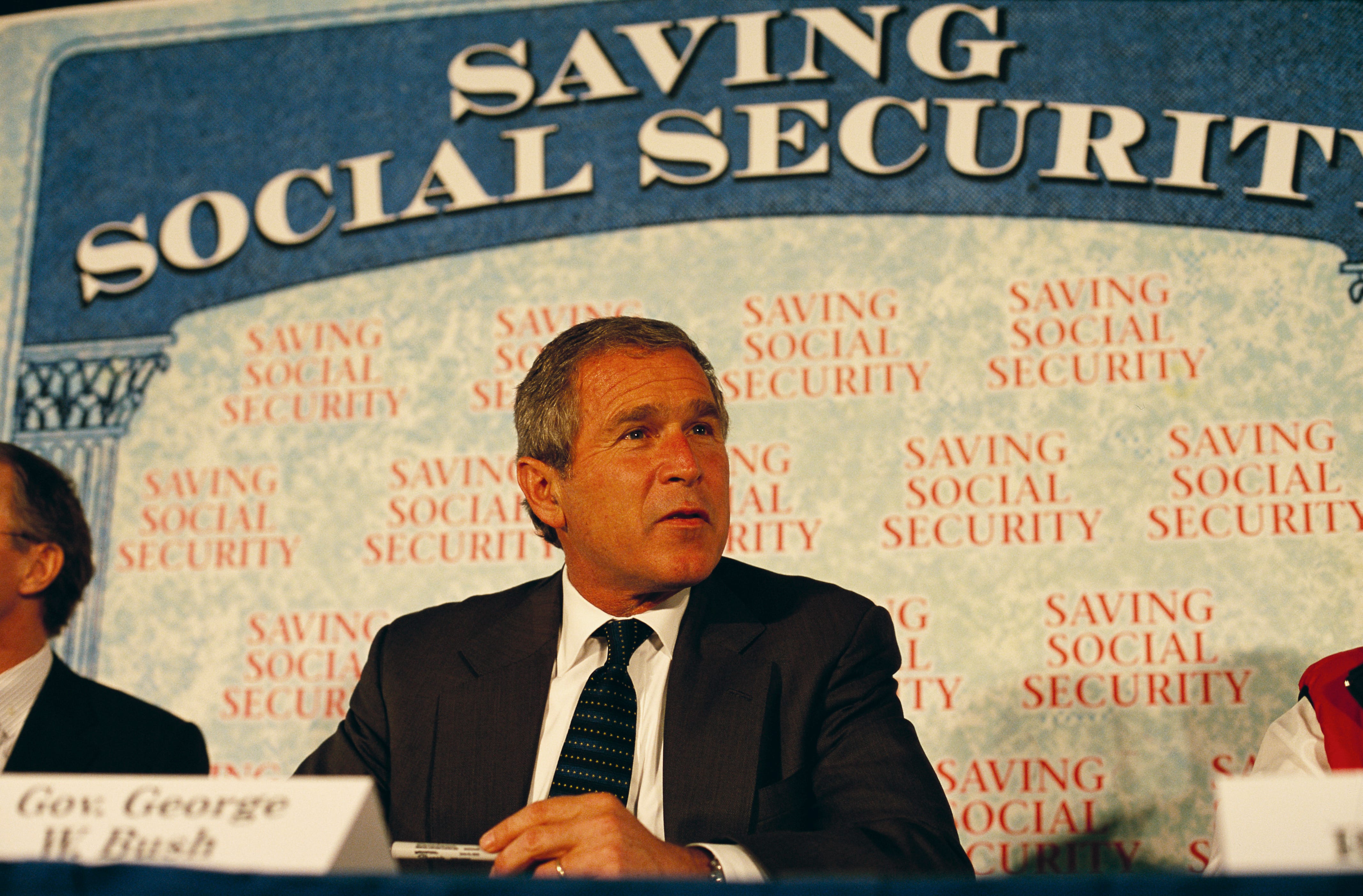
DWD: In retrospect what do you think about the policy merits of Bush’s 2005 Social Security plan? Obviously opposing it was good politics and I don’t remember the details of the plan but it seems like we’d be better off with at least some Singapore type elements in the system.
There has been a lot of retrospective misdescription of what Bush’s proposal actually was, some of which is downstream of a very strong tendency by right-wing people to misdescribe what the policy status quo in Singapore is.
But to make a long story short, in Singapore every worker has to make mandatory contributions to what’s called the Central Provident Fund — which is a big state-managed pool of capital, comparable to the sovereign wealth funds of Norway, Saudi Arabia, and other petrostates. Each individual then has what is characterized as a personal account based on their contribution limits. These accounts earn a government-guaranteed rate of return and you are allowed to tap your account for education, to buy a home, to meet health expenses, and for your retirement.
This system has a lot of advantages relative to a “pay as you go” pension system like Social Security — so many that Social Security’s legal structure, with the trust fund and the formula-based benefits, is designed to kinda sorta pretend that it does what Singapore does. Note, though, that the country’s fund has hundreds of billions of dollars in assets for a country with six million people. If you scaled this up to the size of the United States, you’d be talking about something on the order of tens of trillions of dollars, which would be enough to make the American government by far the world’s most important equity owner and asset manager.
This is basically a large program for collective ownership of the means of production. The Bush administration had no interest in doing socialism, so instead their idea was basically to cut Social Security benefits and put some extra money into everyone’s 401(k) account. People would, on average, end up better off that way, but they would have a lot of exposure to idiosyncratic risk.
Joseph America 2028: What if Al Smith had won?
I enjoy alternate history speculations, but with something like this you need some account of why Al Smith won. The 1928 presidential election was not even slightly close. The economy was doing well, and Calvin Coolidge was constitutionally eligible for a third term, which might have opened the door for Democrats to make an argument against breaking George Washington’s precedent. But he opted against trying it, and G.O.P. nominee Herbert Hoover had an extremely strong personal reputation based on his wartime work, and the Democrats basically had nothing. Smith, meanwhile, was Catholic and therefore unacceptable to many voters at the time — the first cracks in the “Solid South” emerged in the 1928 results precisely because a lot of Southerners in particular wouldn’t stomach a Catholic president.
It’s not just that the 1928 election wasn’t close, but it seems like Smith only got the nomination because Democrats knew they had no plan to win the election. That relaxed electability concerns about Smith, since they were losing anyway. If you imagine a different state of the world where the Republicans are looking more vulnerable, then it’s way less likely that Smith gets the nomination. So to even begin to answer the question, you need some story about why this is happening.
It's odd that Singapore appears in the answer to the Social Security question but not in the answer to public sector employment.
Lee Kuan Yew, the founding father of Singapore, famously said, " If you pay peanuts, you will end up with monkeys." As a result, Singapore has one of the most highly compensated public sectors in the world. It is also has very high standards and has very little corruption.
This is a policy choice and one that the Singaporeans themselves talk about a lot.
"Politicians play games with budgets to avoid bad financial optics" seems like common bad pattern. In Boston, we paid $100M in police overtime because (quoting my local Axios email):
Accurately budgeting for the real cost of police overtime would look like a massive increase to the BPD budget, and that would be hard to explain to residents, according to Wu.
"It would be seen as a 20 to 30 percent increase in that budget, which is not palatable, and it's hard to get that nuance out," Wu told the Globe this month.
Wu telling the Globe that she's concerned about the optics of ... accurately accounting for police expense? Seems very hard to build a high functioning government with this kind of silliness at the core.